
What to check before adding an IoT gateway to CNC machine monitoring
Publication Date
author
Before you add an IoT gateway to CNC machine monitoring, the most important question is not which gateway has the longest feature list. It is whether the gateway can collect clean, trustworthy machine data from your actual CNC environment without disrupting production, creating cybersecurity exposure, or forcing expensive integration work later. For most teams, the right decision depends on four checks first: machine interface compatibility, signal integrity, network and uptime requirements, and how the gateway will fit into your wider industrial IoT data collection architecture.
If those basics are not validated early, even a well-marketed gateway can turn into a data bottleneck, a maintenance burden, or a failed pilot. If they are validated properly, the gateway can become a reliable foundation for edge AI for smart manufacturing, machine utilization tracking, condition monitoring, and industrial IoT for predictive maintenance.
What should you verify first before buying or installing an IoT gateway?
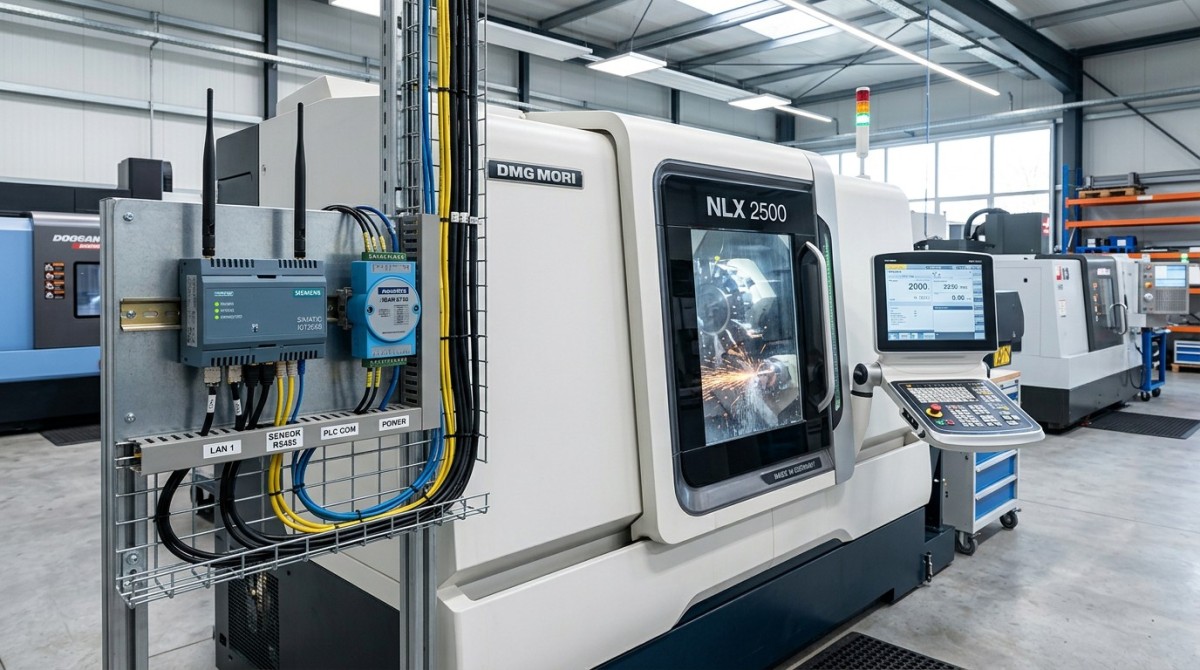
For buyers, plant engineers, operators, and decision-makers, the practical pre-check list usually comes down to this:
- Can the gateway communicate with your CNC machines as they exist today? Older and newer machines often expose very different interfaces and data formats.
- Is the data actually usable? A gateway may connect successfully but still deliver incomplete, noisy, delayed, or misleading signals.
- Will the network and edge setup support stable operation? CNC monitoring fails quickly when connectivity assumptions do not match shop-floor reality.
- Does the cybersecurity model meet plant and enterprise requirements? CNC assets are operational technology, so gateway deployment must not open a weak point.
- Can the data integrate with MES, SCADA, CMMS, ERP, or analytics tools? Monitoring value depends on what happens after data collection.
- What is the business goal? OEE visibility, alarm capture, predictive maintenance, energy tracking, or remote diagnostics each require different data depth.
A useful rule is simple: do not start with the gateway datasheet. Start with the machine fleet, the required decisions you want to support, and the data path from spindle to dashboard.
Will it work with your CNC machines, controllers, and legacy equipment?
This is the first real screening step. Many CNC machine monitoring projects stall because compatibility is assumed rather than verified.
You should check:
- Controller brands and models: Fanuc, Siemens, Mitsubishi, Haas, Heidenhain, Okuma, and others all differ in protocol support and data access depth.
- Communication methods: MTConnect, OPC UA, Modbus, Ethernet/IP, PROFINET, proprietary controller APIs, serial links, or digital I/O.
- Machine age: Legacy CNC machines may not expose rich production data without adapters, PLC access, or signal tapping.
- Read-only vs. read/write access: For most monitoring deployments, read-only access is safer and easier to approve.
- Data granularity: Machine state alone is very different from axis load, spindle speed, alarm codes, temperature, vibration, cycle counts, or tool usage data.
Procurement teams should ask vendors for a machine-controller compatibility matrix, not just a general statement that the gateway “supports CNC integration.” The right question is: which exact machine models, with which controller firmware, can provide which exact data points?
For operators and engineers, another important question is whether installation requires controller-side changes, production stoppage, extra sensors, or OEM permissions. A gateway that looks inexpensive on paper may become costly if it depends on extensive retrofitting.
Is the data accurate enough for machine monitoring and predictive maintenance?
Successful industrial IoT data collection architecture depends on more than connectivity. It depends on data quality.
Before deployment, confirm:
- Sampling rate and timestamp accuracy: Slow polling may be enough for machine state dashboards, but not for high-resolution event analysis.
- Signal consistency: Are values stable, or do they fluctuate due to electrical noise, poor wiring, or protocol translation issues?
- Event completeness: Does the system reliably capture stops, alarms, overrides, idle time, and cycle transitions?
- Context mapping: Can raw signals be translated into meaningful production states such as running, setup, fault, waiting, or maintenance?
- Cross-machine normalization: Can data from different CNC brands be standardized into one reporting model?
This matters because inaccurate data creates false confidence. A dashboard that shows utilization trends but misses micro-stoppages or misclassifies downtime may hurt decisions more than it helps.
For industrial IoT for predictive maintenance, the bar is even higher. If the gateway is expected to support condition monitoring, then teams should verify whether it can handle:
- high-frequency sensor data from vibration, current, or temperature channels
- local buffering when connectivity drops
- synchronized timestamps across data sources
- edge preprocessing to reduce bandwidth and noise
If your use case includes edge AI for smart manufacturing, ask whether preprocessing, filtering, anomaly scoring, or model execution happens at the gateway or only in the cloud. That distinction affects latency, bandwidth usage, and failure resilience.
Can your network and plant environment support reliable gateway operation?
Many CNC monitoring rollouts fail for environmental reasons rather than software reasons. The shop floor is not an office IT environment.
Review the operating conditions carefully:
- Network stability: Is wired Ethernet available at the machine, or will the deployment depend on wireless coverage with variable reliability?
- Latency tolerance: Real-time alerts and edge analytics may require lower latency than periodic KPI reporting.
- Offline resilience: Can the gateway store data locally during network outages and forward it later without data loss?
- Industrial hardening: Temperature, vibration, coolant mist, dust, EMI, and power fluctuations can all affect hardware reliability.
- Power quality: Brownouts and unstable supply can corrupt data collection or shorten gateway life.
For plants running mixed machine groups, it is worth mapping network zones before rollout. Some teams discover too late that machine tools sit on segmented networks, isolated OT domains, or contractor-managed environments that complicate deployment.
Decision-makers should also evaluate uptime assumptions. If machine monitoring data is intended for production management, maintenance planning, or customer traceability, then gateway uptime becomes an operational requirement, not just an IT convenience.
What cybersecurity and OT risk checks should be completed first?
Adding an IoT gateway to CNC machine monitoring creates a new connection point between operational technology and broader digital systems. That makes cybersecurity review mandatory.
At minimum, verify:
- Network segmentation: The gateway should fit within a defined OT security architecture, not bypass it.
- Access control: Role-based permissions, password policy enforcement, and ideally certificate-based authentication.
- Encryption: Data in transit should be protected, especially when sent to cloud or enterprise systems.
- Patch and firmware management: How are security updates delivered, validated, and scheduled?
- Read-only deployment options: For many CNC monitoring cases, avoiding write access reduces risk significantly.
- Auditability: Can actions, configuration changes, and connection attempts be logged?
Buyers should be cautious of gateways marketed for “easy remote access” if the security model is vague. Ease of access is not the same as safe access. In regulated or high-value manufacturing environments, an insecure gateway can become a supply chain risk, an IP exposure risk, or a plant availability risk.
How will the gateway fit into your existing systems and workflows?
A gateway should not be evaluated as a standalone device. It should be evaluated as one component in a larger monitoring and decision stack.
Ask these integration questions early:
- Can it send data to your MES, SCADA, historian, CMMS, ERP, or cloud platform?
- Does it support open standards or will you be locked into one vendor ecosystem?
- Can it map machine data to work orders, part IDs, operators, or maintenance events?
- How much custom middleware is required?
- Who owns data modeling, tag mapping, and dashboard logic?
For operators, usability matters too. If alarms, machine states, and trends are not presented clearly, the monitoring layer may be ignored. For managers, the key issue is whether the gateway turns raw machine signals into actions such as reducing downtime, improving scheduling, or catching maintenance issues earlier.
TSV’s practical view is that the strongest deployments are not the ones with the most data points. They are the ones where the data model supports a clear operating decision.
How do you judge ROI before scaling across multiple CNC machines or plants?
Not every CNC environment needs the same gateway depth. A pilot should prove business relevance before broad rollout.
Measure ROI against concrete outcomes such as:
- Downtime visibility: Are previously hidden stop causes now measurable?
- Maintenance response: Are alarms and condition signals leading to earlier intervention?
- Utilization improvement: Can idle time, waiting time, or setup inefficiency now be quantified?
- Manual reporting reduction: Are operators spending less time entering machine status manually?
- Scalability: Can the same architecture be expanded without major redesign?
For enterprise decision-makers, the most important ROI question is often not “How fast is payback?” but “Can this architecture scale cleanly across mixed equipment and multiple sites?” A gateway that works on one modern machine but struggles across a legacy fleet may not justify enterprise adoption.
A smart pilot usually includes:
- one modern CNC machine and one legacy machine
- one clearly defined business objective
- a fixed validation period
- data quality review against real production events
- security and integration sign-off before expansion
A practical pre-deployment checklist for CNC gateway projects
Before approving installation, use this checklist:
- Confirm exact CNC controller compatibility by model and firmware.
- List required data points: state, alarms, spindle load, cycle count, energy, vibration, or others.
- Validate whether data access is native, adapter-based, or sensor-based.
- Check polling rates, buffering, timestamp behavior, and data loss handling.
- Assess environmental suitability: temperature, dust, vibration, EMI, and power quality.
- Review OT cybersecurity controls, segmentation, and remote access policy.
- Confirm integration path to MES, CMMS, SCADA, cloud, or analytics tools.
- Define edge AI for smart manufacturing requirements, if local analytics are needed.
- Run a pilot on representative machines, not just the easiest machine to connect.
- Document success criteria in operational and financial terms.
Conclusion
Before adding an IoT gateway to CNC machine monitoring, the real decision is whether the gateway can deliver reliable, secure, and decision-ready data in your actual manufacturing environment. Compatibility, data quality, uptime resilience, cybersecurity, and integration matter far more than feature-heavy marketing claims.
If your team verifies those factors first, the gateway can become a strong foundation for industrial IoT data collection architecture, edge AI for smart manufacturing, and industrial IoT for predictive maintenance. If not, the project risks becoming another disconnected pilot that generates data but not operational value.
In CNC monitoring, engineering truth starts with one discipline: trust the data path before you trust the dashboard.
Search News
Hot Articles
- Carbon Fiber StructuresHow to Specify Aerospace Carbon Fiber Assemblies for Lightweight, Load-Bearing PartsJul 11, 2026
- Machine VisionXiaomi, Alibaba DAMO Academy Drive Open-Source Robotics Model Ecosystem, Lowering Algorithm Development Barriers for Overseas SMEs Adopting Chinese Robotics SolutionsMar 30, 2026
- Cobots & ArmsShanxi 'AI+' Conference Showcases Embodied Intelligence with Multinational Buyer Engagement: Key Industry ImplicationsMar 30, 2026
Popular Tags
Recommended News
 Jul 11, 2026How to Specify Aerospace Carbon Fiber Assemblies for Lightweight, Load-Bearing PartsAerospace carbon fiber assemblies: learn how to specify laminate design, load data, joining methods, and inspection controls for lighter, reliable load-bearing aerospace parts.Elena Rostova (UAV Systems Researcher)
 Mar 30, 2026Xiaomi, Alibaba DAMO Academy Drive Open-Source Robotics Model Ecosystem, Lowering Algorithm Development Barriers for Overseas SMEs Adopting Chinese Robotics SolutionsXiaomi & Alibaba DAMO Academy's open-source robotics models lower algorithm barriers for global SMEs. Boost efficiency in manufacturing, logistics & smart retail with ROS 2 compatible solutions.TSV Data Lab
 Mar 30, 2026Shanxi 'AI+' Conference Showcases Embodied Intelligence with Multinational Buyer Engagement: Key Industry ImplicationsShanxi 'AI+' Conference highlights embodied intelligence with Tesla, Ubtech & Jiantao showcasing multimodal robotics. 40+ global buyers validated tech on-site, creating new B2B channels for industrial automation & AI solutions.Chen Wei (Automation Lead Engineer)
 Mar 30, 2026Zhongguancun Unveils 6G Integrated Sensing-Computing-Intelligence Platform to Empower Embodied Robots for Global Industrial ApplicationsZhongguancun's new 6G platform revolutionizes industrial robotics with <10ms latency, empowering global automotive, logistics & port automation. Discover how this tech boosts China's smart manufacturing exports.TSV Data Lab
 Mar 30, 2026Mech-Mind Tianjin Embodied Intelligence R&D and Production Base Goes Live, Cutting Delivery Time by 20%–30% for Global Customized AMR+Vision SolutionsMech-Mind's Tianjin AMR+Vision production base cuts delivery time by 20%-30% for欧美 & Latin American markets. Discover how this PLd-certified facility accelerates customized robotics solutions for smart manufacturing and logistics.Chen Wei (Automation Lead Engineer)
 Mar 30, 2026Boao Forum Reveals 'Co-evolution of Big and Small Brains' Trend in Humanoid Robots, China's Embodied Intelligence Accelerates Adaptation to Overseas Manufacturing Service ScenariosDiscover how China's humanoid robots, featuring 'Co-evolution of Big and Small Brains,' are revolutionizing global manufacturing. Learn about Embodied Tian Gong 3.0's ISO compliance and overseas deployment at Boao Forum 2026.Chen Wei (Automation Lead Engineer)
 Mar 30, 2026China Railway Industrial Secures Patent for Embodied Robotics in Material Handling, Boosting High-Precision Delivery Capabilities for Overseas Infrastructure and Manufacturing ProjectsChina Railway Industrial's new patent for embodied robotics in material handling boosts high-precision delivery for global infrastructure & manufacturing. Discover how this innovation enhances logistics accuracy in automotive, rail transit & EPC projects.Chen Wei (Automation Lead Engineer)
 Oct 27, 2026GXO and Agility Robotics Expand Partnership to Accelerate US Humanoid Robot DeploymentGXO and Agility Robotics plan to expand US humanoid robot deployment with Digit 4 in early 2027. Explore warehouse automation plans, service terms and future Digit 5 upgrades.Chen Wei (Automation Lead Engineer)
 Oct 27, 2026Robotic Automation Costs: Budgeting for Equipment, Integration, and MaintenancePlan your robotics automation cost with confidence. Explore equipment, integration, and maintenance expenses, compare quotes, and build a realistic budget for better ROI.Chen Wei (Automation Lead Engineer)
 Oct 26, 2026AMAXiMAL Releases Open-Source TopMod 3D v3 With Claude AIExplore AMAXiMAL’s free, open-source TopMod 3D v3 with Claude AI assistance, topology-based modeling and plywood fabrication tools that connect complex designs to physical builds.Dr. Marcus Vance
 Oct 26, 2026Choosing a SCADA System Integrator Company: PLC Compatibility and Long-Term SupportChoose a scada system integrator company with proven PLC compatibility and reliable long-term support. Discover what to test, compare, and require before investing.Victor Lin (Chief Software Architect)
 Oct 25, 2026Hesai Leads Global ADAS Main Lidar Shipments in Yole’s 2026 ReportHesai led global ADAS main lidar shipments with a 43% share in 2025, according to Yole’s 2026 report. Explore what this ranking reveals about its automotive market position.TSV Data Lab
 Oct 25, 2026Choosing an Aerospace Materials Manufacturer: Quality and Traceability ChecksChoosing an aerospace materials manufacturer? Learn how to verify certifications, test reports, and lot traceability to qualify suppliers confidently and reduce costly sourcing risks.Dr. Marcus Vance
 Oct 24, 2026Guotai Haitong: Global Entry-Level 3D Printer Shipments Rose 39% in Q1 2026Entry-level 3D printer shipments rose 39% in Q1 2026, Guotai Haitong reports. Explore how AI, multicolor printing and print farms are shaping market growth.Dr. Marcus Vance
 Oct 24, 2026Choosing an Industrial Vision Inspection Supplier: Acceptance Tests That MatterChoose an industrial vision inspection supplier with confidence. Discover acceptance tests for defect detection, false rejects, production speed, and reliable part rejection before you buy.TSV Data Lab
 Oct 23, 2026US Navy Raises Gecko Robotics Contract Ceiling to $300M for Robotic Fleet MaintenanceUS Navy raises Gecko Robotics’ contract ceiling to $300M for Pacific Fleet robotic inspections. Explore potential opportunities for maintenance suppliers and key procurement considerations.Chen Wei (Automation Lead Engineer)
 Oct 23, 2026Choosing Industrial Sensing Systems for Global Plants: Protocol CompatibilityCompare industrial sensing systems international buyers can trust. Explore protocol compatibility, reduce integration risks, and select proven configurations for reliable global plant deployments.TSV Data Lab
 Oct 22, 2026KUKA Showcases Physical AI and iiQKA.AI Vision at NVIDIA GTC BerlinExplore KUKA’s Physical AI showcase at NVIDIA GTC Berlin and discover how iiQKA.AI Vision aims to simplify robotic vision integration and improve 2D and 3D scene recognition.TSV Data Lab
 Oct 22, 2026Robotic Machining of Advanced Composites: What Tolerances Are Achievable?Explore advanced materials machining robotics: discover what drives achievable composite tolerances and how to validate accuracy before investing in your next machining system.Dr. Marcus Vance
 Oct 21, 2026China’s Industrial Robot Exports Near RMB 10 Billion in First Nine Months of 2026China’s industrial robot exports neared RMB 10 billion in January–September 2026, with value rising faster than volume. Explore the data and what it could mean for suppliers.Chen Wei (Automation Lead Engineer)
 Oct 21, 2026Low-Latency Industrial Data Processing: Pricing and Key Cost DriversExplore industrial data latency price drivers, from edge hardware to integration and support. Learn how to compare quotes, verify performance, and avoid unnecessary costs.TSV Data Lab
 Oct 20, 2026KUKA Launches iiQKA.AI Vision to Simplify Industrial Image ProcessingKUKA iiQKA.AI Vision simplifies industrial image processing with controller-based 2D and 3D vision. Explore drag-and-drop setup for vision-guided automation.TSV Data Lab
 Oct 20, 2026Smart Industrial Edge Devices: Key Criteria for Legacy PLC IntegrationChoose smart industrial edge devices for legacy PLC integration. Discover key criteria for compatibility, data quality, security, and reliable collection without disrupting control.TSV Data Lab
 Oct 19, 2026Choosing a Radar Sensor by Application: Range, Resolution, and Field of ViewSimplify radar sensor application based product selection. Compare range, resolution, and field of view to avoid blind spots and choose with confidence. Explore the guide.TSV Data Lab























