
Robotic Automation Costs: Budgeting for Equipment, Integration, and Maintenance
Publication Date
author
A robot’s purchase price is only one line in an automation budget. A usable robotics automation cost estimate must cover the installed cell, the work required to reach production acceptance, and the expense of keeping that cell productive. Tooling, guarding, controls, commissioning, and maintenance belong in the initial comparison because each affects whether the proposed system can deliver the required output.
There is no defensible universal installed price without a defined application. A palletizing cell handling consistent cartons has different cost drivers from machine tending with variable castings or assembly requiring force control. Establish the production requirement first, then compare quotations against the same equipment boundaries, operating assumptions, and acceptance conditions.
Define the production obligation before comparing prices
A quotation becomes meaningful when it describes what must happen between incoming material and an acceptable finished output. Specify the part family, presentation method, required cycle time, production schedule, changeover frequency, and quality criteria. Include the real variation in part dimensions, surface condition, packaging, and upstream delivery.
Cycle time needs a measurement boundary. Robot motion time excludes activities such as loading a fixture, waiting for a machine door, confirming a grip, inspecting a part, and clearing the discharge conveyor. Require the quoted rate to include the sequence that production will actually use. Where tasks overlap, the timing model must show those overlaps and their dependencies.
Payload also needs careful interpretation. The robot carries the gripper, adapters, sensors, dress pack loads, and workpiece. Reach and wrist loading must be assessed at the required poses. Selecting equipment from nominal workpiece weight alone risks an oversized late replacement or a slower operating cycle.
Record the baseline process with equal care. Existing output, scrap, staffing, and downtime establish the comparison against automation. An unreliable baseline produces an unreliable payback calculation, even when every supplier price is accurate.
Separate the robot package from the installed cell
The equipment boundary should be visible in the quotation. A controller and teach pendant may accompany the robot, while application software, communication interfaces, mounting hardware, and external cabling require separate line items. An attractive headline price has limited value until these boundaries are aligned.
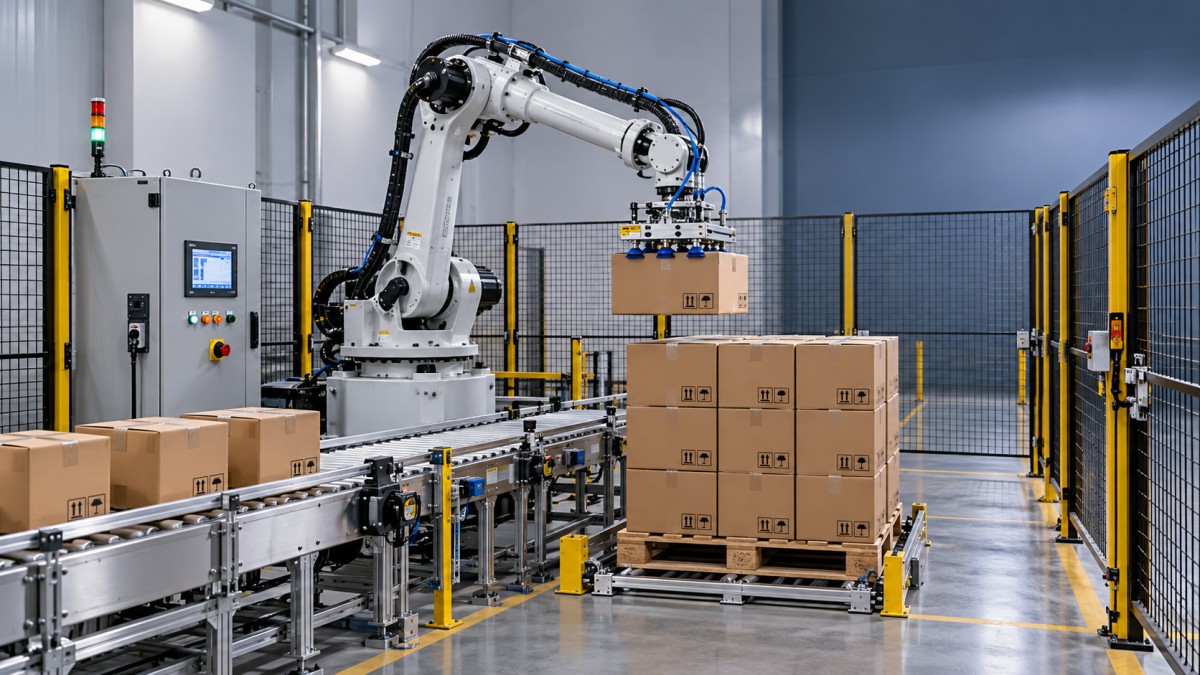
Tooling deserves particular scrutiny. A vacuum gripper that handles clean, sealed cartons may struggle with dusty or porous packaging. Mechanical fingers accommodate different conditions but introduce contact forces, clearance requirements, and wear surfaces. The budget should reflect tests with representative parts, including difficult examples within the agreed specification.
A collaborative robot does not establish the safety or cost of the complete application. Sharp workpieces, pinch points, hot surfaces, and process equipment remain relevant hazards. Where protective operating limits constrain speed, achieving the required throughput could require a different layout or additional equipment.
Integration cost follows uncertainty and interfaces
Integration includes mechanical design, electrical engineering, programming, process development, and coordination with surrounding equipment. Its cost grows when the project contains unresolved behavior: inconsistent part location, undocumented machine signals, unstable upstream delivery, or inspection criteria that cannot yet be measured reliably.
Consider machine tending. The physical loading motion may be straightforward, but production also requires reliable door control, chuck or fixture confirmation, machine-ready signals, part identification, and recovery after an interrupted cycle. Legacy equipment with incomplete interface documentation creates engineering work that a robot-only quotation does not capture.
Vision introduces a similar distinction. A camera price does not cover lighting development, mounting, calibration, image processing, and validation across the agreed part range. Reflective surfaces, changing ambient light, and partial occlusion alter the engineering effort. A successful demonstration using selected samples provides limited evidence about performance across normal production variation.
Resolve unknowns before committing to a fixed scope
Where gripping, recognition, or process capability remains uncertain, a separately scoped feasibility trial can establish the design basis. Define the samples, operating conditions, measurements, and deliverables. The useful result is evidence supporting a design decision, including any restrictions that must appear in the production specification.
Fixed-price integration offers budget certainty only within its stated assumptions. Identify which changes trigger additional charges, how engineering rates apply, and who authorizes variations. A new part variant or a changed conveyor elevation can affect tooling, reach, guarding, and software together; the financial impact extends beyond the component being changed.
Responsibility at each interface also needs an owner. Robot-to-machine communication, safety interlocks, production data exchange, and utility connections should have defined deliverables and acceptance evidence. Gaps between suppliers otherwise become site engineering work after equipment arrives.
Budget for the transition into production
Delivery and production readiness are separate milestones. Site preparation includes utility capacity, network connections, floor suitability, unloading access, and equipment positioning. Installation during an existing production shutdown adds scheduling constraints; delays in one dependency can consume the available commissioning window.
Separate factory acceptance from site acceptance. Factory testing establishes performance under the agreed test conditions. Site testing verifies the installed system with actual utilities, material flow, surrounding equipment, and production interfaces. State which defects prevent shipment, which prevent final acceptance, and how retesting is funded.
Acceptance criteria should make performance measurable:
- Throughput: define the product mix, test duration, loading conditions, and treatment of blocked or starved time.
- Quality acceptance needs measurable limits and an agreed inspection method. A fast cycle that damages surfaces or misloads fixtures does not satisfy the production requirement.
- Recovery behavior: demonstrate restart after representative interruptions, including a failed pick, protective stop, or loss of an upstream signal.
- The handover package should include current drawings, software backups, parameter files, maintenance instructions, and the access rights needed for support.
Training and ramp-up also require funding. Budget time for routine operation, changeovers, fault diagnosis, and maintenance tasks. During commissioning, temporary manual work or parallel production may be necessary to maintain deliveries. Include those transition costs without assuming full automated output immediately after installation.
Build maintenance costs around the complete cell
Maintenance estimates based only on the robot arm overlook many production interruptions. Gripper seals, vacuum filters, hoses, cables, sensors, fixtures, and conveyor components all belong in the service model. Their replacement intervals depend on operating hours, cycle count, contamination, temperature, and the loads imposed by the application.
Request the maintenance schedule for the proposed configuration and duty. Separate scheduled labor, consumables, calibration, software support, and major service work. Clarify whether quoted service includes travel, accommodation, remote diagnosis, and attendance outside normal working hours.
A service response commitment should distinguish acknowledgement, remote troubleshooting, arrival on site, and restoration. A rapid telephone response does not establish when production will resume. Restoration also depends on diagnosis, spare availability, physical access, and whether qualified maintenance support is present.
Spare-part stocking should follow failure consequences and replacement lead time. A low-cost sensor with a long replenishment time can justify local stock when its failure stops the cell. Expensive assemblies require a different assessment involving repair options, exchange units, and available redundancy. Confirm storage conditions and shelf-life restrictions where applicable.
Design choices influence recurring expense. Accessible lubrication points, replaceable gripper fingers, labeled wiring, and usable diagnostics reduce service effort. Conversely, a compact layout that obstructs maintenance access can increase repair duration. Ask for maintenance access to be demonstrated during design review, before the arrangement becomes expensive to change.
Calculate ownership cost and payback on consistent terms
Use a defined evaluation period and production schedule. The model should distinguish initial cash outlay, recurring operating costs, periodic replacement expenses, and end-of-use costs. Include residual value only when there is a credible basis for estimating it.
Total cost of ownership = acquisition and deployment costs + operating and support costs + later modification and retirement costs − recoverable residual value.
Operating costs include electricity, compressed air, consumables, maintenance, software charges, and any continuing manual work. Compressed-air consumption deserves explicit treatment in pneumatic tooling and vacuum generation. Confirm whether quoted consumption represents continuous demand, peak demand, or the actual cycle profile.
Keep production losses visible, but avoid counting the same loss twice. If expected downtime already reduces annual output and contribution, adding the full value of that lost output again as a maintenance expense overstates the penalty. Physical repair costs and lost production are separate effects that need consistent accounting.
Simple payback compares the initial investment with annual net cash benefit. Labor benefit requires a credible staffing change or documented avoidance of additional hiring. Reassigning work creates operational capacity, but it does not automatically reduce payroll. Likewise, additional output has financial value only where demand, downstream capacity, and contribution support it.
Test the result under lower utilization, slower ramp-up, more frequent changeovers, and higher support expense. Vary these assumptions individually before combining them. This reveals whether the investment depends mainly on production volume, staffing changes, or technical availability. For projects with substantial costs spread across years, discounted cash-flow analysis also captures the timing of expenditure and benefits.
Make the commercial comparison reflect the delivered obligation
Normalize competing proposals into a shared cost structure. Mark each required item as included, separately priced, excluded, or unresolved. An exclusion needs a budget allowance and a responsible party; leaving it blank understates the project total. Keep contingency separate from known scope so that missing equipment is not concealed inside a general reserve.
Link payment milestones to verifiable deliverables, such as approved design documentation, completed factory testing, installation, and site acceptance. Warranty terms should identify the start date, covered components, labor and travel treatment, and exclusions associated with wear or operating conditions. Confirm access to programs and configuration backups alongside the terms for future modifications.
A defensible budget ends with an explicit production commitment: the agreed parts, rate, quality, operating conditions, support coverage, and evidence required for acceptance. Any unresolved assumption that could change equipment selection, engineering effort, or achievable output should remain visible in the approval figure.
Search News
Hot Articles
- Carbon Fiber StructuresHow to Specify Aerospace Carbon Fiber Assemblies for Lightweight, Load-Bearing PartsJul 11, 2026
- Machine VisionXiaomi, Alibaba DAMO Academy Drive Open-Source Robotics Model Ecosystem, Lowering Algorithm Development Barriers for Overseas SMEs Adopting Chinese Robotics SolutionsMar 30, 2026
- Cobots & ArmsShanxi 'AI+' Conference Showcases Embodied Intelligence with Multinational Buyer Engagement: Key Industry ImplicationsMar 30, 2026
Popular Tags
Recommended News
 Jul 11, 2026How to Specify Aerospace Carbon Fiber Assemblies for Lightweight, Load-Bearing PartsAerospace carbon fiber assemblies: learn how to specify laminate design, load data, joining methods, and inspection controls for lighter, reliable load-bearing aerospace parts.Elena Rostova (UAV Systems Researcher)
 Mar 30, 2026Xiaomi, Alibaba DAMO Academy Drive Open-Source Robotics Model Ecosystem, Lowering Algorithm Development Barriers for Overseas SMEs Adopting Chinese Robotics SolutionsXiaomi & Alibaba DAMO Academy's open-source robotics models lower algorithm barriers for global SMEs. Boost efficiency in manufacturing, logistics & smart retail with ROS 2 compatible solutions.TSV Data Lab
 Mar 30, 2026Shanxi 'AI+' Conference Showcases Embodied Intelligence with Multinational Buyer Engagement: Key Industry ImplicationsShanxi 'AI+' Conference highlights embodied intelligence with Tesla, Ubtech & Jiantao showcasing multimodal robotics. 40+ global buyers validated tech on-site, creating new B2B channels for industrial automation & AI solutions.Chen Wei (Automation Lead Engineer)
 Mar 30, 2026Zhongguancun Unveils 6G Integrated Sensing-Computing-Intelligence Platform to Empower Embodied Robots for Global Industrial ApplicationsZhongguancun's new 6G platform revolutionizes industrial robotics with <10ms latency, empowering global automotive, logistics & port automation. Discover how this tech boosts China's smart manufacturing exports.TSV Data Lab
 Mar 30, 2026Mech-Mind Tianjin Embodied Intelligence R&D and Production Base Goes Live, Cutting Delivery Time by 20%–30% for Global Customized AMR+Vision SolutionsMech-Mind's Tianjin AMR+Vision production base cuts delivery time by 20%-30% for欧美 & Latin American markets. Discover how this PLd-certified facility accelerates customized robotics solutions for smart manufacturing and logistics.Chen Wei (Automation Lead Engineer)
 Mar 30, 2026Boao Forum Reveals 'Co-evolution of Big and Small Brains' Trend in Humanoid Robots, China's Embodied Intelligence Accelerates Adaptation to Overseas Manufacturing Service ScenariosDiscover how China's humanoid robots, featuring 'Co-evolution of Big and Small Brains,' are revolutionizing global manufacturing. Learn about Embodied Tian Gong 3.0's ISO compliance and overseas deployment at Boao Forum 2026.Chen Wei (Automation Lead Engineer)
 Mar 30, 2026China Railway Industrial Secures Patent for Embodied Robotics in Material Handling, Boosting High-Precision Delivery Capabilities for Overseas Infrastructure and Manufacturing ProjectsChina Railway Industrial's new patent for embodied robotics in material handling boosts high-precision delivery for global infrastructure & manufacturing. Discover how this innovation enhances logistics accuracy in automotive, rail transit & EPC projects.Chen Wei (Automation Lead Engineer)
 Oct 27, 2026Robotic Automation Costs: Budgeting for Equipment, Integration, and MaintenancePlan your robotics automation cost with confidence. Explore equipment, integration, and maintenance expenses, compare quotes, and build a realistic budget for better ROI.Chen Wei (Automation Lead Engineer)
 Oct 26, 2026AMAXiMAL Releases Open-Source TopMod 3D v3 With Claude AIExplore AMAXiMAL’s free, open-source TopMod 3D v3 with Claude AI assistance, topology-based modeling and plywood fabrication tools that connect complex designs to physical builds.Dr. Marcus Vance
 Oct 26, 2026Choosing a SCADA System Integrator Company: PLC Compatibility and Long-Term SupportChoose a scada system integrator company with proven PLC compatibility and reliable long-term support. Discover what to test, compare, and require before investing.Victor Lin (Chief Software Architect)
 Oct 25, 2026Hesai Leads Global ADAS Main Lidar Shipments in Yole’s 2026 ReportHesai led global ADAS main lidar shipments with a 43% share in 2025, according to Yole’s 2026 report. Explore what this ranking reveals about its automotive market position.TSV Data Lab
 Oct 25, 2026Choosing an Aerospace Materials Manufacturer: Quality and Traceability ChecksChoosing an aerospace materials manufacturer? Learn how to verify certifications, test reports, and lot traceability to qualify suppliers confidently and reduce costly sourcing risks.Dr. Marcus Vance
 Oct 24, 2026Guotai Haitong: Global Entry-Level 3D Printer Shipments Rose 39% in Q1 2026Entry-level 3D printer shipments rose 39% in Q1 2026, Guotai Haitong reports. Explore how AI, multicolor printing and print farms are shaping market growth.Dr. Marcus Vance
 Oct 24, 2026Choosing an Industrial Vision Inspection Supplier: Acceptance Tests That MatterChoose an industrial vision inspection supplier with confidence. Discover acceptance tests for defect detection, false rejects, production speed, and reliable part rejection before you buy.TSV Data Lab
 Oct 23, 2026US Navy Raises Gecko Robotics Contract Ceiling to $300M for Robotic Fleet MaintenanceUS Navy raises Gecko Robotics’ contract ceiling to $300M for Pacific Fleet robotic inspections. Explore potential opportunities for maintenance suppliers and key procurement considerations.Chen Wei (Automation Lead Engineer)
 Oct 23, 2026Choosing Industrial Sensing Systems for Global Plants: Protocol CompatibilityCompare industrial sensing systems international buyers can trust. Explore protocol compatibility, reduce integration risks, and select proven configurations for reliable global plant deployments.TSV Data Lab
 Oct 22, 2026KUKA Showcases Physical AI and iiQKA.AI Vision at NVIDIA GTC BerlinExplore KUKA’s Physical AI showcase at NVIDIA GTC Berlin and discover how iiQKA.AI Vision aims to simplify robotic vision integration and improve 2D and 3D scene recognition.TSV Data Lab
 Oct 22, 2026Robotic Machining of Advanced Composites: What Tolerances Are Achievable?Explore advanced materials machining robotics: discover what drives achievable composite tolerances and how to validate accuracy before investing in your next machining system.Dr. Marcus Vance
 Oct 21, 2026China’s Industrial Robot Exports Near RMB 10 Billion in First Nine Months of 2026China’s industrial robot exports neared RMB 10 billion in January–September 2026, with value rising faster than volume. Explore the data and what it could mean for suppliers.Chen Wei (Automation Lead Engineer)
 Oct 21, 2026Low-Latency Industrial Data Processing: Pricing and Key Cost DriversExplore industrial data latency price drivers, from edge hardware to integration and support. Learn how to compare quotes, verify performance, and avoid unnecessary costs.TSV Data Lab
 Oct 20, 2026KUKA Launches iiQKA.AI Vision to Simplify Industrial Image ProcessingKUKA iiQKA.AI Vision simplifies industrial image processing with controller-based 2D and 3D vision. Explore drag-and-drop setup for vision-guided automation.TSV Data Lab
 Oct 20, 2026Smart Industrial Edge Devices: Key Criteria for Legacy PLC IntegrationChoose smart industrial edge devices for legacy PLC integration. Discover key criteria for compatibility, data quality, security, and reliable collection without disrupting control.TSV Data Lab
 Oct 19, 2026Choosing a Radar Sensor by Application: Range, Resolution, and Field of ViewSimplify radar sensor application based product selection. Compare range, resolution, and field of view to avoid blind spots and choose with confidence. Explore the guide.TSV Data Lab
 Oct 18, 2026Comparing Material Options for Procurement: Specs, Costs, and Supply RisksExplore procurement oriented technical content on material options, specs, costs, and supply risks. Compare alternatives to cut hidden expenses and make confident sourcing decisions.Dr. Marcus Vance























