How to vet a fanless industrial computer factory?
Publication Date
author
Choosing the right fanless industrial computer factory is not about glossy claims—it is about verifying engineering depth, supply chain discipline, and long-term reliability. For buyers comparing a din rail pc manufacturer, embedded linux industrial pc wholesale options, or an industrial motherboard OEM, a rigorous vetting process helps separate marketing noise from measurable capability, procurement safety, and deployment-ready performance.
In industrial computing, the cost of a poor factory choice rarely appears on the first quotation sheet. It shows up 6 months later as unstable thermal performance, BIOS inconsistency, delayed RMA handling, connector failures in vibration environments, or product changes with no formal notice. That is why engineering teams, operators, procurement managers, and executives need a factory evaluation method grounded in evidence rather than slogans.
A qualified fanless industrial computer factory should be able to demonstrate more than assembly capability. It should show design control, component traceability, environmental validation, production discipline, and post-shipment support. This is especially important when sourcing embedded box PCs, DIN rail industrial PCs, edge AI gateways, and industrial motherboard platforms intended for 24/7 operation.
The framework below is designed for real B2B assessment. It helps information researchers define screening criteria, helps operators understand deployment risks, helps procurement reduce supplier uncertainty, and helps business decision-makers compare factories on long-term ownership value instead of headline price alone.
Start with Factory Capability, Not Catalog Claims
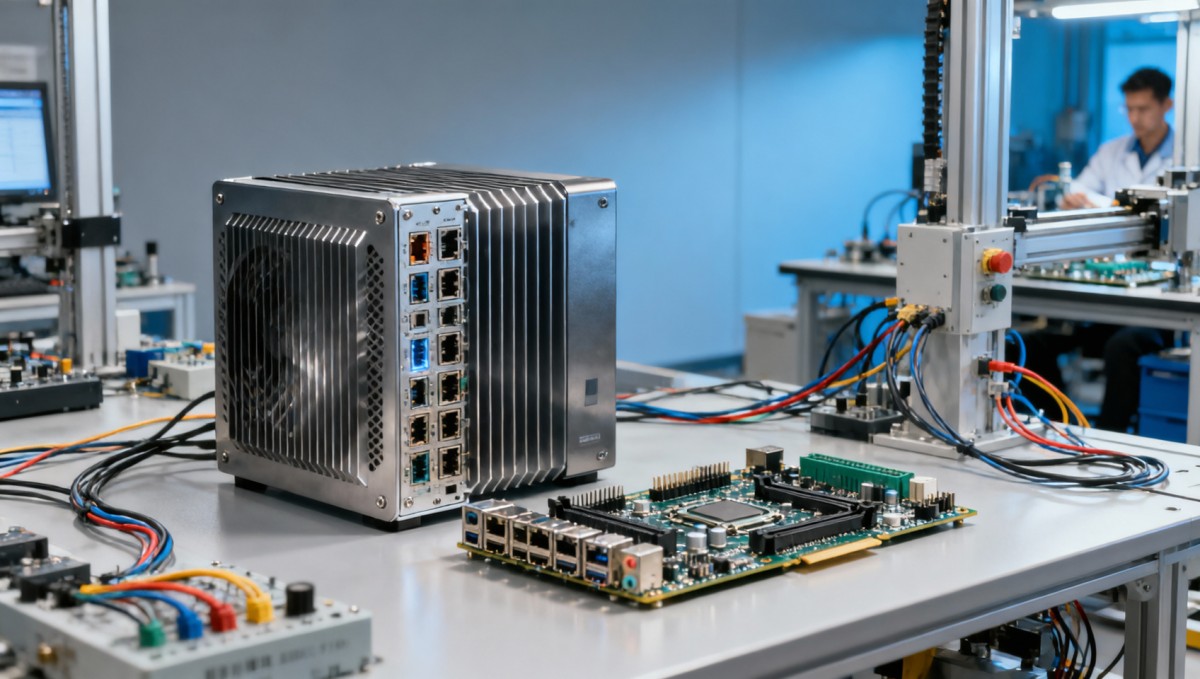
A factory’s catalog may list fanless industrial computers with Intel or ARM platforms, multiple I/O options, Linux support, and wide-temperature operation. None of that proves the factory can build stable products at scale. The first step is to confirm whether the supplier is a true manufacturer, a design house, a trading company, or a mixed model operation with outsourced production.
In practical vetting, buyers should verify 4 basic dimensions within the first 2 weeks: design ownership, production control, engineering team depth, and component sourcing method. If a supplier cannot clearly explain who owns the motherboard design, who controls BIOS revisions, and where final assembly is performed, that is an early warning sign.
A serious fanless industrial computer factory usually supports at least 3 structured processes: new product introduction, engineering change control, and failure feedback closure. These processes matter because industrial deployments often run for 3 to 7 years, much longer than consumer electronics life cycles. Product consistency across batches is often more valuable than a one-time low price.
Ask the factory to show whether it supports standard SKUs only, semi-custom adaptation, or full industrial motherboard OEM projects. Each model has different risks. Standard products can ship in 2 to 4 weeks, while custom I/O, enclosure redesign, or BIOS tailoring may extend lead time to 6 to 12 weeks. A transparent factory will explain these trade-offs instead of promising unrealistic speed.
What to verify in the first screening round
- Whether the factory controls thermal design, chassis structure, board-level integration, and firmware adaptation internally.
- Whether engineering staff can discuss heat dissipation paths, TDP limits, storage endurance, and power input protection in technical terms.
- Whether production includes test stations for burn-in, I/O validation, and serial number traceability.
- Whether procurement can explain component life-cycle planning for 12, 24, or 36 months.
The table below can be used as a first-pass qualification matrix before deep technical review or factory audit.
If a supplier scores weakly in 2 or more of these areas, move carefully. A polished product brochure cannot compensate for weak engineering governance. The most reliable factories usually answer these questions with documents, process charts, or sample records rather than generic assurances.
Evaluate Engineering Depth Through Thermal, Power, and Reliability Evidence
Fanless systems are judged by how well they manage heat, power fluctuation, and continuous duty, not by how clean the enclosure looks. In a factory review, buyers should ask for evidence on operating temperature range, thermal throttling thresholds, power input tolerance, storage endurance options, and long-duration stress behavior. A wide-temperature claim such as -20°C to 60°C should trigger a follow-up question: under what CPU load, enclosure condition, and airflow assumption?
A competent factory should understand the limits of passive cooling. For example, a 15W to 28W processor may perform differently depending on fin density, chassis mass, vertical mounting orientation, and ambient rise inside a cabinet. If the supplier cannot discuss test methods such as 8-hour or 24-hour burn-in, surface temperature measurement points, and CPU frequency behavior under load, the product may be under-validated.
Power design is another critical checkpoint. Many industrial deployments use 9V to 36V or 12V to 24V DC input ranges, but the real issue is transient protection, reverse polarity protection, and resilience to unstable site power. In transportation, automation, and remote edge installations, a power fault can damage storage or corrupt operating systems long before a total unit failure occurs.
Reliability evidence should also extend beyond CPU and enclosure. Ask about SSD temperature handling, memory qualification, connector retention, cable locking, RTC battery access, and watchdog timer behavior. A reliable factory typically has a clear validation matrix covering thermal stress, vibration exposure, port function, and startup consistency across multiple production lots.
Technical questions that reveal real engineering strength
- At 100% CPU load, what is the measured chassis surface temperature and internal hotspot behavior?
- Does the system maintain stable operation for 8, 16, or 24 hours in the stated ambient range?
- What protections are built into the power input stage, and what failure modes have been tested?
- How are BIOS revisions controlled and communicated across production batches?
- What storage options are recommended for high-write or high-vibration applications?
The following table helps compare technical validation quality across candidate suppliers.
The key conclusion is simple: a real factory discusses limits, not just features. When a supplier openly explains thermal derating, recommended mounting conditions, and validated operating windows, that transparency is often a sign of maturity rather than weakness.
Audit Production Discipline, Component Control, and Supply Chain Stability
Even a well-designed industrial computer can fail as a sourcing program if the factory lacks discipline in production and component management. Procurement teams should examine how the factory handles approved vendor lists, incoming inspection, batch records, serial traceability, and change notifications. For long-cycle industrial projects, component substitutions without process control can create serious compatibility problems.
A practical benchmark is whether the supplier can trace a shipped unit back to motherboard revision, BIOS version, memory lot, storage brand, and assembly date. If a field problem occurs 9 months later, this traceability can reduce root-cause investigation time from weeks to days. For enterprise buyers, that translates directly into lower downtime exposure and faster corrective action.
Lead time transparency also matters. Standard fanless box PCs may be available in 2 to 4 weeks when inventory is healthy, while custom I/O layouts, TPM additions, ignition control, or branded front panels may push schedules to 6 to 10 weeks. What buyers need is not the shortest promised lead time, but a realistic lead time with visible bottleneck management and communication discipline.
For embedded linux industrial pc wholesale projects, buyers should also ask whether operating system images are frozen per batch, whether kernel or driver changes are documented, and whether software images are archived for future recovery. Hardware consistency without software version control is only half of production control.
Red flags during factory qualification
- No formal engineering change notice process for BIOS, storage, or connector changes.
- Unclear sourcing channels for key parts such as SSDs, memory, power modules, or industrial NICs.
- Sales teams provide all answers while engineers remain unavailable during technical review.
- RMA statistics, test records, or lot identification methods cannot be explained clearly.
- Quoted lead time remains identical for standard and custom projects, which often indicates weak planning.
Questions procurement should ask before approval
Ask how many component changes typically occur within a 12-month cycle and how customers are informed. Ask whether there is a last-time-buy policy for long-life products. Ask how RMAs are categorized by failure type, and whether the factory can share a standard corrective action workflow within 48 to 72 hours after issue confirmation.
These questions may sound operational, but they are strategic. In industrial environments, a supplier that communicates change early can save months of revalidation work, especially when systems are installed in transport cabinets, machine vision stations, unmanned kiosks, or edge computing nodes spread across multiple sites.
Match the Factory to Your Deployment Scenario and Service Model
Not every fanless industrial computer factory is suitable for every use case. A supplier strong in general embedded box PCs may not be ideal for DIN rail deployments, vehicle computing, edge AI inference, or industrial motherboard OEM integration. The right factory is the one whose validation logic, support model, and product architecture align with your real operating environment.
For example, a din rail pc manufacturer should understand cabinet space constraints, terminal accessibility, grounding practices, power rail behavior, and vertical thermal orientation. An industrial motherboard OEM supplier should be able to discuss board stacking, carrier integration, I/O mapping, and enclosure adaptation. A wholesale embedded Linux supplier should be comfortable with image deployment, remote update control, and peripheral driver compatibility.
Service model is equally important. Some buyers only need standard documentation, while others need pre-sales thermal review, sample-stage BIOS tuning, test image creation, and post-deployment support across 12 to 36 months. The factory should clearly state what is included in standard support, what requires NRE, and how escalation works when failures occur in the field.
If your deployment involves 50, 200, or 1,000 units across regions, also verify packaging consistency, labeling formats, MAC address management, and whether the supplier can preload OS images or asset tags. Seemingly small operational details often determine whether rollout is smooth or expensive.
Scenario-based factory matching guide
The table below helps buyers connect application requirements with factory capabilities that should be validated before supplier selection.
This type of matching prevents a common sourcing error: selecting a factory that can build the unit, but not support the deployment model. For industrial computing, deployment support and life-cycle alignment are often as important as the hardware specification itself.
Use a Structured Vetting Process Before Volume Orders
The safest way to vet a fanless industrial computer factory is to use a staged qualification process instead of moving directly from quotation to bulk purchase. A 5-step method usually works well for B2B buyers: supplier screening, technical review, sample validation, factory audit or remote process review, and pilot batch evaluation. This reduces both sourcing risk and deployment delays.
During sample validation, do not only test whether the unit powers on. Run thermal stress, repeated boot cycles, interface checks, OS image recovery, and application-specific communication tests. If possible, test for at least 72 hours under representative load. For machine control or edge gateway projects, include actual peripherals such as cameras, PLCs, barcode scanners, or fieldbus devices.
A pilot batch is valuable because it exposes process variation. A sample unit built by the engineering team may perform well, while a 30-unit or 100-unit batch reveals inconsistency in assembly torque, BIOS settings, cable routing, or storage brand substitution. Pilot batches help buyers see how the factory performs under real production conditions rather than prototype conditions.
Commercial terms should also be validated before scaling. Confirm warranty duration, dead-on-arrival handling, technical response time, spare unit policy, and RMA turnaround. A factory that offers a 12-month or 24-month warranty is not automatically better unless it also explains how issue triage, repair routing, and root-cause reporting are handled.
Recommended 5-step supplier vetting path
- Screen 5 to 8 candidate factories based on technical fit, not just online visibility.
- Shortlist 2 to 3 suppliers after engineering Q&A and document review.
- Validate 1 to 2 samples per supplier under real application conditions for 72 hours or longer.
- Review production process, traceability method, and change control procedure before approval.
- Place a controlled pilot order, then evaluate consistency, packaging, and support response.
FAQ for buyers and technical teams
How long does qualification usually take?
For standard products, a disciplined review can take 2 to 4 weeks. For custom industrial motherboard OEM or Linux image projects, 6 to 10 weeks is more realistic because hardware, firmware, and software validation need to be aligned.
Should price be the primary decision factor?
No. For 24/7 industrial use, downtime cost, replacement labor, and revalidation work can exceed the original hardware price difference. A unit that is 8% cheaper but causes repeat field failures is often the more expensive choice over 12 to 24 months.
What documents should a reliable factory be able to provide?
At minimum, expect product specifications, interface definitions, power requirements, environmental ranges, revision information, and basic test or inspection descriptions. For custom projects, buyers should also request change control rules, image control details, and warranty workflow information.
Vetting a fanless industrial computer factory is ultimately about evidence, process, and fit. Buyers should confirm who designs the product, how reliability is validated, how components are controlled, and whether the supplier can support the actual deployment scenario over a multi-year life cycle.
For teams sourcing a din rail pc manufacturer, embedded linux industrial pc wholesale partner, or industrial motherboard OEM supplier, the strongest choice is rarely the loudest in marketing. It is the factory that can explain limits clearly, document changes consistently, and support scale without losing technical discipline.
If you are comparing suppliers and need a more rigorous qualification framework, now is the right time to build a structured review checklist and test plan. Contact us to discuss your deployment goals, request a tailored evaluation matrix, or explore industrial computer solutions matched to your technical and procurement requirements.
Search News
Hot Articles
- Carbon Fiber StructuresHow to Specify Aerospace Carbon Fiber Assemblies for Lightweight, Load-Bearing PartsJul 11, 2026
- Machine VisionXiaomi, Alibaba DAMO Academy Drive Open-Source Robotics Model Ecosystem, Lowering Algorithm Development Barriers for Overseas SMEs Adopting Chinese Robotics SolutionsMar 30, 2026
- Cobots & ArmsShanxi 'AI+' Conference Showcases Embodied Intelligence with Multinational Buyer Engagement: Key Industry ImplicationsMar 30, 2026
Popular Tags
Recommended News
 Jul 11, 2026How to Specify Aerospace Carbon Fiber Assemblies for Lightweight, Load-Bearing PartsAerospace carbon fiber assemblies: learn how to specify laminate design, load data, joining methods, and inspection controls for lighter, reliable load-bearing aerospace parts.Elena Rostova (UAV Systems Researcher)
 Mar 30, 2026Xiaomi, Alibaba DAMO Academy Drive Open-Source Robotics Model Ecosystem, Lowering Algorithm Development Barriers for Overseas SMEs Adopting Chinese Robotics SolutionsXiaomi & Alibaba DAMO Academy's open-source robotics models lower algorithm barriers for global SMEs. Boost efficiency in manufacturing, logistics & smart retail with ROS 2 compatible solutions.TSV Data Lab
 Mar 30, 2026Shanxi 'AI+' Conference Showcases Embodied Intelligence with Multinational Buyer Engagement: Key Industry ImplicationsShanxi 'AI+' Conference highlights embodied intelligence with Tesla, Ubtech & Jiantao showcasing multimodal robotics. 40+ global buyers validated tech on-site, creating new B2B channels for industrial automation & AI solutions.Chen Wei (Automation Lead Engineer)
 Mar 30, 2026Zhongguancun Unveils 6G Integrated Sensing-Computing-Intelligence Platform to Empower Embodied Robots for Global Industrial ApplicationsZhongguancun's new 6G platform revolutionizes industrial robotics with <10ms latency, empowering global automotive, logistics & port automation. Discover how this tech boosts China's smart manufacturing exports.TSV Data Lab
 Mar 30, 2026Mech-Mind Tianjin Embodied Intelligence R&D and Production Base Goes Live, Cutting Delivery Time by 20%–30% for Global Customized AMR+Vision SolutionsMech-Mind's Tianjin AMR+Vision production base cuts delivery time by 20%-30% for欧美 & Latin American markets. Discover how this PLd-certified facility accelerates customized robotics solutions for smart manufacturing and logistics.Chen Wei (Automation Lead Engineer)
 Mar 30, 2026Boao Forum Reveals 'Co-evolution of Big and Small Brains' Trend in Humanoid Robots, China's Embodied Intelligence Accelerates Adaptation to Overseas Manufacturing Service ScenariosDiscover how China's humanoid robots, featuring 'Co-evolution of Big and Small Brains,' are revolutionizing global manufacturing. Learn about Embodied Tian Gong 3.0's ISO compliance and overseas deployment at Boao Forum 2026.Chen Wei (Automation Lead Engineer)
 Mar 30, 2026China Railway Industrial Secures Patent for Embodied Robotics in Material Handling, Boosting High-Precision Delivery Capabilities for Overseas Infrastructure and Manufacturing ProjectsChina Railway Industrial's new patent for embodied robotics in material handling boosts high-precision delivery for global infrastructure & manufacturing. Discover how this innovation enhances logistics accuracy in automotive, rail transit & EPC projects.Chen Wei (Automation Lead Engineer)
 Oct 18, 2026Comparing Material Options for Procurement: Specs, Costs, and Supply RisksExplore procurement oriented technical content on material options, specs, costs, and supply risks. Compare alternatives to cut hidden expenses and make confident sourcing decisions.Dr. Marcus Vance
 Oct 17, 20265-Axis CNC Positioning Accuracy: How to Interpret ISO 230-2 Test ResultsAssess 5 axis CNC machining positioning accuracy with ISO 230-2. Learn to interpret repeatability, reversal error, and test conditions to compare suppliers and make confident acceptance decisions.Dr. Marcus Vance
 Oct 16, 2026Choosing a Rugged Edge AI Box Supplier: Thermal Tests and Lifecycle SupportChoose a rugged edge AI box supplier with proven thermal performance and reliable lifecycle support. Discover the tests and commitments to verify before you buy.TSV Data Lab
 Oct 15, 2026R&D Cost Reduction Services: How to Evaluate Fees, Savings, and ROIEvaluate R&D cost reduction services with confidence. Compare fees, verify savings, and calculate ROI without compromising performance. Discover how to choose a provider that delivers real value.Chen Wei (Automation Lead Engineer)
 Oct 18, 2026What Should an AS9100 Machining Supplier Checklist Include?Build an AS9100 machining supplier checklist that verifies capability, traceability, inspection, and outsourced processes. Discover what to check before approving your next aerospace supplier.Dr. Marcus Vance
 Oct 17, 2026How Should You Interpret Industrial Robot Repeatability Specs?Decode industrial robot repeatability specifications, understand ISO 9283 test conditions, and avoid costly selection mistakes. Learn how to verify performance for your process.Chen Wei (Automation Lead Engineer)
 Oct 16, 2026How Can You Fairly Compare MTBF Across Industrial Servo Motors?Make a fair industrial servo motor MTBF comparison with matched operating profiles, failure criteria, and confidence bounds. Discover how to assess reliability beyond advertised numbers.Chen Wei (Automation Lead Engineer)
 Oct 15, 2026How Should You Compare TechStat Vanguard 5-Axis CNC Tolerances?TechStat Vanguard 5-axis CNC tolerance comparison: learn how to verify part accuracy, assess inspection evidence, and choose suppliers that reliably meet your drawing requirements.Dr. Marcus Vance
 Oct 14, 2026Drone Frame Composites: Carbon Fiber vs. Fiberglass for Weight and StiffnessExplore drone structural materials composites: compare carbon fiber and fiberglass for weight, stiffness, cost, and antenna compatibility. Find the right material for your drone frame.Elena Rostova (UAV Systems Researcher)
 Oct 13, 2026Smart Cameras vs. PC-Based Machine Vision: Which Fits High-Speed Inspection?This industrial product comparison for machine vision weighs smart cameras vs. PC-based systems on latency, throughput, and cost. Discover your best fit for high-speed inspection.TSV Data Lab
 Oct 12, 2026How to Verify RoHS Compliance in Industrial Sensing Systems Before DeploymentRoHS compliant sensing systems: learn how to verify materials, supplier declarations, testing, and configuration controls before industrial deployment.TSV Data Lab
 Oct 11, 2026How Procurement-Oriented Content Taxonomy Improves B2B Buying JourneysProcurement-oriented content taxonomy streamlines B2B buying journeys with clearer evidence, supplier comparisons, risk visibility, and faster approvals.TSV Data Lab
 Oct 10, 2026How to Select a Machine Performance Monitoring Platform for OEE and Downtime ReductionMachine performance monitoring platform selection guide: validate machine states, OEE data, downtime reasons, integrations, and scalability to reduce losses with confidence.TSV Data Lab
 Oct 08, 2026How to Machine Inconel 625 Blades Without Heat Cracks or Edge ChippingInconel 625 blade machining guide: prevent heat cracks, edge chipping, chatter, and work hardening with proven tooling, cooling, fixturing, and inspection strategies.Dr. Marcus Vance
 Oct 07, 2026How to Evaluate an HMI Panel Distributor for Industrial Automation ProjectsHMI panel distributor evaluation guide: verify technical compatibility, traceability, supply reliability, lifecycle support, and total cost for automation projects.Victor Lin (Chief Software Architect)
 Oct 06, 2026Navigation Fault Tolerance Standards for AMRs: What Safety Teams Must VerifyNavigation fault tolerance standards: learn what AMR safety teams must verify, from localization loss and sensor faults to stopping distance, safe restart, and site-specific validation.Chen Wei (Automation Lead Engineer)
 Oct 05, 2026Calculating Edge Computing Total Cost of Ownership Across Distributed SitesEdge computing ownership cost explained: calculate deployment, energy, connectivity, security, remote support, and refresh costs across distributed sites.TSV Data Lab