Servo Motors for Robotics Applications: What Fails First?
Publication Date
author
In servo motors for robotics applications, the first failure rarely starts with a dramatic breakdown—it usually begins with subtle heat rise, encoder drift, bearing wear, or overload stress that after-sales maintenance teams can easily miss. Understanding these early weak points is critical for reducing downtime, extending MTBF, and making evidence-based service decisions in demanding industrial environments.
For after-sales maintenance personnel, the short answer is clear: in most robotic systems, the first thing that fails is not the entire servo motor, but one of its stress-sensitive subsystems. Bearings, feedback devices such as encoders or resolvers, cable connections, insulation stressed by heat, and brakes on vertical axes usually degrade before the stator or rotor suffers catastrophic damage.
This matters because service teams are rarely called in when a servo is healthy. They are called in when the robot is overheating, losing position, vibrating during acceleration, tripping on overload, or showing intermittent faults that operators describe vaguely as “unstable.” In these situations, the goal is not theoretical understanding. The goal is to identify what fails first, what symptom appears earliest, and what evidence separates a serviceable motor from a replacement case.
That is why a useful discussion of servo motors for robotics applications should focus less on generic motor theory and more on failure sequence, field symptoms, diagnostic priority, and practical inspection logic. For maintenance teams, the best article is one that helps reduce false replacements, shorten troubleshooting time, and prevent repeat failures caused by upstream mechanical or electrical problems.
What Usually Fails First in Servo Motors for Robotics Applications?
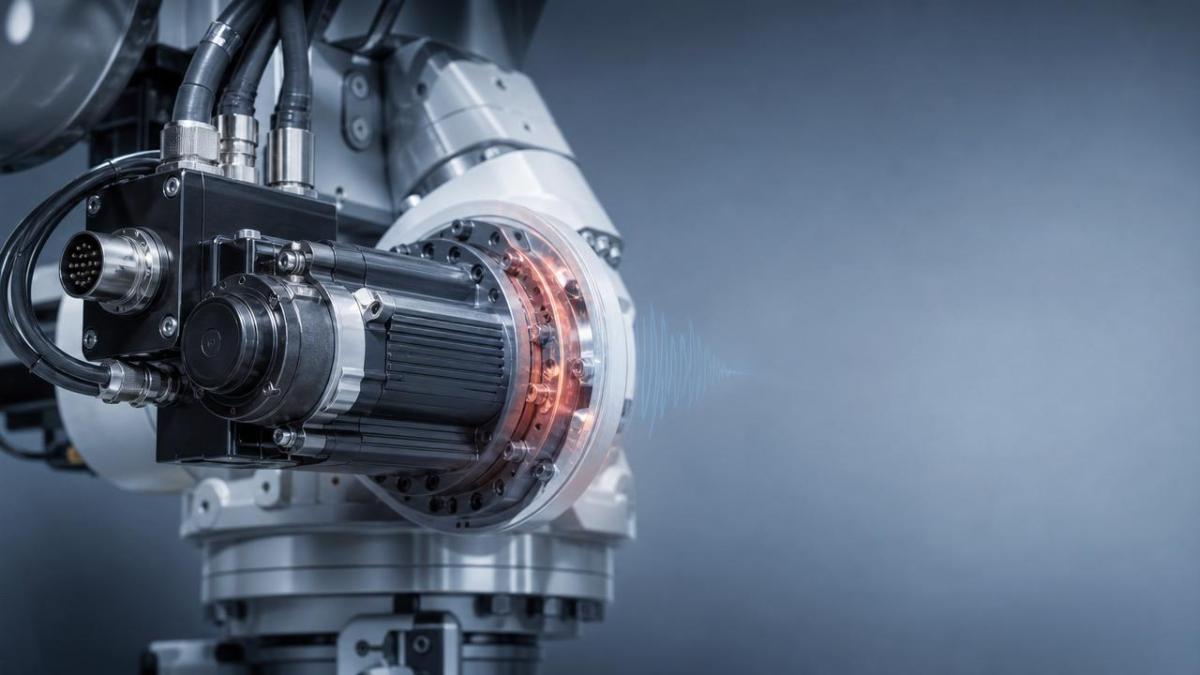
Across industrial robots, cobots, gantry systems, AGVs, and high-duty automation cells, the earliest failures usually appear in five areas: bearings, encoder systems, connectors and cables, brake assemblies, and thermal insulation margins. Which one fails first depends on axis duty cycle, contamination level, mounting orientation, motion profile, and tuning quality.
Bearings are often the first mechanical weak point. They carry radial and axial loads, absorb vibration, and react to misalignment from couplings, gearboxes, or belt drives. In robotic joints with repeated acceleration and deceleration, bearing fatigue develops gradually. The earliest clues are increased noise, micro-vibration, temperature rise near the front housing, and a slight increase in current draw under the same load.
Encoders are often the first precision-related weak point. A robot can still rotate with a stressed encoder, but motion quality deteriorates before total failure occurs. Symptoms include position deviation, unstable speed loop behavior, homing inconsistency, jitter at low speed, and alarm histories that seem random unless trend data is reviewed carefully.
Cables and connectors fail early in systems with continuous flexing, poor routing, oil contamination, or inadequate strain relief. In robotic arms, the problem may not be inside the motor at first. It may begin at the encoder cable, power connector, or terminal interface, causing intermittent feedback loss or overcurrent events that mimic internal servo failure.
Brakes are another frequent first-failure item, especially on vertical axes. In these applications, the motor brake is repeatedly engaged and released while exposed to heat and wear. A brake may still hold under light load but slip under real operating conditions. Teams that replace the motor without testing brake torque can miss the true cause of axis drop, drift, or abnormal restart behavior.
Finally, thermal stress silently shortens insulation life. A servo motor can appear electrically acceptable for a long time while repeated overheating weakens winding insulation, grease life, magnet stability, and encoder reliability. By the time hard electrical failure appears, the earlier warning signs were often already visible in temperature trends, overload frequency, or fan and ventilation issues in the enclosure.
Why Bearings Often Become the Earliest Confirmed Failure
Among all components in servo motors for robotics applications, bearings are frequently the first item that maintenance teams can verify as degraded with confidence. This is because bearing wear creates multiple measurable symptoms at once: vibration, heat, noise, shaft play, and rising friction torque. Unlike some intermittent encoder faults, bearing problems often leave a clearer physical signature.
In robotics, bearing life is affected not only by speed but by motion profile. Frequent starts and stops, rapid reversals, shock loading, and payload variation create stress patterns far different from steady-state motor applications. A robot joint running thousands of short, high-acceleration cycles per shift can consume bearing life faster than a continuously rotating motor at similar average speed.
Poor alignment accelerates the problem. If the servo is coupled to a gearbox with mounting error, side load increases. If the output mechanism has backlash or impact, bearings absorb the consequences. If lubrication is compromised by heat or contamination, surface fatigue develops sooner. In field service, this means a failed bearing should never be treated as an isolated event until alignment, load path, and mounting integrity are checked.
Maintenance teams should listen for tonal changes during ramp-up and deceleration, compare housing temperatures between matched axes, and review current trends under identical commands. A small but repeatable increase in no-load current can be one of the earliest indicators that bearing friction has begun to rise. Vibration analysis, when available, adds strong confirmation, especially if defect frequencies match bearing geometry.
How Encoder Drift and Feedback Faults Show Up Before Total Breakdown
Many service calls begin with complaints about repeatability, unstable path tracking, or unexplained servo alarms. In these cases, the motor may still produce torque normally, but the feedback device is no longer delivering clean positional data. That makes encoder-related issues one of the most important early-stage failures for after-sales teams to understand.
Encoder degradation does not always mean complete signal loss. It may begin as contamination, thermal drift, connector oxidation, shielding problems, or internal electronic aging. The robot may pass basic movement tests but fail during fine positioning, low-speed contouring, or synchronized multi-axis moves. Operators often describe this as “occasional twitching,” “lost zero,” or “position not stable after warm-up.”
A key field mistake is replacing the drive before checking the full feedback chain. In servo motors for robotics applications, encoder faults can originate in the encoder body, cable flex points, grounding quality, or electromagnetic interference from nearby power devices. The maintenance priority should be to confirm whether the feedback signal is consistently clean under motion, temperature, and vibration—not only when the machine is idle.
Trend-based inspection is valuable here. If position deviation alarms occur more frequently after the system heats up, thermal expansion or encoder electronics may be involved. If alarms appear only at specific robot postures, cable bend radius or connector movement may be the trigger. If low-speed instability disappears after cable reseating, the motor itself may not be the root cause at all.
Heat Is Not a Failure Mode by Itself, but It Accelerates Almost Every First Failure
When technicians ask what fails first, the deeper answer is often heat-assisted degradation. Heat does not replace bearings, encoders, brakes, or insulation as the failed component. Instead, it accelerates each of them. In real robotic environments, excessive thermal exposure is one of the strongest predictors that an early subsystem failure is approaching.
High ambient temperature, sealed control cabinets, repeated overload, poor tuning, oversized payloads, brake drag, mechanical binding, and aggressive duty cycles can all push servo temperature upward. Even if the motor remains below the trip threshold, long-term operation near thermal limits reduces grease life, weakens insulation margins, stresses magnets, and increases the risk of encoder instability.
For after-sales maintenance teams, this means temperature data should be treated as a leading indicator, not just a shutdown trigger. Compare surface temperature by axis, by shift, and by task. Look for asymmetry between identical stations. If one axis consistently runs hotter under the same commanded motion, the cause may be internal motor friction, external load resistance, or poor tuning creating unnecessary current demand.
The practical question is not simply “Is it hot?” but “Why is this motor hotter than before, hotter than its pair, or hotter than the application should require?” That mindset helps teams detect first-failure conditions early enough to schedule service before a stop-page event occurs.
Vertical Axes, High-Cycle Joints, and Harsh Environments Fail Differently
Not all servo motors for robotics applications age in the same way. Failure order changes with application type. Vertical axes often expose brake weakness first. High-cycle pick-and-place joints often reveal bearing and cable fatigue first. Washdown, dusty, oily, or high-vibration environments may surface connector, seal, or feedback issues before core motor damage is visible.
On vertical axes, pay special attention to brake release timing, hold stability, and heat generated by frequent engagement. If the axis drifts slightly after stop, hesitates during release, or needs higher current to maintain position, do not assume the servo loop is the only issue. Brake wear or contamination may be the true starting point.
In fast repetitive joints, small increases in vibration and current should be taken seriously. These axes often mask early damage because the machine still meets cycle time. Yet the combination of acceleration peaks and short dwell periods makes them ideal candidates for premature bearing wear, cable flex failure, and connector fatigue.
In harsh environments, contamination changes everything. Fine dust, coolant mist, oil ingress, and temperature cycling can degrade seals, corrode contacts, and destabilize feedback signals. Here, first failure may be less about internal design limit and more about environmental protection failure. Maintenance plans should reflect actual exposure, not just catalog IP ratings.
A Practical Diagnostic Order for After-Sales Maintenance Teams
When a robot presents unstable motion or intermittent servo alarms, a structured diagnostic order saves time and prevents unnecessary parts replacement. Start with symptoms that can be compared and measured. Review alarm history, current trend, temperature trend, and whether the issue changes with load, speed, or warm-up time.
Next, isolate whether the problem is mechanical, electrical, or feedback-related. Check for abnormal noise, axis resistance, brake drag, coupling condition, gearbox backlash, and signs of misalignment. Then inspect power and feedback connectors, cable routing, shielding, grounding, and any flex points subject to repeated bending.
If data and physical inspection still point toward the motor, compare no-load current, housing temperature, encoder stability, and vibration signature against baseline values or sister axes. This comparative method is often more reliable than absolute judgment in the field, especially when OEM thresholds are not immediately available.
Only after these steps should teams conclude that the servo motor itself is the primary failed item. This approach matters commercially as well as technically. Replacing a motor without addressing brake drag, alignment error, cable fatigue, or overload conditions often leads to repeat failure, warranty disputes, and loss of confidence from the end user.
How to Reduce Early Failure and Extend MTBF in Real Service Conditions
The most effective way to improve reliability is to treat early symptoms as data, not annoyance. For servo motors for robotics applications, MTBF improvement usually comes from controlling stress rather than reacting to breakdown. That means reducing unnecessary heat, shock, contamination, and misalignment before component degradation becomes irreversible.
Start with routine trend monitoring. Track current, temperature, alarm frequency, and repeatability by axis. Even a simple monthly comparison can expose slow deterioration. Add vibration checks for critical joints and inspect connector integrity during planned service intervals, especially on robots with constant cable motion.
Verify that motor sizing and tuning still match the real application. Production changes often increase payload, acceleration, or dwell force without updating service assumptions. A servo that was acceptable at commissioning may now be overloaded in practice. Long-term overload rarely creates instant failure, but it strongly influences what fails first.
Protect the surrounding system as carefully as the motor itself. Ensure proper cabinet cooling, cable routing, sealing, brake testing, and alignment control during motor replacement. A high-quality servo installed into a poor mechanical or thermal environment will simply fail along the same path again.
What Maintenance Teams Should Conclude Before Recommending Replacement
Before recommending motor replacement, after-sales personnel should answer five questions clearly. First, what symptom appeared earliest: heat, noise, drift, overload, or holding failure? Second, is the evidence pointing to bearings, encoder, brake, cable, or winding insulation? Third, did an external cause such as misalignment or overload trigger the damage? Fourth, can the fault be reproduced consistently? Fifth, what data supports replacement rather than adjustment or peripheral repair?
This decision discipline improves service quality. It prevents over-replacement, helps customers understand root cause, and creates more credible maintenance records. In high-value robotic systems, the best service teams are not the ones who swap parts fastest. They are the ones who can explain failure sequence with evidence.
So, what fails first in servo motors for robotics applications? Most often, not the motor as a whole. The first failure usually begins in a vulnerable subsystem—bearings under cyclic load, encoders under thermal or signal stress, brakes on vertical axes, connectors in flex-heavy routes, or insulation weakened by chronic heat. The visible breakdown comes later.
For after-sales maintenance teams, that is the key operational insight. If you want fewer emergency stops, longer service life, and better customer trust, look for the first weak signal rather than the final dramatic failure. In robotics, early truth is usually measurable long before it becomes catastrophic.
Search News
Hot Articles
- Carbon Fiber StructuresHow to Specify Aerospace Carbon Fiber Assemblies for Lightweight, Load-Bearing PartsJul 11, 2026
- Machine VisionXiaomi, Alibaba DAMO Academy Drive Open-Source Robotics Model Ecosystem, Lowering Algorithm Development Barriers for Overseas SMEs Adopting Chinese Robotics SolutionsMar 30, 2026
- Cobots & ArmsShanxi 'AI+' Conference Showcases Embodied Intelligence with Multinational Buyer Engagement: Key Industry ImplicationsMar 30, 2026
Popular Tags
Recommended News
 Jul 11, 2026How to Specify Aerospace Carbon Fiber Assemblies for Lightweight, Load-Bearing PartsAerospace carbon fiber assemblies: learn how to specify laminate design, load data, joining methods, and inspection controls for lighter, reliable load-bearing aerospace parts.Elena Rostova (UAV Systems Researcher)
 Mar 30, 2026Xiaomi, Alibaba DAMO Academy Drive Open-Source Robotics Model Ecosystem, Lowering Algorithm Development Barriers for Overseas SMEs Adopting Chinese Robotics SolutionsXiaomi & Alibaba DAMO Academy's open-source robotics models lower algorithm barriers for global SMEs. Boost efficiency in manufacturing, logistics & smart retail with ROS 2 compatible solutions.TSV Data Lab
 Mar 30, 2026Shanxi 'AI+' Conference Showcases Embodied Intelligence with Multinational Buyer Engagement: Key Industry ImplicationsShanxi 'AI+' Conference highlights embodied intelligence with Tesla, Ubtech & Jiantao showcasing multimodal robotics. 40+ global buyers validated tech on-site, creating new B2B channels for industrial automation & AI solutions.Chen Wei (Automation Lead Engineer)
 Mar 30, 2026Zhongguancun Unveils 6G Integrated Sensing-Computing-Intelligence Platform to Empower Embodied Robots for Global Industrial ApplicationsZhongguancun's new 6G platform revolutionizes industrial robotics with <10ms latency, empowering global automotive, logistics & port automation. Discover how this tech boosts China's smart manufacturing exports.TSV Data Lab
 Mar 30, 2026Mech-Mind Tianjin Embodied Intelligence R&D and Production Base Goes Live, Cutting Delivery Time by 20%–30% for Global Customized AMR+Vision SolutionsMech-Mind's Tianjin AMR+Vision production base cuts delivery time by 20%-30% for欧美 & Latin American markets. Discover how this PLd-certified facility accelerates customized robotics solutions for smart manufacturing and logistics.Chen Wei (Automation Lead Engineer)
 Mar 30, 2026Boao Forum Reveals 'Co-evolution of Big and Small Brains' Trend in Humanoid Robots, China's Embodied Intelligence Accelerates Adaptation to Overseas Manufacturing Service ScenariosDiscover how China's humanoid robots, featuring 'Co-evolution of Big and Small Brains,' are revolutionizing global manufacturing. Learn about Embodied Tian Gong 3.0's ISO compliance and overseas deployment at Boao Forum 2026.Chen Wei (Automation Lead Engineer)
 Mar 30, 2026China Railway Industrial Secures Patent for Embodied Robotics in Material Handling, Boosting High-Precision Delivery Capabilities for Overseas Infrastructure and Manufacturing ProjectsChina Railway Industrial's new patent for embodied robotics in material handling boosts high-precision delivery for global infrastructure & manufacturing. Discover how this innovation enhances logistics accuracy in automotive, rail transit & EPC projects.Chen Wei (Automation Lead Engineer)
 Sep 28, 2026Spindle Runout Measurement in Germany: DIN Standards, Methods, and Acceptance LimitsSpindle runout measurement Germany: explore DIN standards, proven methods, acceptance limits, and audit-ready practices for reliable machining quality.Dr. Marcus Vance
 Sep 27, 2026How to Select Wall-Mount Edge Devices for Space-Constrained Factory NetworksWall mount edge devices for space-constrained factories: evaluate workload, thermal design, power resilience, cable access, and network reliability for smarter deployments.TSV Data Lab
 Sep 26, 2026Machining Tolerance Analysis: How to Set Limits That Meet Function and Cost TargetsMachining tolerance analysis: learn how to set functional limits, control tolerance stacks, reduce inspection risk, and balance precision with production cost.Dr. Marcus Vance
 Sep 25, 2026How to Evaluate an Industrial Infrastructure Data Platform for Multi-Site OperationsIndustrial infrastructure data platform evaluation guide for multi-site operations: compare data quality, edge resilience, interoperability, governance, and scalable proof-of-value criteria.Victor Lin (Chief Software Architect)
 Sep 24, 2026How to Select Machine Vision Optics for Accurate Inspection at Different Working DistancesMachine vision optics selection guide for accurate inspection at every working distance. Compare FOV, pixel scale, DOF, distortion, lighting, and telecentric options.TSV Data Lab
 Sep 23, 2026How to Evaluate a Machine Vision System Integrator for High-Speed Inspection LinesChoose a machine vision system integrator with proven expertise in high-speed inspection, reliable reject timing, robust optics, and measurable acceptance criteria.TSV Data Lab
 Sep 28, 2026When is a SCADA API the right choice for connecting plant systems?SCADA API guide: learn when governed plant data integration improves traceability, security, and scalability—without compromising real-time control.Victor Lin (Chief Software Architect)
 Sep 27, 2026How SCADA data integration improves traceability across production linesSCADA data integration connects production-line data to improve traceability, accelerate quality investigations, and strengthen safety decisions.Victor Lin (Chief Software Architect)
 Sep 26, 2026What to define before starting SCADA integration planningSCADA integration planning starts with clear scope, control boundaries, data models, cybersecurity, and testing. Discover the definitions that reduce risk and costly rework.Victor Lin (Chief Software Architect)
 Sep 25, 2026How a smart factory with Industrial IoT reduces production blind spotsDiscover how a smart factory with Industrial IoT turns real-time machine, quality, and workflow data into actionable insights that reduce production blind spots and delivery risks.Victor Lin (Chief Software Architect)
 Sep 24, 2026When does Industrial IoT make smart manufacturing easier to scale?Smart manufacturing Industrial IoT scales when trusted data, interoperable systems, and secure workflows turn connected assets into measurable gains.TSV Data Lab
 Sep 23, 2026What drives ultra-precision machining cost at 1-micron tolerance?Ultra precision machining cost per part at 1 micron tolerance depends on process, material, metrology, and yield. Learn how to compare quotes confidently.Dr. Marcus Vance
 Sep 22, 2026Drone Engine-T550CC Applications: Build the UAV Power System Around the MissionAn application guide for Drone Engine-T550CC integration, covering payload planning, airframe matching, cooling, fuel, vibration, test procedures, documentation, and service preparation.Elena Rostova (UAV Systems Researcher)
 Sep 22, 2026How to Evaluate Industrial Edge Computing Vendors for Factory DeploymentIndustrial edge computing vendor evaluation guide for factories: compare latency, protocol fit, reliability, security, and lifecycle support before deployment.TSV Data Lab
 Sep 21, 2026Drone Payload Integration: Matching Power, Data, and Center of Gravity for Reliable FlightsDrone payload integration made practical: balance power, data, center of gravity, and endurance to build safer, more reliable mission-ready flights.Elena Rostova (UAV Systems Researcher)
 Sep 20, 2026Autonomous Navigation Pricing: Cost Drivers and Budget Benchmarks for AMR ProjectsAutonomous navigation price explained: compare AMR cost drivers, software, sensors, integration, safety, and lifecycle budgets to build a scalable project plan.Chen Wei (Automation Lead Engineer)
 Sep 19, 2026How to Scope Automation Integration Services for Multi-System Factory ProjectsAutomation integration services: learn how to scope multi-system factory projects with clear workflows, interface contracts, safety boundaries, and acceptance criteria.Victor Lin (Chief Software Architect)