Low Latency Robot Testing: What to Measure When Validating Real-Time Control Performance
Publication Date
author
Low Latency Robot Testing: What to Measure When Validating Real-Time Control Performance
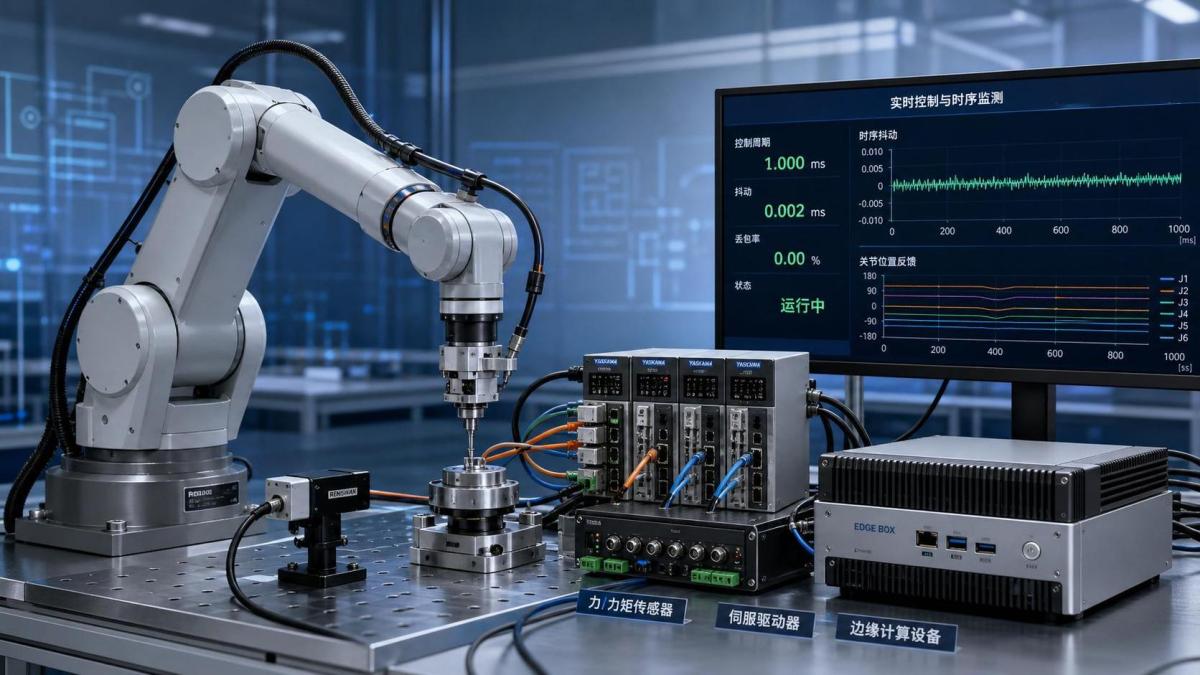
In low latency robot testing, speed alone is rarely the real issue. What matters is whether the control loop stays predictable under load, noise, and changing motion demands.
A robot can look responsive in a demo and still fail in production. That gap usually comes from hidden timing instability, weak synchronization, or poorly measured feedback delays.
For teams reviewing real-time systems, low latency robot testing should answer a narrower question. Can the platform maintain control integrity when every millisecond starts to matter?
That is where engineering discipline matters more than marketing language. As TechStat Vanguard argues, parameters do not lie, and control quality is defined by measurable timing behavior.
Why Low Latency Robot Testing Needs More Than a Response-Time Number
Many datasheets highlight a single latency figure. In practice, that number says very little unless the test path, operating state, and sampling method are clearly defined.
A robot control system includes sensors, fieldbus traffic, edge compute, controller scheduling, actuator drive response, and mechanical execution. Each stage adds delay and uncertainty.
More importantly, delays are not constant. They vary with CPU load, network congestion, interpolation settings, payload, and even logging overhead during the test itself.
This also means low latency robot testing should focus on distributions, not best-case snapshots. Average latency is useful, but worst-case timing often decides safety and control stability.
The Core Failure Pattern
Small timing errors accumulate across the loop. Sensor timestamps drift, command packets arrive late, and servo updates miss their slots. The robot then corrects too late or too aggressively.
The result can appear as path deviation, oscillation, overshoot, contact force spikes, or unstable behavior near dynamic limits. These are performance issues first, then safety issues soon after.
The First Metrics to Measure in Low Latency Robot Testing
A solid test plan starts with timing metrics that map directly to control quality. These measurements should be captured under idle, nominal, and stressed operating conditions.
- End-to-end control latency: from sensor event or command input to physical actuator response.
- Loop jitter: variation in cycle time between expected and actual control updates.
- Sensor-to-controller delay: time from measurement capture to control availability.
- Controller-to-drive delay: command generation to servo drive acceptance.
- Drive-to-motion onset delay: command acceptance to measurable motion start.
- Timestamp synchronization error: clock mismatch across devices and buses.
- Dropped or delayed packets: especially in Ethernet-based real-time networks.
These metrics form the baseline for low latency robot testing. Without them, comparisons between controllers, robots, or edge architectures are mostly anecdotal.
Use Percentiles, Not Just Means
Always record median, 95th percentile, 99th percentile, and max values. Average loop time can look clean while rare spikes still break trajectory tracking in live operation.
Jitter Is Often More Dangerous Than Raw Delay
In many systems, constant delay can be modeled and compensated. Jitter is harder. It changes the loop behavior from cycle to cycle and weakens controller predictability.
This is why experienced teams treat jitter as a primary indicator in low latency robot testing. Stable timing often matters more than a slightly lower nominal delay.
A manipulator doing precision insertion may tolerate a known 8 ms delay. The same system may fail with 4 ms average delay if cycle-to-cycle variance is uncontrolled.
What to Check
- Control cycle period variance at controller level.
- Servo update jitter at each drive.
- Network scheduling jitter during peak traffic.
- Sensor sampling jitter, especially for vision and force feedback.
When reviewing results, look for correlation. If motion error spikes track with timing variance, the root cause is usually already visible in the data.
Synchronization and Timestamp Integrity Matter More Than Many Teams Expect
Low latency robot testing can be misleading when clocks are not aligned. A fast-looking loop may simply be poorly measured because sensor, controller, and logger timestamps disagree.
This becomes critical in multi-axis robots, mobile manipulators, and vision-guided systems. If time bases drift, fusion accuracy falls even when each component seems individually healthy.
Key Synchronization Checks
- Clock offset between sensing, compute, and actuation nodes.
- Clock drift over long tests and thermal changes.
- PTP or distributed clock stability under bus traffic.
- Timestamp insertion point within each device pipeline.
A practical rule helps here. If timestamp provenance is unclear, treat every derived latency claim as provisional until verified by instrumentation.
Measure Physical Control Quality, Not Just Digital Timing
Low latency robot testing should not end at software traces. Real-time control performance is proven when timing quality translates into stable, accurate, physical motion.
That means combining timing data with trajectory, force, and servo behavior metrics. Otherwise, the test validates infrastructure, not control results.
Most Useful Motion-Level Indicators
These metrics make low latency robot testing harder to manipulate. A vendor can polish a single timing number, but coordinated motion behavior is much harder to fake.
Test Under Real Loads, Not Lab-Only Conditions
From recent deployment trends, the bigger issue is not whether a robot passes a clean bench test. It is whether it keeps timing discipline when the whole stack gets busy.
In actual operations, edge inference, vision pipelines, telemetry, safety monitoring, and network traffic often share compute and transport resources with motion control.
That is why low latency robot testing should include stressed scenarios, not just nominal runs.
Recommended Stress Conditions
- Maximum payload and aggressive acceleration profiles.
- Concurrent vision or AI workloads on the same edge system.
- Fieldbus saturation and competing Ethernet traffic.
- Extended-duration tests for thermal and drift effects.
- Safety event handling and fast stop recovery sequences.
The goal is simple. Find the point where deterministic behavior starts to erode, and quantify that boundary before deployment decisions are made.
How to Read Vendor Claims During Low Latency Robot Testing
Vendor latency claims are not automatically wrong. They are often just incomplete. The missing context usually hides the operational risk.
Ask for the measurement path, clock source, load condition, sample size, and percentile reporting. Ask whether the number reflects software acknowledgment or physical motion onset.
Also ask whether the test includes synchronized sensors, closed-loop control, and multi-axis coordination. A narrow microbenchmark does not validate full-system control quality.
A Practical Review Checklist
- Define the exact control loop boundary.
- Separate latency from jitter and synchronization error.
- Measure end-to-end behavior with hardware timestamps where possible.
- Correlate timing logs with motion and force outcomes.
- Repeat tests under realistic stress conditions.
- Report percentiles, worst case, and failure thresholds.
What Good Low Latency Robot Testing Finally Delivers
Good low latency robot testing does not produce a flashy headline number. It produces a trustworthy operating envelope for real-time control performance.
That operating envelope should show when control remains stable, when precision begins to degrade, and which subsystem causes the first meaningful timing failure.
For engineering benchmarking, that is the level that matters. It reduces trial-and-error cost, shortens qualification cycles, and replaces vague promises with measurable control truth.
When validating a robot platform, treat low latency robot testing as a systems exercise. Measure the whole loop, challenge it under stress, and trust the data that survives contact with reality.
Search News
Hot Articles
- Carbon Fiber StructuresHow to Specify Aerospace Carbon Fiber Assemblies for Lightweight, Load-Bearing PartsJul 11, 2026
- Machine VisionXiaomi, Alibaba DAMO Academy Drive Open-Source Robotics Model Ecosystem, Lowering Algorithm Development Barriers for Overseas SMEs Adopting Chinese Robotics SolutionsMar 30, 2026
- Cobots & ArmsShanxi 'AI+' Conference Showcases Embodied Intelligence with Multinational Buyer Engagement: Key Industry ImplicationsMar 30, 2026
Popular Tags
Recommended News
 Jul 11, 2026How to Specify Aerospace Carbon Fiber Assemblies for Lightweight, Load-Bearing PartsAerospace carbon fiber assemblies: learn how to specify laminate design, load data, joining methods, and inspection controls for lighter, reliable load-bearing aerospace parts.Elena Rostova (UAV Systems Researcher)
 Mar 30, 2026Xiaomi, Alibaba DAMO Academy Drive Open-Source Robotics Model Ecosystem, Lowering Algorithm Development Barriers for Overseas SMEs Adopting Chinese Robotics SolutionsXiaomi & Alibaba DAMO Academy's open-source robotics models lower algorithm barriers for global SMEs. Boost efficiency in manufacturing, logistics & smart retail with ROS 2 compatible solutions.TSV Data Lab
 Mar 30, 2026Shanxi 'AI+' Conference Showcases Embodied Intelligence with Multinational Buyer Engagement: Key Industry ImplicationsShanxi 'AI+' Conference highlights embodied intelligence with Tesla, Ubtech & Jiantao showcasing multimodal robotics. 40+ global buyers validated tech on-site, creating new B2B channels for industrial automation & AI solutions.Chen Wei (Automation Lead Engineer)
 Mar 30, 2026Zhongguancun Unveils 6G Integrated Sensing-Computing-Intelligence Platform to Empower Embodied Robots for Global Industrial ApplicationsZhongguancun's new 6G platform revolutionizes industrial robotics with <10ms latency, empowering global automotive, logistics & port automation. Discover how this tech boosts China's smart manufacturing exports.TSV Data Lab
 Mar 30, 2026Mech-Mind Tianjin Embodied Intelligence R&D and Production Base Goes Live, Cutting Delivery Time by 20%–30% for Global Customized AMR+Vision SolutionsMech-Mind's Tianjin AMR+Vision production base cuts delivery time by 20%-30% for欧美 & Latin American markets. Discover how this PLd-certified facility accelerates customized robotics solutions for smart manufacturing and logistics.Chen Wei (Automation Lead Engineer)
 Mar 30, 2026Boao Forum Reveals 'Co-evolution of Big and Small Brains' Trend in Humanoid Robots, China's Embodied Intelligence Accelerates Adaptation to Overseas Manufacturing Service ScenariosDiscover how China's humanoid robots, featuring 'Co-evolution of Big and Small Brains,' are revolutionizing global manufacturing. Learn about Embodied Tian Gong 3.0's ISO compliance and overseas deployment at Boao Forum 2026.Chen Wei (Automation Lead Engineer)
 Mar 30, 2026China Railway Industrial Secures Patent for Embodied Robotics in Material Handling, Boosting High-Precision Delivery Capabilities for Overseas Infrastructure and Manufacturing ProjectsChina Railway Industrial's new patent for embodied robotics in material handling boosts high-precision delivery for global infrastructure & manufacturing. Discover how this innovation enhances logistics accuracy in automotive, rail transit & EPC projects.Chen Wei (Automation Lead Engineer)
 Nov 19, 2026Choosing a Palletizing System for Bagged Food: Speed and Bag HandlingChoose the right palletizing system for bagged food. Compare throughput, bag handling, food safety, and robotic vs. conventional options.Chen Wei (Automation Lead Engineer)
 Nov 18, 2026Formnext 2026 Opens as Additive Manufacturing Advances Industrial ApplicationsFormnext 2026 highlights additive manufacturing innovations for industrial applications. Explore what they could mean for production, procurement and suppliers.Dr. Marcus Vance
 Nov 18, 2026Flexible Robotics Integration for High-Mix, Low-Volume ProductionFlexible robotics integration can make high-mix, low-volume production more adaptable. Explore practical ways to reduce changeover risk and plan a reliable robotic cell.Victor Lin (Chief Software Architect)
 Nov 17, 2026Formnext 2026: UK Additive Manufacturing Leads in Research but Faces Production BarriersUK additive manufacturing leads in research but faces barriers to production at scale. Explore the Formnext 2026 insights and what businesses should consider.Dr. Marcus Vance
 Nov 17, 2026Choosing Warehouse Automation Packaging Systems: Throughput and SpaceCompare warehouse automation packaging systems by throughput, footprint, and order mix. Discover how to choose a layout that meets peak demand.Victor Lin (Chief Software Architect)
 Nov 16, 2026China's October Industrial Robot Output Up 26%, 3D Printing Equipment Up 85.9%China's industrial robot output reportedly rose 26% in October, while 3D printing equipment grew 85.9%. Explore what the figures could mean for buyers.Chen Wei (Automation Lead Engineer)
 Nov 16, 2026Commercial Drones in North America: Choosing Payloads for Inspection and MappingCommercial drones North America: compare RGB, thermal and LiDAR payloads for inspection and mapping, and choose a system that delivers reliable data.Elena Rostova (UAV Systems Researcher)
 Nov 15, 2026Aerospace Materials in the UK: Choosing Metals and Composites for AircraftExplore aerospace materials UK teams use for aircraft. Compare metals and composites by weight, fatigue, manufacturing and approval needs to make informed choices.Dr. Marcus Vance
 Nov 14, 2026Ukraine Tests 3D-Printed Protective Structure Against M2 Heavy Machine-Gun FireUkraine’s 3D-printed protective structure reportedly resisted M2 heavy machine-gun fire. Explore the test’s limits and potential procurement implications.Dr. Marcus Vance
 Nov 14, 2026Rugged UAV Metrics: Assessing Wind Resistance, Endurance and IP RatingsCompare rugged UAV metrics for wind resistance, endurance and IP ratings. Learn what evidence to request and choose a platform fit for your mission.Chen Wei (Automation Lead Engineer)
 Nov 13, 2026Physical AI Gains Attention as Robot Investment Moves Beyond HardwarePhysical AI is reshaping robot investment beyond hardware. Explore what the shift toward perception and algorithms could mean for buyers and suppliers.Chen Wei (Automation Lead Engineer)
 Nov 13, 2026Precision Machining Benchmarks: A Guide to Tolerances and Surface FinishExplore this precision machining benchmarks guide to compare tolerances, surface finish, and inspection methods—and specify parts with confidence.Dr. Marcus Vance
 Nov 12, 2026Beijing Issues Three-Year Plan for Embodied AI Robotics IndustryBeijing’s embodied AI robotics plan targets leading humanoid robot makers by 2028. Explore its goals for supply chains, AI models and deployment.Chen Wei (Automation Lead Engineer)
 Nov 12, 2026Choosing an Edge AI Box for Robotics: Compute, Latency and I/OChoose the right edge AI box for robotics with practical guidance on compute, latency, sensor I/O and sustained performance. Explore the selection checklist.Chen Wei (Automation Lead Engineer)
 Nov 11, 2026Beijing Sets 200,000-Unit Annual Capacity Goal in Robotics PlanBeijing's robotics plan targets 200,000 units of annual capacity by 2027. Explore its technology goals, benchmark applications and adoption outlook.Chen Wei (Automation Lead Engineer)
 Nov 11, 2026Aero Engine Blade Machining: 5-Axis CNC Methods and ChallengesExplore aero engine blade machining, from 5-axis toolpaths to thin-wall challenges, surface integrity, and inspection. Learn what makes a process reliable.Dr. Marcus Vance
 Nov 10, 2026FAA Authorizes Skyways’ Long-Distance BVLOS Flights for Shell in Gulf of MexicoFAA authorizes Skyways’ long-distance BVLOS drone flights for Shell in the Gulf of Mexico. Discover what the decision means for offshore pipeline inspection.Elena Rostova (UAV Systems Researcher)