
How to Read Drone Motor Thrust Test Data for Propeller and ESC Selection
Publication Date
author
Selecting the right propeller and ESC is not a guessing exercise—it starts with understanding drone motor thrust test data.
For technical evaluation, the value lies beyond peak thrust, where efficiency, current draw, voltage sag, thermal behavior, and throttle response decide reliability.
This guide explains how to interpret drone motor thrust test data for motor–propeller–ESC combinations that deliver stable flight, safe electrical margins, and measurable endurance.
Reading Drone Motor Thrust Test Data Starts With the Flight Scenario
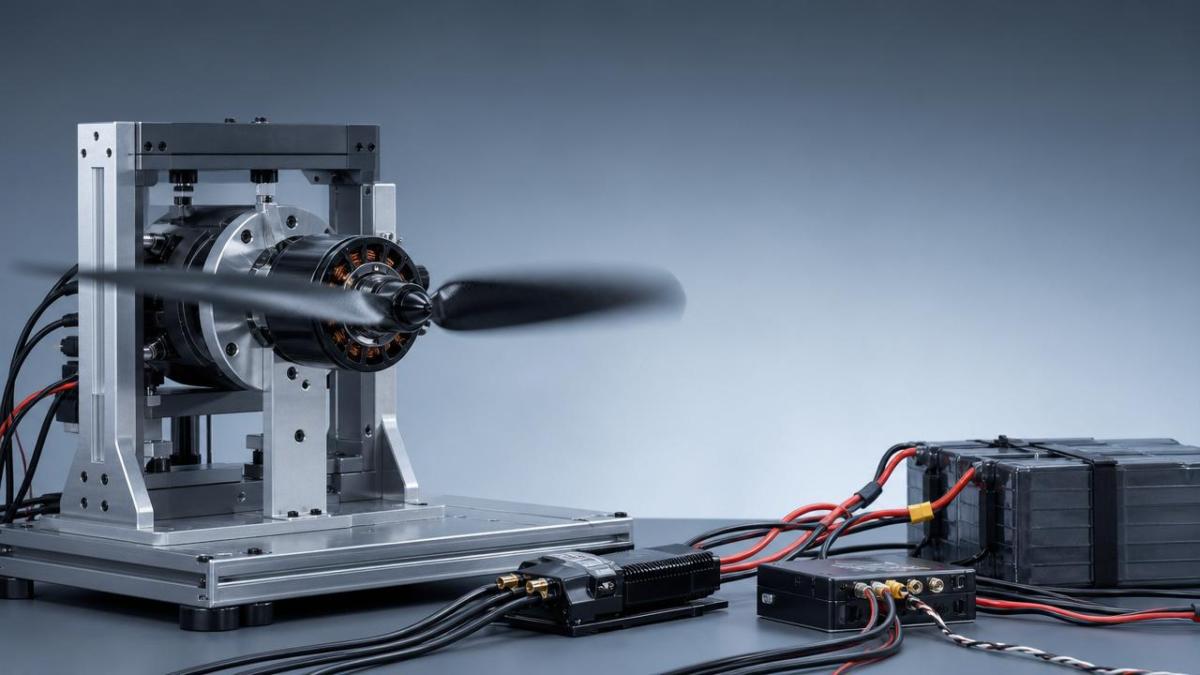
The same motor can look excellent or unsuitable depending on mission profile, airframe mass, battery voltage, and propeller diameter limits.
Drone motor thrust test data becomes useful only when linked to a real operating scenario, not an isolated bench number.
A mapping UAV needs endurance stability. A racing drone needs transient response. A lift platform needs thermal margin under sustained load.
This is why peak thrust should be treated as a boundary condition, not the primary selection target.
Engineering-first evaluation compares thrust, watts, amperage, RPM, efficiency, and temperature across the full throttle curve.
Scenario Background: Why One Test Curve Cannot Fit Every UAV
Drone motor thrust test data usually comes from a thrust stand using a fixed motor, propeller, ESC, and power source.
The bench captures controlled values, but aircraft behavior adds vibration, airflow disturbance, battery aging, and structural drag.
A clean result at 25°C may degrade during hot-field agricultural spraying or slow hovering with limited propeller airflow.
Therefore, drone motor thrust test data should be interpreted with environmental derating and mission duty cycle in mind.
Useful data includes voltage, current, thrust, RPM, electrical power, thrust-to-watt ratio, ESC temperature, and motor temperature.
If a chart reports only maximum thrust, it is insufficient for propeller and ESC selection.
Scenario 1: Endurance Mapping Requires Mid-Throttle Efficiency
Mapping and inspection drones spend most flight time near hover or steady cruise, not full throttle.
In this scenario, drone motor thrust test data should be read around 40% to 70% throttle.
The key metric is grams per watt, because every wasted watt shortens area coverage and survey duration.
A propeller that gives higher peak thrust may be worse if efficiency collapses in the normal cruise band.
Look for smooth current increase, stable RPM progression, and minimal voltage sag near expected takeoff weight.
For endurance missions, the best drone motor thrust test data often shows moderate peak power but excellent mid-band efficiency.
Scenario 2: Heavy-Lift Platforms Need Sustained Thermal Margin
Heavy-lift UAVs demand more than momentary thrust. Payload stability depends on sustained output without overheating.
In this case, drone motor thrust test data must include temperature rise over time, not only short burst measurements.
Check whether the motor can hold required thrust for the expected climb, hover, and maneuver duration.
ESC selection should include continuous current rating, burst rating, cooling conditions, and firmware current limiting behavior.
A safe design keeps operating current below continuous ESC capacity with margin for hot weather and battery voltage drop.
If drone motor thrust test data shows temperature climbing rapidly near mission thrust, choose a larger propeller, motor, or ESC.
Scenario 3: Racing and Agile UAVs Depend on Response Curves
Agile drones need rapid throttle response, fast RPM recovery, and predictable torque under sharp command changes.
For these platforms, drone motor thrust test data should be evaluated alongside dynamic response and not just static thrust.
Smaller propellers may produce less peak thrust but accelerate faster, improving control authority during aggressive flight.
Large propellers can overload the ESC during rapid throttle spikes, especially on high-voltage battery configurations.
Review amperage at high throttle and look for nonlinear jumps that suggest excessive propeller loading.
Good drone motor thrust test data for agile designs shows responsive thrust growth without extreme current penalties.
Scenario 4: Agricultural and Industrial UAVs Require Electrical Robustness
Agricultural spraying, security patrol, and industrial logistics often expose propulsion systems to dust, heat, moisture, and long duty cycles.
In these conditions, drone motor thrust test data should be interpreted conservatively with operational derating.
A motor running near its limit on a test bench may become unstable after filter contamination or reduced cooling.
The ESC should be selected for continuous reliability, not the smallest rating that survives a short test.
Focus on current draw at mission thrust, thermal headroom, connector rating, wire gauge, and battery discharge capability.
Drone motor thrust test data helps identify whether the propulsion chain remains stable under realistic electrical stress.
Key Differences Across Propeller and ESC Selection Scenarios
This comparison shows why drone motor thrust test data must be filtered through mission requirements before selecting components.
How to Read the Numbers Without Being Misled
1. Start With Required Thrust per Motor
Estimate all-up weight, then divide required lift across available motors with a safety factor.
Many multirotors target at least 2:1 thrust-to-weight for stable control, though mission demands vary.
Use drone motor thrust test data to find the throttle point where required thrust is produced efficiently.
2. Compare Efficiency at Mission Thrust
Do not compare propellers only at maximum output. Compare grams per watt at actual hover and cruise thrust.
A high-efficiency propeller reduces battery stress and improves flight endurance.
Reliable drone motor thrust test data should reveal where efficiency peaks and where it declines.
3. Check Current Draw Against ESC Ratings
ESC choice must match continuous current, burst current, voltage rating, cooling, and firmware behavior.
If test current reaches 38 A, a 40 A ESC may be inadequate for continuous hot-field operation.
Drone motor thrust test data should be used with derating, not as a perfect laboratory guarantee.
4. Interpret Voltage Sag Carefully
Voltage sag reduces available power and can distort thrust expectations during real flight.
A strong result on a laboratory supply may not repeat with an aging battery pack.
When reading drone motor thrust test data, confirm whether voltage was measured at the battery, ESC, or test instrument.
Scenario-Based Propeller Selection Advice
- Choose larger, slower propellers when endurance and hover efficiency are more important than rapid response.
- Choose smaller, faster propellers when agility, acceleration, and prop clearance are critical.
- Avoid propellers that create sharp current jumps near normal operating throttle.
- Use drone motor thrust test data to verify propeller load against motor temperature limits.
- Compare multiple propellers at the same voltage, test environment, and measurement method.
Propeller choice changes the entire electrical profile, so every propeller swap should be validated against thrust and current curves.
Scenario-Based ESC Selection Advice
- Select ESC voltage rating above the battery configuration, including fully charged voltage.
- Keep continuous operating current below ESC continuous rating with meaningful thermal margin.
- Check burst current only for short transients, not sustained climb or payload hover.
- Review cooling assumptions, because bench airflow may differ from enclosed aircraft layouts.
- Use drone motor thrust test data to identify current spikes during high-throttle regions.
An undersized ESC may pass a short static test but fail during repeated climbs or hot ambient operation.
Common Misreadings That Lead to Poor Component Choices
The first mistake is selecting the combination with the highest peak thrust without considering efficiency.
Peak thrust is useful for emergency margin, but it rarely represents normal flight behavior.
The second mistake is ignoring temperature. Current draw alone does not show whether copper, magnets, or ESC components are overheating.
The third mistake is comparing drone motor thrust test data from different benches without checking methodology.
Sensor calibration, propeller condition, airflow direction, altitude, and ambient temperature can change results significantly.
The fourth mistake is overlooking battery discharge limits. A suitable motor and ESC still fail if the battery cannot supply current safely.
A Practical Evaluation Workflow for Reliable Selection
- Define mission weight, flight duration, climb demand, and environmental conditions.
- Calculate required thrust per motor with a realistic safety factor.
- Compare drone motor thrust test data at expected hover and cruise thrust.
- Identify propellers that deliver efficiency without excessive current draw.
- Select ESC capacity using continuous current, voltage rating, cooling, and derating.
- Validate the selected combination with onboard logging during controlled flight tests.
This workflow turns drone motor thrust test data into engineering evidence, not a marketing comparison chart.
What High-Quality Test Data Should Include
A credible thrust report should identify motor model, propeller size, propeller pitch, ESC model, battery voltage, and test conditions.
It should include throttle percentage, thrust, RPM, voltage, current, watts, efficiency, and temperature where possible.
Drone motor thrust test data is strongest when repeated runs show consistency and measurement uncertainty is disclosed.
For advanced evaluation, compare static bench data with flight logs covering motor output, battery sag, and ESC temperature.
The best decisions come from correlating controlled tests with real mission telemetry.
Action Guide: Turn Test Curves Into Procurement-Ready Specifications
Start by writing the required thrust, operating current, acceptable temperature range, voltage platform, and endurance target into a specification sheet.
Then request drone motor thrust test data for shortlisted motor, propeller, and ESC combinations under comparable test conditions.
Reject results that hide current draw, omit voltage, or report only maximum thrust without efficiency data.
For final validation, run a controlled ground test, followed by a limited flight envelope test with onboard logging.
TechStat Vanguard’s engineering-first principle is simple: parameters do not lie, and tolerances dictate success.
When drone motor thrust test data is read by scenario, it becomes a reliable foundation for propeller choice, ESC sizing, and flight performance confidence.
Search News
Hot Articles
- Carbon Fiber StructuresHow to Specify Aerospace Carbon Fiber Assemblies for Lightweight, Load-Bearing PartsJul 11, 2026
- Machine VisionXiaomi, Alibaba DAMO Academy Drive Open-Source Robotics Model Ecosystem, Lowering Algorithm Development Barriers for Overseas SMEs Adopting Chinese Robotics SolutionsMar 30, 2026
- Cobots & ArmsShanxi 'AI+' Conference Showcases Embodied Intelligence with Multinational Buyer Engagement: Key Industry ImplicationsMar 30, 2026
Popular Tags
Recommended News
 Jul 11, 2026How to Specify Aerospace Carbon Fiber Assemblies for Lightweight, Load-Bearing PartsAerospace carbon fiber assemblies: learn how to specify laminate design, load data, joining methods, and inspection controls for lighter, reliable load-bearing aerospace parts.Elena Rostova (UAV Systems Researcher)
 Mar 30, 2026Xiaomi, Alibaba DAMO Academy Drive Open-Source Robotics Model Ecosystem, Lowering Algorithm Development Barriers for Overseas SMEs Adopting Chinese Robotics SolutionsXiaomi & Alibaba DAMO Academy's open-source robotics models lower algorithm barriers for global SMEs. Boost efficiency in manufacturing, logistics & smart retail with ROS 2 compatible solutions.TSV Data Lab
 Mar 30, 2026Shanxi 'AI+' Conference Showcases Embodied Intelligence with Multinational Buyer Engagement: Key Industry ImplicationsShanxi 'AI+' Conference highlights embodied intelligence with Tesla, Ubtech & Jiantao showcasing multimodal robotics. 40+ global buyers validated tech on-site, creating new B2B channels for industrial automation & AI solutions.Chen Wei (Automation Lead Engineer)
 Mar 30, 2026Zhongguancun Unveils 6G Integrated Sensing-Computing-Intelligence Platform to Empower Embodied Robots for Global Industrial ApplicationsZhongguancun's new 6G platform revolutionizes industrial robotics with <10ms latency, empowering global automotive, logistics & port automation. Discover how this tech boosts China's smart manufacturing exports.TSV Data Lab
 Mar 30, 2026Mech-Mind Tianjin Embodied Intelligence R&D and Production Base Goes Live, Cutting Delivery Time by 20%–30% for Global Customized AMR+Vision SolutionsMech-Mind's Tianjin AMR+Vision production base cuts delivery time by 20%-30% for欧美 & Latin American markets. Discover how this PLd-certified facility accelerates customized robotics solutions for smart manufacturing and logistics.Chen Wei (Automation Lead Engineer)
 Mar 30, 2026Boao Forum Reveals 'Co-evolution of Big and Small Brains' Trend in Humanoid Robots, China's Embodied Intelligence Accelerates Adaptation to Overseas Manufacturing Service ScenariosDiscover how China's humanoid robots, featuring 'Co-evolution of Big and Small Brains,' are revolutionizing global manufacturing. Learn about Embodied Tian Gong 3.0's ISO compliance and overseas deployment at Boao Forum 2026.Chen Wei (Automation Lead Engineer)
 Mar 30, 2026China Railway Industrial Secures Patent for Embodied Robotics in Material Handling, Boosting High-Precision Delivery Capabilities for Overseas Infrastructure and Manufacturing ProjectsChina Railway Industrial's new patent for embodied robotics in material handling boosts high-precision delivery for global infrastructure & manufacturing. Discover how this innovation enhances logistics accuracy in automotive, rail transit & EPC projects.Chen Wei (Automation Lead Engineer)
 Oct 16, 2026Choosing a Rugged Edge AI Box Supplier: Thermal Tests and Lifecycle SupportChoose a rugged edge AI box supplier with proven thermal performance and reliable lifecycle support. Discover the tests and commitments to verify before you buy.TSV Data Lab
 Oct 15, 2026R&D Cost Reduction Services: How to Evaluate Fees, Savings, and ROIEvaluate R&D cost reduction services with confidence. Compare fees, verify savings, and calculate ROI without compromising performance. Discover how to choose a provider that delivers real value.Chen Wei (Automation Lead Engineer)
 Oct 15, 2026How Should You Compare TechStat Vanguard 5-Axis CNC Tolerances?TechStat Vanguard 5-axis CNC tolerance comparison: learn how to verify part accuracy, assess inspection evidence, and choose suppliers that reliably meet your drawing requirements.Dr. Marcus Vance
 Oct 14, 2026Drone Frame Composites: Carbon Fiber vs. Fiberglass for Weight and StiffnessExplore drone structural materials composites: compare carbon fiber and fiberglass for weight, stiffness, cost, and antenna compatibility. Find the right material for your drone frame.Elena Rostova (UAV Systems Researcher)
 Oct 13, 2026Smart Cameras vs. PC-Based Machine Vision: Which Fits High-Speed Inspection?This industrial product comparison for machine vision weighs smart cameras vs. PC-based systems on latency, throughput, and cost. Discover your best fit for high-speed inspection.TSV Data Lab
 Oct 12, 2026How to Verify RoHS Compliance in Industrial Sensing Systems Before DeploymentRoHS compliant sensing systems: learn how to verify materials, supplier declarations, testing, and configuration controls before industrial deployment.TSV Data Lab
 Oct 11, 2026How Procurement-Oriented Content Taxonomy Improves B2B Buying JourneysProcurement-oriented content taxonomy streamlines B2B buying journeys with clearer evidence, supplier comparisons, risk visibility, and faster approvals.TSV Data Lab
 Oct 10, 2026How to Select a Machine Performance Monitoring Platform for OEE and Downtime ReductionMachine performance monitoring platform selection guide: validate machine states, OEE data, downtime reasons, integrations, and scalability to reduce losses with confidence.TSV Data Lab
 Oct 08, 2026How to Machine Inconel 625 Blades Without Heat Cracks or Edge ChippingInconel 625 blade machining guide: prevent heat cracks, edge chipping, chatter, and work hardening with proven tooling, cooling, fixturing, and inspection strategies.Dr. Marcus Vance
 Oct 07, 2026How to Evaluate an HMI Panel Distributor for Industrial Automation ProjectsHMI panel distributor evaluation guide: verify technical compatibility, traceability, supply reliability, lifecycle support, and total cost for automation projects.Victor Lin (Chief Software Architect)
 Oct 06, 2026Navigation Fault Tolerance Standards for AMRs: What Safety Teams Must VerifyNavigation fault tolerance standards: learn what AMR safety teams must verify, from localization loss and sensor faults to stopping distance, safe restart, and site-specific validation.Chen Wei (Automation Lead Engineer)
 Oct 05, 2026Calculating Edge Computing Total Cost of Ownership Across Distributed SitesEdge computing ownership cost explained: calculate deployment, energy, connectivity, security, remote support, and refresh costs across distributed sites.TSV Data Lab
 Oct 04, 2026CAD/CAM Benchmarking in the GCC: What Manufacturers Should Ask a ConsultantCAD CAM benchmark consultant GCC guide: learn the key questions manufacturers should ask to validate post-processors, workflows, machine performance, and production risk.Victor Lin (Chief Software Architect)
 Oct 03, 2026Selecting Automotive Radar Sensor Modules for ADAS Range, Resolution, and IntegrationAutomotive radar sensor module selection guide for ADAS: compare range, resolution, field of view, latency, and integration to build safer, reliable vehicle systems.TSV Data Lab
 Oct 02, 2026How to Qualify Machined Parts Suppliers for Hard Tech ProgramsHard tech supply chain machined parts demand rigorous supplier qualification. Learn how to assess capability, traceability, quality controls, and delivery resilience.Dr. Marcus Vance
 Oct 01, 2026How to Select an Outdoor Security Radar Sensor for Perimeter Detection?Outdoor security radar sensor selection guide: compare range, accuracy, false-alarm control, integration, and field testing for reliable perimeter detection.TSV Data Lab
 Sep 30, 2026How to Evaluate Solid-State LiDAR Hardware for Outdoor Autonomous VehiclesSolid state LiDAR hardware evaluation guide for outdoor autonomous vehicles—compare range, point-cloud quality, environmental resilience, integration, and safety.TSV Data Lab























