
Why Electronics Assembly Needs More Than a Small Robotic Arm
Publication Date
author
Why does electronics assembly demand more than a small robotic arm? The short answer is that electronics manufacturing is rarely limited by pick-and-place motion alone. In modern production, success depends on a complete automation architecture: a robotic arm for electronics assembly, tightly controlled servo drive response time, machine vision, tooling, software traceability, and seamless AGV integration with ERP WMS. For buyers, engineers, operators, and executives, the real issue is not whether a robot can move parts, but whether the entire system can deliver repeatable quality, scalable throughput, and factory-wide coordination without creating new bottlenecks.
That is why many electronics projects underperform after automation investment. A compact robot may look efficient in demos, but real-world assembly involves ESD control, micron-level placement consistency, feeder stability, test data capture, MES connectivity, changeover efficiency, and upstream-downstream material flow. If those layers are missing, even a capable robotic arm becomes an isolated device rather than a productive manufacturing asset.
Why a Small Robotic Arm Alone Is Not Enough in Electronics Assembly
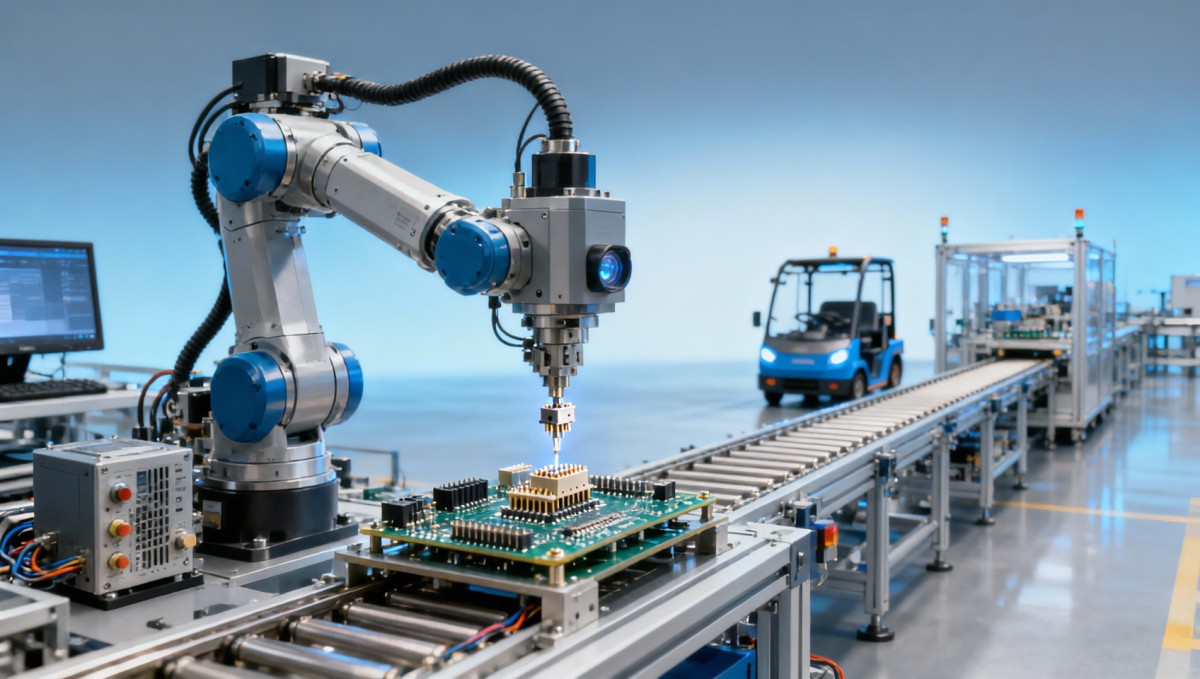
Electronics assembly is a system problem, not a single-machine problem. A small robotic arm can handle specific tasks such as component transfer, screwdriving, dispensing, or simple board handling. But once production moves beyond a lab cell or pilot station, manufacturers quickly face constraints that a standalone arm cannot solve.
The most common limitations include:
- Positioning consistency under real takt time: Reaching a point is not the same as reaching it repeatedly at production speed.
- Servo drive response time and motion stability: In electronics, small delays or vibration can affect placement accuracy, cycle time, and defect rates.
- Vision-guided correction: Tiny connectors, flexible cables, reflective surfaces, and tolerance stack-up require inspection and adaptive alignment.
- Traceability requirements: Many buyers need serialized production data, process logs, and test records linked to batches or units.
- Material flow: If boards, trays, reels, and finished units are not delivered and removed on time, the robot waits idle.
- Line integration: The robot must work with conveyors, fixtures, test equipment, MES, ERP, and warehouse systems.
In other words, a robotic arm for electronics assembly is only one actuator inside a larger automation framework. The real value comes from how well that arm is integrated into process control, quality assurance, and digital operations.
What Buyers and Engineers Should Evaluate Before Choosing an Automation Solution
For procurement teams and technical evaluators, the key question is not “How many axes does the robot have?” but “What production risk does this solution remove?” A useful evaluation starts with the process itself.
1. Define the actual assembly task.
Electronics production may involve PCB handling, connector insertion, micro-screw fastening, adhesive dispensing, soldering assistance, testing, labeling, or packaging. Each task has different force control, vision, ESD, and cycle-time requirements. A robot that is ideal for tray transfer may be unsuitable for delicate press-fit insertion.
2. Check repeatability in production conditions, not marketing conditions.
Ask for repeatability data under payload, acceleration, temperature variation, and real cycle profiles. Demo-room precision does not always reflect factory performance. In electronics, tiny deviations can become scrap, rework, or latent reliability issues.
3. Evaluate servo drive response time as a production parameter.
Fast and stable servo response matters when handling fragile components, stopping precisely at inspection points, or coordinating multi-step motion. Poor response can create overshoot, vibration, inconsistent contact pressure, and reduced takt consistency. For high-mix electronics lines, servo behavior affects both product quality and changeover repeatability.
4. Verify software and data connectivity.
If the system cannot exchange data with MES, ERP, or WMS platforms, then traceability and planning remain manual. That increases error risk and limits management visibility. Integration is not a feature add-on; it is central to scaling electronics operations.
5. Assess maintenance and recovery logic.
Operators should be able to recover from part jams, vision exceptions, feeder misalignment, and interrupted cycles quickly. A technically advanced cell that only specialists can reset may become a hidden operational burden.
Why Factory-Wide Coordination Matters More Than Robot Size
Many automation decisions fail because teams optimize the robot cell instead of the factory flow. In electronics assembly, throughput depends on synchronized movement of materials, information, and quality data across multiple stations.
This is where AGV integration with ERP WMS becomes highly relevant. Automated guided vehicles or AMRs can transport reels, trays, subassemblies, and finished products between storage, kitting, assembly, testing, and packing zones. But their value is highest when they are connected to planning and warehouse systems rather than operating as standalone movers.
When AGV integration with ERP WMS is properly implemented, manufacturers gain:
- More reliable material availability: assembly cells receive the right materials at the right time
- Reduced operator walking and non-value-added handling
- Better inventory accuracy: movement is linked to digital transactions
- Lower line starvation risk: transport becomes part of scheduling logic
- Improved traceability: materials, batches, and work orders stay digitally connected
For decision-makers, this changes the automation business case. The return is not only faster motion at one station, but fewer stoppages, better labor allocation, and more predictable output across the plant.
What a Complete Smart Factory Automation Solution Looks Like
A practical smart factory automation solution for electronics assembly usually combines several layers working together:
- Robotic arm for electronics assembly: handles precise repetitive motion
- Servo system: ensures accurate and responsive movement control
- Vision and sensing: verifies orientation, presence, position, and process quality
- End-of-arm tooling and fixtures: matched to ESD, force, and tolerance needs
- Conveyance or mobile intralogistics: supports station-to-station flow
- MES/ERP/WMS connectivity: supports planning, traceability, and material control
- Inspection and test integration: closes the loop between assembly and quality
- Operator interface and recovery workflows: keeps uptime practical on the shop floor
This broader view is especially important for high-mix, low-to-medium volume electronics production, where flexibility matters as much as speed. In such environments, automation should reduce changeover pain and improve process control, not just replace one manual motion.
Common Mistakes That Lead to Poor ROI in Electronics Automation
Companies often overfocus on hardware cost and underfocus on system fit. The result is disappointing ROI, even when the robot itself performs as specified.
Typical mistakes include:
- Buying based on arm size or price alone without mapping the full process
- Ignoring upstream and downstream bottlenecks, such as feeding, unloading, inspection, or rework flow
- Underestimating integration complexity with MES, ERP, WMS, testers, and legacy equipment
- Skipping traceability design until customer or compliance demands force retrofits
- Not validating servo drive response time for real assembly dynamics
- Assuming operators can adapt without proper HMI and exception handling design
For enterprise decision-makers, these mistakes increase qualification cycles, hidden engineering costs, and deployment delays. For operators and engineers, they create unstable production and frequent manual intervention. The lesson is clear: the automation cell must be evaluated as part of the plant system.
How to Decide Whether a Solution Is Truly Fit for Your Electronics Line
A useful decision framework is to judge the solution against five practical questions:
- Can it meet process accuracy and quality targets under real takt time?
- Can it capture and share the production data needed for traceability and management?
- Can it scale from one station to multiple lines without creating software or logistics fragmentation?
- Can operators run, recover, and maintain it without constant engineering support?
- Can it integrate material movement, including AGV integration with ERP WMS, so the robot does not wait for parts?
If the answer to any of these is weak, then the automation investment may solve a local motion problem while leaving the larger production constraints untouched.
That is why mature manufacturers increasingly prefer integrated smart factory automation solutions over isolated robot purchases. They are not simply buying motion; they are buying control, visibility, consistency, and production resilience.
Conclusion
Electronics assembly needs more than a small robotic arm because electronics manufacturing is defined by precision, coordination, and traceability. A robotic arm for electronics assembly can be valuable, but only when supported by the right servo drive response time, vision, tooling, software integration, and factory logistics. In real production, the winner is not the smallest robot or the cheapest cell. It is the automation system that can maintain quality, support scalable throughput, connect with MES and business systems, and work reliably across the full manufacturing workflow.
For buyers, engineers, operators, and executives, the best decision is to evaluate electronics automation as a complete operating system for production. Once that perspective is clear, it becomes obvious why a small robotic arm alone is rarely enough.
Search News
Hot Articles
- Carbon Fiber StructuresHow to Specify Aerospace Carbon Fiber Assemblies for Lightweight, Load-Bearing PartsJul 11, 2026
- Machine VisionXiaomi, Alibaba DAMO Academy Drive Open-Source Robotics Model Ecosystem, Lowering Algorithm Development Barriers for Overseas SMEs Adopting Chinese Robotics SolutionsMar 30, 2026
- Cobots & ArmsShanxi 'AI+' Conference Showcases Embodied Intelligence with Multinational Buyer Engagement: Key Industry ImplicationsMar 30, 2026
Popular Tags
Recommended News
 Jul 11, 2026How to Specify Aerospace Carbon Fiber Assemblies for Lightweight, Load-Bearing PartsAerospace carbon fiber assemblies: learn how to specify laminate design, load data, joining methods, and inspection controls for lighter, reliable load-bearing aerospace parts.Elena Rostova (UAV Systems Researcher)
 Mar 30, 2026Xiaomi, Alibaba DAMO Academy Drive Open-Source Robotics Model Ecosystem, Lowering Algorithm Development Barriers for Overseas SMEs Adopting Chinese Robotics SolutionsXiaomi & Alibaba DAMO Academy's open-source robotics models lower algorithm barriers for global SMEs. Boost efficiency in manufacturing, logistics & smart retail with ROS 2 compatible solutions.TSV Data Lab
 Mar 30, 2026Shanxi 'AI+' Conference Showcases Embodied Intelligence with Multinational Buyer Engagement: Key Industry ImplicationsShanxi 'AI+' Conference highlights embodied intelligence with Tesla, Ubtech & Jiantao showcasing multimodal robotics. 40+ global buyers validated tech on-site, creating new B2B channels for industrial automation & AI solutions.Chen Wei (Automation Lead Engineer)
 Mar 30, 2026Zhongguancun Unveils 6G Integrated Sensing-Computing-Intelligence Platform to Empower Embodied Robots for Global Industrial ApplicationsZhongguancun's new 6G platform revolutionizes industrial robotics with <10ms latency, empowering global automotive, logistics & port automation. Discover how this tech boosts China's smart manufacturing exports.TSV Data Lab
 Mar 30, 2026Mech-Mind Tianjin Embodied Intelligence R&D and Production Base Goes Live, Cutting Delivery Time by 20%–30% for Global Customized AMR+Vision SolutionsMech-Mind's Tianjin AMR+Vision production base cuts delivery time by 20%-30% for欧美 & Latin American markets. Discover how this PLd-certified facility accelerates customized robotics solutions for smart manufacturing and logistics.Chen Wei (Automation Lead Engineer)
 Mar 30, 2026Boao Forum Reveals 'Co-evolution of Big and Small Brains' Trend in Humanoid Robots, China's Embodied Intelligence Accelerates Adaptation to Overseas Manufacturing Service ScenariosDiscover how China's humanoid robots, featuring 'Co-evolution of Big and Small Brains,' are revolutionizing global manufacturing. Learn about Embodied Tian Gong 3.0's ISO compliance and overseas deployment at Boao Forum 2026.Chen Wei (Automation Lead Engineer)
 Mar 30, 2026China Railway Industrial Secures Patent for Embodied Robotics in Material Handling, Boosting High-Precision Delivery Capabilities for Overseas Infrastructure and Manufacturing ProjectsChina Railway Industrial's new patent for embodied robotics in material handling boosts high-precision delivery for global infrastructure & manufacturing. Discover how this innovation enhances logistics accuracy in automotive, rail transit & EPC projects.Chen Wei (Automation Lead Engineer)
 Oct 15, 2026R&D Cost Reduction Services: How to Evaluate Fees, Savings, and ROIEvaluate R&D cost reduction services with confidence. Compare fees, verify savings, and calculate ROI without compromising performance. Discover how to choose a provider that delivers real value.Chen Wei (Automation Lead Engineer)
 Oct 14, 2026Drone Frame Composites: Carbon Fiber vs. Fiberglass for Weight and StiffnessExplore drone structural materials composites: compare carbon fiber and fiberglass for weight, stiffness, cost, and antenna compatibility. Find the right material for your drone frame.Elena Rostova (UAV Systems Researcher)
 Oct 13, 2026Smart Cameras vs. PC-Based Machine Vision: Which Fits High-Speed Inspection?This industrial product comparison for machine vision weighs smart cameras vs. PC-based systems on latency, throughput, and cost. Discover your best fit for high-speed inspection.TSV Data Lab
 Oct 12, 2026How to Verify RoHS Compliance in Industrial Sensing Systems Before DeploymentRoHS compliant sensing systems: learn how to verify materials, supplier declarations, testing, and configuration controls before industrial deployment.TSV Data Lab
 Oct 11, 2026How Procurement-Oriented Content Taxonomy Improves B2B Buying JourneysProcurement-oriented content taxonomy streamlines B2B buying journeys with clearer evidence, supplier comparisons, risk visibility, and faster approvals.TSV Data Lab
 Oct 10, 2026How to Select a Machine Performance Monitoring Platform for OEE and Downtime ReductionMachine performance monitoring platform selection guide: validate machine states, OEE data, downtime reasons, integrations, and scalability to reduce losses with confidence.TSV Data Lab
 Oct 08, 2026How to Machine Inconel 625 Blades Without Heat Cracks or Edge ChippingInconel 625 blade machining guide: prevent heat cracks, edge chipping, chatter, and work hardening with proven tooling, cooling, fixturing, and inspection strategies.Dr. Marcus Vance
 Oct 07, 2026How to Evaluate an HMI Panel Distributor for Industrial Automation ProjectsHMI panel distributor evaluation guide: verify technical compatibility, traceability, supply reliability, lifecycle support, and total cost for automation projects.Victor Lin (Chief Software Architect)
 Oct 06, 2026Navigation Fault Tolerance Standards for AMRs: What Safety Teams Must VerifyNavigation fault tolerance standards: learn what AMR safety teams must verify, from localization loss and sensor faults to stopping distance, safe restart, and site-specific validation.Chen Wei (Automation Lead Engineer)
 Oct 05, 2026Calculating Edge Computing Total Cost of Ownership Across Distributed SitesEdge computing ownership cost explained: calculate deployment, energy, connectivity, security, remote support, and refresh costs across distributed sites.TSV Data Lab
 Oct 04, 2026CAD/CAM Benchmarking in the GCC: What Manufacturers Should Ask a ConsultantCAD CAM benchmark consultant GCC guide: learn the key questions manufacturers should ask to validate post-processors, workflows, machine performance, and production risk.Victor Lin (Chief Software Architect)
 Oct 03, 2026Selecting Automotive Radar Sensor Modules for ADAS Range, Resolution, and IntegrationAutomotive radar sensor module selection guide for ADAS: compare range, resolution, field of view, latency, and integration to build safer, reliable vehicle systems.TSV Data Lab
 Oct 02, 2026How to Qualify Machined Parts Suppliers for Hard Tech ProgramsHard tech supply chain machined parts demand rigorous supplier qualification. Learn how to assess capability, traceability, quality controls, and delivery resilience.Dr. Marcus Vance
 Oct 01, 2026How to Select an Outdoor Security Radar Sensor for Perimeter Detection?Outdoor security radar sensor selection guide: compare range, accuracy, false-alarm control, integration, and field testing for reliable perimeter detection.TSV Data Lab
 Sep 30, 2026How to Evaluate Solid-State LiDAR Hardware for Outdoor Autonomous VehiclesSolid state LiDAR hardware evaluation guide for outdoor autonomous vehicles—compare range, point-cloud quality, environmental resilience, integration, and safety.TSV Data Lab
 Sep 29, 2026ISO 9283 Repeatability: How to Evaluate Cobot Positioning PerformanceISO 9283 cobot repeatability explained: learn how payload, reach, approach direction, and test conditions affect positioning performance and cell capability.Chen Wei (Automation Lead Engineer)
 Oct 14, 2026How tight can micro machining aerospace tolerances be in production?Micro machining aerospace tolerances can reach low-micron levels in production. Learn what controls repeatability, inspection confidence, and flight-critical quality.Dr. Marcus Vance























