What payload capacity really changes in collaborative robots
Publication Date
author
In technical evaluation, collaborative robots payload capacity is far more than a lifting number—it directly influences cycle stability, end-effector selection, reach performance, safety margins, and long-term ROI. For engineering and sourcing teams comparing cobot platforms, understanding what payload really changes helps separate usable specifications from marketing shorthand and supports better decisions in automation planning, benchmarking, and supplier qualification.
For technical evaluators, the fastest way to assess collaborative robots payload capacity is not to start with brochures or headline specifications. It is to work through a checklist: what mass is truly moving, where that mass sits relative to the flange, how speed changes under load, what safety derating applies, and how the robot behaves over long duty cycles. This checklist approach matters because two cobots with the same nominal payload may deliver very different usable performance once tooling, cable routing, acceleration, and reach are included.
At TechStat Vanguard, we treat payload as an engineering variable, not a marketing badge. In real deployments, collaborative robots payload capacity changes the available process window. It affects whether a screwdriving cell remains repeatable after thousands of cycles, whether a machine-tending arm can hold tolerance at full extension, and whether a palletizing application keeps throughput without nuisance faults. The practical question is simple: how much of the rated payload remains usable in your actual application envelope?
Why technical teams should judge payload through a checklist, not a headline number
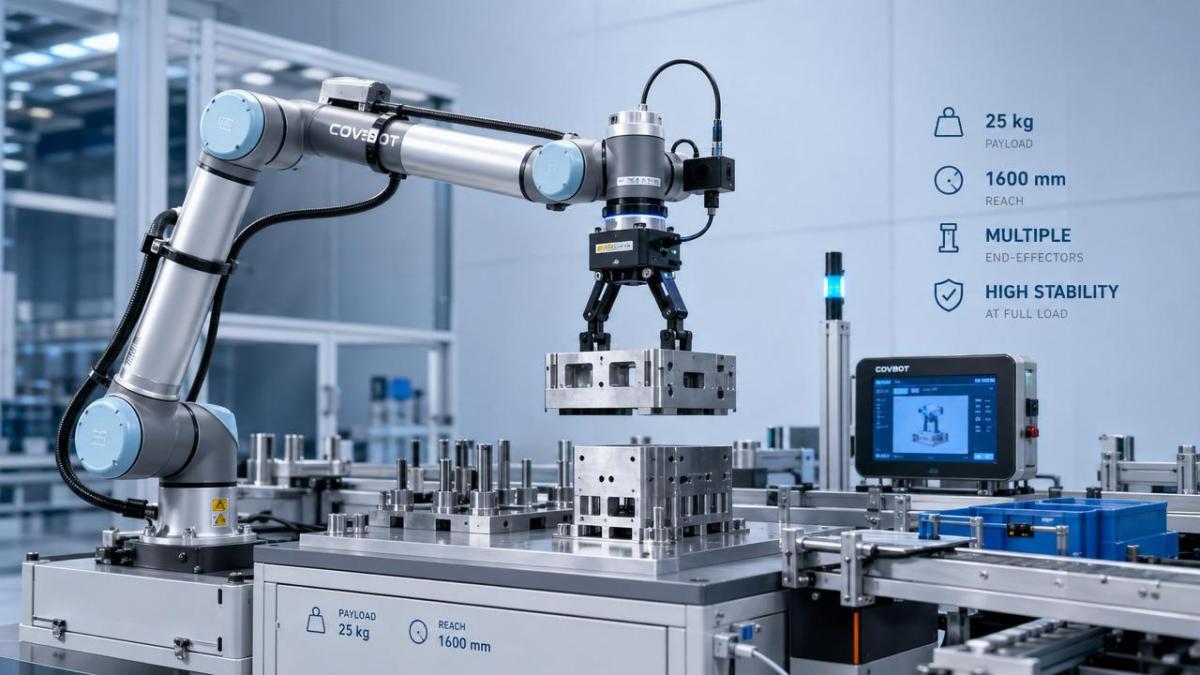
A nominal payload rating is usually measured under defined conditions. Those conditions may not match your end-effector mass, center of gravity, speed target, mounting orientation, or ambient duty profile. That is why collaborative robots payload capacity should always be evaluated together with torque limits, wrist loading, moment capacity, and dynamic behavior. A 10 kg rating does not automatically mean 10 kg of useful part mass at full reach with a vacuum gripper, dress pack, and aggressive cycle time.
- Payload changes motion planning because higher moving mass often forces lower acceleration, softer path transitions, or reduced top speed.
- Payload changes tool selection because grippers, force sensors, tool changers, and brackets consume part of the rated load budget.
- Payload changes reach usability because the same mass produces very different joint torque at short reach versus extended reach.
- Payload changes safety strategy because collaborative operating modes may derate speed or force under heavier loads.
- Payload changes lifecycle economics because motors, reducers, and brakes experience different stress profiles under continuous high-load use.
For sourcing and benchmarking, this means the payload number only becomes meaningful after conversion into application-specific usable payload. That distinction is where many comparisons fail.
Core checklist: what to confirm first when evaluating collaborative robots payload capacity
1. Separate nominal payload from usable payload
Start by subtracting everything mounted on the flange except the workpiece alone. Include the gripper, adapter plate, tool changer, sensors, air fittings, vacuum manifold, and cable strain relief. Then check whether the vendor payload rating already assumes a specified center of gravity. In many cells, the real usable part mass is 20% to 40% below the advertised figure.
2. Verify center of gravity and moment limits
Collaborative robots payload capacity is not only about kilograms. A light but long tool can exceed wrist moment before it exceeds mass. Ask for the maximum allowable center-of-gravity offset and wrist moment around each axis. If a tool extends far from the flange, joint loading rises sharply and repeatability often degrades before alarms appear.
3. Check performance at full reach, not just near the base
Payload and reach are coupled. A cobot may carry a rated load close to the base but require speed reduction or trajectory constraints near maximum extension. For machine tending, packaging, and palletizing, ask for performance data at the farthest working point, because that is where cycle instability and path error usually emerge first.
4. Review acceleration, cycle time, and settling behavior under load
Technical evaluation should include how the robot starts, stops, and settles with actual payload. A cobot that reaches target position but oscillates for an extra fraction of a second can miss takt time or reduce insertion quality. Ask for loaded cycle tests, not unloaded demos. Collaborative robots payload capacity becomes operationally important when motion quality, not only lift ability, is measured.
5. Confirm repeatability under realistic loading and orientation
Published repeatability values are frequently measured under favorable conditions. In your review, ask whether repeatability is maintained with the intended tool mass, cable drag, mounting angle, and process acceleration. For precision dispensing, screwdriving, or part placement, a payload increase can amplify path deviation even when the static rating is respected.
6. Check collaborative mode derating and safety impact
In collaborative applications, heavier payload can reduce permitted speed, contact force thresholds, or coexistence flexibility. Some systems achieve rated payload only outside the most open collaborative mode. This is a critical sourcing point: if your cell depends on speed-and-separation monitoring or hand-guided interaction, payload may constrain productivity more than expected.
7. Examine duty cycle and thermal limits
A robot that can lift a load for short demonstrations may not sustain the same load over multi-shift production. Ask for continuous-duty behavior, thermal derating rules, and fault frequency under high utilization. For technical evaluators, collaborative robots payload capacity should always be checked against shift pattern, ambient temperature, and maintenance interval expectations.
A practical evaluation table for collaborative robots payload capacity
Use the following judging framework when comparing vendors or building an internal benchmark sheet.
What changes by application scenario
Machine tending
In CNC loading or unloading, collaborative robots payload capacity influences door reach, fixture clearance, and grip robustness. The issue is often not the raw blank mass alone, but the combined weight of dual grippers, pneumatic tooling, and safety reserve for oily or uneven parts. Evaluate wrist torque during insertion and extraction, especially at awkward approach angles.
Palletizing and case handling
Here, payload capacity strongly affects maximum stack height, cycle speed, and box pattern flexibility. Vacuum tooling can be deceptively heavy once manifolds and hoses are included. Also check whether performance degrades at upper pallet layers where reach is longer and motion transitions are sharper.
Assembly and screwdriving
Even when parts are light, payload still matters because added tool mass changes compliance and positioning behavior. A larger screwdriver spindle, torque transducer, or automatic feeder hose can reduce agility. For these tasks, collaborative robots payload capacity influences precision margin more than brute lifting ability.
Inspection, dispensing, and light process automation
These applications usually sit far below rated payload, yet overload can still occur through poor tool design or cable management. The lesson is that payload evaluation is not only for heavy handling. It is equally relevant when maintaining smooth path control, stable scan distance, or constant nozzle orientation.
Common oversights that distort payload assessment
- Ignoring the dress pack. Hoses and cables add mass and create dynamic resistance that behaves worse than static weight alone.
- Assuming a vertical lift test represents the full process. Lateral motion and long reach create different joint loads.
- Comparing only kilograms and reach while skipping moment charts and speed limits.
- Using peak demonstration performance instead of continuous-duty production data.
- Overlooking safety mode derating, especially in true human-robot collaborative cells.
- Treating repeatability as constant regardless of payload, orientation, or acceleration profile.
Execution advice for engineering and sourcing teams
If you are screening suppliers or platforms, build the review around a controlled payload qualification package. Request a payload worksheet that includes end-effector CAD mass, center-of-gravity coordinates, part mass range, target cycle time, reach map, mounting orientation, and operating mode. Then ask the vendor to validate the exact configuration rather than a nearest standard model. This turns collaborative robots payload capacity from a vague sales attribute into a verifiable engineering input.
A strong internal process usually includes three stages. First, calculate the static payload stack-up. Second, simulate or test motion at the heaviest and farthest condition. Third, validate thermal stability and repeatability over representative production duration. If any of these stages are skipped, hidden constraints often appear only after commissioning.
For organizations managing formal supplier qualification, add documentary requirements: rated payload conditions, wrist moment tables, load-versus-reach limitations, safety certification scope, preventive maintenance intervals, and evidence of similar field deployments. These records reduce trial-and-error costs and make cross-vendor comparison more objective.
FAQ for technical evaluation teams
Is a higher payload always better?
No. A higher-payload cobot may be larger, slower in collaborative mode, or less cost-efficient for light tasks. Choose the smallest model that preserves payload margin, reach, and cycle stability for the real application.
How much payload margin should be reserved?
There is no universal rule, but technical teams often reserve margin for tooling growth, part variation, dynamic loading, and reliability. The correct value depends on duty cycle, safety mode, and process sensitivity. Margin should be justified by actual risk, not guesswork.
Can two robots with equal payload ratings perform differently?
Yes. Differences in arm stiffness, joint torque distribution, control tuning, reach geometry, and safety implementation can produce very different outcomes. That is why collaborative robots payload capacity must be assessed together with dynamic and structural data.
Final decision guide: what to prepare before the next supplier discussion
Before moving forward, prepare five items: the full tooling mass breakdown, center-of-gravity estimate, heaviest part condition, maximum reach point in the process, and target cycle time. With those inputs, vendors can provide a more honest answer on collaborative robots payload capacity, not just a brochure claim. If you need deeper confirmation, the next discussion should focus on loaded performance data, reach-specific limitations, thermal duty behavior, safety mode impact, and documented repeatability under your exact tool and path assumptions. That is the shortest path to an automation decision grounded in engineering truth rather than nominal specifications.
Search News
Hot Articles
- Carbon Fiber StructuresHow to Specify Aerospace Carbon Fiber Assemblies for Lightweight, Load-Bearing PartsJul 11, 2026
- Machine VisionXiaomi, Alibaba DAMO Academy Drive Open-Source Robotics Model Ecosystem, Lowering Algorithm Development Barriers for Overseas SMEs Adopting Chinese Robotics SolutionsMar 30, 2026
- Cobots & ArmsShanxi 'AI+' Conference Showcases Embodied Intelligence with Multinational Buyer Engagement: Key Industry ImplicationsMar 30, 2026
Popular Tags
Recommended News
 Jul 11, 2026How to Specify Aerospace Carbon Fiber Assemblies for Lightweight, Load-Bearing PartsAerospace carbon fiber assemblies: learn how to specify laminate design, load data, joining methods, and inspection controls for lighter, reliable load-bearing aerospace parts.Elena Rostova (UAV Systems Researcher)
 Mar 30, 2026Xiaomi, Alibaba DAMO Academy Drive Open-Source Robotics Model Ecosystem, Lowering Algorithm Development Barriers for Overseas SMEs Adopting Chinese Robotics SolutionsXiaomi & Alibaba DAMO Academy's open-source robotics models lower algorithm barriers for global SMEs. Boost efficiency in manufacturing, logistics & smart retail with ROS 2 compatible solutions.TSV Data Lab
 Mar 30, 2026Shanxi 'AI+' Conference Showcases Embodied Intelligence with Multinational Buyer Engagement: Key Industry ImplicationsShanxi 'AI+' Conference highlights embodied intelligence with Tesla, Ubtech & Jiantao showcasing multimodal robotics. 40+ global buyers validated tech on-site, creating new B2B channels for industrial automation & AI solutions.Chen Wei (Automation Lead Engineer)
 Mar 30, 2026Zhongguancun Unveils 6G Integrated Sensing-Computing-Intelligence Platform to Empower Embodied Robots for Global Industrial ApplicationsZhongguancun's new 6G platform revolutionizes industrial robotics with <10ms latency, empowering global automotive, logistics & port automation. Discover how this tech boosts China's smart manufacturing exports.TSV Data Lab
 Mar 30, 2026Mech-Mind Tianjin Embodied Intelligence R&D and Production Base Goes Live, Cutting Delivery Time by 20%–30% for Global Customized AMR+Vision SolutionsMech-Mind's Tianjin AMR+Vision production base cuts delivery time by 20%-30% for欧美 & Latin American markets. Discover how this PLd-certified facility accelerates customized robotics solutions for smart manufacturing and logistics.Chen Wei (Automation Lead Engineer)
 Mar 30, 2026Boao Forum Reveals 'Co-evolution of Big and Small Brains' Trend in Humanoid Robots, China's Embodied Intelligence Accelerates Adaptation to Overseas Manufacturing Service ScenariosDiscover how China's humanoid robots, featuring 'Co-evolution of Big and Small Brains,' are revolutionizing global manufacturing. Learn about Embodied Tian Gong 3.0's ISO compliance and overseas deployment at Boao Forum 2026.Chen Wei (Automation Lead Engineer)
 Mar 30, 2026China Railway Industrial Secures Patent for Embodied Robotics in Material Handling, Boosting High-Precision Delivery Capabilities for Overseas Infrastructure and Manufacturing ProjectsChina Railway Industrial's new patent for embodied robotics in material handling boosts high-precision delivery for global infrastructure & manufacturing. Discover how this innovation enhances logistics accuracy in automotive, rail transit & EPC projects.Chen Wei (Automation Lead Engineer)
 Sep 28, 2026Spindle Runout Measurement in Germany: DIN Standards, Methods, and Acceptance LimitsSpindle runout measurement Germany: explore DIN standards, proven methods, acceptance limits, and audit-ready practices for reliable machining quality.Dr. Marcus Vance
 Sep 27, 2026How to Select Wall-Mount Edge Devices for Space-Constrained Factory NetworksWall mount edge devices for space-constrained factories: evaluate workload, thermal design, power resilience, cable access, and network reliability for smarter deployments.TSV Data Lab
 Sep 26, 2026Machining Tolerance Analysis: How to Set Limits That Meet Function and Cost TargetsMachining tolerance analysis: learn how to set functional limits, control tolerance stacks, reduce inspection risk, and balance precision with production cost.Dr. Marcus Vance
 Sep 25, 2026How to Evaluate an Industrial Infrastructure Data Platform for Multi-Site OperationsIndustrial infrastructure data platform evaluation guide for multi-site operations: compare data quality, edge resilience, interoperability, governance, and scalable proof-of-value criteria.Victor Lin (Chief Software Architect)
 Sep 24, 2026How to Select Machine Vision Optics for Accurate Inspection at Different Working DistancesMachine vision optics selection guide for accurate inspection at every working distance. Compare FOV, pixel scale, DOF, distortion, lighting, and telecentric options.TSV Data Lab
 Sep 23, 2026How to Evaluate a Machine Vision System Integrator for High-Speed Inspection LinesChoose a machine vision system integrator with proven expertise in high-speed inspection, reliable reject timing, robust optics, and measurable acceptance criteria.TSV Data Lab
 Sep 28, 2026When is a SCADA API the right choice for connecting plant systems?SCADA API guide: learn when governed plant data integration improves traceability, security, and scalability—without compromising real-time control.Victor Lin (Chief Software Architect)
 Sep 27, 2026How SCADA data integration improves traceability across production linesSCADA data integration connects production-line data to improve traceability, accelerate quality investigations, and strengthen safety decisions.Victor Lin (Chief Software Architect)
 Sep 26, 2026What to define before starting SCADA integration planningSCADA integration planning starts with clear scope, control boundaries, data models, cybersecurity, and testing. Discover the definitions that reduce risk and costly rework.Victor Lin (Chief Software Architect)
 Sep 25, 2026How a smart factory with Industrial IoT reduces production blind spotsDiscover how a smart factory with Industrial IoT turns real-time machine, quality, and workflow data into actionable insights that reduce production blind spots and delivery risks.Victor Lin (Chief Software Architect)
 Sep 24, 2026When does Industrial IoT make smart manufacturing easier to scale?Smart manufacturing Industrial IoT scales when trusted data, interoperable systems, and secure workflows turn connected assets into measurable gains.TSV Data Lab
 Sep 23, 2026What drives ultra-precision machining cost at 1-micron tolerance?Ultra precision machining cost per part at 1 micron tolerance depends on process, material, metrology, and yield. Learn how to compare quotes confidently.Dr. Marcus Vance
 Sep 22, 2026Drone Engine-T550CC Applications: Build the UAV Power System Around the MissionAn application guide for Drone Engine-T550CC integration, covering payload planning, airframe matching, cooling, fuel, vibration, test procedures, documentation, and service preparation.Elena Rostova (UAV Systems Researcher)
 Sep 22, 2026How to Evaluate Industrial Edge Computing Vendors for Factory DeploymentIndustrial edge computing vendor evaluation guide for factories: compare latency, protocol fit, reliability, security, and lifecycle support before deployment.TSV Data Lab
 Sep 21, 2026Drone Payload Integration: Matching Power, Data, and Center of Gravity for Reliable FlightsDrone payload integration made practical: balance power, data, center of gravity, and endurance to build safer, more reliable mission-ready flights.Elena Rostova (UAV Systems Researcher)
 Sep 20, 2026Autonomous Navigation Pricing: Cost Drivers and Budget Benchmarks for AMR ProjectsAutonomous navigation price explained: compare AMR cost drivers, software, sensors, integration, safety, and lifecycle budgets to build a scalable project plan.Chen Wei (Automation Lead Engineer)
 Sep 19, 2026How to Scope Automation Integration Services for Multi-System Factory ProjectsAutomation integration services: learn how to scope multi-system factory projects with clear workflows, interface contracts, safety boundaries, and acceptance criteria.Victor Lin (Chief Software Architect)