Top Mistakes When Choosing Palletizing Robot Suppliers for End-of-Line Automation
Publication Date
author
Choosing among palletizing robot suppliers can determine whether your end-of-line automation delivers measurable uptime, stable throughput, and long-term ROI—or creates costly integration risks. For procurement teams, the real challenge is not comparing marketing claims, but identifying suppliers with proven engineering data, service capability, and system compatibility. This article breaks down the most common selection mistakes and how to avoid them.
Why procurement teams should use a checklist before shortlisting palletizing robot suppliers
In end-of-line automation, palletizing rarely fails because the robot arm “does not move.” It fails because the full system is mismatched to carton variability, line speed, pallet patterns, infeed layout, software interfaces, or after-sales support. That is why procurement teams should assess palletizing robot suppliers through a structured checklist rather than general reputation alone.
For buyers, the risk is not only capital cost. A weak supplier choice can trigger delayed commissioning, unstable cycle time, damaged products, operator workarounds, and repeated engineering changes. In many factories, these hidden losses quickly exceed the original purchase price difference between two proposals.
A checklist-based review helps separate engineering substance from sales language. It also supports internal alignment between procurement, operations, maintenance, EHS, and plant engineering. Instead of asking who offers the lowest quote, the better question is which palletizing robot suppliers can document the lowest total operational risk.
Start with these priority questions
- Can the supplier prove throughput under your actual case size, weight, and pattern complexity?
- Does the system integrate with your conveyors, stretch wrapping, labeling, WMS, and PLC environment?
- Is local or regional service available for urgent downtime events?
- Can the supplier show reference installations in comparable industries and shift conditions?
- Are spare parts, training, safety validation, and software support clearly defined in writing?
When these questions are answered early, procurement can avoid spending weeks on suppliers that look competitive on paper but are weak in execution.
Top mistakes buyers make when evaluating palletizing robot suppliers
The most expensive mistakes usually happen before the purchase order is issued. Buyers often focus on list price, payload headline, or robot brand name while underestimating integration details. Below are the most common errors procurement teams should actively screen out.
These mistakes are especially common in multi-site manufacturing groups where one team owns sourcing but another team inherits startup, maintenance, and output pressure. A disciplined supplier review prevents responsibility gaps later.
Use the following checklist as an elimination tool when comparing palletizing robot suppliers.
Mistake 1: Choosing on upfront price instead of total installed value
A lower quote can conceal higher integration costs, change-order exposure, and weaker service coverage. If gripper redesign, guarding changes, software modifications, or line-side adjustments are not fully included, the “cheap” proposal can become the most expensive one.
What to verify
- Scope boundaries for mechanical, electrical, controls, safety, commissioning, and training
- Acceptance criteria tied to throughput, accuracy, and uptime
- Software licensing, remote support, and future recipe expansion costs
Mistake 2: Trusting generic payload and speed claims
Robot payload alone does not guarantee palletizing performance. End-of-arm tooling weight, box instability, pick orientation, slip sheets, layer pads, and pallet height all affect real cycle time. Procurement should request tested performance data for the actual application, not catalog maximums.
The strongest palletizing robot suppliers can provide cycle studies, simulation assumptions, and reference line data with defined product conditions.
Mistake 3: Ignoring upstream and downstream compatibility
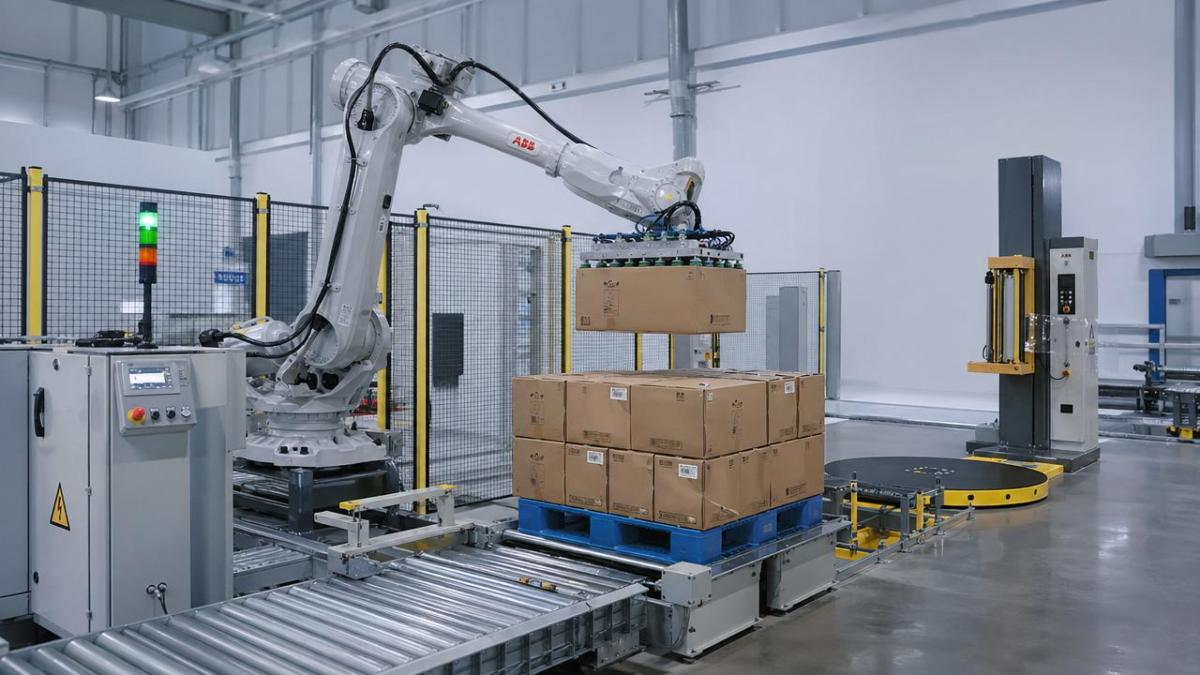
A palletizer is part of a chain, not an isolated machine. If case orientation from the infeed is inconsistent, if pallet supply is unreliable, or if wrapper handshaking is poorly configured, the robot cell will never reach its theoretical output. Compatibility failures are one of the biggest causes of underperformance after installation.
Mistake 4: Overlooking service response and spare parts resilience
Even well-built systems require troubleshooting. Procurement teams often compare specifications in detail but fail to assess who answers a call at 2 a.m., how fast a servo or sensor can be shipped, and whether remote diagnostics are mature. For high-volume plants, support structure is a core buying criterion, not a secondary benefit.
Mistake 5: Assuming every supplier can manage site-specific safety compliance
Guarding, emergency stops, risk assessment, operator access, lockout points, and regional compliance standards vary by site and geography. Procurement should confirm whether palletizing robot suppliers own safety engineering internally or outsource it with limited accountability.
Core evaluation checklist: what to compare before issuing an RFQ award
A useful comparison framework should combine technical fit, commercial clarity, and execution reliability. Procurement teams can use the table below to score palletizing robot suppliers on the factors that most directly influence commissioning success and life-cycle performance.
This approach is especially valuable when multiple suppliers use similar robot brands but differ sharply in tooling design, controls depth, and service discipline.
Weighting can be adjusted by site priorities, but every category below should be reviewed before final selection.
Minimum documents worth requesting
- General arrangement drawing and footprint
- Throughput calculation or simulation basis
- Utility requirements and site assumptions
- Preliminary risk assessment and guarding concept
- Acceptance test plan for FAT and SAT
Scenario-based checks: different plants need different palletizing robot suppliers
Not every supplier is equally strong in every environment. Some palletizing robot suppliers are highly capable in brownfield retrofits, while others perform better in greenfield, high-speed, or mixed-SKU applications. Procurement should match supplier capability to the operating context instead of assuming a universal fit.
This is where many sourcing teams lose precision. A supplier that succeeds in a single-SKU consumer goods line may not be the best option for frequent changeovers, warehouse constraints, or fragile packaging formats.
The following scenario checks can sharpen the selection process.
For brownfield plants with tight space
Focus on footprint, maintenance access, guarding layout, cable routing, and whether the supplier has retrofit experience around legacy conveyors and controls. Space conflicts are often underestimated during quotation.
Priority checks
- 3D layout review with current line dimensions
- Maintenance clearance around robot and gripper
- Shutdown window required for installation
For high-mix and frequent recipe changes
Prioritize software flexibility, recipe management, operator interface simplicity, and changeover validation. The best palletizing robot suppliers for this scenario are those that reduce human setup error and can handle variable pallet patterns without excessive engineering intervention.
For high-speed lines with strict uptime targets
Review redundancy options, diagnostic tools, preventive maintenance plans, and MTBF-related data where available. Throughput claims should be tied to sustained production, not short demo cycles.
Frequently overlooked risks that create post-installation problems
Many end-of-line projects look acceptable in the proposal stage but develop friction during FAT, SAT, or the first months of production. These issues are often preventable if procurement asks sharper questions earlier.
The goal is not to make supplier selection slower. It is to make risk visible before contracts are locked and schedules become expensive to change.
Below are several warning signs that buyers should treat seriously when screening palletizing robot suppliers.
- Unclear performance baselines. If the supplier cannot state the assumptions behind cases per minute, pallet height, or product stability, comparison is unreliable.
- Vague change-order language. If scope exclusions are not explicit, downstream cost growth is likely.
- No named project team. Procurement should know who owns mechanical, controls, safety, and commissioning.
- Weak training coverage. Operators and maintenance teams need structured handover, not informal instruction.
- Limited reference access. Strong palletizing robot suppliers should be able to discuss comparable applications with credible detail.
A practical risk reminder
If a proposal sounds technically smooth but contains little measurable detail, procurement should slow down. In automation sourcing, ambiguity usually transfers risk from the supplier to the buyer.
Execution guide: how to make the final decision with confidence
The final stage should combine data review, internal alignment, and supplier verification. Procurement teams that move directly from quote comparison to award often miss critical execution details. A better process is short, disciplined, and evidence-based.
This is also where organizations aligned with data-first thinking gain an advantage. Instead of rewarding the most polished presentation, they prioritize parameter clarity, integration realism, and support accountability.
Use the following decision sequence before selecting among palletizing robot suppliers.
Final award checklist
- Validate line data, SKU range, and target throughput with plant engineering
- Review 2 to 3 comparable references with similar packaging conditions
- Confirm FAT and SAT metrics in contract language
- Map spare parts, training, and service-level expectations
- Document all inclusions, exclusions, interfaces, and customer responsibilities
- Check long-term software support and future expansion options
What to ask in the supplier meeting
Ask for the exact assumptions behind performance figures, the failure modes seen in similar projects, the average commissioning timeline, and the most common reasons for delay. Ask how the supplier handles product variation, what data they log for diagnostics, and which components are considered critical spares. These questions quickly reveal whether a vendor is process-mature or presentation-heavy.
For procurement teams comparing palletizing robot suppliers, the best decision is usually the one that reduces uncertainty, not simply the one that reduces initial price. End-of-line automation succeeds when engineering evidence, operational fit, and support depth are all visible before the contract is signed.
If your organization is moving toward supplier shortlisting, prepare a data package first: carton dimensions, weight ranges, throughput target, shift profile, pallet patterns, line layout, controls environment, site safety standards, and service expectations. With that information, discussions with palletizing robot suppliers become faster, more comparable, and far more likely to produce durable ROI.
Search News
Hot Articles
- Carbon Fiber StructuresHow to Specify Aerospace Carbon Fiber Assemblies for Lightweight, Load-Bearing PartsJul 11, 2026
- Machine VisionXiaomi, Alibaba DAMO Academy Drive Open-Source Robotics Model Ecosystem, Lowering Algorithm Development Barriers for Overseas SMEs Adopting Chinese Robotics SolutionsMar 30, 2026
- Cobots & ArmsShanxi 'AI+' Conference Showcases Embodied Intelligence with Multinational Buyer Engagement: Key Industry ImplicationsMar 30, 2026
Popular Tags
Recommended News
 Jul 11, 2026How to Specify Aerospace Carbon Fiber Assemblies for Lightweight, Load-Bearing PartsAerospace carbon fiber assemblies: learn how to specify laminate design, load data, joining methods, and inspection controls for lighter, reliable load-bearing aerospace parts.Elena Rostova (UAV Systems Researcher)
 Mar 30, 2026Xiaomi, Alibaba DAMO Academy Drive Open-Source Robotics Model Ecosystem, Lowering Algorithm Development Barriers for Overseas SMEs Adopting Chinese Robotics SolutionsXiaomi & Alibaba DAMO Academy's open-source robotics models lower algorithm barriers for global SMEs. Boost efficiency in manufacturing, logistics & smart retail with ROS 2 compatible solutions.TSV Data Lab
 Mar 30, 2026Shanxi 'AI+' Conference Showcases Embodied Intelligence with Multinational Buyer Engagement: Key Industry ImplicationsShanxi 'AI+' Conference highlights embodied intelligence with Tesla, Ubtech & Jiantao showcasing multimodal robotics. 40+ global buyers validated tech on-site, creating new B2B channels for industrial automation & AI solutions.Chen Wei (Automation Lead Engineer)
 Mar 30, 2026Zhongguancun Unveils 6G Integrated Sensing-Computing-Intelligence Platform to Empower Embodied Robots for Global Industrial ApplicationsZhongguancun's new 6G platform revolutionizes industrial robotics with <10ms latency, empowering global automotive, logistics & port automation. Discover how this tech boosts China's smart manufacturing exports.TSV Data Lab
 Mar 30, 2026Mech-Mind Tianjin Embodied Intelligence R&D and Production Base Goes Live, Cutting Delivery Time by 20%–30% for Global Customized AMR+Vision SolutionsMech-Mind's Tianjin AMR+Vision production base cuts delivery time by 20%-30% for欧美 & Latin American markets. Discover how this PLd-certified facility accelerates customized robotics solutions for smart manufacturing and logistics.Chen Wei (Automation Lead Engineer)
 Mar 30, 2026Boao Forum Reveals 'Co-evolution of Big and Small Brains' Trend in Humanoid Robots, China's Embodied Intelligence Accelerates Adaptation to Overseas Manufacturing Service ScenariosDiscover how China's humanoid robots, featuring 'Co-evolution of Big and Small Brains,' are revolutionizing global manufacturing. Learn about Embodied Tian Gong 3.0's ISO compliance and overseas deployment at Boao Forum 2026.Chen Wei (Automation Lead Engineer)
 Mar 30, 2026China Railway Industrial Secures Patent for Embodied Robotics in Material Handling, Boosting High-Precision Delivery Capabilities for Overseas Infrastructure and Manufacturing ProjectsChina Railway Industrial's new patent for embodied robotics in material handling boosts high-precision delivery for global infrastructure & manufacturing. Discover how this innovation enhances logistics accuracy in automotive, rail transit & EPC projects.Chen Wei (Automation Lead Engineer)
 Oct 29, 2026Aerospace Aluminum Alloy Strength: 2024-T3 vs. 7075-T6 ComparedCompare aerospace aluminum alloy strength in 2024-T3 vs. 7075-T6. Explore fatigue, corrosion, and weight trade-offs to choose the right alloy for your design.Dr. Marcus Vance
 Oct 28, 2026IDC: Global Quadruped Robot Shipments Rise 92.5% in H1 2026 as Volume and Value DivergeGlobal quadruped robot shipments rose 92.5% in H1 2026, according to IDC. Explore what diverging volume and value trends mean for industrial buyers and manufacturers.Chen Wei (Automation Lead Engineer)
 Oct 28, 2026Interpreting Industrial IoT Latency Data for Monitoring and Real-Time ControlInterpret industrial category latency data to assess jitter, deadline misses, and real-time readiness. Learn how to benchmark IIoT systems and choose monitoring and control solutions.TSV Data Lab
 Oct 27, 2026GXO and Agility Robotics Expand Partnership to Accelerate US Humanoid Robot DeploymentGXO and Agility Robotics plan to expand US humanoid robot deployment with Digit 4 in early 2027. Explore warehouse automation plans, service terms and future Digit 5 upgrades.Chen Wei (Automation Lead Engineer)
 Oct 27, 2026Robotic Automation Costs: Budgeting for Equipment, Integration, and MaintenancePlan your robotics automation cost with confidence. Explore equipment, integration, and maintenance expenses, compare quotes, and build a realistic budget for better ROI.Chen Wei (Automation Lead Engineer)
 Oct 26, 2026AMAXiMAL Releases Open-Source TopMod 3D v3 With Claude AIExplore AMAXiMAL’s free, open-source TopMod 3D v3 with Claude AI assistance, topology-based modeling and plywood fabrication tools that connect complex designs to physical builds.Dr. Marcus Vance
 Oct 26, 2026Choosing a SCADA System Integrator Company: PLC Compatibility and Long-Term SupportChoose a scada system integrator company with proven PLC compatibility and reliable long-term support. Discover what to test, compare, and require before investing.Victor Lin (Chief Software Architect)
 Oct 25, 2026Hesai Leads Global ADAS Main Lidar Shipments in Yole’s 2026 ReportHesai led global ADAS main lidar shipments with a 43% share in 2025, according to Yole’s 2026 report. Explore what this ranking reveals about its automotive market position.TSV Data Lab
 Oct 25, 2026Choosing an Aerospace Materials Manufacturer: Quality and Traceability ChecksChoosing an aerospace materials manufacturer? Learn how to verify certifications, test reports, and lot traceability to qualify suppliers confidently and reduce costly sourcing risks.Dr. Marcus Vance
 Oct 24, 2026Guotai Haitong: Global Entry-Level 3D Printer Shipments Rose 39% in Q1 2026Entry-level 3D printer shipments rose 39% in Q1 2026, Guotai Haitong reports. Explore how AI, multicolor printing and print farms are shaping market growth.Dr. Marcus Vance
 Oct 24, 2026Choosing an Industrial Vision Inspection Supplier: Acceptance Tests That MatterChoose an industrial vision inspection supplier with confidence. Discover acceptance tests for defect detection, false rejects, production speed, and reliable part rejection before you buy.TSV Data Lab
 Oct 23, 2026US Navy Raises Gecko Robotics Contract Ceiling to $300M for Robotic Fleet MaintenanceUS Navy raises Gecko Robotics’ contract ceiling to $300M for Pacific Fleet robotic inspections. Explore potential opportunities for maintenance suppliers and key procurement considerations.Chen Wei (Automation Lead Engineer)
 Oct 23, 2026Choosing Industrial Sensing Systems for Global Plants: Protocol CompatibilityCompare industrial sensing systems international buyers can trust. Explore protocol compatibility, reduce integration risks, and select proven configurations for reliable global plant deployments.TSV Data Lab
 Oct 22, 2026KUKA Showcases Physical AI and iiQKA.AI Vision at NVIDIA GTC BerlinExplore KUKA’s Physical AI showcase at NVIDIA GTC Berlin and discover how iiQKA.AI Vision aims to simplify robotic vision integration and improve 2D and 3D scene recognition.TSV Data Lab
 Oct 22, 2026Robotic Machining of Advanced Composites: What Tolerances Are Achievable?Explore advanced materials machining robotics: discover what drives achievable composite tolerances and how to validate accuracy before investing in your next machining system.Dr. Marcus Vance
 Oct 21, 2026China’s Industrial Robot Exports Near RMB 10 Billion in First Nine Months of 2026China’s industrial robot exports neared RMB 10 billion in January–September 2026, with value rising faster than volume. Explore the data and what it could mean for suppliers.Chen Wei (Automation Lead Engineer)
 Oct 21, 2026Low-Latency Industrial Data Processing: Pricing and Key Cost DriversExplore industrial data latency price drivers, from edge hardware to integration and support. Learn how to compare quotes, verify performance, and avoid unnecessary costs.TSV Data Lab