
Is robotic polishing right for aerospace parts finishing
Publication Date
author
For aerospace manufacturers evaluating robotic polishing for aerospace parts, the real question is not hype but measurable finishing performance, repeatability, compliance, and cost. This article examines whether robotic polishing can meet strict aerospace surface requirements, reduce operator variability, and fit broader automation strategies alongside systems such as cobot for medical device assembly and robotic arm for electronics assembly.
When is robotic polishing a practical choice for aerospace parts finishing?
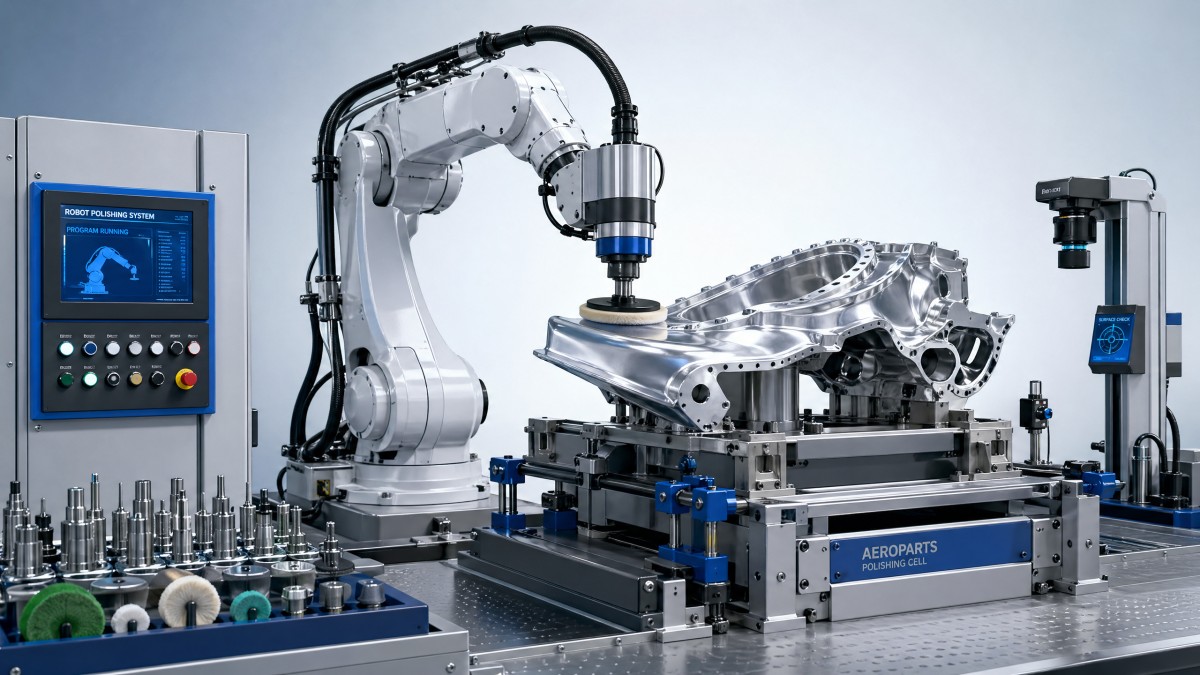
Robotic polishing is most suitable when aerospace parts finishing involves repeatable geometry, defined surface quality targets, and production volumes large enough to justify process engineering. In practical terms, this often includes structural aluminum parts, titanium brackets, turbine-adjacent non-critical housings, composite molds, and machined components that require controlled deburring, edge blending, or cosmetic surface preparation before coating, inspection, or assembly.
It is less useful when buyers expect a robot to solve every finishing problem without stable upstream machining quality. If incoming parts vary beyond the process window, robotic polishing can become a consistency amplifier rather than a consistency fixer. For aerospace teams, the first decision point is not the robot brand. It is whether the part family, tolerance stack, fixture method, and target roughness range can be translated into a controlled finishing recipe.
TSV’s engineering view is simple: parameters matter more than promotional claims. Before approving a robotic polishing cell, procurement and manufacturing teams should define 3 core metrics. These are surface requirement, dimensional preservation, and cycle stability. If one of these remains vague, supplier comparisons become unreliable and project risk rises during FAT, SAT, and line ramp-up.
In aerospace parts finishing, common decision thresholds include repeatability in the robot and tooling path, part-to-part variation after machining, and whether the process must support 1 shift, 2 shifts, or near-continuous operation. A robotic cell that performs well over 20 sample parts but drifts after 200 parts under abrasive wear is not ready for production release.
What problems does robotic polishing actually solve?
For operators, robotic polishing reduces fatigue from repetitive force-controlled finishing and improves process traceability. For procurement teams, it creates a clearer link between capital spending and labor redeployment. For decision-makers, it supports a broader automation roadmap that may already include machine tending, optical inspection, and adjacent systems such as cobot for medical device assembly or robotic arm for electronics assembly.
- Lower dependence on individual manual polishing skill, especially when finishing quality currently varies by shift or operator experience.
- More stable cycle time, often easier to plan in cells designed around 2–5 minute takt windows for repeatable part families.
- Better process documentation, including programmable path control, force settings, abrasive change intervals, and inspection checkpoints.
- Safer handling of dust, burrs, and repetitive wrist-intensive work when combined with extraction, guarding, and validated fixturing.
That said, robotic polishing is not automatically a lower-cost option for every aerospace supplier. Small-batch, highly variable repair work or complex freeform surfaces with frequent engineering changes may still favor skilled manual finishing or hybrid cells. The right answer depends on process stability, not on automation fashion.
Which technical parameters determine finishing quality and repeatability?
The quality of robotic polishing for aerospace parts is governed by an interaction of robot motion, spindle or end-effector performance, abrasive behavior, fixture rigidity, and part measurement feedback. Buyers often focus on robot repeatability alone, yet that is only one variable. A cell with strong arm repeatability can still produce inconsistent results if force control, abrasive wear compensation, or part positioning are unstable.
In aerospace parts finishing, it is common to define acceptance through roughness targets, edge radius limits, non-removal zones, and allowable stock removal. Depending on the application, engineering teams may assess Ra or similar surface metrics, verify edge blend continuity, and confirm no damage to nearby datum features. For coated parts, polishing must also support downstream adhesion and cleanliness requirements without introducing embedded contamination.
A realistic qualification plan usually includes at least 3 stages: offline process definition, pilot validation on representative samples, and production verification under expected abrasive wear conditions. This structure is more useful than evaluating a polished demo piece with unknown settings. Aerospace buyers should ask for evidence over a run length, not only a single part result.
The table below summarizes key technical factors that matter during robotic polishing system evaluation. These are not universal pass-fail values, because aerospace parts finishing requirements differ by component function, alloy, and downstream process. They are, however, the right dimensions for structured comparison.
For users and process engineers, the takeaway is clear: robotic polishing quality is a system output, not a robot-only output. A supplier that explains spindle power, compliance method, abrasive strategy, and inspection loop in one process chain is usually more credible than one that talks mainly about speed.
How should aerospace teams verify process capability?
Recommended validation checklist
- Run at least 2–3 abrasive life stages: new, mid-life, and end-of-life condition.
- Test more than one material where relevant, such as aluminum and titanium, because heat and removal behavior differ.
- Measure both finish and geometry preservation, especially on edges, sealing faces, and reference features.
- Review cycle consistency across 1 full shift or a representative pilot batch rather than only short demonstration runs.
This kind of verification aligns with TSV’s data-first approach. Buyers need engineering evidence that the cell can maintain process stability over time, not just polished sample photographs or general claims about automation benefits.
Robotic polishing vs manual finishing: where does each option win?
Aerospace procurement teams often compare robotic polishing with manual finishing as if one must fully replace the other. In reality, many successful factories run both. Robotic polishing works well for repeatable families, documented recipes, and stable takt expectations. Manual finishing remains valuable for prototype work, repair, low-volume variability, and last-mile touch-up on highly complex surfaces.
The real comparison should include labor availability, process documentation burden, scrap risk, qualification effort, and scalability. If a shop depends on a small number of highly skilled polishers and faces hiring pressure, robotic polishing may reduce operational fragility. If the part mix changes every week and each geometry requires unique hand judgment, automation payback may stretch beyond an acceptable range.
The table below helps information researchers, operators, and decision-makers compare the two routes using practical aerospace parts finishing criteria rather than generic claims. It also highlights why some teams choose a hybrid model, especially during the first 6–12 months after installation.
For many aerospace suppliers, the best path is phased adoption. Start by automating the 20% of parts that consume the highest polishing hours but have the most stable geometry. This often provides more reliable ROI than trying to automate the entire finishing department at once.
This comparison method also mirrors how advanced manufacturers evaluate adjacent automation categories. The same logic used when selecting a cobot for medical device assembly or a robotic arm for electronics assembly applies here: map the process, quantify the variation, then determine whether the automation envelope fits the task.
What should buyers check before investing in a robotic polishing cell?
A procurement decision for robotic polishing should be based on a structured technical-commercial review, not only a quotation comparison. Aerospace parts finishing projects often fail in early deployment when buyers underestimate fixturing complexity, qualification time, dust extraction requirements, or recipe transfer between part revisions. A low initial price can become expensive if commissioning takes 8–12 weeks longer than planned.
Before final selection, teams should organize the decision around 5 practical checkpoints: part suitability, finish specification clarity, validation plan, support model, and total cost of ownership. This creates a stronger basis for supplier negotiation and avoids confusion between machine capability and actual process capability.
Aerospace procurement checklist
- Define the part family scope. Separate repeatable production parts from prototype, repair, or engineering-change parts.
- Confirm finish acceptance criteria in measurable terms, including roughness target, visual standard, edge requirements, and restricted zones.
- Ask for sample validation across a meaningful batch, not a single polished demonstration part.
- Review the implementation scope: robot, spindle, abrasive supply, enclosure, extraction, programming, training, FAT, SAT, and spare parts.
- Clarify ramp-up support, response time, and how process changes are handled after part revision or material change.
Aerospace buyers should also align the cell with internal compliance systems. Even when robotic polishing itself is not a certifiable product, the process still interacts with AS9100-oriented quality systems, document control, operator training, and inspection traceability. If the finishing stage affects critical geometry or surface performance, the approval route must include quality engineering, not just manufacturing engineering.
Typical implementation timelines vary by complexity. A relatively standard cell may move from specification freeze to acceptance in roughly 8–16 weeks, while more customized aerospace parts finishing systems can take longer due to tooling trials, safety review, and part qualification. The important point is to budget time for process proof, not merely for equipment delivery.
Cost, alternatives, and hybrid deployment logic
Total cost of ownership should include abrasives, spindle maintenance, dust management, training, recipe updates, and downtime planning. In some cases, a semi-automated workstation or force-assisted manual station may be a better intermediate step than full robotic polishing. This is especially true when annual part volume is moderate, but process variation remains high.
Alternatives should be evaluated honestly. For example, if upstream machining quality can reduce burr size or improve surface consistency, the finishing burden may shrink enough that a smaller robotic cell becomes viable. In other cases, improved fixture design and in-process inspection can deliver more value than adding robot complexity too early.
Common misconceptions, compliance concerns, and the next step
One common misconception is that robotic polishing automatically guarantees aerospace-grade finish. It does not. The robot executes a process; it does not define the process physics. Another misconception is that any robot integrator can transfer a polishing application from automotive or consumer products directly into aerospace parts finishing. Aerospace work usually requires tighter documentation, stronger fixture discipline, more cautious material removal control, and closer connection to inspection data.
Another risk is underestimating operator involvement after automation. Even in highly automated cells, operators still manage abrasive changes, part loading, visual checks, cleaning, and response to variation. Training should therefore cover 4 areas: HMI operation, fixture loading discipline, tool wear checks, and escalation triggers when finish drift appears. A robot reduces manual polishing effort, but it does not eliminate process ownership.
FAQ for buyers and engineers
Is robotic polishing suitable for low-volume aerospace production?
It can be, but only if the low volume still comes from a repeatable part family and the value of consistency, labor reduction, or documentation is high. For highly mixed, low-repeat jobs, manual or hybrid methods may remain more economical.
How long does process validation usually take?
For a defined part family, initial trials may take days, but full validation often extends across several weeks because teams need to check abrasive life, repeatability, inspection results, and operator workflow. More complex aerospace approvals can take longer when finish affects downstream certification-sensitive processes.
What is the biggest selection mistake?
Choosing based on robot specification alone. The bigger determinants are fixture repeatability, force control, abrasive strategy, and the supplier’s ability to prove stable finishing results over a representative batch.
Can robotic polishing support broader automation strategy?
Yes. When implemented correctly, it complements machine tending, vision inspection, and process traceability systems. It also fits organizations already standardizing automation decisions across cells such as cobot for medical device assembly and robotic arm for electronics assembly.
Why work with a data-driven technical partner?
At TechStat Vanguard, the focus is not on generic claims about smart manufacturing. The focus is on whether robotic polishing for aerospace parts finishing can meet the required process window, inspection logic, implementation schedule, and sourcing logic. That means clearer parameter review, sharper supplier comparison, and less noise in internal decision-making.
If your team is assessing robotic polishing, contact us for support on parameter confirmation, part-family suitability review, supplier benchmarking, implementation risk checks, delivery timeline evaluation, and compliance-oriented specification drafting. We can also help compare full robotic cells against hybrid alternatives so your decision is based on measurable engineering fit rather than assumptions.
Search News
Hot Articles
- Carbon Fiber StructuresHow to Specify Aerospace Carbon Fiber Assemblies for Lightweight, Load-Bearing PartsJul 11, 2026
- Machine VisionXiaomi, Alibaba DAMO Academy Drive Open-Source Robotics Model Ecosystem, Lowering Algorithm Development Barriers for Overseas SMEs Adopting Chinese Robotics SolutionsMar 30, 2026
- Cobots & ArmsShanxi 'AI+' Conference Showcases Embodied Intelligence with Multinational Buyer Engagement: Key Industry ImplicationsMar 30, 2026
Popular Tags
Recommended News
 Jul 11, 2026How to Specify Aerospace Carbon Fiber Assemblies for Lightweight, Load-Bearing PartsAerospace carbon fiber assemblies: learn how to specify laminate design, load data, joining methods, and inspection controls for lighter, reliable load-bearing aerospace parts.Elena Rostova (UAV Systems Researcher)
 Mar 30, 2026Xiaomi, Alibaba DAMO Academy Drive Open-Source Robotics Model Ecosystem, Lowering Algorithm Development Barriers for Overseas SMEs Adopting Chinese Robotics SolutionsXiaomi & Alibaba DAMO Academy's open-source robotics models lower algorithm barriers for global SMEs. Boost efficiency in manufacturing, logistics & smart retail with ROS 2 compatible solutions.TSV Data Lab
 Mar 30, 2026Shanxi 'AI+' Conference Showcases Embodied Intelligence with Multinational Buyer Engagement: Key Industry ImplicationsShanxi 'AI+' Conference highlights embodied intelligence with Tesla, Ubtech & Jiantao showcasing multimodal robotics. 40+ global buyers validated tech on-site, creating new B2B channels for industrial automation & AI solutions.Chen Wei (Automation Lead Engineer)
 Mar 30, 2026Zhongguancun Unveils 6G Integrated Sensing-Computing-Intelligence Platform to Empower Embodied Robots for Global Industrial ApplicationsZhongguancun's new 6G platform revolutionizes industrial robotics with <10ms latency, empowering global automotive, logistics & port automation. Discover how this tech boosts China's smart manufacturing exports.TSV Data Lab
 Mar 30, 2026Mech-Mind Tianjin Embodied Intelligence R&D and Production Base Goes Live, Cutting Delivery Time by 20%–30% for Global Customized AMR+Vision SolutionsMech-Mind's Tianjin AMR+Vision production base cuts delivery time by 20%-30% for欧美 & Latin American markets. Discover how this PLd-certified facility accelerates customized robotics solutions for smart manufacturing and logistics.Chen Wei (Automation Lead Engineer)
 Mar 30, 2026Boao Forum Reveals 'Co-evolution of Big and Small Brains' Trend in Humanoid Robots, China's Embodied Intelligence Accelerates Adaptation to Overseas Manufacturing Service ScenariosDiscover how China's humanoid robots, featuring 'Co-evolution of Big and Small Brains,' are revolutionizing global manufacturing. Learn about Embodied Tian Gong 3.0's ISO compliance and overseas deployment at Boao Forum 2026.Chen Wei (Automation Lead Engineer)
 Mar 30, 2026China Railway Industrial Secures Patent for Embodied Robotics in Material Handling, Boosting High-Precision Delivery Capabilities for Overseas Infrastructure and Manufacturing ProjectsChina Railway Industrial's new patent for embodied robotics in material handling boosts high-precision delivery for global infrastructure & manufacturing. Discover how this innovation enhances logistics accuracy in automotive, rail transit & EPC projects.Chen Wei (Automation Lead Engineer)
 Oct 26, 2026AMAXiMAL Releases Open-Source TopMod 3D v3 With Claude AIExplore AMAXiMAL’s free, open-source TopMod 3D v3 with Claude AI assistance, topology-based modeling and plywood fabrication tools that connect complex designs to physical builds.Dr. Marcus Vance
 Oct 26, 2026Choosing a SCADA System Integrator Company: PLC Compatibility and Long-Term SupportChoose a scada system integrator company with proven PLC compatibility and reliable long-term support. Discover what to test, compare, and require before investing.Victor Lin (Chief Software Architect)
 Oct 25, 2026Hesai Leads Global ADAS Main Lidar Shipments in Yole’s 2026 ReportHesai led global ADAS main lidar shipments with a 43% share in 2025, according to Yole’s 2026 report. Explore what this ranking reveals about its automotive market position.TSV Data Lab
 Oct 25, 2026Choosing an Aerospace Materials Manufacturer: Quality and Traceability ChecksChoosing an aerospace materials manufacturer? Learn how to verify certifications, test reports, and lot traceability to qualify suppliers confidently and reduce costly sourcing risks.Dr. Marcus Vance
 Oct 24, 2026Guotai Haitong: Global Entry-Level 3D Printer Shipments Rose 39% in Q1 2026Entry-level 3D printer shipments rose 39% in Q1 2026, Guotai Haitong reports. Explore how AI, multicolor printing and print farms are shaping market growth.Dr. Marcus Vance
 Oct 24, 2026Choosing an Industrial Vision Inspection Supplier: Acceptance Tests That MatterChoose an industrial vision inspection supplier with confidence. Discover acceptance tests for defect detection, false rejects, production speed, and reliable part rejection before you buy.TSV Data Lab
 Oct 23, 2026US Navy Raises Gecko Robotics Contract Ceiling to $300M for Robotic Fleet MaintenanceUS Navy raises Gecko Robotics’ contract ceiling to $300M for Pacific Fleet robotic inspections. Explore potential opportunities for maintenance suppliers and key procurement considerations.Chen Wei (Automation Lead Engineer)
 Oct 23, 2026Choosing Industrial Sensing Systems for Global Plants: Protocol CompatibilityCompare industrial sensing systems international buyers can trust. Explore protocol compatibility, reduce integration risks, and select proven configurations for reliable global plant deployments.TSV Data Lab
 Oct 22, 2026KUKA Showcases Physical AI and iiQKA.AI Vision at NVIDIA GTC BerlinExplore KUKA’s Physical AI showcase at NVIDIA GTC Berlin and discover how iiQKA.AI Vision aims to simplify robotic vision integration and improve 2D and 3D scene recognition.TSV Data Lab
 Oct 22, 2026Robotic Machining of Advanced Composites: What Tolerances Are Achievable?Explore advanced materials machining robotics: discover what drives achievable composite tolerances and how to validate accuracy before investing in your next machining system.Dr. Marcus Vance
 Oct 21, 2026China’s Industrial Robot Exports Near RMB 10 Billion in First Nine Months of 2026China’s industrial robot exports neared RMB 10 billion in January–September 2026, with value rising faster than volume. Explore the data and what it could mean for suppliers.Chen Wei (Automation Lead Engineer)
 Oct 21, 2026Low-Latency Industrial Data Processing: Pricing and Key Cost DriversExplore industrial data latency price drivers, from edge hardware to integration and support. Learn how to compare quotes, verify performance, and avoid unnecessary costs.TSV Data Lab
 Oct 20, 2026KUKA Launches iiQKA.AI Vision to Simplify Industrial Image ProcessingKUKA iiQKA.AI Vision simplifies industrial image processing with controller-based 2D and 3D vision. Explore drag-and-drop setup for vision-guided automation.TSV Data Lab
 Oct 20, 2026Smart Industrial Edge Devices: Key Criteria for Legacy PLC IntegrationChoose smart industrial edge devices for legacy PLC integration. Discover key criteria for compatibility, data quality, security, and reliable collection without disrupting control.TSV Data Lab
 Oct 19, 2026Choosing a Radar Sensor by Application: Range, Resolution, and Field of ViewSimplify radar sensor application based product selection. Compare range, resolution, and field of view to avoid blind spots and choose with confidence. Explore the guide.TSV Data Lab
 Oct 18, 2026Comparing Material Options for Procurement: Specs, Costs, and Supply RisksExplore procurement oriented technical content on material options, specs, costs, and supply risks. Compare alternatives to cut hidden expenses and make confident sourcing decisions.Dr. Marcus Vance
 Oct 17, 20265-Axis CNC Positioning Accuracy: How to Interpret ISO 230-2 Test ResultsAssess 5 axis CNC machining positioning accuracy with ISO 230-2. Learn to interpret repeatability, reversal error, and test conditions to compare suppliers and make confident acceptance decisions.Dr. Marcus Vance























