
How to read a robotic arm IP67 waterproof test report
Publication Date
author
For engineers, buyers, and technical decision-makers, a robotic arm IP67 waterproof test report is more than a compliance document—it is evidence of real-world reliability. This guide explains how to read each key section, verify test conditions, and distinguish meaningful protection data from marketing claims, helping you assess whether a robotic arm for electronics assembly or harsh industrial use truly meets operational risk and procurement standards.
What does an IP67 robotic arm test report really prove?
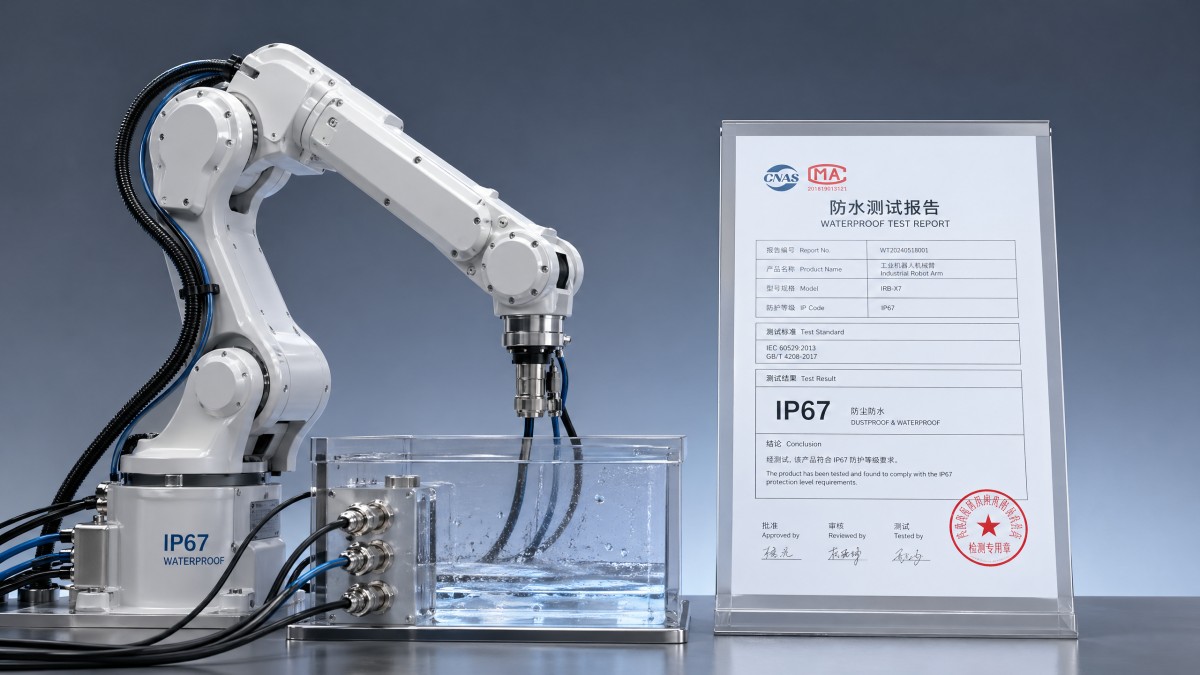
A robotic arm IP67 waterproof test report should be read as a controlled verification record, not as a blanket promise that the robot can survive any wet, dusty, or washdown environment. In practical procurement, IP67 means the enclosure has been tested against dust ingress and temporary immersion in water under specified conditions. It does not automatically confirm resistance to chemicals, high-pressure jets, hot washdown, or long-term submerged operation.
For research teams and procurement managers, the first judgment is simple: does the report clearly tie the test result to a specific robotic arm model, enclosure design, cable configuration, and mounting condition? If a report only states “IP67 compliant” without describing the tested sample, it has limited value for supplier qualification. Even small changes in connector type, gland sealing, or wrist tooling interface can affect the result.
In most industrial review workflows, you should look for 3 core facts within the first 1–2 pages: the applicable standard reference, the tested product identification, and the pass/fail conclusion for each digit in the IP code. If any of those are missing, the robotic arm IP67 waterproof test report becomes harder to compare across vendors or across different production lots.
This matters across mixed-industry use cases. Electronics assembly cells may face coolant mist, cleaning cycles, and airborne particles. Food-adjacent automation may involve frequent wash exposure. Outdoor loading stations may see rain and dust. In each scenario, decision-makers need engineering truth, not simplified marketing language. That is why TSV emphasizes parameter-level reading rather than headline claims.
The meaning of the two digits in IP67
The “6” refers to dust-tight protection. In plain terms, the enclosure should prevent dust ingress under the prescribed test conditions. The “7” refers to protection against temporary immersion in water. Under IEC 60529, this is typically interpreted as immersion up to 1 meter for up to 30 minutes unless otherwise specified by the manufacturer and test body. Buyers should verify whether the report states the exact immersion depth and duration rather than assuming a universal interpretation.
A common mistake is to read IP67 as a durability rating. It is not. It is an ingress protection rating. A robotic arm can pass an IP67 test and still perform poorly in cable fatigue, seal aging, thermal cycling, or repeated connector handling. For users and operators, that means the test report should be one part of a broader reliability review including maintenance intervals, joint sealing design, and operating temperature range.
- Use the report to confirm enclosure protection under defined test conditions, not to infer all-environment suitability.
- Match the tested configuration with the exact robot variant, especially end effector interface, cable routing, and connector arrangement.
- Check whether the robotic arm IP67 waterproof test report is current, version-controlled, and linked to product revision history.
How to read the key sections of a robotic arm IP67 waterproof test report
A credible robotic arm IP67 waterproof test report usually follows a repeatable structure. Once you know that structure, screening reports becomes much faster for engineering teams, sourcing teams, and management reviewers. In many cases, 5 sections determine whether the report is actionable: product identification, test standard, test setup, test execution, and post-test inspection or functional verification.
Do not skip the product identification block. It should include model number, serial number or sample identifier, enclosure status, accessory status, and sometimes firmware or hardware revision. If the report lacks traceability, there is no strong basis to assume the tested unit reflects current production. For high-value automation procurement, traceability gaps can prolong qualification by 2–4 weeks because teams must request supplementary evidence.
The test standard section should identify the governing framework, usually IEC 60529 for IP ratings. However, the real value comes from the exact clauses applied, any deviations, and any manufacturer-defined conditions. If the report references an internal method without mapping it back to a recognized standard, the result may still be useful internally, but it is less powerful for cross-supplier comparison.
The setup section is where many weak reports fail. It should explain whether the robotic arm was powered on or off, whether axes were stationary or positioned in a defined posture, whether external cables were installed, and whether sealing surfaces were new or previously used. A good report also states ambient temperature conditions, such as 15°C–35°C, because seal behavior can change with temperature.
Five sections you should verify line by line
The table below helps reviewers identify what a useful robotic arm IP67 waterproof test report should contain and where misleading gaps usually appear.
If a report only includes a final pass stamp but omits setup, acceptance criteria, or post-test verification, procurement risk increases. In supplier evaluation, a short report can still be acceptable, but only when it is backed by a full annex, test photos, or a lab data sheet available on request.
What the post-test section should show
The post-test review should not stop at “no abnormality observed.” A stronger robotic arm IP67 waterproof test report will note whether insulation resistance, motion control, axis homing, connector sealing, and external surface condition were checked after the immersion cycle. For practical decision-making, 4–6 post-test checks are usually enough to identify whether the enclosure remained functional, not just formally compliant.
- Visual inspection for water ingress, corrosion marks, seal displacement, or trapped moisture.
- Electrical check for alarms, insulation anomalies, or connector continuity issues.
- Functional motion check across multiple axes after the exposure cycle.
- Documentation review for photos, timestamps, and operator signatures or lab approval marks.
Which test conditions separate engineering evidence from marketing claims?
When teams compare vendors, the biggest mistake is treating all IP67 statements as equivalent. They are not. The quality of a robotic arm IP67 waterproof test report depends heavily on how clearly it documents the test boundary. One supplier may show only enclosure immersion. Another may include configured cables, mounted covers, and a post-test motion cycle. Those are not the same evidence level.
For operators and maintenance teams, cable entries and connector interfaces are often the weak points. A robot body may pass the enclosure test, while the installed application package does not. This is especially relevant when the robotic arm supports dress packs, external sensors, vision modules, or tool changers. Every added interface creates another sealing question that the report should either include or explicitly exclude.
You should also distinguish between temporary immersion protection and washdown protection. IP67 does not equal IP69 or chemical resistance. If the target environment includes detergents, alkaline cleaning agents, or hot water cycles above typical room temperature, the waterproof test report alone is insufficient. In many procurement reviews, this is where operations and sourcing teams need a second round of technical clarification lasting 3–7 working days.
TSV’s data-first approach is useful here: ask not “Does it have IP67?” but “Under which exact conditions was IP67 demonstrated, and what failure modes remain outside the report scope?” That question usually exposes whether a supplier is providing engineering evidence or only a sales shorthand.
Comparison points that often change the purchasing decision
The following comparison table shows how two robotic arm IP67 waterproof test reports can both claim compliance while delivering very different decision value.
For enterprise decision-makers, the practical takeaway is clear: a robotic arm IP67 waterproof test report is valuable only when its boundaries are visible. Hidden assumptions increase warranty disputes, retrofit cost, and site acceptance delays.
Common warning signs in weak reports
- No mention of test date, making it hard to know whether the report reflects current design status.
- No statement on whether the sample was production-equivalent or prototype-only.
- No clarification on accessories, even though deployed systems often include 2–5 external interface points.
- No explanation of failure criteria, leaving “pass” open to interpretation.
How should buyers and engineers use the report in a procurement process?
A robotic arm IP67 waterproof test report should feed directly into the procurement workflow, not sit as a disconnected attachment. For information researchers, it helps narrow the vendor list. For operators, it informs maintenance expectations. For buyers, it supports technical compliance checks. For executives, it reduces the chance of hidden environmental mismatch after installation.
The most effective method is to convert the report into a 4-step review path: confirm the rating claim, compare the tested configuration with the intended application, identify uncovered risks, and request additional evidence where needed. This can shorten early-stage supplier screening from several rounds of informal discussion to one structured technical review meeting.
In mixed manufacturing sectors, environmental requirements often vary by line segment. One station may only need splash protection. Another may need dust-tight protection plus frequent sanitizing cycles. Another may require sealed joints plus corrosion-resistant external materials. The report therefore belongs in a wider requirement matrix that includes operating temperature, cleaning method, cable life, and service interval expectations over 12–36 months.
This is where TSV adds value: we help teams translate raw technical documents into benchmarkable procurement criteria. Instead of asking broad questions like “Is this robot waterproof?”, we help define engineering-level questions around scope, tolerances, environmental limits, and acceptance evidence.
A practical review checklist for sourcing teams
- Check whether the robotic arm IP67 waterproof test report matches the exact model and optional package being quoted.
- Verify whether the actual application involves temporary immersion, splash exposure, coolant mist, or chemical washdown, because those are not equivalent risks.
- Request supporting documents if the report omits test setup photos, immersion depth, or post-test functional records.
- Align acceptance with your internal spec sheet, including service access points, cable glands, and tool interface sealing.
- Use the report alongside other qualification items such as repeatability, MTBF references, maintenance intervals, and operating environment limits.
When to ask for more than an IP67 report
If the robotic arm will operate in outdoor logistics, battery production, wet machining cells, or food-related peripheral zones, the basic report may not be enough. You may need additional evidence such as material compatibility statements, connector sealing details, jet-water resistance information, or long-cycle environmental testing. In many projects, asking these questions before PO issuance avoids late engineering changes that can disrupt delivery by 2–6 weeks.
Also consider the difference between a sealed robot body and a sealed automation system. End effectors, cameras, grippers, and quick-change couplings can become the weakest link. Procurement teams should therefore review the full cell, not just the base robotic arm rating.
FAQ: what do companies most often misunderstand about IP67 robotic arm reports?
Many search queries around robotic arm IP67 waterproof test reports come from teams trying to reconcile brochure claims with real operating conditions. The questions below address the most common decision points and misreadings.
Does IP67 mean a robotic arm is suitable for any wet environment?
No. IP67 generally addresses dust-tight performance and temporary immersion protection under defined conditions, often up to 1 meter for up to 30 minutes. It does not automatically confirm resistance to hot washdown, high-pressure spray, aggressive cleaning chemicals, or continuous submersion. Always compare the report scope with the real operating environment.
Can I rely on a summary certificate without the full test details?
A summary certificate can be useful for initial screening, but it is rarely enough for final procurement approval in B2B automation. For a serious capital equipment review, you should request the underlying robotic arm IP67 waterproof test report or an equivalent technical file showing sample identity, setup, duration, and post-test verification. This is especially important when delivery commitments or warranty terms depend on environmental suitability.
What should operators care about if the robot already passed IP67?
Operators should focus on maintenance interfaces, connector handling, cleaning practice, and seal wear over time. A pass result does not remove the need for proper cable management, inspection intervals, and approved cleaning procedures. In plants with frequent exposure cycles, checking seals and access covers every month or every quarter can be more important than the initial pass statement.
How can decision-makers compare two suppliers that both claim IP67?
Compare the evidence depth, not just the claim. Look at traceability, test boundary clarity, post-test functionality, and exclusions. A stronger report reduces qualification uncertainty and makes it easier to write enforceable purchasing specifications. A weaker report may still be usable, but only with additional clarification and contract language.
Why work with TSV when reviewing robotic arm protection claims?
TechStat Vanguard helps engineering teams and procurement leaders cut through noise by translating technical claims into measurable decision criteria. When reviewing a robotic arm IP67 waterproof test report, we focus on what truly affects project risk: test boundary definition, configuration traceability, operating relevance, and comparison readiness across suppliers.
Our approach fits organizations that cannot afford vague documentation in high-value automation sourcing. If you are drafting a spec sheet, evaluating shortlist vendors, or challenging an ambiguous compliance statement, we can help structure the review around 3 practical outputs: parameter confirmation, supplier comparison logic, and risk-based procurement notes.
You can contact TSV for support on robotic arm environmental protection interpretation, model-level document review, configuration matching, certification requirement mapping, delivery-risk questioning, and benchmark-based selection logic. We also help teams identify when an IP67 claim is sufficient and when additional enclosure, connector, or system-level evidence should be requested before approval.
If your current challenge involves parameter confirmation, product selection, lead-time risk, customization scope, compliance questions, sample evaluation logic, or quotation-stage technical alignment, reach out with the report, model details, and target application. TSV will help you turn a generic waterproof claim into a clear engineering decision.
Search News
Hot Articles
- Carbon Fiber StructuresHow to Specify Aerospace Carbon Fiber Assemblies for Lightweight, Load-Bearing PartsJul 11, 2026
- Machine VisionXiaomi, Alibaba DAMO Academy Drive Open-Source Robotics Model Ecosystem, Lowering Algorithm Development Barriers for Overseas SMEs Adopting Chinese Robotics SolutionsMar 30, 2026
- Cobots & ArmsShanxi 'AI+' Conference Showcases Embodied Intelligence with Multinational Buyer Engagement: Key Industry ImplicationsMar 30, 2026
Popular Tags
Recommended News
 Jul 11, 2026How to Specify Aerospace Carbon Fiber Assemblies for Lightweight, Load-Bearing PartsAerospace carbon fiber assemblies: learn how to specify laminate design, load data, joining methods, and inspection controls for lighter, reliable load-bearing aerospace parts.Elena Rostova (UAV Systems Researcher)
 Mar 30, 2026Xiaomi, Alibaba DAMO Academy Drive Open-Source Robotics Model Ecosystem, Lowering Algorithm Development Barriers for Overseas SMEs Adopting Chinese Robotics SolutionsXiaomi & Alibaba DAMO Academy's open-source robotics models lower algorithm barriers for global SMEs. Boost efficiency in manufacturing, logistics & smart retail with ROS 2 compatible solutions.TSV Data Lab
 Mar 30, 2026Shanxi 'AI+' Conference Showcases Embodied Intelligence with Multinational Buyer Engagement: Key Industry ImplicationsShanxi 'AI+' Conference highlights embodied intelligence with Tesla, Ubtech & Jiantao showcasing multimodal robotics. 40+ global buyers validated tech on-site, creating new B2B channels for industrial automation & AI solutions.Chen Wei (Automation Lead Engineer)
 Mar 30, 2026Zhongguancun Unveils 6G Integrated Sensing-Computing-Intelligence Platform to Empower Embodied Robots for Global Industrial ApplicationsZhongguancun's new 6G platform revolutionizes industrial robotics with <10ms latency, empowering global automotive, logistics & port automation. Discover how this tech boosts China's smart manufacturing exports.TSV Data Lab
 Mar 30, 2026Mech-Mind Tianjin Embodied Intelligence R&D and Production Base Goes Live, Cutting Delivery Time by 20%–30% for Global Customized AMR+Vision SolutionsMech-Mind's Tianjin AMR+Vision production base cuts delivery time by 20%-30% for欧美 & Latin American markets. Discover how this PLd-certified facility accelerates customized robotics solutions for smart manufacturing and logistics.Chen Wei (Automation Lead Engineer)
 Mar 30, 2026Boao Forum Reveals 'Co-evolution of Big and Small Brains' Trend in Humanoid Robots, China's Embodied Intelligence Accelerates Adaptation to Overseas Manufacturing Service ScenariosDiscover how China's humanoid robots, featuring 'Co-evolution of Big and Small Brains,' are revolutionizing global manufacturing. Learn about Embodied Tian Gong 3.0's ISO compliance and overseas deployment at Boao Forum 2026.Chen Wei (Automation Lead Engineer)
 Mar 30, 2026China Railway Industrial Secures Patent for Embodied Robotics in Material Handling, Boosting High-Precision Delivery Capabilities for Overseas Infrastructure and Manufacturing ProjectsChina Railway Industrial's new patent for embodied robotics in material handling boosts high-precision delivery for global infrastructure & manufacturing. Discover how this innovation enhances logistics accuracy in automotive, rail transit & EPC projects.Chen Wei (Automation Lead Engineer)
 Oct 27, 2026Robotic Automation Costs: Budgeting for Equipment, Integration, and MaintenancePlan your robotics automation cost with confidence. Explore equipment, integration, and maintenance expenses, compare quotes, and build a realistic budget for better ROI.Chen Wei (Automation Lead Engineer)
 Oct 26, 2026AMAXiMAL Releases Open-Source TopMod 3D v3 With Claude AIExplore AMAXiMAL’s free, open-source TopMod 3D v3 with Claude AI assistance, topology-based modeling and plywood fabrication tools that connect complex designs to physical builds.Dr. Marcus Vance
 Oct 26, 2026Choosing a SCADA System Integrator Company: PLC Compatibility and Long-Term SupportChoose a scada system integrator company with proven PLC compatibility and reliable long-term support. Discover what to test, compare, and require before investing.Victor Lin (Chief Software Architect)
 Oct 25, 2026Hesai Leads Global ADAS Main Lidar Shipments in Yole’s 2026 ReportHesai led global ADAS main lidar shipments with a 43% share in 2025, according to Yole’s 2026 report. Explore what this ranking reveals about its automotive market position.TSV Data Lab
 Oct 25, 2026Choosing an Aerospace Materials Manufacturer: Quality and Traceability ChecksChoosing an aerospace materials manufacturer? Learn how to verify certifications, test reports, and lot traceability to qualify suppliers confidently and reduce costly sourcing risks.Dr. Marcus Vance
 Oct 24, 2026Guotai Haitong: Global Entry-Level 3D Printer Shipments Rose 39% in Q1 2026Entry-level 3D printer shipments rose 39% in Q1 2026, Guotai Haitong reports. Explore how AI, multicolor printing and print farms are shaping market growth.Dr. Marcus Vance
 Oct 24, 2026Choosing an Industrial Vision Inspection Supplier: Acceptance Tests That MatterChoose an industrial vision inspection supplier with confidence. Discover acceptance tests for defect detection, false rejects, production speed, and reliable part rejection before you buy.TSV Data Lab
 Oct 23, 2026US Navy Raises Gecko Robotics Contract Ceiling to $300M for Robotic Fleet MaintenanceUS Navy raises Gecko Robotics’ contract ceiling to $300M for Pacific Fleet robotic inspections. Explore potential opportunities for maintenance suppliers and key procurement considerations.Chen Wei (Automation Lead Engineer)
 Oct 23, 2026Choosing Industrial Sensing Systems for Global Plants: Protocol CompatibilityCompare industrial sensing systems international buyers can trust. Explore protocol compatibility, reduce integration risks, and select proven configurations for reliable global plant deployments.TSV Data Lab
 Oct 22, 2026KUKA Showcases Physical AI and iiQKA.AI Vision at NVIDIA GTC BerlinExplore KUKA’s Physical AI showcase at NVIDIA GTC Berlin and discover how iiQKA.AI Vision aims to simplify robotic vision integration and improve 2D and 3D scene recognition.TSV Data Lab
 Oct 22, 2026Robotic Machining of Advanced Composites: What Tolerances Are Achievable?Explore advanced materials machining robotics: discover what drives achievable composite tolerances and how to validate accuracy before investing in your next machining system.Dr. Marcus Vance
 Oct 21, 2026China’s Industrial Robot Exports Near RMB 10 Billion in First Nine Months of 2026China’s industrial robot exports neared RMB 10 billion in January–September 2026, with value rising faster than volume. Explore the data and what it could mean for suppliers.Chen Wei (Automation Lead Engineer)
 Oct 21, 2026Low-Latency Industrial Data Processing: Pricing and Key Cost DriversExplore industrial data latency price drivers, from edge hardware to integration and support. Learn how to compare quotes, verify performance, and avoid unnecessary costs.TSV Data Lab
 Oct 20, 2026KUKA Launches iiQKA.AI Vision to Simplify Industrial Image ProcessingKUKA iiQKA.AI Vision simplifies industrial image processing with controller-based 2D and 3D vision. Explore drag-and-drop setup for vision-guided automation.TSV Data Lab
 Oct 20, 2026Smart Industrial Edge Devices: Key Criteria for Legacy PLC IntegrationChoose smart industrial edge devices for legacy PLC integration. Discover key criteria for compatibility, data quality, security, and reliable collection without disrupting control.TSV Data Lab
 Oct 19, 2026Choosing a Radar Sensor by Application: Range, Resolution, and Field of ViewSimplify radar sensor application based product selection. Compare range, resolution, and field of view to avoid blind spots and choose with confidence. Explore the guide.TSV Data Lab
 Oct 18, 2026Comparing Material Options for Procurement: Specs, Costs, and Supply RisksExplore procurement oriented technical content on material options, specs, costs, and supply risks. Compare alternatives to cut hidden expenses and make confident sourcing decisions.Dr. Marcus Vance























