How to Compare Palletizing Robot Suppliers Beyond Payload
Publication Date
author
Choosing among palletizing robot suppliers requires more than checking payload ratings. For procurement teams, the real differences often lie in cycle stability, integration flexibility, footprint efficiency, after-sales support, and long-term maintenance risk. This guide explains how to evaluate suppliers through measurable engineering and sourcing criteria, helping you reduce qualification time, avoid specification noise, and make decisions based on operational value rather than marketing claims.
What procurement teams are really comparing when payload is no longer the differentiator
Many palletizing projects fail at supplier selection because buyers compare headline payload numbers before they compare line realities, uptime needs, and integration constraints.
In practice, most qualified suppliers can meet basic load requirements. The harder question is which supplier can deliver stable throughput, lower lifecycle cost, and less commissioning risk.
For procurement professionals, that means shifting evaluation away from brochure claims and toward measurable factory performance under your actual case dimensions, pallet patterns, and shift schedules.
A robot rated for heavy loads may still underperform if acceleration drops with real tooling, if reach creates awkward pallet layouts, or if service support is weak.
So when reviewing palletizing robot suppliers, payload should be treated as a threshold requirement, not the final decision criterion. The smarter comparison framework starts after payload is confirmed.
Start with the operating envelope, not the catalog specification
Before contacting suppliers, define the operating envelope your site actually needs. This helps procurement avoid side-by-side comparisons based on inconsistent assumptions and incomplete applications.
Document carton or bag dimensions, product variability, target picks per minute, pallet height, infeed configuration, available floor space, and environmental conditions such as dust or humidity.
You should also specify gripper mass, slip sheets, corner boards, and future SKU expansion. These details directly affect real speed, reach, and motion profile.
Without this baseline, suppliers will quote different system assumptions. One proposal may include reduced layer complexity, while another assumes a slower line or simpler end-of-arm tooling.
That makes the sourcing process look competitive on price, but not comparable on engineering reality. A strong procurement process begins by forcing a common application definition.
Cycle stability matters more than peak speed
One of the most important differences between palletizing robot suppliers is not maximum speed on paper, but cycle stability over long operating windows.
Suppliers often advertise impressive picks per minute under ideal test conditions. Procurement should ask what output remains sustainable after eight, sixteen, or twenty-four hours of operation.
Stable output depends on robot motion tuning, gripper reliability, conveyor synchronization, layer formation logic, and fault recovery design. A fast demonstration cell may not represent production reality.
Ask suppliers for documented throughput under a defined SKU mix and pallet pattern. If possible, request customer references with similar product handling conditions and shift intensity.
It is also useful to ask how performance changes when payload approaches practical working limits, not just rated limits. Dynamic performance degradation is often overlooked in vendor comparisons.
For procurement, the key metric is not highest theoretical speed. It is repeatable cases per hour at required uptime with acceptable fault frequency.
Compare footprint efficiency and line layout flexibility
Factory floor space has direct economic value, especially in brownfield plants where expansion is limited. That makes footprint efficiency a serious sourcing criterion.
Two suppliers may offer similar throughput, yet one design may need a larger safety perimeter, taller guarding, or more awkward infeed positioning.
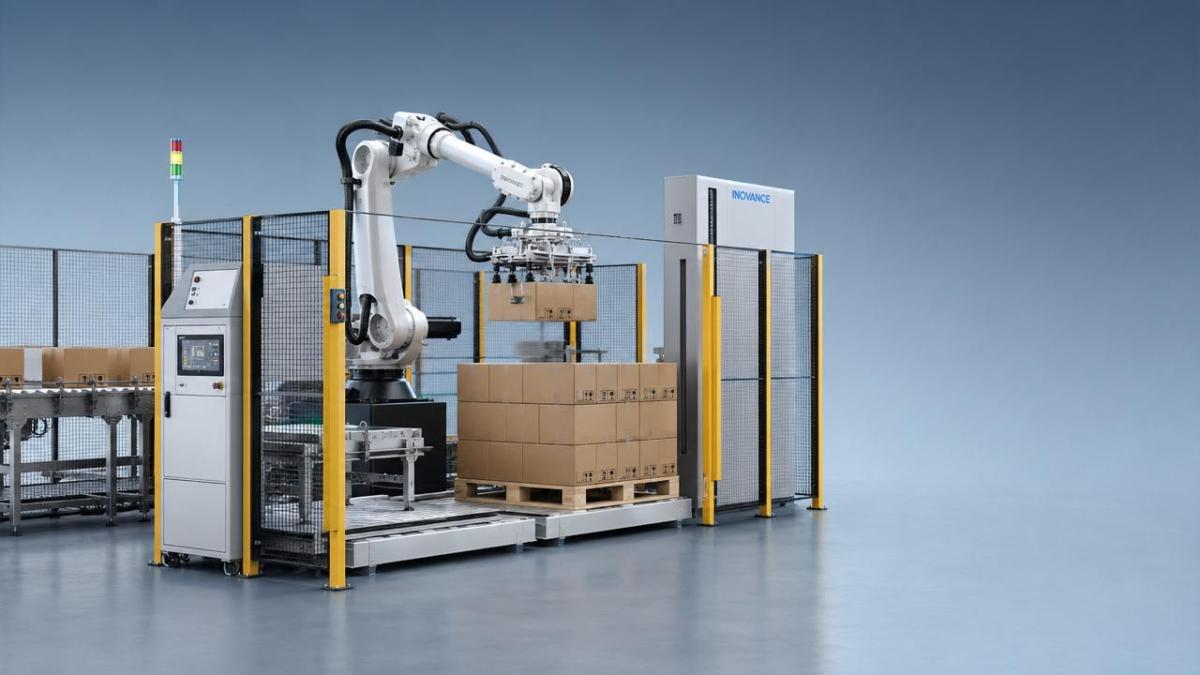
Procurement teams should compare full cell layout drawings, not just robot dimensions. Include pallet magazine placement, access for maintenance, operator walkways, and future line modifications.
A smaller robotic arm does not automatically create a better footprint. Sometimes the surrounding structures, tool changers, or guarding architecture consume the real space.
Ask whether the cell can handle multiple pallet positions, dual infeed lines, or mixed-SKU expansion without major relocation. Layout flexibility can save far more than a lower initial quote.
This is especially important for operations that expect seasonal product changes, new packaging formats, or later integration with stretch wrapping and warehouse automation.
Integration capability often separates strong suppliers from basic machine sellers
When procurement compares palletizing robot suppliers, integration capability is often the most important hidden variable in project success.
A palletizing robot does not operate alone. It must communicate with conveyors, barcode systems, upstream case erectors, pallet dispensers, safety PLCs, MES layers, and sometimes WMS platforms.
If a supplier cannot define interface responsibility clearly, the project risk rises quickly. Delays, blame shifting, and commissioning disputes usually start at these boundaries.
Ask each supplier for a standard interface list covering electrical, controls, network protocols, alarm handling, and data exchange expectations. Mature suppliers usually have this ready.
It is also worth checking whether their engineering team can adapt to your plant standards, including preferred PLC brand, HMI structure, cybersecurity rules, and remote diagnostics requirements.
Suppliers with strong integration discipline usually shorten startup time because they treat the project as a system, not just a robot shipment.
Do not ignore gripper engineering and product handling risk
Many buyers focus heavily on robot brand, but the gripper often determines whether the palletizing cell performs reliably in real packaging conditions.
Vacuum, clamp, fork, bag, and hybrid grippers all have different failure modes. The wrong design can lead to dropped products, skewed layers, unstable pallets, and maintenance headaches.
Procurement should ask suppliers how the end-of-arm tool handles damaged cartons, porous materials, label variability, or slight dimensional deviations.
For bag palletizing, ask about anti-slip handling, compression effects, and how the tool manages inconsistent fill levels. For cartons, ask about vacuum reserve and suction monitoring.
Also request wear component details, replacement intervals, and spare parts sourcing. A low-cost gripper may create expensive downtime if seals, cups, or sensors fail frequently.
In many projects, real differentiation between palletizing robot suppliers comes from application-specific tooling expertise rather than the robot arm itself.
Evaluate software usability, recipe management, and changeover practicality
Procurement decisions should reflect how the system will be used daily by operators, supervisors, and maintenance technicians, not only by commissioning engineers.
If your operation handles multiple SKUs, pallet patterns, or customer-specific stacking rules, software usability becomes a major productivity factor.
Ask suppliers how new recipes are created, validated, and protected. Can plant staff adjust pallet patterns without external programming support? How are errors prevented during changeover?
A user-friendly HMI can reduce training time and dependence on the supplier. A rigid or overly technical interface can turn simple product changeovers into avoidable support calls.
Also compare alarm visibility, production reporting, remote troubleshooting functions, and backup procedures. These software details affect maintenance burden and line recovery speed.
Good procurement practice is to include a live software walkthrough during technical review, not just a promise that the interface is intuitive.
After-sales support and spare parts response are not secondary issues
For automated palletizing, after-sales capability is a commercial risk factor, not a soft service topic. A lower purchase price can become costly if support response is slow.
Procurement should evaluate service coverage by region, local technician availability, remote diagnostics readiness, spare parts stock strategy, and contractual response commitments.
Ask where critical parts are stored, what the standard lead times are, and which components are proprietary versus globally available. Proprietary dependence increases long-term sourcing risk.
It is also wise to distinguish between robot brand support and system integrator support. Even if the robot OEM is strong, the cell builder may still be the service bottleneck.
Request sample preventive maintenance schedules and expected annual maintenance tasks. This helps estimate labor burden and required technician skill level.
Among palletizing robot suppliers, the best long-term partner is often the one with the most transparent support infrastructure, not the most aggressive sales presentation.
Use lifecycle cost, not purchase price, as the commercial decision model
Procurement teams are usually asked to justify investment in financial terms. That makes lifecycle cost a better decision lens than initial capital expenditure alone.
Compare energy use, expected wear parts consumption, maintenance hours, training needs, software licensing, remote support fees, and likely downtime exposure.
Even modest differences in uptime can outweigh major quote differences over several years. A system that reduces stoppages and operator intervention often delivers better total return.
You should also include commissioning duration, production ramp-up risk, and internal engineering time required from your own plant team.
When suppliers submit proposals, ask them to standardize cost assumptions over three to five years. This makes the comparison more objective and less vulnerable to sales framing.
A disciplined total cost of ownership model helps procurement defend its decision internally and prevents overemphasis on the cheapest visible quote.
How to structure a practical supplier scorecard
To compare palletizing robot suppliers fairly, create a weighted scorecard before final commercial negotiation. This prevents the selection process from drifting toward price-only discussions.
Typical categories include application fit, throughput stability, footprint efficiency, controls integration, tooling design, software usability, service capability, lead time, and lifecycle cost.
Each category should include measurable evidence. For example, throughput should rely on tested case data, while support capability should rely on named service resources and parts strategy.
For procurement teams, a weighted scorecard also improves cross-functional alignment with operations, maintenance, engineering, and safety stakeholders.
This matters because supplier selection for palletizing is rarely a pure purchasing decision. It affects plant performance, manpower planning, and operational resilience.
Where possible, include a factory acceptance test plan and site acceptance criteria in the bid process. This turns evaluation logic into contractual accountability.
Questions procurement should ask before shortlisting suppliers
Several focused questions can quickly reveal which suppliers are technically mature and which rely mostly on generic marketing language.
Ask for proven throughput on comparable products, defined under real payload and gripper conditions. Ask what assumptions are built into the quoted cycle rate.
Ask which interfaces are included, which are excluded, and who owns integration with adjacent equipment. Ambiguity here is a major source of project overrun.
Ask how recipe changes are handled, what local service coverage exists, and what spare parts are considered critical for the first year.
Ask for expected preventive maintenance hours per month, recommended operator training scope, and examples of common field failures with similar applications.
Strong suppliers usually answer with structure and data. Weak suppliers often return to generic claims about quality, innovation, or being a leading provider.
Final decision: choose the supplier that reduces operational uncertainty
The best palletizing robot supplier is not necessarily the one with the largest payload, the lowest quote, or the most recognized brand name.
For procurement, the strongest choice is usually the supplier that best reduces uncertainty across performance, integration, support, and lifecycle cost.
If two suppliers can both lift the required load, then the real decision should center on who can deliver stable output, fit the site, support the line, and scale with future needs.
That is why serious comparison must go beyond payload. Payload only tells you whether the robot can pick the product. It does not tell you whether the project will succeed.
By using a structured, engineering-based sourcing framework, procurement teams can shorten qualification cycles, avoid specification noise, and select partners on measurable operational value.
In a market crowded with broad claims, the most reliable procurement decisions come from comparing facts: tested throughput, interface clarity, service readiness, and total ownership risk.
Search News
Hot Articles
- Carbon Fiber StructuresHow to Specify Aerospace Carbon Fiber Assemblies for Lightweight, Load-Bearing PartsJul 11, 2026
- Machine VisionXiaomi, Alibaba DAMO Academy Drive Open-Source Robotics Model Ecosystem, Lowering Algorithm Development Barriers for Overseas SMEs Adopting Chinese Robotics SolutionsMar 30, 2026
- Cobots & ArmsShanxi 'AI+' Conference Showcases Embodied Intelligence with Multinational Buyer Engagement: Key Industry ImplicationsMar 30, 2026
Popular Tags
Recommended News
 Jul 11, 2026How to Specify Aerospace Carbon Fiber Assemblies for Lightweight, Load-Bearing PartsAerospace carbon fiber assemblies: learn how to specify laminate design, load data, joining methods, and inspection controls for lighter, reliable load-bearing aerospace parts.Elena Rostova (UAV Systems Researcher)
 Mar 30, 2026Xiaomi, Alibaba DAMO Academy Drive Open-Source Robotics Model Ecosystem, Lowering Algorithm Development Barriers for Overseas SMEs Adopting Chinese Robotics SolutionsXiaomi & Alibaba DAMO Academy's open-source robotics models lower algorithm barriers for global SMEs. Boost efficiency in manufacturing, logistics & smart retail with ROS 2 compatible solutions.TSV Data Lab
 Mar 30, 2026Shanxi 'AI+' Conference Showcases Embodied Intelligence with Multinational Buyer Engagement: Key Industry ImplicationsShanxi 'AI+' Conference highlights embodied intelligence with Tesla, Ubtech & Jiantao showcasing multimodal robotics. 40+ global buyers validated tech on-site, creating new B2B channels for industrial automation & AI solutions.Chen Wei (Automation Lead Engineer)
 Mar 30, 2026Zhongguancun Unveils 6G Integrated Sensing-Computing-Intelligence Platform to Empower Embodied Robots for Global Industrial ApplicationsZhongguancun's new 6G platform revolutionizes industrial robotics with <10ms latency, empowering global automotive, logistics & port automation. Discover how this tech boosts China's smart manufacturing exports.TSV Data Lab
 Mar 30, 2026Mech-Mind Tianjin Embodied Intelligence R&D and Production Base Goes Live, Cutting Delivery Time by 20%–30% for Global Customized AMR+Vision SolutionsMech-Mind's Tianjin AMR+Vision production base cuts delivery time by 20%-30% for欧美 & Latin American markets. Discover how this PLd-certified facility accelerates customized robotics solutions for smart manufacturing and logistics.Chen Wei (Automation Lead Engineer)
 Mar 30, 2026Boao Forum Reveals 'Co-evolution of Big and Small Brains' Trend in Humanoid Robots, China's Embodied Intelligence Accelerates Adaptation to Overseas Manufacturing Service ScenariosDiscover how China's humanoid robots, featuring 'Co-evolution of Big and Small Brains,' are revolutionizing global manufacturing. Learn about Embodied Tian Gong 3.0's ISO compliance and overseas deployment at Boao Forum 2026.Chen Wei (Automation Lead Engineer)
 Mar 30, 2026China Railway Industrial Secures Patent for Embodied Robotics in Material Handling, Boosting High-Precision Delivery Capabilities for Overseas Infrastructure and Manufacturing ProjectsChina Railway Industrial's new patent for embodied robotics in material handling boosts high-precision delivery for global infrastructure & manufacturing. Discover how this innovation enhances logistics accuracy in automotive, rail transit & EPC projects.Chen Wei (Automation Lead Engineer)
 Sep 28, 2026Spindle Runout Measurement in Germany: DIN Standards, Methods, and Acceptance LimitsSpindle runout measurement Germany: explore DIN standards, proven methods, acceptance limits, and audit-ready practices for reliable machining quality.Dr. Marcus Vance
 Sep 27, 2026How to Select Wall-Mount Edge Devices for Space-Constrained Factory NetworksWall mount edge devices for space-constrained factories: evaluate workload, thermal design, power resilience, cable access, and network reliability for smarter deployments.TSV Data Lab
 Sep 26, 2026Machining Tolerance Analysis: How to Set Limits That Meet Function and Cost TargetsMachining tolerance analysis: learn how to set functional limits, control tolerance stacks, reduce inspection risk, and balance precision with production cost.Dr. Marcus Vance
 Sep 25, 2026How to Evaluate an Industrial Infrastructure Data Platform for Multi-Site OperationsIndustrial infrastructure data platform evaluation guide for multi-site operations: compare data quality, edge resilience, interoperability, governance, and scalable proof-of-value criteria.Victor Lin (Chief Software Architect)
 Sep 24, 2026How to Select Machine Vision Optics for Accurate Inspection at Different Working DistancesMachine vision optics selection guide for accurate inspection at every working distance. Compare FOV, pixel scale, DOF, distortion, lighting, and telecentric options.TSV Data Lab
 Sep 23, 2026How to Evaluate a Machine Vision System Integrator for High-Speed Inspection LinesChoose a machine vision system integrator with proven expertise in high-speed inspection, reliable reject timing, robust optics, and measurable acceptance criteria.TSV Data Lab
 Sep 28, 2026When is a SCADA API the right choice for connecting plant systems?SCADA API guide: learn when governed plant data integration improves traceability, security, and scalability—without compromising real-time control.Victor Lin (Chief Software Architect)
 Sep 27, 2026How SCADA data integration improves traceability across production linesSCADA data integration connects production-line data to improve traceability, accelerate quality investigations, and strengthen safety decisions.Victor Lin (Chief Software Architect)
 Sep 26, 2026What to define before starting SCADA integration planningSCADA integration planning starts with clear scope, control boundaries, data models, cybersecurity, and testing. Discover the definitions that reduce risk and costly rework.Victor Lin (Chief Software Architect)
 Sep 25, 2026How a smart factory with Industrial IoT reduces production blind spotsDiscover how a smart factory with Industrial IoT turns real-time machine, quality, and workflow data into actionable insights that reduce production blind spots and delivery risks.Victor Lin (Chief Software Architect)
 Sep 24, 2026When does Industrial IoT make smart manufacturing easier to scale?Smart manufacturing Industrial IoT scales when trusted data, interoperable systems, and secure workflows turn connected assets into measurable gains.TSV Data Lab
 Sep 23, 2026What drives ultra-precision machining cost at 1-micron tolerance?Ultra precision machining cost per part at 1 micron tolerance depends on process, material, metrology, and yield. Learn how to compare quotes confidently.Dr. Marcus Vance
 Sep 22, 2026Drone Engine-T550CC Applications: Build the UAV Power System Around the MissionAn application guide for Drone Engine-T550CC integration, covering payload planning, airframe matching, cooling, fuel, vibration, test procedures, documentation, and service preparation.Elena Rostova (UAV Systems Researcher)
 Sep 22, 2026How to Evaluate Industrial Edge Computing Vendors for Factory DeploymentIndustrial edge computing vendor evaluation guide for factories: compare latency, protocol fit, reliability, security, and lifecycle support before deployment.TSV Data Lab
 Sep 21, 2026Drone Payload Integration: Matching Power, Data, and Center of Gravity for Reliable FlightsDrone payload integration made practical: balance power, data, center of gravity, and endurance to build safer, more reliable mission-ready flights.Elena Rostova (UAV Systems Researcher)
 Sep 20, 2026Autonomous Navigation Pricing: Cost Drivers and Budget Benchmarks for AMR ProjectsAutonomous navigation price explained: compare AMR cost drivers, software, sensors, integration, safety, and lifecycle budgets to build a scalable project plan.Chen Wei (Automation Lead Engineer)
 Sep 19, 2026How to Scope Automation Integration Services for Multi-System Factory ProjectsAutomation integration services: learn how to scope multi-system factory projects with clear workflows, interface contracts, safety boundaries, and acceptance criteria.Victor Lin (Chief Software Architect)