Collaborative Robot Safety Standards That Change System Design
Publication Date
author
Collaborative robots safety standards do far more than define compliance checklists—they directly reshape cell layout, sensing architecture, speed limits, and risk mitigation strategy. For quality and safety leaders, understanding how ISO- and application-driven requirements influence system design is essential to reducing integration risk, preventing costly retrofits, and ensuring reliable human-robot collaboration in real production environments.
Why quality and safety teams should use a checklist first
When teams discuss collaborative robots safety standards, they often start with a narrow question: “Is the cobot compliant?” That is usually the wrong starting point. Compliance is not a single equipment attribute. It is the result of system-level decisions involving the robot arm, end effector, fixture design, sensing, software logic, operator access, and the real production task. For quality personnel and safety managers, a checklist approach is the fastest way to identify whether a proposed design aligns with actual risk conditions before procurement, installation, or validation.
This matters because collaborative applications are highly context dependent. A robot that is acceptable for light pick-and-place may become noncompliant when fitted with a sharp gripper, a heavier payload, a longer reach, or a different cycle time. In practice, collaborative robots safety standards change system design by forcing teams to verify safe speed, stopping distance, pinch-point exposure, energy limits, and operator interaction modes early. If these checks are postponed, retrofits often include added scanners, reduced throughput, restricted access zones, or complete fixture redesign.
Start with the standards that most directly affect design decisions
Before reviewing hardware, quality and safety leaders should identify the standards framework that will govern the cell. The most common references include ISO 10218 for industrial robot safety requirements, ISO/TS 15066 for collaborative robot applications, and broader machine safety concepts such as risk assessment, safeguarding validation, emergency stop performance, and functional safety architecture. Depending on geography and industry, additional national regulations, customer standards, and sector-specific validation rules may apply.
The important operational point is this: collaborative robots safety standards do not simply approve a robot model. They define what must be demonstrated in the installed application. That means your documentation package should connect the intended operating mode, identified hazards, measured force or pressure exposure where relevant, and verification results for the final integrated system.
Core checklist: the first design items to verify
Use the following checklist at concept stage, supplier review, and pre-acceptance testing. These are the key checkpoints that most often determine whether collaborative robots safety standards will force design changes.
- Confirm the collaboration mode. Determine whether the system relies on safety-rated monitored stop, hand guiding, speed and separation monitoring, or power and force limiting. Each mode creates different sensor, control, and layout requirements.
- Define the actual task, not just the robot model. Include payload mass, product geometry, edge sharpness, tool type, process force, and operator hand position during normal and abnormal operations.
- Review end-of-arm tooling hazards. Many collaborative applications fail not because of the robot arm, but because grippers, cutters, vacuum cups, screws, or custom tools introduce crush, puncture, or entanglement risks.
- Check stopping performance and protective distance. If the design uses speed and separation monitoring, scanner coverage, response time, and braking distance must be validated as a system.
- Map all pinch and trap points. Fixtures, pallets, conveyors, part nests, and nearby structures can create hazardous points even when the robot itself is collaborative.
- Verify safety function architecture. Safe limited speed, safe stop, safe position, and other functions should be supported by the controller and integrated with safety-rated devices using an appropriate performance level.
- Evaluate foreseeable misuse. Consider maintenance reach-in, recovery after faults, manual clearing of jammed parts, and unauthorized changes to speed or path settings.
- Plan validation evidence. Decide how force, pressure, speed, access, and fault response will be measured and recorded for sign-off.
How collaborative robots safety standards change system design in practice
1. Cell layout changes
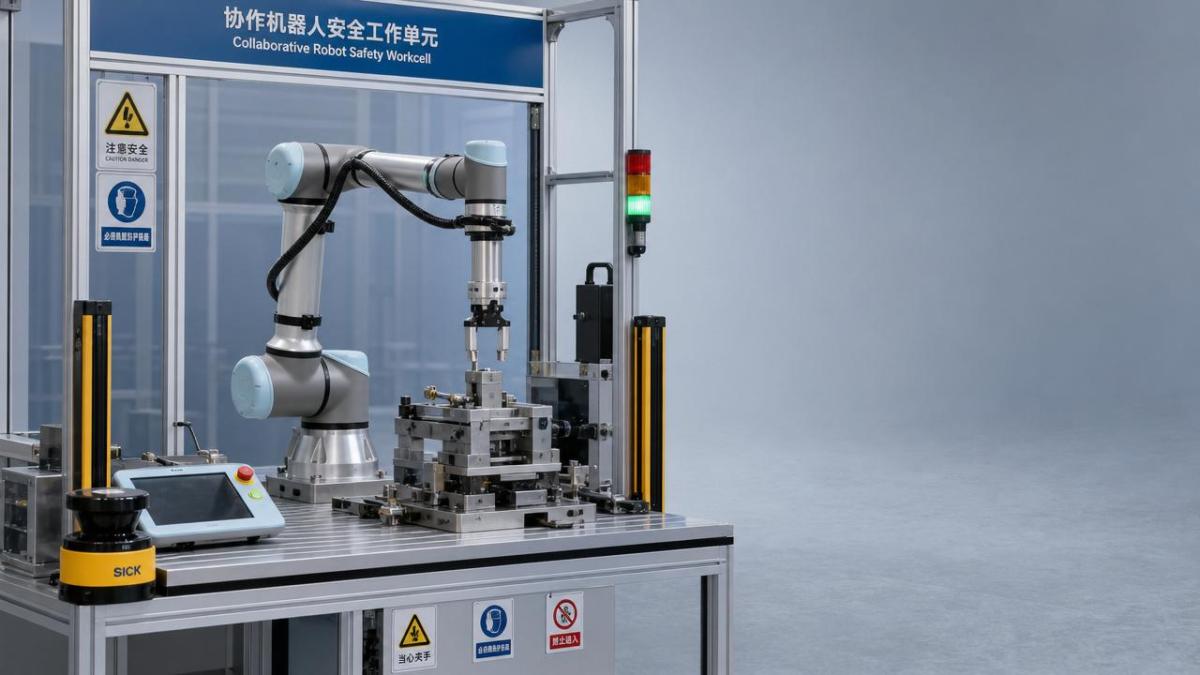
A collaborative robot rarely eliminates the need for layout engineering. Standards-driven design often requires more controlled operator approach paths, fewer hidden access points, better visibility, and greater separation between robot motion and manual work zones. Safety managers should ask whether operators can unexpectedly enter from the rear, reach under fixtures, or contact moving parts during replenishment. Even a small change in workstation orientation can reduce risk and preserve cycle time better than adding more hardware later.
2. Speed and throughput limits change
One of the most common surprises is that collaborative robots safety standards may reduce allowable operating speed far below the theoretical robot specification. If risk reduction depends on power and force limiting, the acceptable speed depends on tool shape, payload inertia, contact location, and body-region exposure. Quality teams should therefore treat quoted cycle time with caution until application-specific limits are validated.
3. Sensor architecture becomes mandatory, not optional
For applications using speed and separation monitoring, safety scanners, vision-based detection, area monitoring, and controller response times become central design inputs. These elements affect floor space, cable routing, restart logic, and maintenance burden. A robot marketed as easy to deploy may still require a sophisticated sensing architecture once the actual human approach pattern is considered.
4. End effector redesign is often required
Rounded geometry, guarded edges, lower gripping force, and reduced protrusions are frequent outcomes of applying collaborative robots safety standards correctly. In many projects, redesigning the tool is the fastest route to acceptable risk. This is especially true in assembly, packaging, electronics handling, and inspection cells where hand access is frequent.
Quick comparison table for safety and quality review
Checklist by scenario: what changes across applications
Assembly and small-parts handling
Prioritize hand proximity, fixture pinch points, tool edge radius, and restart behavior after part jams. In these cells, frequent operator intervention increases the importance of intuitive status indication, controlled manual recovery, and low-force end effectors.
Machine tending
Do not assume a collaborative robot makes the whole machine collaborative. The machine itself may introduce cutting, ejection, thermal, or door-interlock hazards. Collaborative robots safety standards must be considered together with machine safeguarding and sequence control.
Packaging and palletizing
Check reach envelope, payload variation, stack stability, and operator approach from replenishment zones. These applications often look simple but create high inertia and long stopping distances that limit collaborative operation.
Inspection and lab environments
Focus on precision motion near personnel, sample contamination controls, and integration with vision systems. Here, slow speed alone is not enough; unintended motion during calibration or recipe changes can still create exposure.
Common oversights that trigger noncompliance or poor performance
- Treating the cobot datasheet as proof of application safety.
- Ignoring the effect of a heavier or custom end effector on impact risk.
- Failing to validate safety functions after software updates or recipe changes.
- Overlooking maintenance access, cleaning tasks, and fault recovery conditions.
- Assuming scanner placement is acceptable without checking blind spots and approach speed.
- Underestimating the documentation needed for audits, customer approval, or internal sign-off.
Execution plan: what to prepare before supplier review or internal approval
If your company is evaluating a new collaborative cell, prepare a structured input package. Include the process description, part dimensions, target cycle time, payload, operator touchpoints, shift pattern, maintenance tasks, existing safety architecture, and required validation records. This gives integrators and internal reviewers enough data to determine how collaborative robots safety standards will influence design choices from the start.
For best results, quality and safety teams should also request specific evidence instead of general compliance claims. Ask for the risk assessment summary, assumed operating mode, safety function list, stop-time data, scanner coverage logic, end-effector hazard controls, and planned acceptance test criteria. At TechStat Vanguard, this parameter-first mindset reflects a simple engineering truth: decisions improve when specifications, tolerances, and test conditions are explicit rather than implied.
FAQ for quality and safety leaders
Does a collaborative robot remove the need for guarding?
No. Collaborative robots safety standards may still require guarding, scanners, interlocks, or restricted zones depending on the task, tool, speed, and surrounding hazards.
Can we approve a system based only on manufacturer certification?
No. Certification of components does not replace application-level risk assessment and validation for the final integrated cell.
What is the most common source of redesign?
Usually the end effector, fixture pinch points, or underestimated stopping and separation requirements rather than the robot arm itself.
Final action guide
The most effective way to manage collaborative robots safety standards is to review them as system design inputs, not as a late-stage compliance task. Start by confirming the collaboration mode, task hazards, tooling profile, speed limits, and safety architecture. Then validate the actual installed application with measurable evidence. This checklist-driven approach reduces audit risk, prevents throughput surprises, and supports safer human-robot collaboration.
If you need to move from concept to implementation, the next conversation should focus on five items first: required operating mode, task-specific hazards, acceptable cycle time after safety limits, validation method for force or separation performance, and documentation needed for internal approval or customer acceptance. Those questions will reveal whether the proposed system is truly ready—or whether the standards are about to change the design more than expected.
Search News
Hot Articles
- Carbon Fiber StructuresHow to Specify Aerospace Carbon Fiber Assemblies for Lightweight, Load-Bearing PartsJul 11, 2026
- Machine VisionXiaomi, Alibaba DAMO Academy Drive Open-Source Robotics Model Ecosystem, Lowering Algorithm Development Barriers for Overseas SMEs Adopting Chinese Robotics SolutionsMar 30, 2026
- Cobots & ArmsShanxi 'AI+' Conference Showcases Embodied Intelligence with Multinational Buyer Engagement: Key Industry ImplicationsMar 30, 2026
Popular Tags
Recommended News
 Jul 11, 2026How to Specify Aerospace Carbon Fiber Assemblies for Lightweight, Load-Bearing PartsAerospace carbon fiber assemblies: learn how to specify laminate design, load data, joining methods, and inspection controls for lighter, reliable load-bearing aerospace parts.Elena Rostova (UAV Systems Researcher)
 Mar 30, 2026Xiaomi, Alibaba DAMO Academy Drive Open-Source Robotics Model Ecosystem, Lowering Algorithm Development Barriers for Overseas SMEs Adopting Chinese Robotics SolutionsXiaomi & Alibaba DAMO Academy's open-source robotics models lower algorithm barriers for global SMEs. Boost efficiency in manufacturing, logistics & smart retail with ROS 2 compatible solutions.TSV Data Lab
 Mar 30, 2026Shanxi 'AI+' Conference Showcases Embodied Intelligence with Multinational Buyer Engagement: Key Industry ImplicationsShanxi 'AI+' Conference highlights embodied intelligence with Tesla, Ubtech & Jiantao showcasing multimodal robotics. 40+ global buyers validated tech on-site, creating new B2B channels for industrial automation & AI solutions.Chen Wei (Automation Lead Engineer)
 Mar 30, 2026Zhongguancun Unveils 6G Integrated Sensing-Computing-Intelligence Platform to Empower Embodied Robots for Global Industrial ApplicationsZhongguancun's new 6G platform revolutionizes industrial robotics with <10ms latency, empowering global automotive, logistics & port automation. Discover how this tech boosts China's smart manufacturing exports.TSV Data Lab
 Mar 30, 2026Mech-Mind Tianjin Embodied Intelligence R&D and Production Base Goes Live, Cutting Delivery Time by 20%–30% for Global Customized AMR+Vision SolutionsMech-Mind's Tianjin AMR+Vision production base cuts delivery time by 20%-30% for欧美 & Latin American markets. Discover how this PLd-certified facility accelerates customized robotics solutions for smart manufacturing and logistics.Chen Wei (Automation Lead Engineer)
 Mar 30, 2026Boao Forum Reveals 'Co-evolution of Big and Small Brains' Trend in Humanoid Robots, China's Embodied Intelligence Accelerates Adaptation to Overseas Manufacturing Service ScenariosDiscover how China's humanoid robots, featuring 'Co-evolution of Big and Small Brains,' are revolutionizing global manufacturing. Learn about Embodied Tian Gong 3.0's ISO compliance and overseas deployment at Boao Forum 2026.Chen Wei (Automation Lead Engineer)
 Mar 30, 2026China Railway Industrial Secures Patent for Embodied Robotics in Material Handling, Boosting High-Precision Delivery Capabilities for Overseas Infrastructure and Manufacturing ProjectsChina Railway Industrial's new patent for embodied robotics in material handling boosts high-precision delivery for global infrastructure & manufacturing. Discover how this innovation enhances logistics accuracy in automotive, rail transit & EPC projects.Chen Wei (Automation Lead Engineer)
 Sep 29, 2026ISO 9283 Repeatability: How to Evaluate Cobot Positioning PerformanceISO 9283 cobot repeatability explained: learn how payload, reach, approach direction, and test conditions affect positioning performance and cell capability.Chen Wei (Automation Lead Engineer)
 Sep 28, 2026Spindle Runout Measurement in Germany: DIN Standards, Methods, and Acceptance LimitsSpindle runout measurement Germany: explore DIN standards, proven methods, acceptance limits, and audit-ready practices for reliable machining quality.Dr. Marcus Vance
 Sep 27, 2026How to Select Wall-Mount Edge Devices for Space-Constrained Factory NetworksWall mount edge devices for space-constrained factories: evaluate workload, thermal design, power resilience, cable access, and network reliability for smarter deployments.TSV Data Lab
 Sep 26, 2026Machining Tolerance Analysis: How to Set Limits That Meet Function and Cost TargetsMachining tolerance analysis: learn how to set functional limits, control tolerance stacks, reduce inspection risk, and balance precision with production cost.Dr. Marcus Vance
 Sep 25, 2026How to Evaluate an Industrial Infrastructure Data Platform for Multi-Site OperationsIndustrial infrastructure data platform evaluation guide for multi-site operations: compare data quality, edge resilience, interoperability, governance, and scalable proof-of-value criteria.Victor Lin (Chief Software Architect)
 Sep 24, 2026How to Select Machine Vision Optics for Accurate Inspection at Different Working DistancesMachine vision optics selection guide for accurate inspection at every working distance. Compare FOV, pixel scale, DOF, distortion, lighting, and telecentric options.TSV Data Lab
 Sep 23, 2026How to Evaluate a Machine Vision System Integrator for High-Speed Inspection LinesChoose a machine vision system integrator with proven expertise in high-speed inspection, reliable reject timing, robust optics, and measurable acceptance criteria.TSV Data Lab
 Sep 28, 2026When is a SCADA API the right choice for connecting plant systems?SCADA API guide: learn when governed plant data integration improves traceability, security, and scalability—without compromising real-time control.Victor Lin (Chief Software Architect)
 Sep 27, 2026How SCADA data integration improves traceability across production linesSCADA data integration connects production-line data to improve traceability, accelerate quality investigations, and strengthen safety decisions.Victor Lin (Chief Software Architect)
 Sep 26, 2026What to define before starting SCADA integration planningSCADA integration planning starts with clear scope, control boundaries, data models, cybersecurity, and testing. Discover the definitions that reduce risk and costly rework.Victor Lin (Chief Software Architect)
 Sep 25, 2026How a smart factory with Industrial IoT reduces production blind spotsDiscover how a smart factory with Industrial IoT turns real-time machine, quality, and workflow data into actionable insights that reduce production blind spots and delivery risks.Victor Lin (Chief Software Architect)
 Sep 24, 2026When does Industrial IoT make smart manufacturing easier to scale?Smart manufacturing Industrial IoT scales when trusted data, interoperable systems, and secure workflows turn connected assets into measurable gains.TSV Data Lab
 Sep 23, 2026What drives ultra-precision machining cost at 1-micron tolerance?Ultra precision machining cost per part at 1 micron tolerance depends on process, material, metrology, and yield. Learn how to compare quotes confidently.Dr. Marcus Vance
 Sep 22, 2026Drone Engine-T550CC Applications: Build the UAV Power System Around the MissionAn application guide for Drone Engine-T550CC integration, covering payload planning, airframe matching, cooling, fuel, vibration, test procedures, documentation, and service preparation.Elena Rostova (UAV Systems Researcher)
 Sep 22, 2026How to Evaluate Industrial Edge Computing Vendors for Factory DeploymentIndustrial edge computing vendor evaluation guide for factories: compare latency, protocol fit, reliability, security, and lifecycle support before deployment.TSV Data Lab
 Sep 21, 2026Drone Payload Integration: Matching Power, Data, and Center of Gravity for Reliable FlightsDrone payload integration made practical: balance power, data, center of gravity, and endurance to build safer, more reliable mission-ready flights.Elena Rostova (UAV Systems Researcher)
 Sep 20, 2026Autonomous Navigation Pricing: Cost Drivers and Budget Benchmarks for AMR ProjectsAutonomous navigation price explained: compare AMR cost drivers, software, sensors, integration, safety, and lifecycle budgets to build a scalable project plan.Chen Wei (Automation Lead Engineer)