
Cobot Cost Breakdown: How to Estimate Total Cost and Payback for Assembly Cells
Publication Date
author
Understanding cobots cost requires looking beyond the robot’s purchase price. A credible assembly-cell budget must include tooling, safety validation, integration, software, training, uptime assumptions, and ongoing support. The useful question is not “What does the robot cost?” but “What does one reliable, accepted production hour cost over the life of the cell?”
That distinction matters because collaborative automation is often presented as a low-barrier alternative to conventional industrial robotics. In some applications it is. A compact cobot can reduce guarding requirements, fit into constrained workstations, and be redeployed more easily than a fixed robot cell. Yet the robot arm is only one component in an operating system that must pick parts, orient them, perform a process, verify the result, recover from errors, and hand the work back to the production flow.
For assembly operations, the largest budgeting errors usually occur when a project is costed as an arm plus an end effector, while the actual production requirement is a complete automation cell. A sound capital request should separate the costs that are fixed, the costs that scale with process complexity, and the assumptions that determine whether payback is real.
The purchase price is only the starting point
A typical collaborative robot arm, including its controller and basic teach pendant, may represent a minority of the delivered cost of an assembly cell. Pricing varies substantially by payload, reach, repeatability, market, regional distribution model, and included software. A small cobot for light assembly may be priced in the tens of thousands of US dollars, while higher-payload models, specialized variants, or systems sold with expanded software and service packages can cost materially more.
That number is useful for initial screening, but it is not an investment estimate. The all-in budget must answer several operational questions:
- What exactly enters the cell: loose parts, trays, pallets, bulk-fed components, or manually presented workpieces?
- What does the robot do: pick-and-place, screwdriving, dispensing, press fitting, labeling, testing, inspection, or packaging?
- How is a completed unit verified and routed?
- How often will product variants change?
- What happens when a part is missing, misaligned, damaged, or outside tolerance?
- Can the line maintain required output through shift changes, replenishment, and planned maintenance?
The more ambiguous these questions are at approval stage, the more likely that integration cost, schedule risk, and commissioning effort will expand after the purchase order is issued.
A practical cost structure for a cobot assembly cell
Capital planning is clearer when costs are grouped by their role in producing a stable cycle rather than by supplier quotation line items.
Robot, controller, and core accessories
This category includes the arm, controller, pendant or programming interface, mounting hardware, cables, and sometimes a pedestal. It may also include a seventh-axis rail, rotary table, or mobile base, although these additions can change both the technical risk and the safety case. For a basic fixed workstation, the robot itself is usually the most visible cost but not necessarily the most consequential one.
Approvers should confirm whether quoted payload applies at the required reach and tool center point. A robot that is nominally capable of handling a part may become unsuitable after the mass and moment of inertia of the gripper, screwdriver, camera, cable dress pack, and product are added. Selecting a larger arm later can affect not only equipment price but also cycle performance, pedestal design, safety zoning, and floor layout.
End-of-arm tooling and process equipment
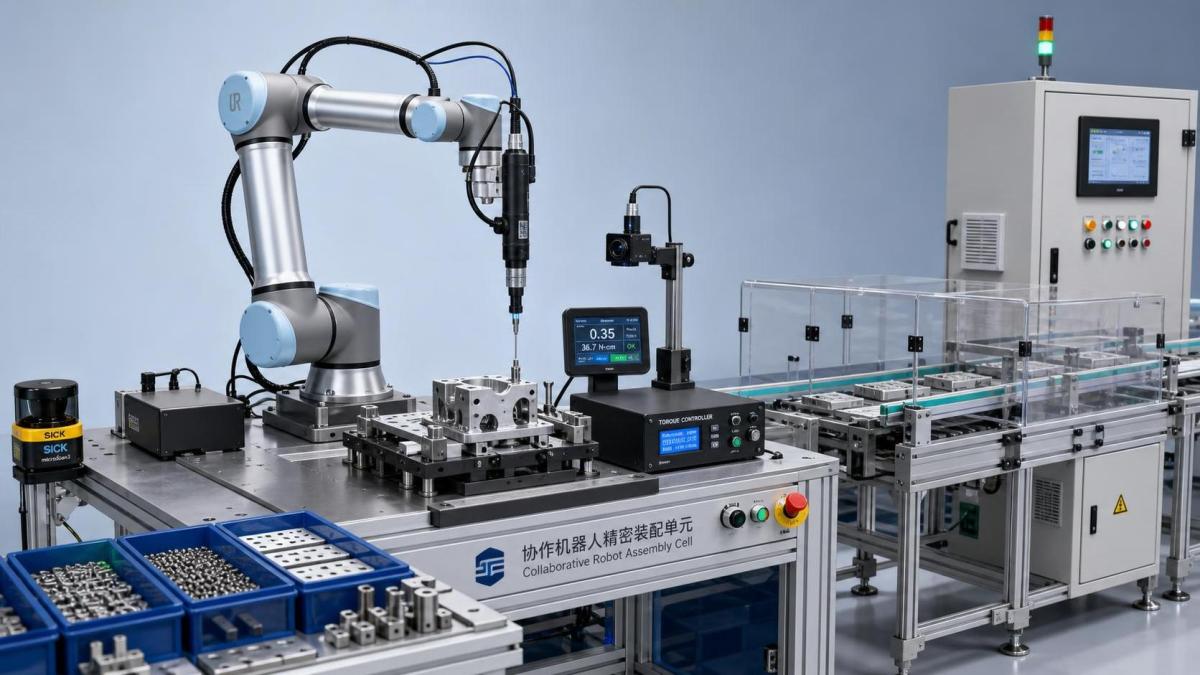
In assembly, the end effector often determines the business case. A simple vacuum gripper may be inexpensive, but a production-grade gripper may require vacuum generation, pressure monitoring, part-present sensing, compliant mounts, quick-change hardware, and spare cups. Mechanical grippers may need custom fingers for each product family. Screwdriving tools require torque control, bit management, screw feeding, depth or angle verification, and error-proofing logic. Dispensing systems add pumps, fluid conditioning, calibration, purge procedures, and consumable management.
Tooling should be budgeted as a product-life-cycle asset, not as a one-time accessory. If a plant changes packaging, fastener sizes, or molded part geometry regularly, the cost of change parts and revalidation can outweigh the initial savings from a low-priced gripper.
Part presentation, fixturing, and material flow
Many apparently attractive cobot projects fail their financial model here. A human operator can compensate for mixed orientation, minor component variation, damaged trays, and poor ergonomic presentation without formally recording the effort. A robot cannot. If parts arrive randomly oriented, the project may need structured trays, a bowl feeder, a flex feeder, vision guidance, conveyors, or redesigned packaging.
Fixtures must locate the product consistently enough for the process. A press-fit task may need compliance and force sensing; a precision placement task may require datum features that the existing product does not provide. The cost of an automated cell can rise quickly when upstream variability has been treated as “operator skill” rather than a process defect.
Safety engineering and validation
“Collaborative” does not mean inherently safe in every operating condition. Risk assessment remains necessary for the complete application: robot, tool, workpiece, process forces, pinch points, sharp edges, stored energy, and interaction with surrounding equipment. A screwdriver, cutter, hot process, heavy payload, or fast-moving part can create hazards that are not resolved merely because the robot is a cobot.
Costs may include risk assessment, safety controls, scanners or area monitoring, interlocked access where needed, emergency-stop integration, safety-rated I/O, validation testing, signage, and documentation. International guidance commonly referenced in this area includes ISO 10218 for industrial robot safety and ISO/TS 15066 for collaborative robot applications, but local legal requirements, machinery regulations, and site standards determine what must be implemented.
The financial concern is not simply the price of a scanner or fence. It is the risk of discovering late in commissioning that the intended collaborative mode cannot support the required speed, reach, or process force. Early safety review can prevent a project from being redesigned after equipment is already on site.
Integration, controls, and software
Integration is where quotations can become difficult to compare. One supplier may offer a low equipment figure while excluding controls engineering, PLC interface work, factory acceptance testing, installation, production ramp-up support, and documentation. Another may quote a higher turnkey price that includes those items. Neither is automatically better; the scope must be normalized.
Common integration work includes robot programming, PLC or line-controller communication, HMI development, machine vision configuration, traceability links, recipe management, barcode handling, network cybersecurity review, and fault-recovery logic. In regulated or high-value assembly, electronic records, torque traceability, image retention, and serialized work-order integration may be as important as the physical motion.
A useful procurement discipline is to request an explicit “included versus excluded” matrix. It should identify who owns each interface, who supplies production-ready recipes, who resolves cycle-time shortfalls, and what acceptance criteria define completion.
Installation, training, and ramp-up
Site preparation can be modest for a tabletop cobot station, but it should not be assumed to be zero. Electrical supply, compressed air, extraction, network drops, grounding, floor loading, line-side space, and access for maintenance all need review. Production disruption during installation also has an economic cost.
Training should cover more than basic robot programming. Maintenance personnel need fault-recovery procedures, safe restart methods, spare-part identification, backup and restore processes, and escalation channels. Operators need clear instructions for replenishment, quality checks, and exception handling. Without this, the cell can become dependent on one external programmer or one internal “robot champion,” creating an avoidable availability risk.
Build the estimate in three numbers, not one
For approval purposes, a single all-in capital figure is insufficient. The budget should show a base case, a likely case, and a constrained case.
The base case assumes stable part presentation, limited variants, a proven process, and straightforward interfaces. The likely case includes realistic allowances for fixture iteration, commissioning support, production trials, and operator training. The constrained case reflects known uncertainties: difficult materials, frequent product changes, immature upstream feeding, uncertain cycle time, or a new software interface.
This approach is more informative than adding a generic contingency percentage without explanation. A 10% contingency may be excessive for a repeat deployment of a standardized cell but inadequate for a first-time automated assembly process involving vision, force control, and several product variants.
Capital expenditure should also be separated from recurring operating costs. Recurring costs can include preventive maintenance, software subscriptions, remote support, calibration, consumables, replacement gripper components, vision lighting, vacuum filters, and periodic safety inspection. These expenses may be small individually, but they matter in a five- to seven-year total cost of ownership model.
Payback must be based on recoverable value, not gross labor cost
The most common error in cobot ROI calculations is treating the fully loaded wage of every touched labor hour as immediate savings. That is only valid if headcount can actually be reduced, temporary labor avoided, overtime eliminated, or capacity redeployed to work that would otherwise require additional hiring.
A better annual benefit model is:
Annual benefit = recoverable labor value + additional contribution from capacity + quality-loss reduction + safety/ergonomic benefit where measurable − annual operating cost.
Recoverable labor value is not necessarily the same as payroll. If the robot allows one operator to supervise two stations, removes a night-shift staffing requirement, or avoids hiring as order volume grows, the value can be material. If the displaced labor is retained and there is no bottleneck elsewhere to absorb it, the near-term cash benefit may be limited even if productivity improves.
Capacity value also needs discipline. A faster station has economic value only when it relieves a recognized constraint, supports demand that would otherwise be lost, or prevents a future capital or labor expense. Producing more units into inventory is not a return.
Quality savings are often underestimated, particularly in repetitive fastening, dispensing, inspection, and traceable assembly. The relevant figure is not the theoretical reduction in defects. It is the verified cost of poor quality avoided: scrap material, rework labor, test time, warranty exposure, line stoppage, sorting, and customer chargebacks. Historical quality records should establish the baseline before projected gains are credited.
A simple payback model, with the assumptions visible
Consider an assembly cell with an installed cost of US$180,000. This includes the cobot, gripper, screwdriver system, fixtures, safety controls, integration, installation, and training. Annual maintenance, software, and consumables are estimated at US$12,000.
The station operates two shifts for 250 production days. Automation removes 0.75 recoverable labor equivalent per shift through reassignment and avoids regular overtime. The verified annual labor value is US$78,000. Better torque traceability and consistent fastening reduce rework and scrap by an estimated US$24,000 annually. The cell also creates US$30,000 of annual contribution by relieving a documented bottleneck. Annual gross benefit is therefore US$132,000; after US$12,000 of recurring cost, net annual benefit is US$120,000.
Simple payback is:
US$180,000 ÷ US$120,000 = 1.5 years.
This is a reasonable screening result, but it should not be treated as a guaranteed outcome. If actual availability is lower than planned, if output is constrained downstream, or if labor cannot be redeployed, the result changes sharply. If only US$60,000 of labor value is recoverable and bottleneck contribution does not materialize, net benefit may fall to US$72,000, extending simple payback to 2.5 years.
For larger programs, discounted cash flow, net present value, internal rate of return, depreciation treatment, taxes, financing costs, and working-capital effects should be considered under the organization’s standard capital policy. The simple payback remains useful because it exposes operational assumptions quickly; it should not replace a full investment appraisal where the project is material.
Utilization is the hidden variable in most optimistic cases
A cobot does not create value while waiting for material, stopped for changeover, or held because an operator is unavailable to clear a minor fault. Nameplate cycle time is not production output. Financial models should use an expected productive utilization rate based on the real duty cycle.
Track planned production time, actual robot running time, stoppage categories, mean time to recover, first-pass yield, and manual intervention frequency. Early projects often require more human intervention than expected because exception handling was not fully designed. A cell that runs well in a supplier demonstration with ideal parts may behave very differently after several weeks of normal production variability.
Acceptance criteria should therefore include more than a best-case cycle-time test. They should define acceptable throughput over a sustained run, quality performance, fault recovery, changeover time, documentation delivery, and support obligations after site acceptance.
Questions that reveal whether a quotation is investable
Before approval, the project team should be able to answer a short set of commercially important questions without relying on verbal assurances:
- Is the quoted price a robot package, a functional workstation, or a fully installed and accepted production cell?
- Which product variants are included, and what will it cost to add another?
- What assumptions have been made about part orientation, tolerances, cleanliness, and replenishment?
- What cycle time has been demonstrated with representative production parts?
- What safety measures are included after the complete tool and process hazard assessment?
- Who is responsible for electrical, network, MES, traceability, and upstream/downstream interfaces?
- What spare parts, warranty terms, response times, and software fees apply after commissioning?
- What measurable baseline supports labor, quality, and capacity benefits?
The strongest cobot business cases are usually not those with the cheapest robot. They are the applications with stable inputs, repeatable work, a clear bottleneck or staffing constraint, manageable product variation, and a defined owner for uptime. In those conditions, collaborative automation can be a disciplined capital investment rather than an experimental technology purchase.
When evaluating cobots cost, the decision should rest on the cost of a dependable production outcome, the value that outcome can genuinely recover, and the operational evidence behind both numbers. That is the point at which a compelling demonstration becomes an approvable assembly-cell investment.
Search News
Hot Articles
- Carbon Fiber StructuresHow to Specify Aerospace Carbon Fiber Assemblies for Lightweight, Load-Bearing PartsJul 11, 2026
- Machine VisionXiaomi, Alibaba DAMO Academy Drive Open-Source Robotics Model Ecosystem, Lowering Algorithm Development Barriers for Overseas SMEs Adopting Chinese Robotics SolutionsMar 30, 2026
- Cobots & ArmsShanxi 'AI+' Conference Showcases Embodied Intelligence with Multinational Buyer Engagement: Key Industry ImplicationsMar 30, 2026
Popular Tags
Recommended News
 Jul 11, 2026How to Specify Aerospace Carbon Fiber Assemblies for Lightweight, Load-Bearing PartsAerospace carbon fiber assemblies: learn how to specify laminate design, load data, joining methods, and inspection controls for lighter, reliable load-bearing aerospace parts.Elena Rostova (UAV Systems Researcher)
 Mar 30, 2026Xiaomi, Alibaba DAMO Academy Drive Open-Source Robotics Model Ecosystem, Lowering Algorithm Development Barriers for Overseas SMEs Adopting Chinese Robotics SolutionsXiaomi & Alibaba DAMO Academy's open-source robotics models lower algorithm barriers for global SMEs. Boost efficiency in manufacturing, logistics & smart retail with ROS 2 compatible solutions.TSV Data Lab
 Mar 30, 2026Shanxi 'AI+' Conference Showcases Embodied Intelligence with Multinational Buyer Engagement: Key Industry ImplicationsShanxi 'AI+' Conference highlights embodied intelligence with Tesla, Ubtech & Jiantao showcasing multimodal robotics. 40+ global buyers validated tech on-site, creating new B2B channels for industrial automation & AI solutions.Chen Wei (Automation Lead Engineer)
 Mar 30, 2026Zhongguancun Unveils 6G Integrated Sensing-Computing-Intelligence Platform to Empower Embodied Robots for Global Industrial ApplicationsZhongguancun's new 6G platform revolutionizes industrial robotics with <10ms latency, empowering global automotive, logistics & port automation. Discover how this tech boosts China's smart manufacturing exports.TSV Data Lab
 Mar 30, 2026Mech-Mind Tianjin Embodied Intelligence R&D and Production Base Goes Live, Cutting Delivery Time by 20%–30% for Global Customized AMR+Vision SolutionsMech-Mind's Tianjin AMR+Vision production base cuts delivery time by 20%-30% for欧美 & Latin American markets. Discover how this PLd-certified facility accelerates customized robotics solutions for smart manufacturing and logistics.Chen Wei (Automation Lead Engineer)
 Mar 30, 2026Boao Forum Reveals 'Co-evolution of Big and Small Brains' Trend in Humanoid Robots, China's Embodied Intelligence Accelerates Adaptation to Overseas Manufacturing Service ScenariosDiscover how China's humanoid robots, featuring 'Co-evolution of Big and Small Brains,' are revolutionizing global manufacturing. Learn about Embodied Tian Gong 3.0's ISO compliance and overseas deployment at Boao Forum 2026.Chen Wei (Automation Lead Engineer)
 Mar 30, 2026China Railway Industrial Secures Patent for Embodied Robotics in Material Handling, Boosting High-Precision Delivery Capabilities for Overseas Infrastructure and Manufacturing ProjectsChina Railway Industrial's new patent for embodied robotics in material handling boosts high-precision delivery for global infrastructure & manufacturing. Discover how this innovation enhances logistics accuracy in automotive, rail transit & EPC projects.Chen Wei (Automation Lead Engineer)
 Oct 13, 2026Smart Cameras vs. PC-Based Machine Vision: Which Fits High-Speed Inspection?This industrial product comparison for machine vision weighs smart cameras vs. PC-based systems on latency, throughput, and cost. Discover your best fit for high-speed inspection.TSV Data Lab
 Oct 12, 2026How to Verify RoHS Compliance in Industrial Sensing Systems Before DeploymentRoHS compliant sensing systems: learn how to verify materials, supplier declarations, testing, and configuration controls before industrial deployment.TSV Data Lab
 Oct 11, 2026How Procurement-Oriented Content Taxonomy Improves B2B Buying JourneysProcurement-oriented content taxonomy streamlines B2B buying journeys with clearer evidence, supplier comparisons, risk visibility, and faster approvals.TSV Data Lab
 Oct 10, 2026How to Select a Machine Performance Monitoring Platform for OEE and Downtime ReductionMachine performance monitoring platform selection guide: validate machine states, OEE data, downtime reasons, integrations, and scalability to reduce losses with confidence.TSV Data Lab
 Oct 08, 2026How to Machine Inconel 625 Blades Without Heat Cracks or Edge ChippingInconel 625 blade machining guide: prevent heat cracks, edge chipping, chatter, and work hardening with proven tooling, cooling, fixturing, and inspection strategies.Dr. Marcus Vance
 Oct 07, 2026How to Evaluate an HMI Panel Distributor for Industrial Automation ProjectsHMI panel distributor evaluation guide: verify technical compatibility, traceability, supply reliability, lifecycle support, and total cost for automation projects.Victor Lin (Chief Software Architect)
 Oct 06, 2026Navigation Fault Tolerance Standards for AMRs: What Safety Teams Must VerifyNavigation fault tolerance standards: learn what AMR safety teams must verify, from localization loss and sensor faults to stopping distance, safe restart, and site-specific validation.Chen Wei (Automation Lead Engineer)
 Oct 05, 2026Calculating Edge Computing Total Cost of Ownership Across Distributed SitesEdge computing ownership cost explained: calculate deployment, energy, connectivity, security, remote support, and refresh costs across distributed sites.TSV Data Lab
 Oct 04, 2026CAD/CAM Benchmarking in the GCC: What Manufacturers Should Ask a ConsultantCAD CAM benchmark consultant GCC guide: learn the key questions manufacturers should ask to validate post-processors, workflows, machine performance, and production risk.Victor Lin (Chief Software Architect)
 Oct 03, 2026Selecting Automotive Radar Sensor Modules for ADAS Range, Resolution, and IntegrationAutomotive radar sensor module selection guide for ADAS: compare range, resolution, field of view, latency, and integration to build safer, reliable vehicle systems.TSV Data Lab
 Oct 02, 2026How to Qualify Machined Parts Suppliers for Hard Tech ProgramsHard tech supply chain machined parts demand rigorous supplier qualification. Learn how to assess capability, traceability, quality controls, and delivery resilience.Dr. Marcus Vance
 Oct 01, 2026How to Select an Outdoor Security Radar Sensor for Perimeter Detection?Outdoor security radar sensor selection guide: compare range, accuracy, false-alarm control, integration, and field testing for reliable perimeter detection.TSV Data Lab
 Sep 30, 2026How to Evaluate Solid-State LiDAR Hardware for Outdoor Autonomous VehiclesSolid state LiDAR hardware evaluation guide for outdoor autonomous vehicles—compare range, point-cloud quality, environmental resilience, integration, and safety.TSV Data Lab
 Sep 29, 2026ISO 9283 Repeatability: How to Evaluate Cobot Positioning PerformanceISO 9283 cobot repeatability explained: learn how payload, reach, approach direction, and test conditions affect positioning performance and cell capability.Chen Wei (Automation Lead Engineer)
 Oct 13, 2026How to keep an industrial robotic integration project on scheduleIndustrial robotic integration project management: keep automation on schedule with proven controls for interfaces, suppliers, FAT, commissioning, and change risk.Victor Lin (Chief Software Architect)
 Oct 12, 2026What should be included in predictive maintenance pricing for factories?Predictive maintenance pricing for factories: compare sensors, software, integration, support, and total cost to secure measurable uptime gains and avoid hidden expenses.TSV Data Lab
 Oct 11, 2026How payload and reach change the cost of an industrial robotCost of industrial robot systems depends heavily on payload and reach. Learn how sizing, torque, tooling, safety, and lifecycle factors shape smarter automation investments.Chen Wei (Automation Lead Engineer)























