Cobot Collision Detection Threshold Too Low or Too High?
Publication Date
author
Setting the cobot collision detection threshold too low can trigger nuisance stops; setting it too high can weaken operator protection, reduce process confidence, and hide mechanical risk until it becomes costly downtime. Across mixed manufacturing environments, this parameter is no longer treated as a simple safety setting. It has become a measurable performance variable shaped by payload, joint speed, tool center point dynamics, end-effector mass, contact scenario, and acceptable residual risk. As collaborative automation expands from light assembly into tending, packaging, inspection, and flexible machining support, the question is not whether to change the threshold, but how to define a cobot collision detection threshold that is technically justified, repeatable, and traceable.
Why the cobot collision detection threshold is under closer scrutiny now
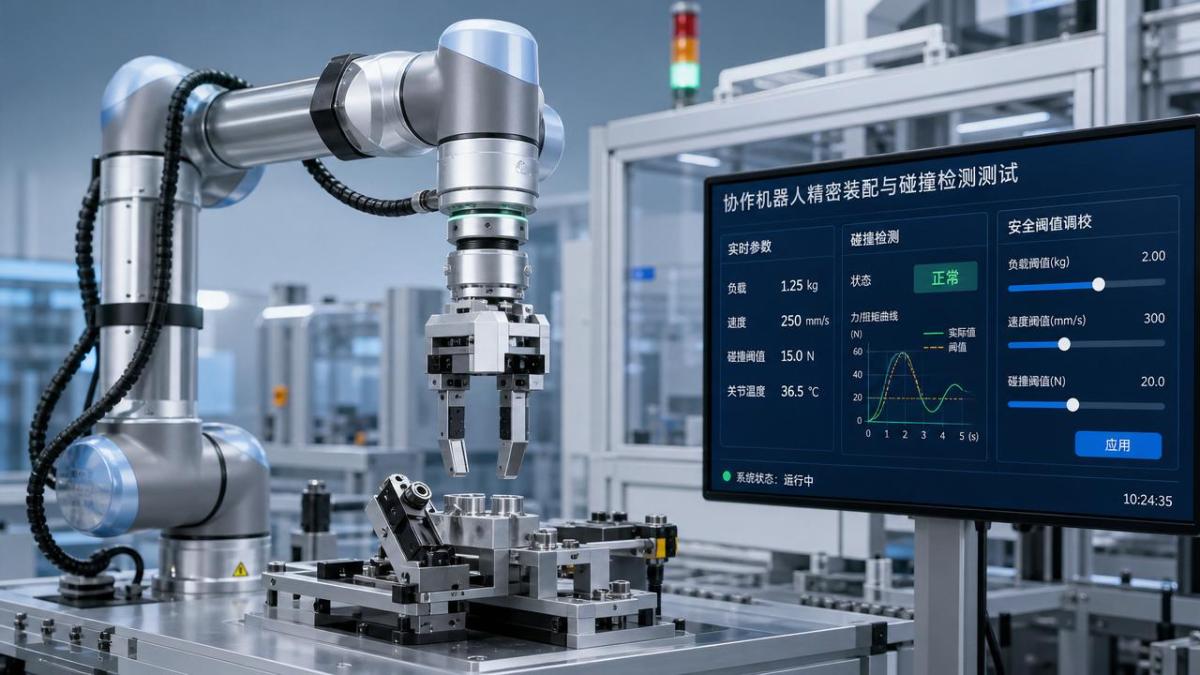
A few years ago, many deployments used factory defaults and accepted occasional stoppages as part of collaborative operation. That approach is becoming less sustainable. Cells are now expected to run faster, switch SKUs more often, and handle more variable tooling. At the same time, compliance expectations have tightened around documented risk assessment, validation evidence, and application-specific safety settings. In this environment, the cobot collision detection threshold directly affects both uptime and defensible engineering decisions.
The change is also driven by application diversity. A threshold that works for a low-mass gripper placing plastic components may be completely wrong for a long-reach arm carrying a vision-guided tool, dispensing head, or screwdriving spindle. In practice, the effective collision profile depends on inertia, leverage, acceleration ramp, mounting orientation, fixture rigidity, and process contact forces. This is why a single “safe” value often creates false confidence. The right cobot collision detection threshold is not universal; it is contextual.
The strongest signals point to application-specific threshold tuning
Several industry signals explain why threshold tuning is moving from optional optimization to core deployment practice. Instead of relying on assumptions, engineering teams are increasingly linking collision sensitivity to measured process behavior.
These signals point to one conclusion: the cobot collision detection threshold should be treated as a calibrated parameter within a broader control strategy, not a static checkbox in commissioning.
What actually drives a threshold too low or too high
In field conditions, poor threshold selection usually comes from oversimplifying the physics of the task. A threshold that is too low often reacts to normal dynamic loads such as rapid deceleration, gearbox backlash compensation, cable drag, part pickup variation, or expected insertion force. A threshold that is too high may allow excessive force before detection, especially when a long tool or off-center payload amplifies contact at the edge of the work envelope.
- Payload mass and center of gravity shift after picking a part
- Tooling inertia, especially with long or offset end effectors
- Joint speed, acceleration, and deceleration profiles
- Rigid versus compliant process contact
- Mounting angle, reach extension, and singularity-adjacent motion
- Fixture repeatability, stack-up variation, and part tolerance drift
- Differences between free-space motion and contact-rich operations
For that reason, the best cobot collision detection threshold is often segmented by motion phase. Travel moves, approach moves, insertion moves, and retreat moves do not carry the same risk or dynamic signature. If a controller supports zone-based or task-based settings, using one threshold for all motion types can leave both safety and throughput below potential.
The business impact extends beyond safety stops
Threshold errors affect more than immediate interruption. When the cobot collision detection threshold is too low, repeated nuisance stops can distort cycle-time models, lower trust in collaborative automation, and encourage unsafe operator workarounds such as disabling sensitivity or altering paths without formal review. Small stoppages also accumulate into hidden losses in OEE, especially in high-mix production where restarts and re-teaching consume engineering time.
When the threshold is too high, the damage can be subtler at first. Mechanical interfaces may absorb repeated impacts that do not trigger immediate alarms. This can accelerate wear in reducers, couplings, grippers, and fixtures. It can also compromise product quality if contact with parts, trays, or locating features goes undetected long enough to create alignment drift. In regulated or high-traceability environments, an unjustified cobot collision detection threshold can become a documentation weakness as well as a technical one.
What deserves priority when evaluating threshold settings
A sound review should focus on measurable variables rather than vendor-neutral assumptions or generic “safe mode” language. The following points deserve priority attention:
- Actual operating payload: validate empty-tool, nominal-load, and worst-case load states separately.
- Tool center point geometry: long tools create different collision moments than compact grippers.
- Speed profile by segment: approach and contact moves usually need tighter sensitivity than long travel moves.
- Expected process forces: pressing, insertion, wiping, or screwdriving may need differentiated logic.
- False trip history: nuisance-stop logs can reveal whether the present cobot collision detection threshold is too conservative.
- Recovery burden: if one trip causes long restart steps, sensitivity strategy should account for operational cost.
- Risk assessment traceability: every threshold decision should map to documented hazards and validation tests.
A practical method for setting the cobot collision detection threshold
A robust method starts with baseline characterization, not tuning during production pressure. First, measure normal torque, current, or force signatures across representative cycles. Then separate free motion from intentional contact phases. After that, test controlled deviations such as part misalignment, fixture obstruction, and payload variation. The goal is to define a cobot collision detection threshold that clearly distinguishes expected process loads from abnormal events.
- Record several stable cycles under nominal conditions.
- Add max payload and worst-case tooling configuration.
- Map peak dynamic values by path segment.
- Introduce controlled collision-like scenarios at low speed.
- Set initial thresholds above normal process peaks but below harmful abnormal loads.
- Verify restart frequency, stop distance, and product impact over extended runs.
- Revalidate after changes to EOAT, software, part geometry, or cycle speed.
This method supports a data-driven cobot collision detection threshold rather than a reactive one. It also aligns with the broader engineering principle that parameters should be justified by observed system behavior.
How to judge whether current settings are still valid
Threshold settings can drift out of relevance even when nothing appears broken. A process may add a heavier part family, a new tray pattern, or a more rigid fixture. Firmware updates may alter motion response. Preventive maintenance can reduce friction and change baseline load signatures. Any of these can shift the line between normal and abnormal behavior.
The next step is disciplined validation, not guesswork
The most effective response is to treat the cobot collision detection threshold as a living engineering parameter tied to real operating evidence. Build a validation routine that captures payload states, motion phases, false-stop counts, and controlled abnormal scenarios. Store the rationale with risk assessment records so future changes can be reviewed against a known baseline. This approach improves safety, protects uptime, and creates a cleaner decision trail when applications scale or evolve.
In practical terms, start by auditing one active cell: compare current stop events with actual process phases, check whether payload and tool data are current, and test whether the present cobot collision detection threshold still separates normal dynamics from true collision conditions. In modern automation, better results rarely come from choosing the lowest or highest setting. They come from engineering the right threshold for the task, documenting it, and updating it whenever the process changes.
Search News
Hot Articles
- Carbon Fiber StructuresHow to Specify Aerospace Carbon Fiber Assemblies for Lightweight, Load-Bearing PartsJul 11, 2026
- Machine VisionXiaomi, Alibaba DAMO Academy Drive Open-Source Robotics Model Ecosystem, Lowering Algorithm Development Barriers for Overseas SMEs Adopting Chinese Robotics SolutionsMar 30, 2026
- Cobots & ArmsShanxi 'AI+' Conference Showcases Embodied Intelligence with Multinational Buyer Engagement: Key Industry ImplicationsMar 30, 2026
Popular Tags
Recommended News
 Jul 11, 2026How to Specify Aerospace Carbon Fiber Assemblies for Lightweight, Load-Bearing PartsAerospace carbon fiber assemblies: learn how to specify laminate design, load data, joining methods, and inspection controls for lighter, reliable load-bearing aerospace parts.Elena Rostova (UAV Systems Researcher)
 Mar 30, 2026Xiaomi, Alibaba DAMO Academy Drive Open-Source Robotics Model Ecosystem, Lowering Algorithm Development Barriers for Overseas SMEs Adopting Chinese Robotics SolutionsXiaomi & Alibaba DAMO Academy's open-source robotics models lower algorithm barriers for global SMEs. Boost efficiency in manufacturing, logistics & smart retail with ROS 2 compatible solutions.TSV Data Lab
 Mar 30, 2026Shanxi 'AI+' Conference Showcases Embodied Intelligence with Multinational Buyer Engagement: Key Industry ImplicationsShanxi 'AI+' Conference highlights embodied intelligence with Tesla, Ubtech & Jiantao showcasing multimodal robotics. 40+ global buyers validated tech on-site, creating new B2B channels for industrial automation & AI solutions.Chen Wei (Automation Lead Engineer)
 Mar 30, 2026Zhongguancun Unveils 6G Integrated Sensing-Computing-Intelligence Platform to Empower Embodied Robots for Global Industrial ApplicationsZhongguancun's new 6G platform revolutionizes industrial robotics with <10ms latency, empowering global automotive, logistics & port automation. Discover how this tech boosts China's smart manufacturing exports.TSV Data Lab
 Mar 30, 2026Mech-Mind Tianjin Embodied Intelligence R&D and Production Base Goes Live, Cutting Delivery Time by 20%–30% for Global Customized AMR+Vision SolutionsMech-Mind's Tianjin AMR+Vision production base cuts delivery time by 20%-30% for欧美 & Latin American markets. Discover how this PLd-certified facility accelerates customized robotics solutions for smart manufacturing and logistics.Chen Wei (Automation Lead Engineer)
 Mar 30, 2026Boao Forum Reveals 'Co-evolution of Big and Small Brains' Trend in Humanoid Robots, China's Embodied Intelligence Accelerates Adaptation to Overseas Manufacturing Service ScenariosDiscover how China's humanoid robots, featuring 'Co-evolution of Big and Small Brains,' are revolutionizing global manufacturing. Learn about Embodied Tian Gong 3.0's ISO compliance and overseas deployment at Boao Forum 2026.Chen Wei (Automation Lead Engineer)
 Mar 30, 2026China Railway Industrial Secures Patent for Embodied Robotics in Material Handling, Boosting High-Precision Delivery Capabilities for Overseas Infrastructure and Manufacturing ProjectsChina Railway Industrial's new patent for embodied robotics in material handling boosts high-precision delivery for global infrastructure & manufacturing. Discover how this innovation enhances logistics accuracy in automotive, rail transit & EPC projects.Chen Wei (Automation Lead Engineer)
 Sep 28, 2026Spindle Runout Measurement in Germany: DIN Standards, Methods, and Acceptance LimitsSpindle runout measurement Germany: explore DIN standards, proven methods, acceptance limits, and audit-ready practices for reliable machining quality.Dr. Marcus Vance
 Sep 27, 2026How to Select Wall-Mount Edge Devices for Space-Constrained Factory NetworksWall mount edge devices for space-constrained factories: evaluate workload, thermal design, power resilience, cable access, and network reliability for smarter deployments.TSV Data Lab
 Sep 26, 2026Machining Tolerance Analysis: How to Set Limits That Meet Function and Cost TargetsMachining tolerance analysis: learn how to set functional limits, control tolerance stacks, reduce inspection risk, and balance precision with production cost.Dr. Marcus Vance
 Sep 25, 2026How to Evaluate an Industrial Infrastructure Data Platform for Multi-Site OperationsIndustrial infrastructure data platform evaluation guide for multi-site operations: compare data quality, edge resilience, interoperability, governance, and scalable proof-of-value criteria.Victor Lin (Chief Software Architect)
 Sep 24, 2026How to Select Machine Vision Optics for Accurate Inspection at Different Working DistancesMachine vision optics selection guide for accurate inspection at every working distance. Compare FOV, pixel scale, DOF, distortion, lighting, and telecentric options.TSV Data Lab
 Sep 23, 2026How to Evaluate a Machine Vision System Integrator for High-Speed Inspection LinesChoose a machine vision system integrator with proven expertise in high-speed inspection, reliable reject timing, robust optics, and measurable acceptance criteria.TSV Data Lab
 Sep 28, 2026When is a SCADA API the right choice for connecting plant systems?SCADA API guide: learn when governed plant data integration improves traceability, security, and scalability—without compromising real-time control.Victor Lin (Chief Software Architect)
 Sep 27, 2026How SCADA data integration improves traceability across production linesSCADA data integration connects production-line data to improve traceability, accelerate quality investigations, and strengthen safety decisions.Victor Lin (Chief Software Architect)
 Sep 26, 2026What to define before starting SCADA integration planningSCADA integration planning starts with clear scope, control boundaries, data models, cybersecurity, and testing. Discover the definitions that reduce risk and costly rework.Victor Lin (Chief Software Architect)
 Sep 25, 2026How a smart factory with Industrial IoT reduces production blind spotsDiscover how a smart factory with Industrial IoT turns real-time machine, quality, and workflow data into actionable insights that reduce production blind spots and delivery risks.Victor Lin (Chief Software Architect)
 Sep 24, 2026When does Industrial IoT make smart manufacturing easier to scale?Smart manufacturing Industrial IoT scales when trusted data, interoperable systems, and secure workflows turn connected assets into measurable gains.TSV Data Lab
 Sep 23, 2026What drives ultra-precision machining cost at 1-micron tolerance?Ultra precision machining cost per part at 1 micron tolerance depends on process, material, metrology, and yield. Learn how to compare quotes confidently.Dr. Marcus Vance
 Sep 22, 2026Drone Engine-T550CC Applications: Build the UAV Power System Around the MissionAn application guide for Drone Engine-T550CC integration, covering payload planning, airframe matching, cooling, fuel, vibration, test procedures, documentation, and service preparation.Elena Rostova (UAV Systems Researcher)
 Sep 22, 2026How to Evaluate Industrial Edge Computing Vendors for Factory DeploymentIndustrial edge computing vendor evaluation guide for factories: compare latency, protocol fit, reliability, security, and lifecycle support before deployment.TSV Data Lab
 Sep 21, 2026Drone Payload Integration: Matching Power, Data, and Center of Gravity for Reliable FlightsDrone payload integration made practical: balance power, data, center of gravity, and endurance to build safer, more reliable mission-ready flights.Elena Rostova (UAV Systems Researcher)
 Sep 20, 2026Autonomous Navigation Pricing: Cost Drivers and Budget Benchmarks for AMR ProjectsAutonomous navigation price explained: compare AMR cost drivers, software, sensors, integration, safety, and lifecycle budgets to build a scalable project plan.Chen Wei (Automation Lead Engineer)
 Sep 19, 2026How to Scope Automation Integration Services for Multi-System Factory ProjectsAutomation integration services: learn how to scope multi-system factory projects with clear workflows, interface contracts, safety boundaries, and acceptance criteria.Victor Lin (Chief Software Architect)