Why AGV and AMR fault tolerance fails in live traffic
Publication Date
author
In controlled demos, AGV AMR dynamic navigation fault tolerance often looks reliable—but live traffic exposes the gap between lab assumptions and operational reality. For project managers responsible for uptime, safety, and deployment risk, understanding why fault recovery breaks down under mixed traffic, sensor noise, and edge-case congestion is essential before scaling any autonomous material handling system.
Why project managers should assess this topic as a checklist, not a feature claim
The biggest mistake in AGV and AMR deployments is treating fault tolerance as a binary capability: either the vehicle “has it” or it does not. In reality, AGV AMR dynamic navigation fault tolerance is conditional. It depends on traffic density, map freshness, aisle geometry, wireless latency, human behavior, fleet logic, and the system’s ability to degrade safely without stalling the entire operation.
That is why a checklist-based evaluation matters. Project leaders do not need marketing phrases about intelligent recovery. They need a structured way to verify what happens when two robots enter the same choke point, when a pallet protrudes into a lane, when a forklift blocks line of sight, or when localization quality drops for three seconds during a shift peak. Live traffic failure is usually not a single bug. It is a chain reaction across sensing, planning, communication, and workflow design.
First-pass checklist: what to confirm before trusting live-traffic fault recovery
- Whether the vendor defines fault tolerance with measurable thresholds, such as maximum obstacle dwell time, reroute success rate, and recovery time after localization degradation.
- Whether test data comes from mixed traffic conditions, not isolated demo lanes.
- Whether the fleet manager can resolve multi-robot deadlocks without manual intervention.
- Whether safety slowdowns are distinguishable from navigation failures in system logs.
- Whether the site layout contains narrow crossings, blind corners, staging spillover, and pedestrian overlap zones that invalidate demo assumptions.
- Whether operational KPIs include blocked-path minutes, recovery attempts, manual rescue frequency, and mission abandonment rate.
If any of these points are vague, your AGV AMR dynamic navigation fault tolerance is probably not ready for full-scale deployment, no matter how smooth the proof of concept looked.
Core failure pattern 1: live traffic creates interactions that demos rarely simulate
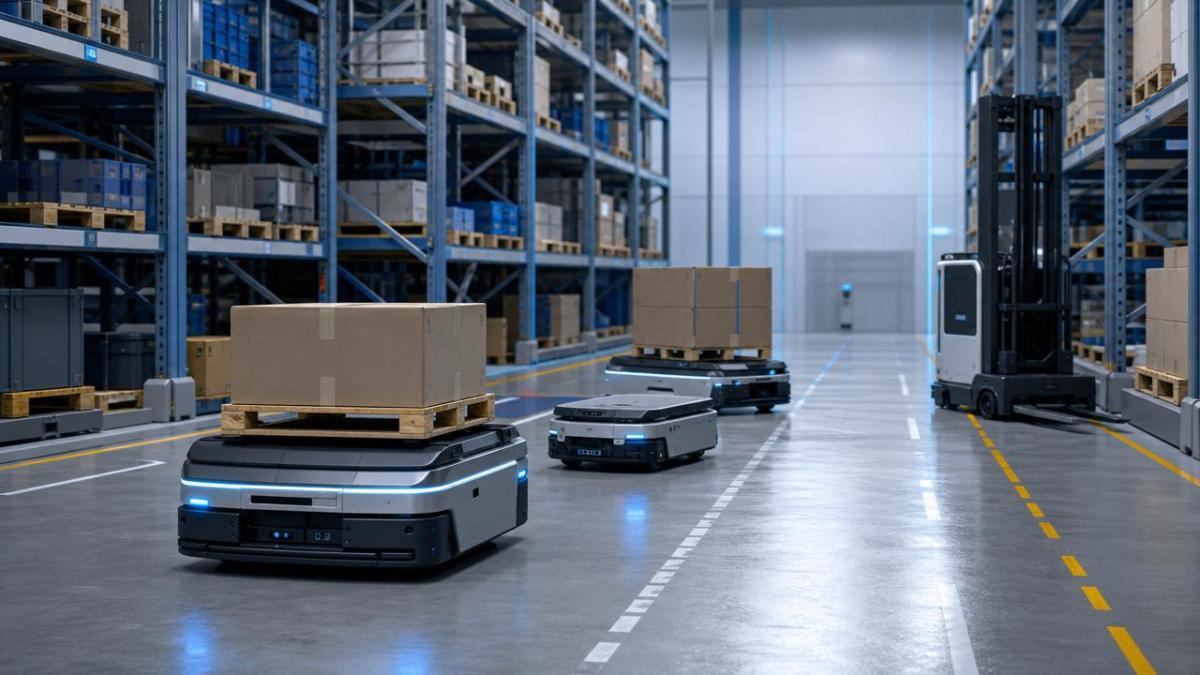
In a demo, a vehicle reacts to one obstacle at a time. In production, it reacts to moving people, forklifts, parked carts, temporary pallets, and other robots that are also replanning. This creates interaction complexity. A route that is valid for one AMR may become unstable once several nearby vehicles update their plans simultaneously.
Project managers should check whether the supplier has validated conflict resolution under these real conditions:
- Bidirectional traffic in aisles too narrow for comfortable passing.
- Intersections where human workers cross unpredictably.
- Task surges that concentrate many missions in one zone.
- Priority conflicts between urgent dispatches and normal replenishment tasks.
When AGV AMR dynamic navigation fault tolerance fails here, the symptom is often not a collision. It is throughput collapse: excessive waiting, stop-and-go movement, route thrashing, and manual intervention. This is a hidden failure mode because the system remains “safe” while becoming operationally unreliable.
Core failure pattern 2: sensor confidence degrades faster than the fleet logic expects
Most autonomous vehicles perform well when localization references are stable and obstacle signatures are clean. Live industrial environments are not clean. Reflective wrap, open rack edges, dust, low-angle sunlight at dock doors, hanging packaging film, and forklift masts can distort sensor interpretation. The vehicle may still detect “something,” but not with enough consistency to support stable path planning.
This is where fault tolerance often breaks down. The robot enters a degraded state but the system does not have a robust strategy for graceful recovery. Instead of switching intelligently to a low-speed, low-confidence mode with clear escape rules, it oscillates between caution and retry. For a project leader, this should be measured, not assumed.
Key judgment standard: ask for evidence on how long the vehicle can continue mission execution under partial sensor degradation before it must stop, re-localize, or request assistance. A vendor that cannot quantify this is likely relying on best-case perception performance.
Core failure pattern 3: deadlock handling is weaker than obstacle avoidance
Many teams over-focus on obstacle avoidance because it is visible and easy to demonstrate. Yet in live traffic, deadlock handling matters more. Two or more vehicles can create a state where each one is safe but none can proceed. Add a person stepping into the area, and the local planner may repeatedly abandon and rebuild routes without ever producing a practical escape path.
A strong AGV AMR dynamic navigation fault tolerance design needs deadlock detection at both vehicle and fleet levels. Project managers should verify whether the system can:
- Identify cyclical wait states rather than treating them as ordinary delays.
- Reassign priorities dynamically based on queue age, mission urgency, and zone congestion.
- Reserve path segments ahead of time in tight areas.
- Trigger zone-level recovery rules instead of isolated robot retries.
If the answer is only “the robot will recalculate,” that is not a recovery strategy. It is a hope strategy.
Core failure pattern 4: map truth and operational truth drift apart
Static maps age quickly in active facilities. Temporary racks become semi-permanent. Staging areas overflow. Safety barriers move. Walking routes change during peak production. Once the real site no longer matches the navigation model, fault tolerance becomes brittle because the robot’s recovery logic is solving the wrong problem.
This is especially relevant for project owners managing phased rollouts. A pilot may work in one zone, but expansion introduces map inconsistency and operational exceptions. Before scale-up, confirm how often maps are updated, how temporary obstacles are classified, and how route policies adapt to changing floor rules. Reliable AGV AMR dynamic navigation fault tolerance requires map governance, not just better software.
Practical evaluation table: what to ask, what to measure, what failure looks like
Scenario-specific checks: the risk is different in each operating environment
Manufacturing lines
Focus on predictable congestion and line-side variability. Small obstructions, operator pull-outs, and takt-driven bursts often expose weak fault recovery. Here, AGV AMR dynamic navigation fault tolerance must protect flow continuity more than route elegance.
Warehousing and fulfillment
Focus on intersections, staging overflow, and mixed human-machine traffic. Throughput peaks can make even a safe system unstable. You should verify queue management, dispatch prioritization, and how recovery behavior changes when mission density doubles.
Brownfield retrofits
This is the highest-risk case. Legacy floor markings, uneven navigation zones, inconsistent housekeeping, and frequent temporary changes can overwhelm recovery logic. In brownfield sites, operational discipline and route governance are as important as the robot platform itself.
Commonly ignored items that cause expensive surprises
- Manual rescue is not being tracked. If operators regularly push vehicles out of blocked states, the apparent uptime is misleading.
- Safety settings are tuned after go-live without evaluating throughput impact. Overly conservative zones can mimic navigation failure.
- Wireless network quality is assumed to be adequate. In practice, intermittent communication delays can disrupt fleet coordination even if each robot still navigates locally.
- The pilot excludes shift change, replenishment peak, or forklift-heavy periods. This hides the exact conditions where fault tolerance matters most.
- Exception workflows are unclear. When the system fails to recover, teams lose time deciding who responds, how the event is logged, and whether root cause analysis happens.
Execution plan: how to validate AGV AMR dynamic navigation fault tolerance before scaling
For project managers, the best approach is staged validation with explicit pass-fail criteria. Start by defining operationally meaningful tests instead of accepting generic acceptance demos. Your test plan should include blocked aisle recovery, intersection conflicts, congestion waves, temporary map changes, and degraded sensor conditions. Measure not only safety outcomes but mission completion stability.
Next, separate vehicle capability from system capability. A robot may navigate well individually while the fleet software fails under density. Review logs at three levels: sensor confidence events, planner decisions, and fleet coordination actions. If the supplier cannot provide this traceability, diagnosing future failures will be slow and expensive.
Finally, define operational ownership. Fault tolerance is not only an automation issue. Facilities, IT, safety, operations, and continuous improvement teams all influence live traffic performance. Recovery rules, map changes, housekeeping standards, and escalation procedures must be governed together.
FAQ for decision makers
Is stopping safely proof of good fault tolerance?
No. Safe stopping is essential, but AGV AMR dynamic navigation fault tolerance should also include timely recovery, low manual intervention, and stable throughput under disruption.
Should we prioritize better sensors or better fleet software?
Usually both matter, but live traffic failures often escalate because fleet coordination and exception handling are weaker than raw perception. Better sensing helps, yet poor congestion logic will still create bottlenecks.
Can pilot success predict scale success?
Only if the pilot includes real traffic density, real shift conditions, and real exception patterns. A clean pilot lane is not evidence of scalable fault recovery.
What to prepare before the next vendor review or internal go/no-go decision
Bring a structured question set: actual traffic maps, congestion zones, mission peaks by hour, known obstacle patterns, network coverage data, intervention records, and safety zone policies. Ask vendors to respond with measured recovery behavior, not broad product descriptions. The goal is to determine whether their AGV AMR dynamic navigation fault tolerance matches your live environment rather than a generic benchmark scenario.
If you need to move toward implementation, prioritize discussion around threshold parameters, site adaptation effort, fleet scaling limits, map maintenance workflow, exception ownership, deployment timeline, and support model. Those topics reveal whether the solution can survive real traffic, which is the only environment that ultimately matters.
Search News
Hot Articles
- Carbon Fiber StructuresHow to Specify Aerospace Carbon Fiber Assemblies for Lightweight, Load-Bearing PartsJul 11, 2026
- Machine VisionXiaomi, Alibaba DAMO Academy Drive Open-Source Robotics Model Ecosystem, Lowering Algorithm Development Barriers for Overseas SMEs Adopting Chinese Robotics SolutionsMar 30, 2026
- Cobots & ArmsShanxi 'AI+' Conference Showcases Embodied Intelligence with Multinational Buyer Engagement: Key Industry ImplicationsMar 30, 2026
Popular Tags
Recommended News
 Jul 11, 2026How to Specify Aerospace Carbon Fiber Assemblies for Lightweight, Load-Bearing PartsAerospace carbon fiber assemblies: learn how to specify laminate design, load data, joining methods, and inspection controls for lighter, reliable load-bearing aerospace parts.Elena Rostova (UAV Systems Researcher)
 Mar 30, 2026Xiaomi, Alibaba DAMO Academy Drive Open-Source Robotics Model Ecosystem, Lowering Algorithm Development Barriers for Overseas SMEs Adopting Chinese Robotics SolutionsXiaomi & Alibaba DAMO Academy's open-source robotics models lower algorithm barriers for global SMEs. Boost efficiency in manufacturing, logistics & smart retail with ROS 2 compatible solutions.TSV Data Lab
 Mar 30, 2026Shanxi 'AI+' Conference Showcases Embodied Intelligence with Multinational Buyer Engagement: Key Industry ImplicationsShanxi 'AI+' Conference highlights embodied intelligence with Tesla, Ubtech & Jiantao showcasing multimodal robotics. 40+ global buyers validated tech on-site, creating new B2B channels for industrial automation & AI solutions.Chen Wei (Automation Lead Engineer)
 Mar 30, 2026Zhongguancun Unveils 6G Integrated Sensing-Computing-Intelligence Platform to Empower Embodied Robots for Global Industrial ApplicationsZhongguancun's new 6G platform revolutionizes industrial robotics with <10ms latency, empowering global automotive, logistics & port automation. Discover how this tech boosts China's smart manufacturing exports.TSV Data Lab
 Mar 30, 2026Mech-Mind Tianjin Embodied Intelligence R&D and Production Base Goes Live, Cutting Delivery Time by 20%–30% for Global Customized AMR+Vision SolutionsMech-Mind's Tianjin AMR+Vision production base cuts delivery time by 20%-30% for欧美 & Latin American markets. Discover how this PLd-certified facility accelerates customized robotics solutions for smart manufacturing and logistics.Chen Wei (Automation Lead Engineer)
 Mar 30, 2026Boao Forum Reveals 'Co-evolution of Big and Small Brains' Trend in Humanoid Robots, China's Embodied Intelligence Accelerates Adaptation to Overseas Manufacturing Service ScenariosDiscover how China's humanoid robots, featuring 'Co-evolution of Big and Small Brains,' are revolutionizing global manufacturing. Learn about Embodied Tian Gong 3.0's ISO compliance and overseas deployment at Boao Forum 2026.Chen Wei (Automation Lead Engineer)
 Mar 30, 2026China Railway Industrial Secures Patent for Embodied Robotics in Material Handling, Boosting High-Precision Delivery Capabilities for Overseas Infrastructure and Manufacturing ProjectsChina Railway Industrial's new patent for embodied robotics in material handling boosts high-precision delivery for global infrastructure & manufacturing. Discover how this innovation enhances logistics accuracy in automotive, rail transit & EPC projects.Chen Wei (Automation Lead Engineer)
 Sep 28, 2026Spindle Runout Measurement in Germany: DIN Standards, Methods, and Acceptance LimitsSpindle runout measurement Germany: explore DIN standards, proven methods, acceptance limits, and audit-ready practices for reliable machining quality.Dr. Marcus Vance
 Sep 27, 2026How to Select Wall-Mount Edge Devices for Space-Constrained Factory NetworksWall mount edge devices for space-constrained factories: evaluate workload, thermal design, power resilience, cable access, and network reliability for smarter deployments.TSV Data Lab
 Sep 26, 2026Machining Tolerance Analysis: How to Set Limits That Meet Function and Cost TargetsMachining tolerance analysis: learn how to set functional limits, control tolerance stacks, reduce inspection risk, and balance precision with production cost.Dr. Marcus Vance
 Sep 25, 2026How to Evaluate an Industrial Infrastructure Data Platform for Multi-Site OperationsIndustrial infrastructure data platform evaluation guide for multi-site operations: compare data quality, edge resilience, interoperability, governance, and scalable proof-of-value criteria.Victor Lin (Chief Software Architect)
 Sep 24, 2026How to Select Machine Vision Optics for Accurate Inspection at Different Working DistancesMachine vision optics selection guide for accurate inspection at every working distance. Compare FOV, pixel scale, DOF, distortion, lighting, and telecentric options.TSV Data Lab
 Sep 23, 2026How to Evaluate a Machine Vision System Integrator for High-Speed Inspection LinesChoose a machine vision system integrator with proven expertise in high-speed inspection, reliable reject timing, robust optics, and measurable acceptance criteria.TSV Data Lab
 Sep 28, 2026When is a SCADA API the right choice for connecting plant systems?SCADA API guide: learn when governed plant data integration improves traceability, security, and scalability—without compromising real-time control.Victor Lin (Chief Software Architect)
 Sep 27, 2026How SCADA data integration improves traceability across production linesSCADA data integration connects production-line data to improve traceability, accelerate quality investigations, and strengthen safety decisions.Victor Lin (Chief Software Architect)
 Sep 26, 2026What to define before starting SCADA integration planningSCADA integration planning starts with clear scope, control boundaries, data models, cybersecurity, and testing. Discover the definitions that reduce risk and costly rework.Victor Lin (Chief Software Architect)
 Sep 25, 2026How a smart factory with Industrial IoT reduces production blind spotsDiscover how a smart factory with Industrial IoT turns real-time machine, quality, and workflow data into actionable insights that reduce production blind spots and delivery risks.Victor Lin (Chief Software Architect)
 Sep 24, 2026When does Industrial IoT make smart manufacturing easier to scale?Smart manufacturing Industrial IoT scales when trusted data, interoperable systems, and secure workflows turn connected assets into measurable gains.TSV Data Lab
 Sep 23, 2026What drives ultra-precision machining cost at 1-micron tolerance?Ultra precision machining cost per part at 1 micron tolerance depends on process, material, metrology, and yield. Learn how to compare quotes confidently.Dr. Marcus Vance
 Sep 22, 2026Drone Engine-T550CC Applications: Build the UAV Power System Around the MissionAn application guide for Drone Engine-T550CC integration, covering payload planning, airframe matching, cooling, fuel, vibration, test procedures, documentation, and service preparation.Elena Rostova (UAV Systems Researcher)
 Sep 22, 2026How to Evaluate Industrial Edge Computing Vendors for Factory DeploymentIndustrial edge computing vendor evaluation guide for factories: compare latency, protocol fit, reliability, security, and lifecycle support before deployment.TSV Data Lab
 Sep 21, 2026Drone Payload Integration: Matching Power, Data, and Center of Gravity for Reliable FlightsDrone payload integration made practical: balance power, data, center of gravity, and endurance to build safer, more reliable mission-ready flights.Elena Rostova (UAV Systems Researcher)
 Sep 20, 2026Autonomous Navigation Pricing: Cost Drivers and Budget Benchmarks for AMR ProjectsAutonomous navigation price explained: compare AMR cost drivers, software, sensors, integration, safety, and lifecycle budgets to build a scalable project plan.Chen Wei (Automation Lead Engineer)
 Sep 19, 2026How to Scope Automation Integration Services for Multi-System Factory ProjectsAutomation integration services: learn how to scope multi-system factory projects with clear workflows, interface contracts, safety boundaries, and acceptance criteria.Victor Lin (Chief Software Architect)