
When does AGV positioning accuracy really need millimeter level
Publication Date
author
In AGV deployment, millimeter-level positioning is not a universal requirement. In most warehouses, buffer zones, pallet handling, and line-side logistics tasks, centimeter-level performance is enough if the vehicle can stop consistently, recover reliably, and maintain safe flow. Millimeter accuracy becomes valuable only when the AGV must interact with tight-tolerance equipment, constrained docking points, robotic handoff stations, or precision loading processes where small offsets directly create downtime, defects, or safety risk.
For engineers, operators, buyers, and decision-makers comparing an autonomous mobile robot China supplier or evaluating automated guided vehicle price, the key question is not “Can this AGV reach millimeter accuracy?” but “What process actually benefits from it, and what does it cost to achieve and maintain it?” The right answer depends on docking tolerance, payload behavior, floor condition, navigation method, and the true economics of your workflow.
Start with the real decision: does the process need precision, or just repeatable docking?
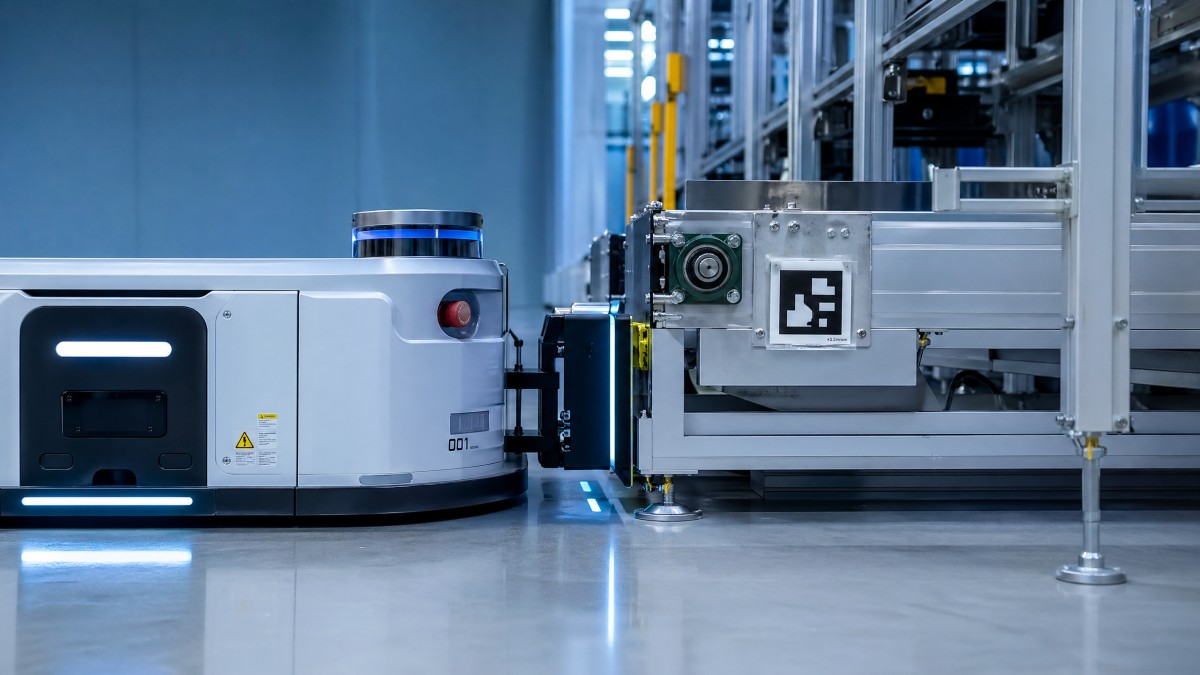
The most common buying mistake in AGV projects is treating positioning accuracy as a prestige specification instead of a process requirement. A line item such as “±2 mm” may sound impressive, but if the vehicle is feeding a supermarket rack, moving carts between zones, or transporting pallets to a human-operated station, that number may not improve throughput at all.
What most facilities actually need is not absolute millimeter positioning everywhere, but predictable and repeatable final alignment where transfer occurs. In practical terms, an AGV often succeeds when it can:
- arrive in the correct zone without navigation drift that affects traffic flow,
- dock repeatedly within the tolerance window of the station,
- compensate for payload shift, wheel wear, and floor variation,
- recover quickly after minor disturbances, and
- maintain performance over time without constant recalibration.
That is why procurement teams should separate three different concepts before comparing systems:
- Global navigation accuracy: how closely the AGV follows its map across the facility.
- Docking repeatability: how consistently it reaches the same final pose at a station.
- Process accuracy requirement: the actual tolerance allowed by the equipment, fixture, conveyor, or robot interface.
In many projects, the third item decides everything. If the station tolerance is ±15 mm, paying for ±2 mm vehicle positioning may produce no real return. If the station tolerance is ±3 mm and there is no passive compliance in the transfer mechanism, then millimeter-level control may be justified.
When millimeter-level AGV positioning accuracy really matters
Millimeter-level positioning is typically justified only when small errors translate directly into process failure, quality loss, or safety exposure. The following scenarios are the most common.
1. Precision machine loading and unloading
If an AGV interfaces with CNC machines, test fixtures, battery module stations, semiconductor tools, or aerospace subassembly cells, the handoff point may have very limited tolerance. Even a small offset can prevent proper insertion, cause jams, or require human correction.
In these cases, millimeter-level performance reduces:
- misload events,
- fixture collisions,
- cycle interruptions,
- manual intervention, and
- tooling wear from repeated correction attempts.
2. Robotic handoff with tight end-effector windows
When a fixed robot picks from or places onto an AGV, the robot usually assumes a known part location. If the AGV stops outside the expected tolerance window, either the robot needs a larger vision and compensation system, or the transfer reliability drops. For high-speed automated cells, improving AGV stop repeatability may be cheaper than redesigning the robot station.
3. Conveyor docking with hard mechanical interfaces
Some conveyor or transfer systems do not tolerate lateral or angular mismatch well. Precision becomes important when product transfer depends on exact roller height, narrow gap alignment, or synchronized engagement with mechanical stops.
4. High-value or fragile payload transfer
For optics, electronics, medical assemblies, or aerospace components, even small docking errors can create shock, edge contact, or unstable placement. Here, precision is not only about speed; it is about yield protection.
5. Very narrow aisles or constrained staging geometry
In dense manufacturing layouts, AGVs may need to align with racks, lift tables, or carts where clearance is extremely limited. The tighter the layout, the more final-position error matters.
6. Automated systems that must run with minimal human attendance
If your business case depends on lights-out operation, one small misalignment per shift can destroy the ROI model. In such environments, higher positioning accuracy may be justified because labor-free recovery is part of the value equation.
When millimeter accuracy is usually unnecessary
There are also many cases where buyers over-specify precision and end up paying for complexity they do not use.
Typical examples include:
- pallet transport between warehouse zones,
- cart movement to manual workstations,
- finished goods relocation,
- buffer area replenishment,
- long-distance intralogistics where transfer points have mechanical guides or operator adjustment,
- environments with rough floors or changing traffic conditions.
In these situations, a vehicle with good navigation stability, safe obstacle handling, and strong uptime often delivers more value than one designed around extreme positioning precision. For many operators, smooth fleet behavior and dependable docking matter more than chasing a laboratory-grade number.
This is especially relevant when reviewing automated guided vehicle price. A more expensive platform may advertise higher precision, but if your process is tolerant and your transfer point includes funnels, guides, or floating interfaces, the extra cost may not convert into measurable productivity.
What determines whether an AGV can actually hold millimeter-level accuracy in the field?
Published specifications alone are not enough. Real-world AGV positioning accuracy millimeter depends on the complete system, not just the navigation module.
Floor quality
Uneven, damaged, vibrating, or contaminated floors can undermine precision quickly. A supplier may demonstrate excellent numbers on a flat test floor, but your facility may introduce wheel slip, chassis vibration, or micro-tilt that changes docking behavior.
Payload dynamics
Heavy, tall, off-center, or shifting loads affect stopping behavior and pose stability. A vehicle that docks accurately with a nominal load may perform differently at maximum payload or under repeated acceleration cycles.
Navigation architecture
Different systems use natural navigation, SLAM, QR codes, reflectors, magnetic guidance, LiDAR fusion, vision markers, or local precision referencing. Millimeter-level docking often requires a layered approach: broader navigation for travel and local referencing for final positioning.
Mechanical design and control loop quality
Wheel encoder resolution, servo response, braking control, chassis rigidity, steering backlash, and lift mechanism repeatability all affect final stop precision. Two AGVs using the same sensor type may perform very differently because of mechanical execution.
Environmental change
Dust, light variation, reflective surfaces, traffic congestion, and temporary obstacles can all affect consistency. This matters when evaluating any autonomous mobile robot China supplier or international vendor: ask how performance changes in your actual environment, not only in the demo center.
Calibration and maintenance discipline
Millimeter-level claims are only meaningful if they remain stable over time. If the system requires frequent recalibration or sensitive maintenance procedures, the lifetime operating burden may be higher than expected.
How buyers and engineers should evaluate the requirement before paying for it
If you are building a specification, use a process-first method rather than a marketing-first method.
Ask these five questions:
- What is the true tolerance of the receiving station?
Measure the actual acceptable offset in X, Y, and angular orientation. Do not rely on informal assumptions. - Does the station have passive compliance?
If there are guide pins, tapered entries, floating rollers, software correction, or operator adjustment, the AGV may not need extreme precision. - What is the cost of one misdock?
Is it a 10-second delay, a line stop, a part scratch, or a safety event? The severity determines whether higher precision is economically justified. - How often does the precision-critical event occur?
If the event happens hundreds of times per day, even small error improvements can pay back quickly. - Can the problem be solved at the interface instead?
Sometimes adding a docking guide, compliance feature, or local sensor at the station is cheaper than upgrading the entire AGV platform.
This approach helps both procurement and operations teams make better trade-offs between capital cost, integration difficulty, and actual production value.
Cost, complexity, and ROI: the hidden trade-off behind high-precision AGV systems
Millimeter-level positioning rarely comes free. It often increases system cost in multiple ways:
- higher-grade sensors or local markers,
- more advanced control hardware,
- stricter floor and installation requirements,
- additional commissioning time,
- more precise station design,
- higher maintenance and recalibration burden.
That is why automated guided vehicle price should never be compared as a standalone number. A lower-cost AGV with slightly lower positioning precision may produce a better total result if your process allows compliant docking. Conversely, a more expensive precision platform may be the cheaper choice if it prevents line stoppages in a fully automated cell.
For enterprise decision-makers, the ROI model should include:
- downtime avoided,
- labor intervention reduced,
- quality loss prevented,
- throughput gain achieved,
- commissioning risk,
- lifecycle support requirements.
The right investment level is the one that matches process sensitivity—not the one with the most aggressive brochure claim.
What to ask AGV and AMR suppliers before making a decision
Whether you are sourcing locally or comparing an autonomous mobile robot China manufacturer with global brands, ask for evidence that connects precision to your use case.
Key questions include:
- Is the stated accuracy absolute, repeatability-based, or measured only at docking?
- Under what payload, speed, and floor conditions was the number achieved?
- What is the angular accuracy at final stop?
- How does performance change over long runs and after wheel wear?
- Does the system use local markers or special station references for precision docking?
- What recalibration interval is required?
- Can the supplier provide misdock rate data, not just accuracy figures?
- What station-side design assumptions are required to achieve the claimed result?
- How many customer sites run this configuration in production?
These questions help filter out vague claims and focus the conversation on engineering truth: repeatable performance in your actual operating envelope.
A practical rule of thumb for deciding
If the AGV’s job is mainly transport, traffic flow, and material availability, prioritize safety, uptime, fleet coordination, and stable docking over millimeter-level headline specs. If the AGV is part of a tightly coupled automation cell where final pose directly determines transfer success, product quality, or unmanned runtime, then millimeter-level positioning may be worth the investment.
In other words:
- Choose millimeter-level accuracy when process failure cost is high and tolerance windows are truly narrow.
- Choose robust repeatable docking when the workflow is tolerant and operational resilience matters more than ultra-fine positioning.
Conclusion
AGV positioning accuracy at the millimeter level is not a default requirement. It is a targeted capability for specific high-precision, high-consequence transfer scenarios. The right question is not whether such accuracy is technically possible, but whether your process, economics, and automation architecture actually need it.
For operators, procurement teams, and business leaders, the best decision comes from matching tolerance requirements to real process risk. When millimeter precision prevents defects, downtime, or failed robotic handoffs, it creates clear value. When the application only needs stable and repeatable docking, paying extra for extreme precision can add cost without adding performance. In AGV selection, engineering truth starts with process fit.
Search News
Hot Articles
- Carbon Fiber StructuresHow to Specify Aerospace Carbon Fiber Assemblies for Lightweight, Load-Bearing PartsJul 11, 2026
- Machine VisionXiaomi, Alibaba DAMO Academy Drive Open-Source Robotics Model Ecosystem, Lowering Algorithm Development Barriers for Overseas SMEs Adopting Chinese Robotics SolutionsMar 30, 2026
- Cobots & ArmsShanxi 'AI+' Conference Showcases Embodied Intelligence with Multinational Buyer Engagement: Key Industry ImplicationsMar 30, 2026
Popular Tags
Recommended News
 Jul 11, 2026How to Specify Aerospace Carbon Fiber Assemblies for Lightweight, Load-Bearing PartsAerospace carbon fiber assemblies: learn how to specify laminate design, load data, joining methods, and inspection controls for lighter, reliable load-bearing aerospace parts.Elena Rostova (UAV Systems Researcher)
 Mar 30, 2026Xiaomi, Alibaba DAMO Academy Drive Open-Source Robotics Model Ecosystem, Lowering Algorithm Development Barriers for Overseas SMEs Adopting Chinese Robotics SolutionsXiaomi & Alibaba DAMO Academy's open-source robotics models lower algorithm barriers for global SMEs. Boost efficiency in manufacturing, logistics & smart retail with ROS 2 compatible solutions.TSV Data Lab
 Mar 30, 2026Shanxi 'AI+' Conference Showcases Embodied Intelligence with Multinational Buyer Engagement: Key Industry ImplicationsShanxi 'AI+' Conference highlights embodied intelligence with Tesla, Ubtech & Jiantao showcasing multimodal robotics. 40+ global buyers validated tech on-site, creating new B2B channels for industrial automation & AI solutions.Chen Wei (Automation Lead Engineer)
 Mar 30, 2026Zhongguancun Unveils 6G Integrated Sensing-Computing-Intelligence Platform to Empower Embodied Robots for Global Industrial ApplicationsZhongguancun's new 6G platform revolutionizes industrial robotics with <10ms latency, empowering global automotive, logistics & port automation. Discover how this tech boosts China's smart manufacturing exports.TSV Data Lab
 Mar 30, 2026Mech-Mind Tianjin Embodied Intelligence R&D and Production Base Goes Live, Cutting Delivery Time by 20%–30% for Global Customized AMR+Vision SolutionsMech-Mind's Tianjin AMR+Vision production base cuts delivery time by 20%-30% for欧美 & Latin American markets. Discover how this PLd-certified facility accelerates customized robotics solutions for smart manufacturing and logistics.Chen Wei (Automation Lead Engineer)
 Mar 30, 2026Boao Forum Reveals 'Co-evolution of Big and Small Brains' Trend in Humanoid Robots, China's Embodied Intelligence Accelerates Adaptation to Overseas Manufacturing Service ScenariosDiscover how China's humanoid robots, featuring 'Co-evolution of Big and Small Brains,' are revolutionizing global manufacturing. Learn about Embodied Tian Gong 3.0's ISO compliance and overseas deployment at Boao Forum 2026.Chen Wei (Automation Lead Engineer)
 Mar 30, 2026China Railway Industrial Secures Patent for Embodied Robotics in Material Handling, Boosting High-Precision Delivery Capabilities for Overseas Infrastructure and Manufacturing ProjectsChina Railway Industrial's new patent for embodied robotics in material handling boosts high-precision delivery for global infrastructure & manufacturing. Discover how this innovation enhances logistics accuracy in automotive, rail transit & EPC projects.Chen Wei (Automation Lead Engineer)
 Oct 26, 2026AMAXiMAL Releases Open-Source TopMod 3D v3 With Claude AIExplore AMAXiMAL’s free, open-source TopMod 3D v3 with Claude AI assistance, topology-based modeling and plywood fabrication tools that connect complex designs to physical builds.Dr. Marcus Vance
 Oct 26, 2026Choosing a SCADA System Integrator Company: PLC Compatibility and Long-Term SupportChoose a scada system integrator company with proven PLC compatibility and reliable long-term support. Discover what to test, compare, and require before investing.Victor Lin (Chief Software Architect)
 Oct 25, 2026Hesai Leads Global ADAS Main Lidar Shipments in Yole’s 2026 ReportHesai led global ADAS main lidar shipments with a 43% share in 2025, according to Yole’s 2026 report. Explore what this ranking reveals about its automotive market position.TSV Data Lab
 Oct 25, 2026Choosing an Aerospace Materials Manufacturer: Quality and Traceability ChecksChoosing an aerospace materials manufacturer? Learn how to verify certifications, test reports, and lot traceability to qualify suppliers confidently and reduce costly sourcing risks.Dr. Marcus Vance
 Oct 24, 2026Guotai Haitong: Global Entry-Level 3D Printer Shipments Rose 39% in Q1 2026Entry-level 3D printer shipments rose 39% in Q1 2026, Guotai Haitong reports. Explore how AI, multicolor printing and print farms are shaping market growth.Dr. Marcus Vance
 Oct 24, 2026Choosing an Industrial Vision Inspection Supplier: Acceptance Tests That MatterChoose an industrial vision inspection supplier with confidence. Discover acceptance tests for defect detection, false rejects, production speed, and reliable part rejection before you buy.TSV Data Lab
 Oct 23, 2026US Navy Raises Gecko Robotics Contract Ceiling to $300M for Robotic Fleet MaintenanceUS Navy raises Gecko Robotics’ contract ceiling to $300M for Pacific Fleet robotic inspections. Explore potential opportunities for maintenance suppliers and key procurement considerations.Chen Wei (Automation Lead Engineer)
 Oct 23, 2026Choosing Industrial Sensing Systems for Global Plants: Protocol CompatibilityCompare industrial sensing systems international buyers can trust. Explore protocol compatibility, reduce integration risks, and select proven configurations for reliable global plant deployments.TSV Data Lab
 Oct 22, 2026KUKA Showcases Physical AI and iiQKA.AI Vision at NVIDIA GTC BerlinExplore KUKA’s Physical AI showcase at NVIDIA GTC Berlin and discover how iiQKA.AI Vision aims to simplify robotic vision integration and improve 2D and 3D scene recognition.TSV Data Lab
 Oct 22, 2026Robotic Machining of Advanced Composites: What Tolerances Are Achievable?Explore advanced materials machining robotics: discover what drives achievable composite tolerances and how to validate accuracy before investing in your next machining system.Dr. Marcus Vance
 Oct 21, 2026China’s Industrial Robot Exports Near RMB 10 Billion in First Nine Months of 2026China’s industrial robot exports neared RMB 10 billion in January–September 2026, with value rising faster than volume. Explore the data and what it could mean for suppliers.Chen Wei (Automation Lead Engineer)
 Oct 21, 2026Low-Latency Industrial Data Processing: Pricing and Key Cost DriversExplore industrial data latency price drivers, from edge hardware to integration and support. Learn how to compare quotes, verify performance, and avoid unnecessary costs.TSV Data Lab
 Oct 20, 2026KUKA Launches iiQKA.AI Vision to Simplify Industrial Image ProcessingKUKA iiQKA.AI Vision simplifies industrial image processing with controller-based 2D and 3D vision. Explore drag-and-drop setup for vision-guided automation.TSV Data Lab
 Oct 20, 2026Smart Industrial Edge Devices: Key Criteria for Legacy PLC IntegrationChoose smart industrial edge devices for legacy PLC integration. Discover key criteria for compatibility, data quality, security, and reliable collection without disrupting control.TSV Data Lab
 Oct 19, 2026Choosing a Radar Sensor by Application: Range, Resolution, and Field of ViewSimplify radar sensor application based product selection. Compare range, resolution, and field of view to avoid blind spots and choose with confidence. Explore the guide.TSV Data Lab
 Oct 18, 2026Comparing Material Options for Procurement: Specs, Costs, and Supply RisksExplore procurement oriented technical content on material options, specs, costs, and supply risks. Compare alternatives to cut hidden expenses and make confident sourcing decisions.Dr. Marcus Vance
 Oct 17, 20265-Axis CNC Positioning Accuracy: How to Interpret ISO 230-2 Test ResultsAssess 5 axis CNC machining positioning accuracy with ISO 230-2. Learn to interpret repeatability, reversal error, and test conditions to compare suppliers and make confident acceptance decisions.Dr. Marcus Vance























