What lidar for AGV obstacle avoidance gets wrong indoors
Publication Date
author
Many teams assume lidar for AGV obstacle avoidance is a plug-and-play answer indoors, but that assumption fails quickly in real facilities. The biggest search intent behind this topic is practical evaluation: users want to know why indoor lidar performance often disappoints, what can go wrong during daily operation, and how to judge whether a sensor setup is actually safe and reliable.
For operators and on-site users, the main concerns are rarely theoretical. They care about missed detections near pallet forks, nuisance stops in narrow aisles, unstable behavior near glass or shiny floors, and whether people, carts, and mixed traffic will confuse the system. They also want a simple way to tell good specifications from marketing claims.
The most helpful content, therefore, is not a generic lidar overview. It is a field-oriented explanation of indoor failure modes, the parameters that really matter, the limits of lidar-only safety thinking, and a practical checklist for reducing navigation risk. This article focuses on those points and avoids broad, low-value discussion about autonomous mobility trends.
What lidar for AGV obstacle avoidance gets wrong indoors
Indoor AGV projects often treat lidar as if it were a complete answer.
In reality, indoor environments create edge cases that simple range numbers never reveal.
The core mistake is assuming obstacle avoidance depends mainly on detection distance.
Indoors, reliability depends more on geometry, reflectivity, mounting, speed, and traffic complexity.
That is why a lidar that looks excellent on a datasheet may perform poorly on a warehouse floor.
Why indoor facilities are harder than many vendors admit
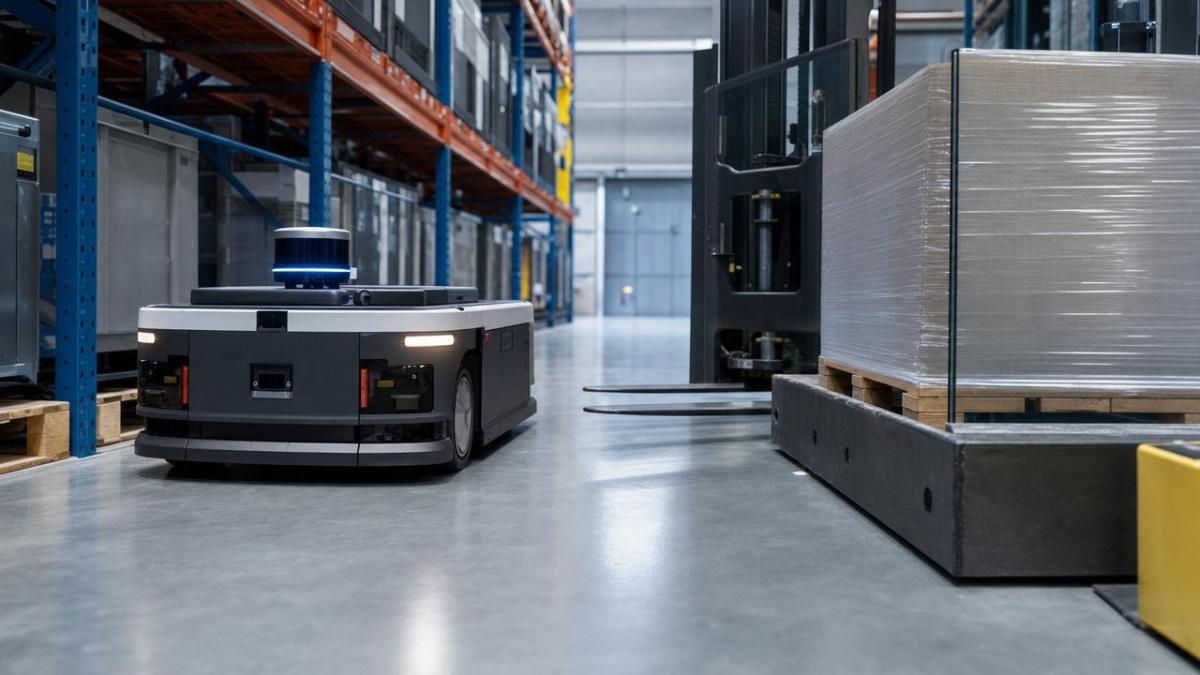
Outdoor marketing language often emphasizes long range, weather tolerance, and broad field coverage.
But indoor AGV behavior is shaped by short stopping distances and cluttered scenes.
Warehouses and factories are full of partial obstructions, low objects, and inconsistent surfaces.
Pallet corners, dangling wrap, floor transitions, and open rack legs are common examples.
These features may not behave like clean, solid targets in ideal test conditions.
Mixed traffic also changes everything.
Humans do not move like fixed objects, and indoor pathways are often unpredictable.
A worker stepping from behind a rack requires more than simple forward object detection.
The AGV must detect quickly, classify conservatively, and respond without unstable braking behavior.
That is where many expectations around lidar for AGV obstacle avoidance become unrealistic.
The biggest misconception: long range does not equal safer indoor avoidance
Many buyers compare lidar products by maximum detection range first.
That approach makes sense only if the operating environment actually needs long forward visibility.
Most indoor AGVs move at modest speeds in constrained lanes and shared work zones.
What matters more is how reliably the sensor detects small, awkward, or low-contrast obstacles nearby.
A 30-meter claim does not help much if pallet fork tips are inconsistently captured at two meters.
Indoor safety margins depend on stopping distance and update confidence.
If scan rate, angular resolution, or filtering causes late recognition, long range becomes irrelevant.
Operators usually experience this as sudden stops, delayed stops, or inconsistent reactions.
Those symptoms are not always software bugs.
Often, they come from choosing lidar with the wrong performance priorities for indoor use.
Reflective floors and glossy surfaces can distort confidence
One common indoor problem is highly reflective flooring.
Polished concrete, epoxy coatings, and wet patches can alter return behavior significantly.
In some conditions, the sensor may produce unstable returns or lose confidence near the ground plane.
That matters because many low hazards first appear close to the floor.
If the sensing model is weak there, avoidance performance can become inconsistent.
Operators may notice that the AGV behaves differently by zone.
It may pass reliably in one aisle, then generate nuisance alarms in another.
That kind of inconsistency is dangerous because it reduces trust in the system.
When people stop believing warnings are meaningful, they work around them.
So indoor lidar quality is not just about physics; it directly affects operational discipline.
Glass, plastic wrap, and dark materials are frequent troublemakers
Another indoor issue is target material.
Glass panels, transparent barriers, thin plastic film, and black rubber surfaces can all challenge detection.
Some materials reflect poorly, unpredictably, or at angles that reduce usable returns.
In a clean demo area, these weaknesses may stay hidden.
In a live facility, they become regular sources of false negatives or unstable mapping.
Stretch-wrapped pallets are especially deceptive.
The shape appears large to a human operator, but the lidar may see mixed or fragmented returns.
Depending on beam divergence and angle, the object boundary may look incomplete.
That can affect both path planning and braking logic.
For users, the takeaway is simple: obstacle size alone does not guarantee dependable detection.
Low-profile hazards are where many indoor systems look better than they are
Some of the most serious indoor misses involve objects below the main scan plane.
Pallet fork tips, dropped parts, wheels, straps, and low carts can sit under or between beams.
If the lidar is mounted at one height only, detection gaps may remain invisible during commissioning.
These are not rare corner cases.
They are exactly the kind of floor-level hazards that appear during normal production.
This is why mounting height matters as much as sensor brand.
A technically capable lidar can still perform poorly if placed too high, too low, or at the wrong angle.
Single-plane systems often need careful validation against the smallest expected obstacle class.
Without that, users may believe they have coverage that does not actually exist.
That false confidence is one of the biggest indoor risk factors.
Narrow aisles create false positives and unstable behavior
Indoor AGVs often work in tight aisles where shelves, pallets, and cross traffic are close together.
In these spaces, lidar can become too sensitive to normal structure around the vehicle.
The result may be repeated slowing, hesitation, or unnecessary emergency stops.
From a safety view, conservative behavior sounds good.
From an operations view, constant nuisance stopping can break throughput and tempt unsafe overrides.
False positives are not a minor inconvenience.
They can reduce operator trust just as much as missed detections do.
If teams start dismissing alerts as normal noise, real hazards may be ignored.
Good indoor obstacle avoidance must balance caution with repeatable behavior.
That balance depends on environment tuning, zone design, and realistic acceptance testing.
Which lidar parameters matter most indoors
For indoor use, several specifications deserve more attention than headline range.
First is angular resolution, because it affects how clearly small objects are separated from background clutter.
Second is scan frequency, which influences how quickly moving hazards are refreshed in the control loop.
Third is minimum detection performance at short distance, not just maximum distance in ideal conditions.
These three factors often matter more than flashy range marketing.
Field of view also matters, especially around corners and during turns.
Blind zones near the body of the AGV can be critical in shared pedestrian spaces.
Users should also ask about performance against low reflectivity and transparent materials.
If a vendor cannot explain indoor target limitations clearly, that is a warning sign.
Strong indoor sensing always comes with clearly stated boundary conditions.
Another important factor is filtering behavior.
Some systems smooth noisy data aggressively, which may improve visual stability during demos.
But heavy filtering can delay reaction to sudden obstacles or erase small transient hazards.
Operators should ask how raw returns become stop decisions.
Avoidance quality depends on the full chain, not the sensor alone.
Why lidar-only thinking is risky for AGV obstacle avoidance
Lidar is powerful, but indoor safety should not depend on one sensing principle alone.
Every modality has blind spots, and indoor environments combine many of them at once.
Camera vision can help with semantic context, while bumpers and safety edges add last-resort protection.
Ultrasonic sensors may still help in very close-range situations with awkward surfaces.
The right stack depends on the task, speed, and traffic model.
For users, this does not mean every AGV needs maximum sensor complexity.
It means a lidar-only claim should be examined carefully.
If the site includes glass, wrap, floor glare, and low obstacles, redundancy becomes more valuable.
A layered approach often reduces both safety risk and nuisance behavior.
That is usually a better outcome than demanding one lidar solve every indoor problem.
How operators can test indoor lidar performance before full deployment
The best way to judge lidar for AGV obstacle avoidance is through structured site testing.
Do not rely only on corridor demos or supplier videos.
Create a test plan based on your real hazards, materials, aisle widths, and traffic behaviors.
Include pallet forks, black objects, wrapped loads, transparent barriers, and low obstacles.
Test both static and moving scenarios.
Run the AGV at actual operating speeds, not reduced demonstration speeds.
Measure stop distance consistency, not just whether a stop eventually occurs.
Repeat the same test in different lighting and floor conditions.
If the facility has highly polished or wet areas, include them on purpose.
Indoor reliability is proven by repeatability across zones, not by one successful pass.
Users should also document nuisance stops.
Count where they happen, what nearby structures are present, and whether the same trigger repeats.
This helps separate random noise from systematic sensing weakness.
It also gives engineering teams evidence for tuning or redesign.
Good deployment decisions come from observed patterns, not impressions.
A practical checklist for choosing indoor lidar more intelligently
Start with the smallest and hardest object you need to detect.
Then define the minimum reliable detection distance required at actual vehicle speed.
After that, check whether the scan plane and mounting geometry truly cover that hazard.
If they do not, range claims are irrelevant.
This simple sequence prevents many expensive selection mistakes.
Next, map the material risks in your facility.
List glass, film wrap, black surfaces, polished floors, and low-profile obstacles by zone.
Ask suppliers for evidence against those exact conditions.
Not generic indoor claims, but test results tied to comparable surfaces and geometry.
Serious vendors should be able to discuss limitations without hiding behind slogans.
Finally, judge the whole behavior, not one specification.
Evaluate detection consistency, false positive rate, braking smoothness, recovery behavior, and maintenance tolerance.
A sensor that needs constant retuning may be technically capable but operationally weak.
For operators, dependable daily behavior matters more than lab-perfect performance.
That is the standard that should guide indoor AGV decisions.
Conclusion: the indoor question is not “does it have lidar,” but “does it stay reliable here”
Indoor obstacle avoidance fails when teams confuse sensor presence with proven safety performance.
Lidar can be highly effective, but only when matched to real indoor hazards and validated on site.
Reflective floors, glass, wrap, low objects, and narrow aisles all expose the limits of oversimplified selection.
That is why marketing range numbers are a poor shortcut.
Real value comes from evidence, coverage logic, and repeatable behavior.
If you are evaluating lidar for AGV obstacle avoidance, focus on short-range reliability, low-obstacle coverage, nuisance-stop behavior, and performance across actual facility materials. The right question is not whether lidar is advanced enough in theory. It is whether the sensing stack remains trustworthy under your floor conditions, traffic patterns, and operating speeds. Indoors, that difference determines whether an AGV feels dependable or dangerous.
Search News
Hot Articles
- Carbon Fiber StructuresHow to Specify Aerospace Carbon Fiber Assemblies for Lightweight, Load-Bearing PartsJul 11, 2026
- Machine VisionXiaomi, Alibaba DAMO Academy Drive Open-Source Robotics Model Ecosystem, Lowering Algorithm Development Barriers for Overseas SMEs Adopting Chinese Robotics SolutionsMar 30, 2026
- Cobots & ArmsShanxi 'AI+' Conference Showcases Embodied Intelligence with Multinational Buyer Engagement: Key Industry ImplicationsMar 30, 2026
Popular Tags
Recommended News
 Jul 11, 2026How to Specify Aerospace Carbon Fiber Assemblies for Lightweight, Load-Bearing PartsAerospace carbon fiber assemblies: learn how to specify laminate design, load data, joining methods, and inspection controls for lighter, reliable load-bearing aerospace parts.Elena Rostova (UAV Systems Researcher)
 Mar 30, 2026Xiaomi, Alibaba DAMO Academy Drive Open-Source Robotics Model Ecosystem, Lowering Algorithm Development Barriers for Overseas SMEs Adopting Chinese Robotics SolutionsXiaomi & Alibaba DAMO Academy's open-source robotics models lower algorithm barriers for global SMEs. Boost efficiency in manufacturing, logistics & smart retail with ROS 2 compatible solutions.TSV Data Lab
 Mar 30, 2026Shanxi 'AI+' Conference Showcases Embodied Intelligence with Multinational Buyer Engagement: Key Industry ImplicationsShanxi 'AI+' Conference highlights embodied intelligence with Tesla, Ubtech & Jiantao showcasing multimodal robotics. 40+ global buyers validated tech on-site, creating new B2B channels for industrial automation & AI solutions.Chen Wei (Automation Lead Engineer)
 Mar 30, 2026Zhongguancun Unveils 6G Integrated Sensing-Computing-Intelligence Platform to Empower Embodied Robots for Global Industrial ApplicationsZhongguancun's new 6G platform revolutionizes industrial robotics with <10ms latency, empowering global automotive, logistics & port automation. Discover how this tech boosts China's smart manufacturing exports.TSV Data Lab
 Mar 30, 2026Mech-Mind Tianjin Embodied Intelligence R&D and Production Base Goes Live, Cutting Delivery Time by 20%–30% for Global Customized AMR+Vision SolutionsMech-Mind's Tianjin AMR+Vision production base cuts delivery time by 20%-30% for欧美 & Latin American markets. Discover how this PLd-certified facility accelerates customized robotics solutions for smart manufacturing and logistics.Chen Wei (Automation Lead Engineer)
 Mar 30, 2026Boao Forum Reveals 'Co-evolution of Big and Small Brains' Trend in Humanoid Robots, China's Embodied Intelligence Accelerates Adaptation to Overseas Manufacturing Service ScenariosDiscover how China's humanoid robots, featuring 'Co-evolution of Big and Small Brains,' are revolutionizing global manufacturing. Learn about Embodied Tian Gong 3.0's ISO compliance and overseas deployment at Boao Forum 2026.Chen Wei (Automation Lead Engineer)
 Mar 30, 2026China Railway Industrial Secures Patent for Embodied Robotics in Material Handling, Boosting High-Precision Delivery Capabilities for Overseas Infrastructure and Manufacturing ProjectsChina Railway Industrial's new patent for embodied robotics in material handling boosts high-precision delivery for global infrastructure & manufacturing. Discover how this innovation enhances logistics accuracy in automotive, rail transit & EPC projects.Chen Wei (Automation Lead Engineer)
 Oct 04, 2026CAD/CAM Benchmarking in the GCC: What Manufacturers Should Ask a ConsultantCAD CAM benchmark consultant GCC guide: learn the key questions manufacturers should ask to validate post-processors, workflows, machine performance, and production risk.Victor Lin (Chief Software Architect)
 Oct 03, 2026Selecting Automotive Radar Sensor Modules for ADAS Range, Resolution, and IntegrationAutomotive radar sensor module selection guide for ADAS: compare range, resolution, field of view, latency, and integration to build safer, reliable vehicle systems.TSV Data Lab
 Oct 02, 2026How to Qualify Machined Parts Suppliers for Hard Tech ProgramsHard tech supply chain machined parts demand rigorous supplier qualification. Learn how to assess capability, traceability, quality controls, and delivery resilience.Dr. Marcus Vance
 Oct 01, 2026How to Select an Outdoor Security Radar Sensor for Perimeter Detection?Outdoor security radar sensor selection guide: compare range, accuracy, false-alarm control, integration, and field testing for reliable perimeter detection.TSV Data Lab
 Sep 30, 2026How to Evaluate Solid-State LiDAR Hardware for Outdoor Autonomous VehiclesSolid state LiDAR hardware evaluation guide for outdoor autonomous vehicles—compare range, point-cloud quality, environmental resilience, integration, and safety.TSV Data Lab
 Sep 29, 2026ISO 9283 Repeatability: How to Evaluate Cobot Positioning PerformanceISO 9283 cobot repeatability explained: learn how payload, reach, approach direction, and test conditions affect positioning performance and cell capability.Chen Wei (Automation Lead Engineer)
 Oct 04, 2026How Should You Compare 5-Axis CNC Machine Accuracy Claims?How do I compare 5-axis CNC machine accuracy claims? Learn how to assess standards, thermal stability, TCP accuracy, and real-world test evidence.Dr. Marcus Vance
 Oct 03, 2026Is Edge Computing Necessary for Real-Time Quality Inspection?Is industrial edge computing necessary for real-time quality inspection? Explore how latency, data volume, reliability, and control integration shape the right architecture.TSV Data Lab
 Oct 02, 2026What Documents Prove a Precision Machining Supplier Can Hold Tolerance?What documents prove a precision machining supplier can hold tolerance? Explore certificates, FAI reports, calibration, SPC, and traceability evidence to qualify suppliers with confidence.Dr. Marcus Vance
 Oct 01, 2026Can a Machining Supplier Meet Aerospace Fatigue Testing Requirements?Can a machining supplier meet aerospace fatigue testing requirements? Learn the traceability, process control, and test evidence needed for reliable aerospace parts.Dr. Marcus Vance
 Sep 30, 2026Which Industrial Robot Specifications Matter for High-Precision Assembly?Which industrial robot specifications matter most for high-precision assembly? Explore repeatability, accuracy, stiffness, vibration, calibration, and force control for reliable yields.Chen Wei (Automation Lead Engineer)
 Sep 29, 2026How Do You Verify Servo Motor Torque Under Continuous Load?How do I verify servo motor torque under continuous load? Learn RMS torque checks, torque-speed limits, thermal derating, and real-machine testing.Chen Wei (Automation Lead Engineer)
 Oct 02, 2026ZD330 Software Configuration: Verifying Cut-List Import Before PurchaseZD330 software and machine configuration: verify cut-list imports, data mapping, labels, and workflow before purchase to reduce errors and choose with confidence.Victor Lin (Chief Software Architect)
 Sep 28, 2026Spindle Runout Measurement in Germany: DIN Standards, Methods, and Acceptance LimitsSpindle runout measurement Germany: explore DIN standards, proven methods, acceptance limits, and audit-ready practices for reliable machining quality.Dr. Marcus Vance
 Sep 27, 2026How to Select Wall-Mount Edge Devices for Space-Constrained Factory NetworksWall mount edge devices for space-constrained factories: evaluate workload, thermal design, power resilience, cable access, and network reliability for smarter deployments.TSV Data Lab
 Sep 26, 2026Machining Tolerance Analysis: How to Set Limits That Meet Function and Cost TargetsMachining tolerance analysis: learn how to set functional limits, control tolerance stacks, reduce inspection risk, and balance precision with production cost.Dr. Marcus Vance
 Sep 25, 2026How to Evaluate an Industrial Infrastructure Data Platform for Multi-Site OperationsIndustrial infrastructure data platform evaluation guide for multi-site operations: compare data quality, edge resilience, interoperability, governance, and scalable proof-of-value criteria.Victor Lin (Chief Software Architect)