Shenzhen Robot Industry Output Exceeds $24B; Industrial AGV Exports Up 67%
Publication Date
author
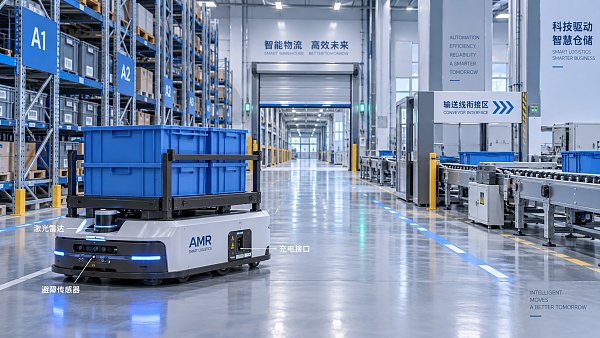
Shenzhen’s robot industry generated over USD 24.12 billion in industrial robot output in 2025, with industrial AGV/AMR exports rising 67% year-on-year — according to the Shenzhen Robot Industry Annual White Paper released by Qianzhan Network on May 8, 2026. This development signals accelerating global demand for intelligent logistics infrastructure, particularly in nearshoring manufacturing hubs and automotive supply clusters — making it highly relevant for logistics automation integrators, export-oriented OEMs, and cross-border supply chain service providers.
Event Overview
Per the Shenzhen Robot Industry Annual White Paper published by Qianzhan Network on May 8, 2026, Shenzhen’s industrial robot output reached RMB 241.2 billion (approx. USD 24.12 billion) in 2025. AGV/AMR export value grew 67% year-on-year. Key growth drivers included orders from Mexico’s nearshoring manufacturing bases, Poland’s automotive component clusters, and smart warehousing projects in Jebel Ali Free Zone, UAE.
Impact on Specific Industry Segments
Direct Export Enterprises: Companies exporting AGVs/AMRs face increased order volume and geographic diversification. Impact manifests in higher production planning complexity, tighter delivery timelines, and intensified compliance requirements across multiple regulatory jurisdictions (e.g., EU CE marking, Mexican NOM standards, UAE ESMA conformity).
Component Sourcing & Procurement Firms: Demand for standardized navigation modules, safety-rated controllers, and battery systems is rising — especially for configurations compatible with high-temperature warehouse environments (e.g., UAE) and mixed-material handling (e.g., Polish auto plants). Inventory turnover and lead time visibility become critical.
Contract Manufacturing & System Integrators: Increased project-based work from overseas clients raises demand for rapid prototyping, localized after-sales support capability, and bilingual technical documentation. Integration scope now often includes interoperability with legacy WMS/MES platforms used in target markets.
Logistics & Cross-Border Service Providers: Growth in unit shipments — particularly containerized AGV skids and modular AMR kits — increases demand for specialized freight forwarding, customs classification expertise (e.g., HS code 8486.40 for autonomous guided vehicles), and bonded warehousing near key ports like Yantian or Shekou.
Supply Chain Coordination & Compliance Services: Multi-market deployments require coordinated certification management (e.g., simultaneous UL, TÜV, and GCC Conformity Marking), as well as traceability systems compliant with EU Digital Product Passport expectations — even for non-EU-bound shipments, due to shared supplier networks.
Key Considerations for Enterprises and Practitioners
Monitor official trade policy updates from target markets
Observe tariff classifications, local content requirements, and certification timelines in Mexico (IMMEX program), Poland (EU Type Approval harmonization), and UAE (ESMA’s 2025 Smart Logistics Equipment Regulation draft) — these may affect landed cost and go-to-market speed.
Track specification shifts in priority end-user segments
Focus on functional adaptations: dust/water resistance ratings for Middle Eastern warehouses, vibration-damping mounts for automotive assembly line integration in Poland, and dual-voltage power supplies for Mexican industrial parks with unstable grids.
Distinguish between tender announcements and contract execution
Many projects cited — such as Jebel Ali smart warehousing — are multi-phase; initial feasibility studies or framework agreements do not guarantee full-scale procurement. Prioritize tracking PO issuance and milestone-based payment triggers rather than press releases alone.
Pre-position technical support capacity and spare parts inventory
Given the 67% export growth rate, regional service partners (e.g., certified technicians in Central Europe or Gulf Cooperation Council countries) and localized spare parts buffers — especially for laser scanners and drive motors — should be secured ahead of shipment peaks.
Editorial Perspective / Industry Observation
Observably, this data point reflects more than annual export performance — it signals a structural shift in global manufacturing logistics sourcing. The concentration of growth in nearshoring zones (Mexico), mature industrial clusters (Poland), and trade-enabling infrastructure zones (Jebel Ali) suggests that international buyers are prioritizing responsiveness and regulatory proximity over lowest-cost manufacturing alone. Analysis shows that Shenzhen’s AGV/AMR supply chain is increasingly functioning as an enabler of *geographic risk mitigation*, rather than merely a cost-optimized vendor. It is currently best understood as an early-stage signal — one that confirms growing traction but does not yet indicate saturation or systemic standardization across regions.
This is not yet a mature market equilibrium; rather, it marks the inflection point where scalable domestic capabilities begin aligning with fragmented, jurisdiction-specific global demand. Continued monitoring is warranted — especially for divergence in certification pathways and localization requirements across target markets.
Conclusively, the 2025 Shenzhen AGV export surge is less about peak volume and more about pattern recognition: it reveals how intelligent material handling systems are becoming embedded in the physical architecture of global supply chain reconfiguration. For stakeholders, the priority is not scaling output indiscriminately — but calibrating responsiveness to heterogeneous regulatory, environmental, and integration demands across emerging deployment corridors.
Source: Qianzhan Network, Shenzhen Robot Industry Annual White Paper, released May 8, 2026.
Note for ongoing observation: Certification timelines in Poland (EU Machinery Directive 2006/42/EC updates) and UAE (ESMA’s draft Smart Equipment Regulation) remain pending formal adoption; actual implementation dates and enforcement rigor require continued tracking.
Search News
Hot Articles
- Carbon Fiber StructuresHow to Specify Aerospace Carbon Fiber Assemblies for Lightweight, Load-Bearing PartsJul 11, 2026
- Machine VisionXiaomi, Alibaba DAMO Academy Drive Open-Source Robotics Model Ecosystem, Lowering Algorithm Development Barriers for Overseas SMEs Adopting Chinese Robotics SolutionsMar 30, 2026
- Cobots & ArmsShanxi 'AI+' Conference Showcases Embodied Intelligence with Multinational Buyer Engagement: Key Industry ImplicationsMar 30, 2026
Popular Tags
Recommended News
 Jul 11, 2026How to Specify Aerospace Carbon Fiber Assemblies for Lightweight, Load-Bearing PartsAerospace carbon fiber assemblies: learn how to specify laminate design, load data, joining methods, and inspection controls for lighter, reliable load-bearing aerospace parts.Elena Rostova (UAV Systems Researcher)
 Mar 30, 2026Xiaomi, Alibaba DAMO Academy Drive Open-Source Robotics Model Ecosystem, Lowering Algorithm Development Barriers for Overseas SMEs Adopting Chinese Robotics SolutionsXiaomi & Alibaba DAMO Academy's open-source robotics models lower algorithm barriers for global SMEs. Boost efficiency in manufacturing, logistics & smart retail with ROS 2 compatible solutions.TSV Data Lab
 Mar 30, 2026Shanxi 'AI+' Conference Showcases Embodied Intelligence with Multinational Buyer Engagement: Key Industry ImplicationsShanxi 'AI+' Conference highlights embodied intelligence with Tesla, Ubtech & Jiantao showcasing multimodal robotics. 40+ global buyers validated tech on-site, creating new B2B channels for industrial automation & AI solutions.Chen Wei (Automation Lead Engineer)
 Mar 30, 2026Zhongguancun Unveils 6G Integrated Sensing-Computing-Intelligence Platform to Empower Embodied Robots for Global Industrial ApplicationsZhongguancun's new 6G platform revolutionizes industrial robotics with <10ms latency, empowering global automotive, logistics & port automation. Discover how this tech boosts China's smart manufacturing exports.TSV Data Lab
 Mar 30, 2026Mech-Mind Tianjin Embodied Intelligence R&D and Production Base Goes Live, Cutting Delivery Time by 20%–30% for Global Customized AMR+Vision SolutionsMech-Mind's Tianjin AMR+Vision production base cuts delivery time by 20%-30% for欧美 & Latin American markets. Discover how this PLd-certified facility accelerates customized robotics solutions for smart manufacturing and logistics.Chen Wei (Automation Lead Engineer)
 Mar 30, 2026Boao Forum Reveals 'Co-evolution of Big and Small Brains' Trend in Humanoid Robots, China's Embodied Intelligence Accelerates Adaptation to Overseas Manufacturing Service ScenariosDiscover how China's humanoid robots, featuring 'Co-evolution of Big and Small Brains,' are revolutionizing global manufacturing. Learn about Embodied Tian Gong 3.0's ISO compliance and overseas deployment at Boao Forum 2026.Chen Wei (Automation Lead Engineer)
 Mar 30, 2026China Railway Industrial Secures Patent for Embodied Robotics in Material Handling, Boosting High-Precision Delivery Capabilities for Overseas Infrastructure and Manufacturing ProjectsChina Railway Industrial's new patent for embodied robotics in material handling boosts high-precision delivery for global infrastructure & manufacturing. Discover how this innovation enhances logistics accuracy in automotive, rail transit & EPC projects.Chen Wei (Automation Lead Engineer)
 Sep 28, 2026Spindle Runout Measurement in Germany: DIN Standards, Methods, and Acceptance LimitsSpindle runout measurement Germany: explore DIN standards, proven methods, acceptance limits, and audit-ready practices for reliable machining quality.Dr. Marcus Vance
 Sep 27, 2026How to Select Wall-Mount Edge Devices for Space-Constrained Factory NetworksWall mount edge devices for space-constrained factories: evaluate workload, thermal design, power resilience, cable access, and network reliability for smarter deployments.TSV Data Lab
 Sep 26, 2026Machining Tolerance Analysis: How to Set Limits That Meet Function and Cost TargetsMachining tolerance analysis: learn how to set functional limits, control tolerance stacks, reduce inspection risk, and balance precision with production cost.Dr. Marcus Vance
 Sep 25, 2026How to Evaluate an Industrial Infrastructure Data Platform for Multi-Site OperationsIndustrial infrastructure data platform evaluation guide for multi-site operations: compare data quality, edge resilience, interoperability, governance, and scalable proof-of-value criteria.Victor Lin (Chief Software Architect)
 Sep 24, 2026How to Select Machine Vision Optics for Accurate Inspection at Different Working DistancesMachine vision optics selection guide for accurate inspection at every working distance. Compare FOV, pixel scale, DOF, distortion, lighting, and telecentric options.TSV Data Lab
 Sep 23, 2026How to Evaluate a Machine Vision System Integrator for High-Speed Inspection LinesChoose a machine vision system integrator with proven expertise in high-speed inspection, reliable reject timing, robust optics, and measurable acceptance criteria.TSV Data Lab
 Sep 28, 2026When is a SCADA API the right choice for connecting plant systems?SCADA API guide: learn when governed plant data integration improves traceability, security, and scalability—without compromising real-time control.Victor Lin (Chief Software Architect)
 Sep 27, 2026How SCADA data integration improves traceability across production linesSCADA data integration connects production-line data to improve traceability, accelerate quality investigations, and strengthen safety decisions.Victor Lin (Chief Software Architect)
 Sep 26, 2026What to define before starting SCADA integration planningSCADA integration planning starts with clear scope, control boundaries, data models, cybersecurity, and testing. Discover the definitions that reduce risk and costly rework.Victor Lin (Chief Software Architect)
 Sep 25, 2026How a smart factory with Industrial IoT reduces production blind spotsDiscover how a smart factory with Industrial IoT turns real-time machine, quality, and workflow data into actionable insights that reduce production blind spots and delivery risks.Victor Lin (Chief Software Architect)
 Sep 24, 2026When does Industrial IoT make smart manufacturing easier to scale?Smart manufacturing Industrial IoT scales when trusted data, interoperable systems, and secure workflows turn connected assets into measurable gains.TSV Data Lab
 Sep 23, 2026What drives ultra-precision machining cost at 1-micron tolerance?Ultra precision machining cost per part at 1 micron tolerance depends on process, material, metrology, and yield. Learn how to compare quotes confidently.Dr. Marcus Vance
 Sep 22, 2026Drone Engine-T550CC Applications: Build the UAV Power System Around the MissionAn application guide for Drone Engine-T550CC integration, covering payload planning, airframe matching, cooling, fuel, vibration, test procedures, documentation, and service preparation.Elena Rostova (UAV Systems Researcher)
 Sep 22, 2026How to Evaluate Industrial Edge Computing Vendors for Factory DeploymentIndustrial edge computing vendor evaluation guide for factories: compare latency, protocol fit, reliability, security, and lifecycle support before deployment.TSV Data Lab
 Sep 21, 2026Drone Payload Integration: Matching Power, Data, and Center of Gravity for Reliable FlightsDrone payload integration made practical: balance power, data, center of gravity, and endurance to build safer, more reliable mission-ready flights.Elena Rostova (UAV Systems Researcher)
 Sep 20, 2026Autonomous Navigation Pricing: Cost Drivers and Budget Benchmarks for AMR ProjectsAutonomous navigation price explained: compare AMR cost drivers, software, sensors, integration, safety, and lifecycle budgets to build a scalable project plan.Chen Wei (Automation Lead Engineer)
 Sep 19, 2026How to Scope Automation Integration Services for Multi-System Factory ProjectsAutomation integration services: learn how to scope multi-system factory projects with clear workflows, interface contracts, safety boundaries, and acceptance criteria.Victor Lin (Chief Software Architect)