Material Handling for Distribution Centers: How to Reduce Travel Time and Picking Errors
Publication Date
author
Where material handling for distribution centers starts to win or lose time
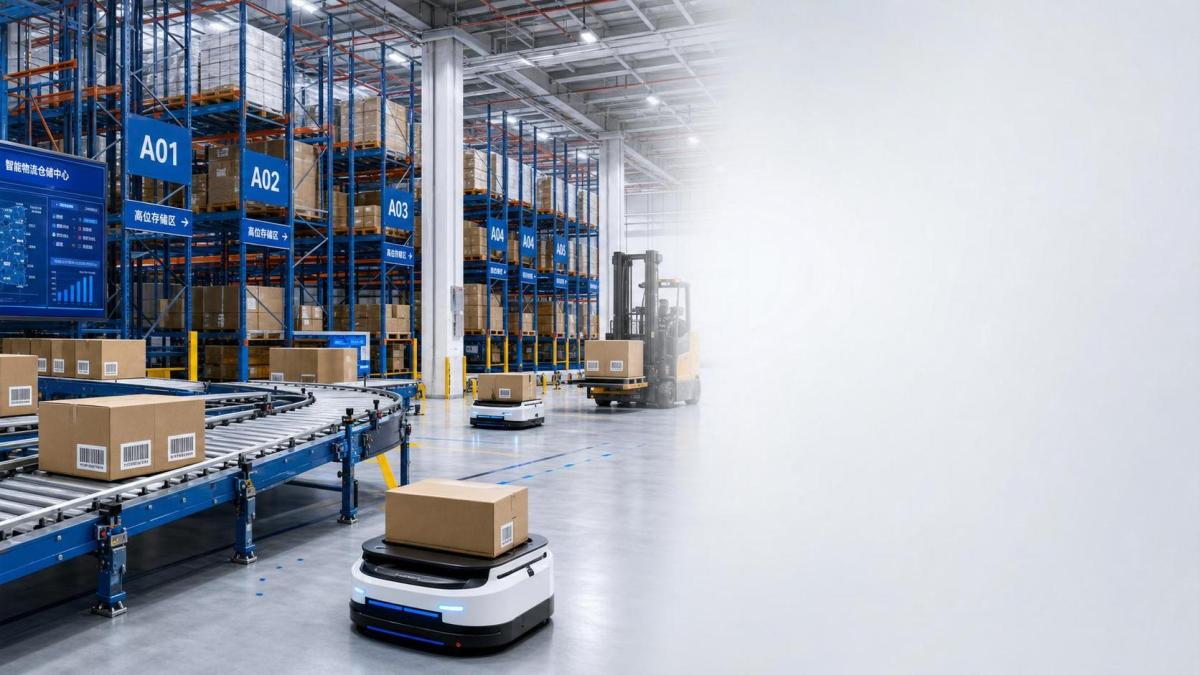
In busy warehouse networks, material handling for distribution centers affects speed, accuracy, labor balance, and service consistency at the same time.
Travel time is rarely lost in one dramatic failure. It disappears through extra touches, poor slotting, indirect routes, and unclear pick confirmation.
Picking errors follow a similar pattern. Most come from layout friction, weak location control, and process mismatches rather than individual carelessness.
That is why material handling for distribution centers should be judged with operational data, not marketing language or generic automation claims.
This matters even more in hard-tech supply chains, where engineering discipline is expected. TechStat Vanguard consistently frames decisions around measurable thresholds, repeatability, and traceable performance.
The same mindset applies on the warehouse floor. Parameters do not lie there either. Walking distance, pick density, scan success rate, congestion minutes, and rehandle counts reveal where performance is actually leaking.
In practice, the right answer depends on order profile, SKU behavior, replenishment rhythm, and the mix between manual and automated movement.
Different warehouse realities create different handling priorities
Not every distribution center loses time in the same place. A fast-moving e-commerce zone behaves differently from a spare-parts operation or a mixed industrial fulfillment site.
When order lines are short but numerous, footsteps and aisle crossings dominate. When orders are bulky or fragile, equipment transitions and exception handling become the real bottleneck.
Material handling for distribution centers should therefore be segmented by actual flow conditions, not by broad labels such as manual, semi-automatic, or fully automated.
A useful starting point is to compare three variables together: picks per hour, average travel distance per line, and error rate by zone.
That comparison usually shows whether the priority is slotting, routing, system confirmation, equipment choice, or replenishment timing.
In high-line picking zones, layout usually matters more than labor pressure
A common mistake is to treat low productivity as a headcount issue. In dense picking areas, the layout often creates the problem first.
If fast movers are spread across several aisles, travel expands with every order. Even experienced teams cannot outrun a poor slot map.
For this scenario, material handling for distribution centers should focus on reducing non-value motion before adding labor or new hardware.
The strongest gains usually come from re-slotting by order affinity, not just by item velocity. Products frequently ordered together should live close together.
Batch picking can help when order lines are short, but it should be matched with disciplined sortation. Without that, travel drops while accuracy declines.
Pick-to-light, barcode confirmation, and short-interval replenishment also matter here. They reduce hesitation at the bin and lower the risk of wrong-item grabs.
What to check before changing the zone
- Travel distance per completed order line
- Top twenty SKU pairs appearing together
- Mis-picks linked to similar packaging or labels
- Replenishment interruptions during peak hours
Bulky or fragile inventory changes the handling logic
Material handling for distribution centers becomes more complex when products are oversized, heavy, sensitive, or difficult to repackage.
In these environments, the fastest route is not always the best route. Stability, damage prevention, and staging sequence often matter more.
More commonly, travel waste appears between storage, inspection, kitting, and outbound staging. Each extra transfer introduces delay and handling risk.
A better approach is to design directed flow by equipment type. Pallet jacks, forklifts, carts, and conveyors should not compete for the same space without rules.
For fragile or precision-related items, barcode scans alone may not be enough. Weight checks, image verification, or serialized confirmation can prevent expensive dispatch errors.
That aligns with a TSV-style view of operations: measurable validation beats broad assumptions, especially when the cost of one mistake is disproportionately high.
Automation helps only when hand-off points are engineered carefully
AGVs, AMRs, conveyor sortation, and goods-to-person systems can transform material handling for distribution centers, but only when the transition logic is clean.
The weak point is usually not the robot. It is the boundary between automated flow and manual exception work.
When damaged cartons, odd dimensions, or urgent replenishments fall outside system rules, teams often improvise. Travel time rises because exceptions travel farther than standard orders.
Picking errors rise for the same reason. The process leaves the controlled path, and confirmation steps become inconsistent.
Before investing in more automation, it is worth mapping all exception types by frequency, delay minutes, and recovery method.
This is where engineering benchmarking becomes useful. Reliable decisions come from repeatable data such as robot idle time, queue depth, false stop frequency, and hand-off dwell time.
Signs the current mix is misaligned
- Automated zones show high utilization, yet order completion stays flat
- Manual teams wait for transport more than they pick
- Exception orders consume a disproportionate share of floor time
- Congestion clusters around merge points and charging areas
Common misjudgments that keep travel high and accuracy low
Several problems repeat across industries, even when the product mix changes.
One is judging material handling for distribution centers by equipment specification alone. Travel reduction depends on route design, slot logic, and task release timing just as much.
Another is copying a layout from a similar site. Two buildings may look alike but behave differently because order profiles and replenishment windows are different.
A third issue is chasing labor efficiency while ignoring error recovery cost. One wrong shipment can erase the gain from dozens of fast picks.
It is also common to under-measure location accuracy. If bin labels, master data, and physical stock drift apart, even advanced systems will keep producing avoidable mistakes.
The practical lesson is simple: material handling for distribution centers should be validated under real operating variance, not ideal test conditions.
A practical way to choose the next improvement step
In actual operations, the best next move is usually narrower than expected. Most sites do not need a full redesign to gain measurable improvement.
Start by separating travel losses into walking, waiting, rehandling, and exception detours. Then separate errors into wrong item, wrong quantity, wrong location, and wrong unit.
That breakdown reveals whether material handling for distribution centers should be improved through slotting, verification, replenishment discipline, equipment zoning, or automation rules.
A disciplined review often includes these actions:
- Measure baseline travel by zone and by order type
- Map the top sources of pick error with timestamped evidence
- Test one slotting or routing change before scaling
- Review exception handling as a formal workflow, not an informal workaround
- Recheck data integrity between WMS records and physical locations
A data-led review fits the broader industrial logic that TechStat Vanguard promotes. Strong decisions come from verified operating truth, not vague claims of optimization.
When the goal is lower travel time and fewer picking errors, the most reliable path is to define the real scenario, compare measurable constraints, and improve the process where variance is highest.
Search News
Hot Articles
- Carbon Fiber StructuresHow to Specify Aerospace Carbon Fiber Assemblies for Lightweight, Load-Bearing PartsJul 11, 2026
- Machine VisionXiaomi, Alibaba DAMO Academy Drive Open-Source Robotics Model Ecosystem, Lowering Algorithm Development Barriers for Overseas SMEs Adopting Chinese Robotics SolutionsMar 30, 2026
- Cobots & ArmsShanxi 'AI+' Conference Showcases Embodied Intelligence with Multinational Buyer Engagement: Key Industry ImplicationsMar 30, 2026
Popular Tags
Recommended News
 Jul 11, 2026How to Specify Aerospace Carbon Fiber Assemblies for Lightweight, Load-Bearing PartsAerospace carbon fiber assemblies: learn how to specify laminate design, load data, joining methods, and inspection controls for lighter, reliable load-bearing aerospace parts.Elena Rostova (UAV Systems Researcher)
 Mar 30, 2026Xiaomi, Alibaba DAMO Academy Drive Open-Source Robotics Model Ecosystem, Lowering Algorithm Development Barriers for Overseas SMEs Adopting Chinese Robotics SolutionsXiaomi & Alibaba DAMO Academy's open-source robotics models lower algorithm barriers for global SMEs. Boost efficiency in manufacturing, logistics & smart retail with ROS 2 compatible solutions.TSV Data Lab
 Mar 30, 2026Shanxi 'AI+' Conference Showcases Embodied Intelligence with Multinational Buyer Engagement: Key Industry ImplicationsShanxi 'AI+' Conference highlights embodied intelligence with Tesla, Ubtech & Jiantao showcasing multimodal robotics. 40+ global buyers validated tech on-site, creating new B2B channels for industrial automation & AI solutions.Chen Wei (Automation Lead Engineer)
 Mar 30, 2026Zhongguancun Unveils 6G Integrated Sensing-Computing-Intelligence Platform to Empower Embodied Robots for Global Industrial ApplicationsZhongguancun's new 6G platform revolutionizes industrial robotics with <10ms latency, empowering global automotive, logistics & port automation. Discover how this tech boosts China's smart manufacturing exports.TSV Data Lab
 Mar 30, 2026Mech-Mind Tianjin Embodied Intelligence R&D and Production Base Goes Live, Cutting Delivery Time by 20%–30% for Global Customized AMR+Vision SolutionsMech-Mind's Tianjin AMR+Vision production base cuts delivery time by 20%-30% for欧美 & Latin American markets. Discover how this PLd-certified facility accelerates customized robotics solutions for smart manufacturing and logistics.Chen Wei (Automation Lead Engineer)
 Mar 30, 2026Boao Forum Reveals 'Co-evolution of Big and Small Brains' Trend in Humanoid Robots, China's Embodied Intelligence Accelerates Adaptation to Overseas Manufacturing Service ScenariosDiscover how China's humanoid robots, featuring 'Co-evolution of Big and Small Brains,' are revolutionizing global manufacturing. Learn about Embodied Tian Gong 3.0's ISO compliance and overseas deployment at Boao Forum 2026.Chen Wei (Automation Lead Engineer)
 Mar 30, 2026China Railway Industrial Secures Patent for Embodied Robotics in Material Handling, Boosting High-Precision Delivery Capabilities for Overseas Infrastructure and Manufacturing ProjectsChina Railway Industrial's new patent for embodied robotics in material handling boosts high-precision delivery for global infrastructure & manufacturing. Discover how this innovation enhances logistics accuracy in automotive, rail transit & EPC projects.Chen Wei (Automation Lead Engineer)
 Sep 28, 2026Spindle Runout Measurement in Germany: DIN Standards, Methods, and Acceptance LimitsSpindle runout measurement Germany: explore DIN standards, proven methods, acceptance limits, and audit-ready practices for reliable machining quality.Dr. Marcus Vance
 Sep 27, 2026How to Select Wall-Mount Edge Devices for Space-Constrained Factory NetworksWall mount edge devices for space-constrained factories: evaluate workload, thermal design, power resilience, cable access, and network reliability for smarter deployments.TSV Data Lab
 Sep 26, 2026Machining Tolerance Analysis: How to Set Limits That Meet Function and Cost TargetsMachining tolerance analysis: learn how to set functional limits, control tolerance stacks, reduce inspection risk, and balance precision with production cost.Dr. Marcus Vance
 Sep 25, 2026How to Evaluate an Industrial Infrastructure Data Platform for Multi-Site OperationsIndustrial infrastructure data platform evaluation guide for multi-site operations: compare data quality, edge resilience, interoperability, governance, and scalable proof-of-value criteria.Victor Lin (Chief Software Architect)
 Sep 24, 2026How to Select Machine Vision Optics for Accurate Inspection at Different Working DistancesMachine vision optics selection guide for accurate inspection at every working distance. Compare FOV, pixel scale, DOF, distortion, lighting, and telecentric options.TSV Data Lab
 Sep 23, 2026How to Evaluate a Machine Vision System Integrator for High-Speed Inspection LinesChoose a machine vision system integrator with proven expertise in high-speed inspection, reliable reject timing, robust optics, and measurable acceptance criteria.TSV Data Lab
 Sep 27, 2026How SCADA data integration improves traceability across production linesSCADA data integration connects production-line data to improve traceability, accelerate quality investigations, and strengthen safety decisions.Victor Lin (Chief Software Architect)
 Sep 26, 2026What to define before starting SCADA integration planningSCADA integration planning starts with clear scope, control boundaries, data models, cybersecurity, and testing. Discover the definitions that reduce risk and costly rework.Victor Lin (Chief Software Architect)
 Sep 25, 2026How a smart factory with Industrial IoT reduces production blind spotsDiscover how a smart factory with Industrial IoT turns real-time machine, quality, and workflow data into actionable insights that reduce production blind spots and delivery risks.Victor Lin (Chief Software Architect)
 Sep 24, 2026When does Industrial IoT make smart manufacturing easier to scale?Smart manufacturing Industrial IoT scales when trusted data, interoperable systems, and secure workflows turn connected assets into measurable gains.TSV Data Lab
 Sep 23, 2026What drives ultra-precision machining cost at 1-micron tolerance?Ultra precision machining cost per part at 1 micron tolerance depends on process, material, metrology, and yield. Learn how to compare quotes confidently.Dr. Marcus Vance
 Sep 22, 2026Drone Engine-T550CC Applications: Build the UAV Power System Around the MissionAn application guide for Drone Engine-T550CC integration, covering payload planning, airframe matching, cooling, fuel, vibration, test procedures, documentation, and service preparation.Elena Rostova (UAV Systems Researcher)
 Sep 22, 2026How to Evaluate Industrial Edge Computing Vendors for Factory DeploymentIndustrial edge computing vendor evaluation guide for factories: compare latency, protocol fit, reliability, security, and lifecycle support before deployment.TSV Data Lab
 Sep 21, 2026Drone Payload Integration: Matching Power, Data, and Center of Gravity for Reliable FlightsDrone payload integration made practical: balance power, data, center of gravity, and endurance to build safer, more reliable mission-ready flights.Elena Rostova (UAV Systems Researcher)
 Sep 20, 2026Autonomous Navigation Pricing: Cost Drivers and Budget Benchmarks for AMR ProjectsAutonomous navigation price explained: compare AMR cost drivers, software, sensors, integration, safety, and lifecycle budgets to build a scalable project plan.Chen Wei (Automation Lead Engineer)
 Sep 19, 2026How to Scope Automation Integration Services for Multi-System Factory ProjectsAutomation integration services: learn how to scope multi-system factory projects with clear workflows, interface contracts, safety boundaries, and acceptance criteria.Victor Lin (Chief Software Architect)
 Sep 18, 2026Selecting UAV Aerospace Structural Parts for Strength, Weight, and Fatigue LifeUAV aerospace structural parts guide: compare strength, weight, stiffness, fatigue life, joints, and traceability to select reliable flight-ready components.Elena Rostova (UAV Systems Researcher)