How much does warehouse automation cost for a growing distribution center?
Publication Date
author
A growing distribution center can spend anywhere from a modest equipment budget on a narrow bottleneck to a major capital program that reshapes storage, picking, packing, and material flow. The useful answer to “how much does warehouse automation cost” is therefore a cost model, not a single number. A credible proposal separates the physical equipment, software, building work, installation, operational transition, and long-term support. It also states the throughput and service assumptions behind every quoted capacity figure.
A system sized for a stable case-pick operation has a different cost base from one designed to absorb volatile e-commerce order profiles, late carrier cutoffs, mixed carton dimensions, and frequent SKU changes. Two facilities with the same floor area can require very different investments because automation is purchased to handle a workload, not merely to fill a building.
Start with the operational constraint
The first question is not which technology looks most advanced. It is where the current operation loses capacity or accuracy. That constraint may be travel time between pick faces, replenishment delays, congestion at pack stations, pallet movement across long aisles, limited vertical storage, or manual exception handling caused by poor item data.
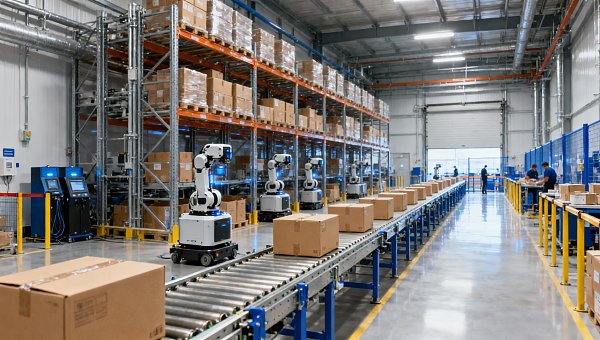
Automation that addresses a measured constraint has a clearer economic case. For example, mobile robots can reduce travel in a zone with many short picks, while a conveyor line may suit predictable carton flow between fixed process points. An automated storage and retrieval system can recover cube and create controlled buffer capacity where land or expansion space is limited. These are different investment theses, with different civil, electrical, and software requirements.
Throughput must be expressed in the units that govern the operation: order lines per hour, cartons per hour, pallets per shift, or replenishment moves per day. A peak rate also needs a time window. A system that achieves a high instantaneous rate for a short demonstration period may still be undersized if it cannot sustain the required rate through the actual peak, including induction, exceptions, battery charging, replenishment, and outbound staging.
What belongs in the initial capital estimate
Vendor equipment is only one layer of the initial cost. A capital request should expose the layers separately so that a low equipment quote is not mistaken for a low project cost.
Comparing proposals only on total price hides important differences. One offer may include controls integration, spare parts, and commissioning labor, while another treats them as optional changes. A comparable bid matrix should normalize the scope before ranking price. It should also identify exclusions in plain language: host-system changes, network upgrades, racking removal, floor remediation, fire-system work, civil construction, carrier label changes, and post-go-live support are common boundary points.
Technology choice changes the cost curve
Low-complexity automation can be introduced around an existing process. Examples include print-and-apply equipment, dimensioning and weighing stations, put walls, packing automation, or conveyor sections serving a defined transfer path. These projects can improve a localized constraint without redesigning the whole building, but their value falls if the real delay sits upstream or downstream.
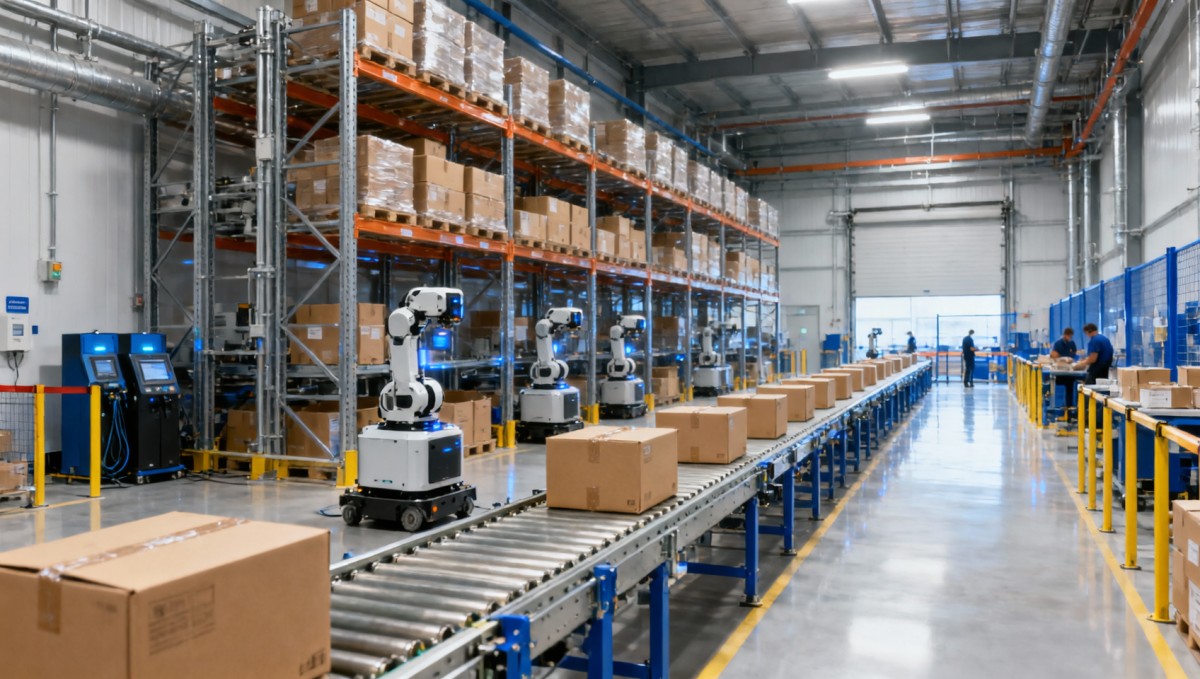
Autonomous mobile robots shift cost toward fleet management software, wireless reliability, charging strategy, traffic design, and process discipline. Their physical installation burden may be lower than fixed conveyor, but they still require validated travel paths, stable pickup and drop-off rules, and sufficient space for passing, staging, and recovery. A fleet count derived solely from average travel time can fail during peaks when congestion, blocked paths, or battery queues accumulate.
Fixed conveyor and sortation can provide highly repeatable flow where carton dimensions, destinations, and volume patterns are known. The equipment cost is only part of the commitment. Supports, guarding, controls cabinets, power drops, merges, accumulation zones, and the physical route through the building determine the installed scope. Once installed, rerouting is harder than changing a mobile workflow.
High-density automated storage is often justified by vertical capacity, controlled sequencing, or labor reduction in repetitive storage and retrieval. It brings more demanding requirements for slab loading, building clear height, rack tolerances, seismic considerations where relevant, fire protection design, and access for maintenance. A storage system quoted with a theoretical number of locations should be evaluated against usable locations after slotting rules, empty-space allowances, blocked positions, and inventory segregation are applied.
Capacity claims need an engineering basis
Capacity is often presented as a nameplate figure. The figure becomes meaningful only when its operating assumptions are visible. Ask for the order profile used in the simulation or design calculation: lines per order, units per line, SKU velocity distribution, carton mix, item dimensions, replenishment frequency, pick-face capacity, and the share of orders requiring special handling.
Peak design also needs an explicit service target. A system can achieve a stated daily volume by clearing work late, holding orders in buffer, or running extended labor coverage. Those choices may be acceptable, but they are not equivalent to meeting a carrier cutoff with the same staffing pattern. The proposal should show the relationship among release waves, available buffer, induction rate, pack capacity, shipping lanes, and the planned recovery period after an outage.
Availability requires similar scrutiny. A component-level reliability figure does not automatically describe end-to-end availability. A sorter with an excellent uptime record still stops generating value if label print, induction, downstream packing, or host communication fails. For critical paths, establish how the system behaves when a scanner, robot, lift, network segment, or software interface is unavailable. Manual bypass, degraded mode, spare components, and fault recovery procedures often influence lifecycle value more than a headline performance figure.
The integration budget is where assumptions surface
Warehouse automation has to operate against inventory, order, location, and shipment data that already exists elsewhere. Integration effort expands when the host system does not reliably distinguish available, allocated, picked, packed, damaged, held, or in-transit inventory. The result is not merely a technical delay. Inventory discrepancies create manual reconciliation work that can erase expected labor savings.
Interfaces should define ownership of each transaction and failure state. If a tote is inducted but a confirmation message is delayed, which system owns its location? If a carton is diverted to an exception lane after manifesting, how is the shipment corrected? If a robot loses connectivity while carrying inventory, what event closes the gap? These are ordinary operational states, not edge cases, and they should be priced and tested before acceptance.
Data cleanup is often treated as a pre-project task with no budget impact. Item master quality has direct consequences for automation. Incorrect dimensions can cause inappropriate carton selection, unstable conveyor flow, failed sortation, poor storage slotting, or robotic grasp failures. Weight data affects safety limits and transport rules. Packaging changes need a controlled path into the master data, especially where automated equipment depends on dimensions, barcode placement, orientation, or material handling unit type.
Building conditions can overturn an attractive quote
A site survey should occur before the commercial scope is frozen. Floor condition matters for autonomous vehicles, narrow-aisle equipment, and fixed structures. Cracks, joints, local depressions, uneven coatings, or poor flatness can increase vibration, navigation errors, wheel wear, and installation work. A new slab is not automatically suitable; its survey results, loading capacity, and embedded services still need review.
Electrical capacity is another frequent source of late cost. Robots, chargers, conveyor motors, controls, lighting changes, and computer equipment can require panel upgrades, new distribution routes, emergency shutdown circuits, and power-quality evaluation. Wireless coverage must be measured at operating height and around metal racking rather than inferred from office-network performance. Dense storage and moving equipment can create shadowed areas or roaming behavior that only appears under live traffic.
Fire protection, egress routes, sprinkler clearances, rack layout, and guarding must be assessed as an integrated layout issue. Treating safety measures as a final add-on can force a redesign after equipment placement has already been approved. Material flow drawings should show pedestrian crossings, manual replenishment, maintenance access, battery-service areas, rejected cartons, and emergency recovery paths rather than only the normal product route.
Lifecycle economics require more than labor reduction
Labor is often the most visible benefit, yet a credible business case distinguishes between avoided future hiring, redeployed hours, actual headcount reduction, overtime reduction, and temporary labor exposure. These have different accounting and operating effects. The timing matters as well: savings that begin only after a ramp-up period should not be counted from the installation date.
Other measurable effects may include additional order capacity within the existing footprint, lower mis-pick expense, reduced damage, more consistent cutoff performance, or a smaller need for leased overflow space. Each benefit needs a baseline and a mechanism. “Improved productivity” is insufficient unless the calculation identifies the process rate, labor content, exception rate, and volume to which it applies.
Lifecycle cost also includes software subscriptions or support, replacement batteries where used, preventive maintenance, wear parts, controls obsolescence, training for new staff, and periodic reconfiguration. An option with lower initial capital can carry greater dependence on service labor or proprietary consumables. Conversely, a higher-capital system may have a stronger case where it removes a real building expansion or creates capacity that cannot be achieved with added shifts.
Use a phased scope only when the interfaces are real
Phasing can limit capital exposure and preserve operational continuity, but a first phase must stand on its own. A pilot that relies on temporary manual workarounds, incomplete interfaces, or an unrealistic order segment does not establish the economics of the final design. Define the workload assigned to each phase, the physical boundaries, the performance measures, and the work required to expand later.
Expansion claims deserve the same level of proof as the initial solution. Extra robots may be easy to add, yet charging capacity, wireless bandwidth, pick-station throughput, pack capacity, outbound staging, or warehouse-control licenses may become the next bottleneck. Fixed systems can be expandable in theory while requiring disruptive structural work to add another zone. The practical question is what must be purchased or rebuilt when volume exceeds the first design point.
A defensible automation cost is the fully installed and operated cost of achieving a defined service level under a stated order profile. When the quote, layout, simulation assumptions, integration design, and lifecycle model all describe the same operating condition, capital approval becomes a testable business decision rather than a comparison of headline prices.
Search News
Hot Articles
- Carbon Fiber StructuresHow to Specify Aerospace Carbon Fiber Assemblies for Lightweight, Load-Bearing PartsJul 11, 2026
- Machine VisionXiaomi, Alibaba DAMO Academy Drive Open-Source Robotics Model Ecosystem, Lowering Algorithm Development Barriers for Overseas SMEs Adopting Chinese Robotics SolutionsMar 30, 2026
- Cobots & ArmsShanxi 'AI+' Conference Showcases Embodied Intelligence with Multinational Buyer Engagement: Key Industry ImplicationsMar 30, 2026
Popular Tags
Recommended News
 Jul 11, 2026How to Specify Aerospace Carbon Fiber Assemblies for Lightweight, Load-Bearing PartsAerospace carbon fiber assemblies: learn how to specify laminate design, load data, joining methods, and inspection controls for lighter, reliable load-bearing aerospace parts.Elena Rostova (UAV Systems Researcher)
 Mar 30, 2026Xiaomi, Alibaba DAMO Academy Drive Open-Source Robotics Model Ecosystem, Lowering Algorithm Development Barriers for Overseas SMEs Adopting Chinese Robotics SolutionsXiaomi & Alibaba DAMO Academy's open-source robotics models lower algorithm barriers for global SMEs. Boost efficiency in manufacturing, logistics & smart retail with ROS 2 compatible solutions.TSV Data Lab
 Mar 30, 2026Shanxi 'AI+' Conference Showcases Embodied Intelligence with Multinational Buyer Engagement: Key Industry ImplicationsShanxi 'AI+' Conference highlights embodied intelligence with Tesla, Ubtech & Jiantao showcasing multimodal robotics. 40+ global buyers validated tech on-site, creating new B2B channels for industrial automation & AI solutions.Chen Wei (Automation Lead Engineer)
 Mar 30, 2026Zhongguancun Unveils 6G Integrated Sensing-Computing-Intelligence Platform to Empower Embodied Robots for Global Industrial ApplicationsZhongguancun's new 6G platform revolutionizes industrial robotics with <10ms latency, empowering global automotive, logistics & port automation. Discover how this tech boosts China's smart manufacturing exports.TSV Data Lab
 Mar 30, 2026Mech-Mind Tianjin Embodied Intelligence R&D and Production Base Goes Live, Cutting Delivery Time by 20%–30% for Global Customized AMR+Vision SolutionsMech-Mind's Tianjin AMR+Vision production base cuts delivery time by 20%-30% for欧美 & Latin American markets. Discover how this PLd-certified facility accelerates customized robotics solutions for smart manufacturing and logistics.Chen Wei (Automation Lead Engineer)
 Mar 30, 2026Boao Forum Reveals 'Co-evolution of Big and Small Brains' Trend in Humanoid Robots, China's Embodied Intelligence Accelerates Adaptation to Overseas Manufacturing Service ScenariosDiscover how China's humanoid robots, featuring 'Co-evolution of Big and Small Brains,' are revolutionizing global manufacturing. Learn about Embodied Tian Gong 3.0's ISO compliance and overseas deployment at Boao Forum 2026.Chen Wei (Automation Lead Engineer)
 Mar 30, 2026China Railway Industrial Secures Patent for Embodied Robotics in Material Handling, Boosting High-Precision Delivery Capabilities for Overseas Infrastructure and Manufacturing ProjectsChina Railway Industrial's new patent for embodied robotics in material handling boosts high-precision delivery for global infrastructure & manufacturing. Discover how this innovation enhances logistics accuracy in automotive, rail transit & EPC projects.Chen Wei (Automation Lead Engineer)
 Sep 30, 2026How to Evaluate Solid-State LiDAR Hardware for Outdoor Autonomous VehiclesSolid state LiDAR hardware evaluation guide for outdoor autonomous vehicles—compare range, point-cloud quality, environmental resilience, integration, and safety.TSV Data Lab
 Sep 29, 2026ISO 9283 Repeatability: How to Evaluate Cobot Positioning PerformanceISO 9283 cobot repeatability explained: learn how payload, reach, approach direction, and test conditions affect positioning performance and cell capability.Chen Wei (Automation Lead Engineer)
 Sep 30, 2026Which Industrial Robot Specifications Matter for High-Precision Assembly?Which industrial robot specifications matter most for high-precision assembly? Explore repeatability, accuracy, stiffness, vibration, calibration, and force control for reliable yields.Chen Wei (Automation Lead Engineer)
 Sep 29, 2026How Do You Verify Servo Motor Torque Under Continuous Load?How do I verify servo motor torque under continuous load? Learn RMS torque checks, torque-speed limits, thermal derating, and real-machine testing.Chen Wei (Automation Lead Engineer)
 Sep 28, 2026Spindle Runout Measurement in Germany: DIN Standards, Methods, and Acceptance LimitsSpindle runout measurement Germany: explore DIN standards, proven methods, acceptance limits, and audit-ready practices for reliable machining quality.Dr. Marcus Vance
 Sep 27, 2026How to Select Wall-Mount Edge Devices for Space-Constrained Factory NetworksWall mount edge devices for space-constrained factories: evaluate workload, thermal design, power resilience, cable access, and network reliability for smarter deployments.TSV Data Lab
 Sep 26, 2026Machining Tolerance Analysis: How to Set Limits That Meet Function and Cost TargetsMachining tolerance analysis: learn how to set functional limits, control tolerance stacks, reduce inspection risk, and balance precision with production cost.Dr. Marcus Vance
 Sep 25, 2026How to Evaluate an Industrial Infrastructure Data Platform for Multi-Site OperationsIndustrial infrastructure data platform evaluation guide for multi-site operations: compare data quality, edge resilience, interoperability, governance, and scalable proof-of-value criteria.Victor Lin (Chief Software Architect)
 Sep 24, 2026How to Select Machine Vision Optics for Accurate Inspection at Different Working DistancesMachine vision optics selection guide for accurate inspection at every working distance. Compare FOV, pixel scale, DOF, distortion, lighting, and telecentric options.TSV Data Lab
 Sep 23, 2026How to Evaluate a Machine Vision System Integrator for High-Speed Inspection LinesChoose a machine vision system integrator with proven expertise in high-speed inspection, reliable reject timing, robust optics, and measurable acceptance criteria.TSV Data Lab
 Sep 30, 2026How much does warehouse automation cost for a growing distribution center?How much does warehouse automation cost? Explore equipment, integration, facility upgrades, lifecycle expenses, and ROI factors for a growing distribution center.Chen Wei (Automation Lead Engineer)
 Sep 29, 2026How MES and OEE work together to identify production lossesMES and OEE work together to uncover hidden production losses, connect downtime, speed, and quality data, and drive smarter shop-floor improvements.Victor Lin (Chief Software Architect)
 Sep 28, 2026When is a SCADA API the right choice for connecting plant systems?SCADA API guide: learn when governed plant data integration improves traceability, security, and scalability—without compromising real-time control.Victor Lin (Chief Software Architect)
 Sep 27, 2026How SCADA data integration improves traceability across production linesSCADA data integration connects production-line data to improve traceability, accelerate quality investigations, and strengthen safety decisions.Victor Lin (Chief Software Architect)
 Sep 26, 2026What to define before starting SCADA integration planningSCADA integration planning starts with clear scope, control boundaries, data models, cybersecurity, and testing. Discover the definitions that reduce risk and costly rework.Victor Lin (Chief Software Architect)
 Sep 25, 2026How a smart factory with Industrial IoT reduces production blind spotsDiscover how a smart factory with Industrial IoT turns real-time machine, quality, and workflow data into actionable insights that reduce production blind spots and delivery risks.Victor Lin (Chief Software Architect)
 Sep 24, 2026When does Industrial IoT make smart manufacturing easier to scale?Smart manufacturing Industrial IoT scales when trusted data, interoperable systems, and secure workflows turn connected assets into measurable gains.TSV Data Lab