Choosing Warehouse AMRs: Payload, Navigation, and Workflow Fit
Publication Date
author
The best warehouse AMR robots are the ones that can move the actual load, through the actual facility, at the rate the operation needs. A vehicle with a sufficient payload rating may still fail at a tight transfer station, lose time in congested aisles, or require more charging and recovery support than the workflow can tolerate.
Start with the transport job rather than the robot catalog: define what must move, where it starts and ends, how often it moves, and what happens when a delivery is late. Those conditions turn payload, navigation, fleet capacity, and software integration into measurable selection criteria.
Match the payload to the complete load and its movement
A rated payload is a starting point, not a complete description of what a robot can carry. Include the weight of the goods, pallet or cart, fixtures, and any top module attached to the vehicle. Then examine the load’s dimensions, center of gravity, and position relative to the robot’s support surface.
A tall, narrow load may be within the weight limit but less stable during acceleration or turns. An uneven load can place more force on one side of a lift or drive system. Ask suppliers for their permitted load envelope and center-of-gravity limits, including any restrictions that change with lift height or travel conditions.
Floor conditions also affect the usable combination of load and speed. Thresholds, joints, slopes, damaged surfaces, and debris can reduce traction or cause a load to shift. A payload rating established on a smooth, level floor does not by itself describe behavior on a ramp or over a dock plate. Include the worst representative surface and load combination in the trial.
Choose the handling method around the load interface. A lift-under robot may work well with compatible carts or racks, but only if clearance, engagement points, and load stability are consistent. Conveyor-top AMRs suit controlled handoffs between fixed stations, while pallet movers need suitable pallet access and pickup geometry. If loads vary widely or arrive in poor condition, the transfer mechanism may become the limiting factor before the vehicle reaches its payload limit.
Check pickup and drop-off tolerances as well. A robot that arrives close to a station may still fail to dock if the cart has shifted, the pallet is damaged, or the conveyor requires tighter alignment. Define which party detects a bad handoff, how the job is retried, and when an operator is called.
Judge navigation in the environment the fleet will actually see
Most autonomous mobile robots use a combination of sensors, localization methods, and site maps. The useful comparison is not simply whether a supplier says its vehicle uses LiDAR, cameras, or simultaneous localization and mapping. Ask how the system maintains position, detects obstacles, and recovers when the environment changes.
A warehouse may contain repetitive rack faces, reflective wrapping, temporary staging, open doors, pedestrians, and forklifts. Each can affect what a robot senses or how freely it moves. Camera-based functions may depend on lighting and visual features; laser-based sensing can also encounter difficult surfaces or layouts. A practical evaluation exposes each candidate to the conditions that matter at the site rather than treating one sensor type as a universal answer.
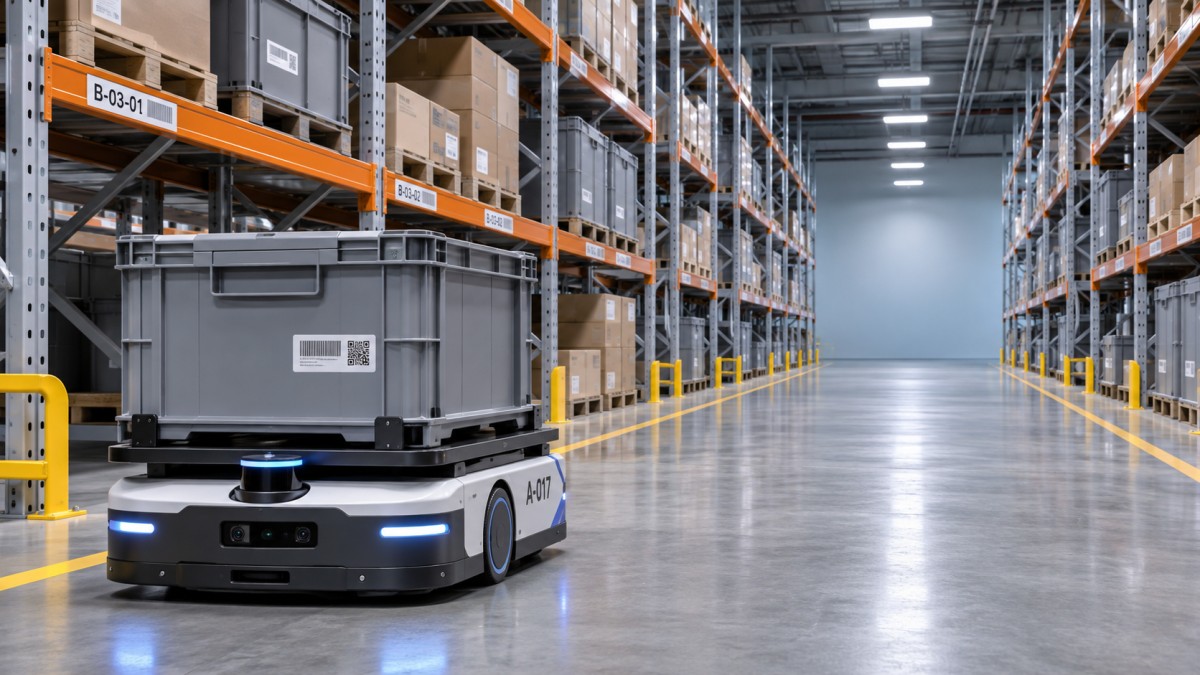
Test with normal traffic and representative obstructions. Observe whether the robot can take an approved alternative route, waits for the obstruction to clear, or requires help. Record both successful recovery and the time spent stopped. A vehicle that avoids every obstacle but repeatedly blocks a narrow aisle can still disrupt the operation.
Navigation and safety are related but distinct. A robot may plan a route around an object while its protective functions independently slow or stop it when a person or obstacle enters a monitored area. Review the intended operating environment, protective zones, speed settings, and responsibilities for the site-level risk assessment. Include intersections, blind corners, shared aisles, and loading stations; do not treat a demonstration of obstacle avoidance as a complete safety assessment.
Also examine map maintenance. If racks move, aisles close, or staging areas expand, who updates the map and validates the change? A system that needs frequent specialist intervention may be a poor fit for a site whose layout changes regularly.
Calculate capacity from completed jobs, not travel speed
Published travel speed describes only part of a delivery cycle. A transport job also includes dispatch, travel to pickup, alignment, loading, travel to the destination, unloading, and any waiting or traffic delay. Charging, maintenance, and exception recovery remove additional time from fleet availability.
Build a demand profile from the warehouse’s order and replenishment patterns. Average jobs per hour can conceal a short peak that creates a queue at packing or production. Separate routine demand from peak demand, and identify jobs with strict delivery windows. Then compare the required completed jobs with the capacity demonstrated under comparable conditions.
For an initial estimate, divide the required jobs during a representative period by the number of jobs one robot can complete in that same period. Adjust the estimate for charging, downtime, traffic, and variation in cycle time. This gives a planning starting point, not a final fleet size: robots share aisles and stations, so adding vehicles does not always increase throughput in proportion.
Station capacity deserves the same scrutiny as fleet capacity. If an operator cannot load a cart until a pick is complete, or a conveyor can accept only one delivery at a time, vehicles may queue even when their routes are clear. Measure waiting at pickup and drop-off separately from travel time; the appropriate fix may be a station or workflow change rather than another robot.
Fit the AMR to the warehouse workflow
Different tasks put pressure on different parts of the system. Use the intended workflow to decide which performance measures matter most.
Some processes are poor candidates for autonomous transport without changes. A route that is routinely blocked, a pickup point with inconsistent load placement, or a handoff that depends on informal verbal coordination can produce frequent exceptions. Automation may still be viable, but the evaluation should include the cost and operational effect of making those conditions repeatable.
Consider upstream and downstream work as part of the design. Who prepares the load? How does the robot know it is ready? Can the destination accept it immediately? A robot can complete its travel reliably while inventory waits because no one has released the job or the receiving station has no free space.
Examine integration and exception handling before selecting a fleet
A warehouse management system may decide what needs moving, while a fleet manager assigns vehicles and coordinates traffic. In other installations, a warehouse control system or another application sits between them. Draw the intended flow of job requests, status updates, cancellations, and completion confirmations before comparing integration proposals.
Ask suppliers to describe the available interfaces and the data each message carries. A basic “move from A to B” request may be insufficient if the operation needs load identification, priority changes, destination reassignment, or confirmation that a pallet was transferred. Define which system owns each decision and how duplicate or interrupted requests are handled.
Exceptions are especially revealing. Walk through what happens when a destination is full, a load is missing, a robot loses connectivity, or a job is canceled after pickup. The operation needs a clear record of the load’s physical location and job status, plus a recovery path that does not depend on guessing which system is correct. Test how messages are reconciled after communication returns.
Integration scope should include more than software. Wireless coverage, charging locations, traffic rules, station sensors, and operator interfaces all affect the result. Assign ownership for configuration, acceptance testing, support, and future changes across the robot supplier, site team, and any software or equipment partners.
Run a pilot that can change the purchasing decision
A useful pilot compares candidates against agreed acceptance criteria in a representative part of the operation. A short, empty-aisle demonstration can establish basic movement, but it cannot establish production throughput or support needs.
Select a route that includes the relevant floor surfaces, transfers, traffic, and network conditions. Use representative loads, including the least convenient permitted load. Run the process through normal operating periods and the peak conditions the design must support. Record the following alongside the test duration and job mix:
- Completed jobs and cycle time: Measure pickup, travel, waiting, docking, and handoff separately, including the spread between routine and slow jobs.
- Interventions: Record why a person assisted, how long recovery took, and whether the same issue recurred.
- Transfer outcomes: Count successful handoffs, retries, failed pickups, and any load movement or damage observed.
- Fleet availability: Track time spent charging, unavailable, or undergoing maintenance, with the operating conditions attached.
- Traffic effects: Observe queues, blocked work areas, and the impact on other vehicles and workers.
Agree in advance on the sample, pass criteria, and treatment of exceptions. A single average can hide repeated long delays; a completion rate can look good if difficult jobs are excluded. Capture failed and canceled jobs as well as successful ones, and compare suppliers using the same route, load profile, and operating assumptions wherever practical.
Ask for a documented recovery demonstration, not just an uninterrupted run. A stopped robot, an occupied destination, and a failed transfer are ordinary operating scenarios. The time and skill needed to restore service should be part of the acceptance decision.
Compare lifecycle support as well as the vehicle
Before committing, review the full deployment scope: vehicles, handling modules, chargers, software, site changes, integration, training, maintenance, and spare parts. Separate one-time work from recurring charges and identify assumptions about operating hours and fleet size. A low vehicle price can be misleading if the project also needs extensive station modification or ongoing specialist support.
Ask how batteries are charged or exchanged, how charging is scheduled around peaks, and what happens when a charger is unavailable. Review routine maintenance access, replacement parts, diagnostic tools, software updates, and response arrangements. For software-dependent operations, include backup, user access, and recovery after a system outage in the support discussion.
The final choice should follow a traceable chain: required jobs and loads, site constraints, demonstrated performance, integration responsibilities, and support commitments. If a candidate cannot meet a required condition, document the process change needed to make it viable and include that change in the comparison. The most useful specification is one that describes the warehouse’s operating limits clearly enough for a supplier’s proposed solution to be tested against them.
Search News
Hot Articles
- Carbon Fiber StructuresHow to Specify Aerospace Carbon Fiber Assemblies for Lightweight, Load-Bearing PartsJul 11, 2026
- Machine VisionXiaomi, Alibaba DAMO Academy Drive Open-Source Robotics Model Ecosystem, Lowering Algorithm Development Barriers for Overseas SMEs Adopting Chinese Robotics SolutionsMar 30, 2026
- Cobots & ArmsShanxi 'AI+' Conference Showcases Embodied Intelligence with Multinational Buyer Engagement: Key Industry ImplicationsMar 30, 2026
Popular Tags
Recommended News
 Jul 11, 2026How to Specify Aerospace Carbon Fiber Assemblies for Lightweight, Load-Bearing PartsAerospace carbon fiber assemblies: learn how to specify laminate design, load data, joining methods, and inspection controls for lighter, reliable load-bearing aerospace parts.Elena Rostova (UAV Systems Researcher)
 Mar 30, 2026Xiaomi, Alibaba DAMO Academy Drive Open-Source Robotics Model Ecosystem, Lowering Algorithm Development Barriers for Overseas SMEs Adopting Chinese Robotics SolutionsXiaomi & Alibaba DAMO Academy's open-source robotics models lower algorithm barriers for global SMEs. Boost efficiency in manufacturing, logistics & smart retail with ROS 2 compatible solutions.TSV Data Lab
 Mar 30, 2026Shanxi 'AI+' Conference Showcases Embodied Intelligence with Multinational Buyer Engagement: Key Industry ImplicationsShanxi 'AI+' Conference highlights embodied intelligence with Tesla, Ubtech & Jiantao showcasing multimodal robotics. 40+ global buyers validated tech on-site, creating new B2B channels for industrial automation & AI solutions.Chen Wei (Automation Lead Engineer)
 Mar 30, 2026Zhongguancun Unveils 6G Integrated Sensing-Computing-Intelligence Platform to Empower Embodied Robots for Global Industrial ApplicationsZhongguancun's new 6G platform revolutionizes industrial robotics with <10ms latency, empowering global automotive, logistics & port automation. Discover how this tech boosts China's smart manufacturing exports.TSV Data Lab
 Mar 30, 2026Mech-Mind Tianjin Embodied Intelligence R&D and Production Base Goes Live, Cutting Delivery Time by 20%–30% for Global Customized AMR+Vision SolutionsMech-Mind's Tianjin AMR+Vision production base cuts delivery time by 20%-30% for欧美 & Latin American markets. Discover how this PLd-certified facility accelerates customized robotics solutions for smart manufacturing and logistics.Chen Wei (Automation Lead Engineer)
 Mar 30, 2026Boao Forum Reveals 'Co-evolution of Big and Small Brains' Trend in Humanoid Robots, China's Embodied Intelligence Accelerates Adaptation to Overseas Manufacturing Service ScenariosDiscover how China's humanoid robots, featuring 'Co-evolution of Big and Small Brains,' are revolutionizing global manufacturing. Learn about Embodied Tian Gong 3.0's ISO compliance and overseas deployment at Boao Forum 2026.Chen Wei (Automation Lead Engineer)
 Mar 30, 2026China Railway Industrial Secures Patent for Embodied Robotics in Material Handling, Boosting High-Precision Delivery Capabilities for Overseas Infrastructure and Manufacturing ProjectsChina Railway Industrial's new patent for embodied robotics in material handling boosts high-precision delivery for global infrastructure & manufacturing. Discover how this innovation enhances logistics accuracy in automotive, rail transit & EPC projects.Chen Wei (Automation Lead Engineer)
 Nov 19, 2026Choosing a Palletizing System for Bagged Food: Speed and Bag HandlingChoose the right palletizing system for bagged food. Compare throughput, bag handling, food safety, and robotic vs. conventional options.Chen Wei (Automation Lead Engineer)
 Nov 18, 2026Formnext 2026 Opens as Additive Manufacturing Advances Industrial ApplicationsFormnext 2026 highlights additive manufacturing innovations for industrial applications. Explore what they could mean for production, procurement and suppliers.Dr. Marcus Vance
 Nov 18, 2026Flexible Robotics Integration for High-Mix, Low-Volume ProductionFlexible robotics integration can make high-mix, low-volume production more adaptable. Explore practical ways to reduce changeover risk and plan a reliable robotic cell.Victor Lin (Chief Software Architect)
 Nov 17, 2026Formnext 2026: UK Additive Manufacturing Leads in Research but Faces Production BarriersUK additive manufacturing leads in research but faces barriers to production at scale. Explore the Formnext 2026 insights and what businesses should consider.Dr. Marcus Vance
 Nov 17, 2026Choosing Warehouse Automation Packaging Systems: Throughput and SpaceCompare warehouse automation packaging systems by throughput, footprint, and order mix. Discover how to choose a layout that meets peak demand.Victor Lin (Chief Software Architect)
 Nov 16, 2026China's October Industrial Robot Output Up 26%, 3D Printing Equipment Up 85.9%China's industrial robot output reportedly rose 26% in October, while 3D printing equipment grew 85.9%. Explore what the figures could mean for buyers.Chen Wei (Automation Lead Engineer)
 Nov 16, 2026Commercial Drones in North America: Choosing Payloads for Inspection and MappingCommercial drones North America: compare RGB, thermal and LiDAR payloads for inspection and mapping, and choose a system that delivers reliable data.Elena Rostova (UAV Systems Researcher)
 Nov 15, 2026Aerospace Materials in the UK: Choosing Metals and Composites for AircraftExplore aerospace materials UK teams use for aircraft. Compare metals and composites by weight, fatigue, manufacturing and approval needs to make informed choices.Dr. Marcus Vance
 Nov 14, 2026Ukraine Tests 3D-Printed Protective Structure Against M2 Heavy Machine-Gun FireUkraine’s 3D-printed protective structure reportedly resisted M2 heavy machine-gun fire. Explore the test’s limits and potential procurement implications.Dr. Marcus Vance
 Nov 14, 2026Rugged UAV Metrics: Assessing Wind Resistance, Endurance and IP RatingsCompare rugged UAV metrics for wind resistance, endurance and IP ratings. Learn what evidence to request and choose a platform fit for your mission.Chen Wei (Automation Lead Engineer)
 Nov 13, 2026Physical AI Gains Attention as Robot Investment Moves Beyond HardwarePhysical AI is reshaping robot investment beyond hardware. Explore what the shift toward perception and algorithms could mean for buyers and suppliers.Chen Wei (Automation Lead Engineer)
 Nov 13, 2026Precision Machining Benchmarks: A Guide to Tolerances and Surface FinishExplore this precision machining benchmarks guide to compare tolerances, surface finish, and inspection methods—and specify parts with confidence.Dr. Marcus Vance
 Nov 12, 2026Beijing Issues Three-Year Plan for Embodied AI Robotics IndustryBeijing’s embodied AI robotics plan targets leading humanoid robot makers by 2028. Explore its goals for supply chains, AI models and deployment.Chen Wei (Automation Lead Engineer)
 Nov 12, 2026Choosing an Edge AI Box for Robotics: Compute, Latency and I/OChoose the right edge AI box for robotics with practical guidance on compute, latency, sensor I/O and sustained performance. Explore the selection checklist.Chen Wei (Automation Lead Engineer)
 Nov 11, 2026Beijing Sets 200,000-Unit Annual Capacity Goal in Robotics PlanBeijing's robotics plan targets 200,000 units of annual capacity by 2027. Explore its technology goals, benchmark applications and adoption outlook.Chen Wei (Automation Lead Engineer)
 Nov 11, 2026Aero Engine Blade Machining: 5-Axis CNC Methods and ChallengesExplore aero engine blade machining, from 5-axis toolpaths to thin-wall challenges, surface integrity, and inspection. Learn what makes a process reliable.Dr. Marcus Vance
 Nov 10, 2026FAA Authorizes Skyways’ Long-Distance BVLOS Flights for Shell in Gulf of MexicoFAA authorizes Skyways’ long-distance BVLOS drone flights for Shell in the Gulf of Mexico. Discover what the decision means for offshore pipeline inspection.Elena Rostova (UAV Systems Researcher)