Batch Size and Part Mix: CNC Nesting or Beam Saw for Panel Cutting?
Publication Date
author
A beam saw can make repeated straight cuts across a stack of panels, while a nesting CNC router can cut different shapes and machine selected features in the same setup. Neither fact establishes which route will deliver a project faster. The answer depends on how many identical parts can be grouped, how much machining follows cutting, and whether the rest of the production line can absorb the output.
For a project manager, the comparison starts with the required parts rather than the advertised speed of a machine. A route that looks efficient at the cutting station may create queues at drilling, sorting or edge banding. Conversely, a slower cutting cycle can still support a shorter production route if it removes a separate setup or reduces part handling.
What the two cutting routes actually do
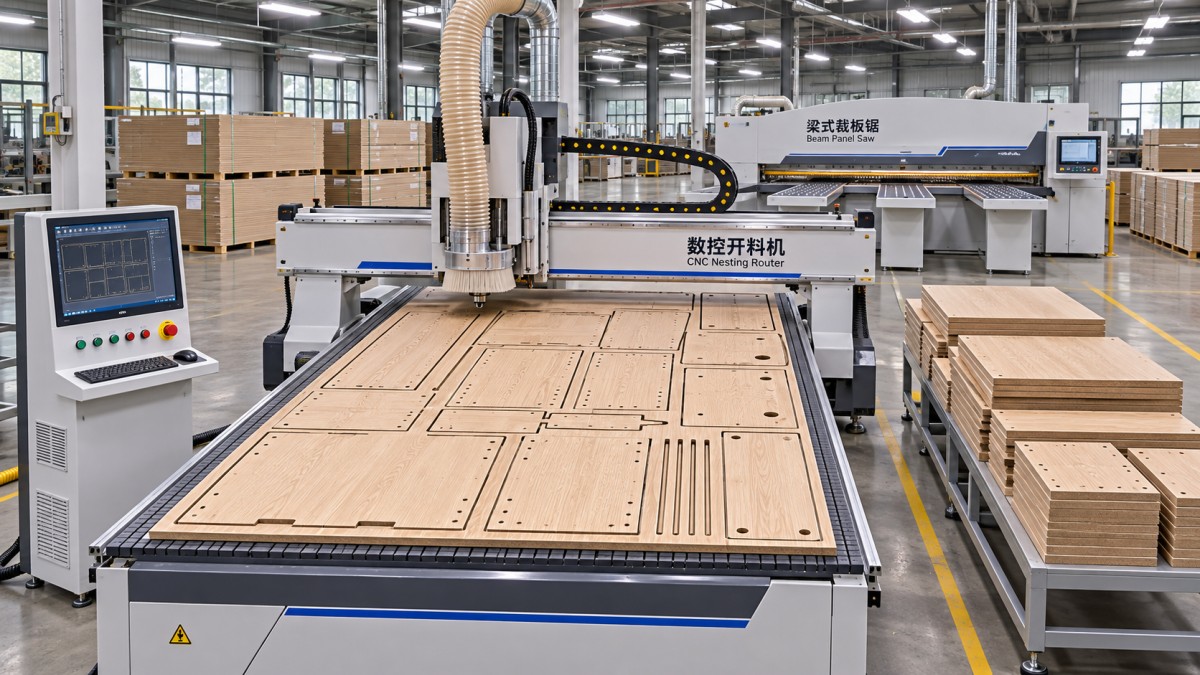
In a nesting operation, software arranges part outlines on a sheet, and a CNC router follows programmed toolpaths to separate them. Depending on the machine, tooling and access to the workpiece, the same setup may also include pockets, grooves and vertical holes. Vacuum hold-down is common, but its effectiveness depends on the table, spoilboard, material and size of the remaining parts.
A beam saw uses a circular saw blade to make straight cuts through panel material. Its cutting pattern is based on sequences of straight cuts, which makes it well suited to rectangular components. Depending on machine capacity, material and quality requirements, more than one sheet may be cut in a stack. Parts requiring curved profiles, pockets or other features will generally need a subsequent operation.
The practical issue in the nesting and beam saw workflow comparison is therefore not simply router versus saw. It is whether the value of cutting multiple sheets and producing straight-edged parts outweighs the extra handling and machining needed to complete them. The answer can change between two orders made from the same board.
Batch size matters only when parts can be grouped
A large order does not automatically give a beam saw a large effective batch. Parts must be compatible in material, thickness, finish, grain direction and cutting sequence before they can be grouped. An order containing many different panel types may break into short runs, each requiring a new stack, program or handling arrangement.
Where a production schedule contains repeated rectangular panels in the same material, a saw route may benefit from stack cutting and repeatable cutting patterns. The advantage is strongest when the cut parts require little additional CNC machining, or when a downstream drilling or machining cell has enough capacity to process them without delay. Stack height should be established for the actual machine and material rather than assumed from a maximum specification: cut quality, sheet condition and handling capability can limit the usable stack.
At the other end of the mix, nesting can accommodate different part shapes and dimensions on one sheet, provided the material and process requirements are compatible. This can be attractive for project-specific interiors or other work where each release contains many unique components. Grouping jobs across orders may improve sheet use, but it can also make it harder to keep each customer order together through finishing and assembly.
Small batches do not automatically favor nesting. If every part is a simple rectangle and the saw is already available, the cost of preparing toolpaths, loading sheets and changing router tools may outweigh the benefits of a combined operation. Equally, repeated parts with pockets and irregular outlines may still justify a nesting route, especially when a saw-cut blank would need careful repositioning at another machine.
Model the whole route, not just cutting time
Build a process map from the arrival of full sheets to the point where parts are ready for the next production stage. Include material identification, loading, programming, cutting, part removal, labeling, secondary machining, inspection and movement between work centers. Use the same start and finish points for both alternatives.
A useful comparison separates machine time from elapsed order time. A router may be cutting while an operator prepares the next sheet, but that overlap depends on the table configuration, loading equipment and staffing. A saw may cut a stack quickly, yet the resulting parts can wait for drilling or edge banding. Record the labor actually required at each stage and the time parts spend waiting, rather than adding machine cycle times and calling the result lead time.
For each candidate route, estimate:
- Preparation: programming, optimization, tooling checks and material staging for the actual mix of sheets and parts.
- Processing: loading, cutting, unloading and any drilling, routing or sizing not completed at the first machine.
- Flow: travel, sorting, identification and expected queues before downstream operations.
- Losses: offcuts, damaged parts, remakes and the labor needed to investigate or correct errors.
- Available capacity: productive time after planned maintenance, changeovers and other committed work.
Do not count an operation as eliminated merely because a machine can perform it. Confirm that the required tool, orientation, accuracy and part access are available in the proposed setup. Horizontal holes, edge features or work on the opposite face, for example, may still require a separate operation after nesting.
Use a representative order mix
Test the route against several types of work: repeat rectangular panels, mixed-size cabinet components, shaped parts and jobs with substantial drilling or routing. Include urgent releases and less favorable materials, not just a clean demonstration job. For each sample, document sheet quantities, part geometry, machining features, due dates and the number of finished kits required.
Calculate the total cost for the same output and quality level. Include material, operator time, consumables, energy where it is material to the decision, software, maintenance and the allocated cost of equipment. Treat shared resources consistently: if both routes use the same edge bander, its capacity and cost should appear in both models. Run a sensitivity check on uncertain inputs such as utilization, scrap, staffing and downstream waiting time.
The figures used in that exercise should come from timed trials, existing production records or supplier proposals with stated assumptions. A supplier’s machine cycle can be useful, but it is not a substitute for a measured route that includes loading, unloading and the remaining operations.
Material yield, edge quality and part control
Yield depends on more than how tightly shapes fit on a screen. Router kerf or tool diameter, saw kerf, trimming allowances, grain direction, defects, part spacing and remnant rules all influence usable output. Nesting may place irregular outlines efficiently, while a saw pattern is constrained by its sequence of straight cuts. The better result for a particular job must be calculated with the same material and finished-part requirements.
Offcuts also need a realistic value. A remnant is not a saving if the business cannot identify, store and retrieve it for a future job. Conversely, treating every offcut as waste can understate the value of a controlled remnant inventory. Agree on minimum reusable dimensions and track whether remnants are actually consumed.
Quality checks should reflect the next operation and the final product. Inspect representative cut edges for chipping, dimensional variation and suitability for edge banding. On a router, small nested parts can move if hold-down becomes inadequate as material is removed. Tabs, onion-skin strategies or alternative holding methods may help in some applications, but they can add cleanup or cycle time. On a saw, stack alignment, panel condition, blade selection and cutting setup can affect whether all parts in a stack meet the same requirements.
Part identification is another route cost. A mixed nest can contain pieces for several assemblies; a stack-cut saw job can produce many visually similar rectangles. Define when labels are applied, how orientation is recorded and who checks that parts reach the correct kit. A fast cutting process is of limited value if assembly teams must sort unidentified parts or stop for remakes.
When a combined route makes sense
A choice does not always require sending every sheet to one machine. A beam saw may handle repeat rectangular components while a nesting router processes shaped panels and parts with significant face machining. This division can protect each machine from work that fits it poorly, but it introduces scheduling and inventory decisions.
The project team should specify the routing rule before purchasing equipment. For example, classify parts by material, geometry, required operations and delivery date, then identify which work center owns each class. Check whether software can transfer part data and labels reliably between routes, and whether operators can recognize exceptions. Splitting a small order between machines may create more sorting than it saves; assigning all of it to one route may be preferable when keeping the kit together matters more than optimizing each individual cut.
Turn the comparison into an acceptance plan
Before requesting final quotations, provide suppliers with representative drawings, material specifications, expected order patterns and the operations that must be complete at handover. Ask each supplier to state its assumptions about tooling, staffing, loading equipment, software, extraction and downstream processing. Separate optional equipment from the configuration used to support the proposed performance.
A practical acceptance plan defines the test material, part mix, tolerances, edge-quality criteria and method of timing. It should also identify who supplies the material, how rejected parts and interruptions are counted, and which features will be measured. An agreed production trial on representative work provides a more useful basis for comparison than demonstrations using different jobs or different definitions of completion.
Include installation space, material access, maintenance access, operator training and dust-extraction design in the project scope. Safety requirements and applicable obligations depend on the equipment and jurisdiction; confirm them with the responsible safety personnel and equipment suppliers rather than assuming that a proposed layout is compliant.
The defensible choice is the route that meets the required part quality and delivery dates at an acceptable whole-process cost, with enough capacity for the expected mix. If the answer changes sharply when batch size, downstream capacity or material yield changes, preserve those assumptions in the project approval and revisit them before the order mix changes.
Search News
Hot Articles
- Carbon Fiber StructuresHow to Specify Aerospace Carbon Fiber Assemblies for Lightweight, Load-Bearing PartsJul 11, 2026
- Machine VisionXiaomi, Alibaba DAMO Academy Drive Open-Source Robotics Model Ecosystem, Lowering Algorithm Development Barriers for Overseas SMEs Adopting Chinese Robotics SolutionsMar 30, 2026
- Cobots & ArmsShanxi 'AI+' Conference Showcases Embodied Intelligence with Multinational Buyer Engagement: Key Industry ImplicationsMar 30, 2026
Popular Tags
Recommended News
 Jul 11, 2026How to Specify Aerospace Carbon Fiber Assemblies for Lightweight, Load-Bearing PartsAerospace carbon fiber assemblies: learn how to specify laminate design, load data, joining methods, and inspection controls for lighter, reliable load-bearing aerospace parts.Elena Rostova (UAV Systems Researcher)
 Mar 30, 2026Xiaomi, Alibaba DAMO Academy Drive Open-Source Robotics Model Ecosystem, Lowering Algorithm Development Barriers for Overseas SMEs Adopting Chinese Robotics SolutionsXiaomi & Alibaba DAMO Academy's open-source robotics models lower algorithm barriers for global SMEs. Boost efficiency in manufacturing, logistics & smart retail with ROS 2 compatible solutions.TSV Data Lab
 Mar 30, 2026Shanxi 'AI+' Conference Showcases Embodied Intelligence with Multinational Buyer Engagement: Key Industry ImplicationsShanxi 'AI+' Conference highlights embodied intelligence with Tesla, Ubtech & Jiantao showcasing multimodal robotics. 40+ global buyers validated tech on-site, creating new B2B channels for industrial automation & AI solutions.Chen Wei (Automation Lead Engineer)
 Mar 30, 2026Zhongguancun Unveils 6G Integrated Sensing-Computing-Intelligence Platform to Empower Embodied Robots for Global Industrial ApplicationsZhongguancun's new 6G platform revolutionizes industrial robotics with <10ms latency, empowering global automotive, logistics & port automation. Discover how this tech boosts China's smart manufacturing exports.TSV Data Lab
 Mar 30, 2026Mech-Mind Tianjin Embodied Intelligence R&D and Production Base Goes Live, Cutting Delivery Time by 20%–30% for Global Customized AMR+Vision SolutionsMech-Mind's Tianjin AMR+Vision production base cuts delivery time by 20%-30% for欧美 & Latin American markets. Discover how this PLd-certified facility accelerates customized robotics solutions for smart manufacturing and logistics.Chen Wei (Automation Lead Engineer)
 Mar 30, 2026Boao Forum Reveals 'Co-evolution of Big and Small Brains' Trend in Humanoid Robots, China's Embodied Intelligence Accelerates Adaptation to Overseas Manufacturing Service ScenariosDiscover how China's humanoid robots, featuring 'Co-evolution of Big and Small Brains,' are revolutionizing global manufacturing. Learn about Embodied Tian Gong 3.0's ISO compliance and overseas deployment at Boao Forum 2026.Chen Wei (Automation Lead Engineer)
 Mar 30, 2026China Railway Industrial Secures Patent for Embodied Robotics in Material Handling, Boosting High-Precision Delivery Capabilities for Overseas Infrastructure and Manufacturing ProjectsChina Railway Industrial's new patent for embodied robotics in material handling boosts high-precision delivery for global infrastructure & manufacturing. Discover how this innovation enhances logistics accuracy in automotive, rail transit & EPC projects.Chen Wei (Automation Lead Engineer)
 Nov 19, 2026Choosing a Palletizing System for Bagged Food: Speed and Bag HandlingChoose the right palletizing system for bagged food. Compare throughput, bag handling, food safety, and robotic vs. conventional options.Chen Wei (Automation Lead Engineer)
 Nov 18, 2026Formnext 2026 Opens as Additive Manufacturing Advances Industrial ApplicationsFormnext 2026 highlights additive manufacturing innovations for industrial applications. Explore what they could mean for production, procurement and suppliers.Dr. Marcus Vance
 Nov 18, 2026Flexible Robotics Integration for High-Mix, Low-Volume ProductionFlexible robotics integration can make high-mix, low-volume production more adaptable. Explore practical ways to reduce changeover risk and plan a reliable robotic cell.Victor Lin (Chief Software Architect)
 Nov 17, 2026Formnext 2026: UK Additive Manufacturing Leads in Research but Faces Production BarriersUK additive manufacturing leads in research but faces barriers to production at scale. Explore the Formnext 2026 insights and what businesses should consider.Dr. Marcus Vance
 Nov 17, 2026Choosing Warehouse Automation Packaging Systems: Throughput and SpaceCompare warehouse automation packaging systems by throughput, footprint, and order mix. Discover how to choose a layout that meets peak demand.Victor Lin (Chief Software Architect)
 Nov 16, 2026China's October Industrial Robot Output Up 26%, 3D Printing Equipment Up 85.9%China's industrial robot output reportedly rose 26% in October, while 3D printing equipment grew 85.9%. Explore what the figures could mean for buyers.Chen Wei (Automation Lead Engineer)
 Nov 16, 2026Commercial Drones in North America: Choosing Payloads for Inspection and MappingCommercial drones North America: compare RGB, thermal and LiDAR payloads for inspection and mapping, and choose a system that delivers reliable data.Elena Rostova (UAV Systems Researcher)
 Nov 15, 2026Aerospace Materials in the UK: Choosing Metals and Composites for AircraftExplore aerospace materials UK teams use for aircraft. Compare metals and composites by weight, fatigue, manufacturing and approval needs to make informed choices.Dr. Marcus Vance
 Nov 14, 2026Ukraine Tests 3D-Printed Protective Structure Against M2 Heavy Machine-Gun FireUkraine’s 3D-printed protective structure reportedly resisted M2 heavy machine-gun fire. Explore the test’s limits and potential procurement implications.Dr. Marcus Vance
 Nov 14, 2026Rugged UAV Metrics: Assessing Wind Resistance, Endurance and IP RatingsCompare rugged UAV metrics for wind resistance, endurance and IP ratings. Learn what evidence to request and choose a platform fit for your mission.Chen Wei (Automation Lead Engineer)
 Nov 13, 2026Physical AI Gains Attention as Robot Investment Moves Beyond HardwarePhysical AI is reshaping robot investment beyond hardware. Explore what the shift toward perception and algorithms could mean for buyers and suppliers.Chen Wei (Automation Lead Engineer)
 Nov 13, 2026Precision Machining Benchmarks: A Guide to Tolerances and Surface FinishExplore this precision machining benchmarks guide to compare tolerances, surface finish, and inspection methods—and specify parts with confidence.Dr. Marcus Vance
 Nov 12, 2026Beijing Issues Three-Year Plan for Embodied AI Robotics IndustryBeijing’s embodied AI robotics plan targets leading humanoid robot makers by 2028. Explore its goals for supply chains, AI models and deployment.Chen Wei (Automation Lead Engineer)
 Nov 12, 2026Choosing an Edge AI Box for Robotics: Compute, Latency and I/OChoose the right edge AI box for robotics with practical guidance on compute, latency, sensor I/O and sustained performance. Explore the selection checklist.Chen Wei (Automation Lead Engineer)
 Nov 11, 2026Beijing Sets 200,000-Unit Annual Capacity Goal in Robotics PlanBeijing's robotics plan targets 200,000 units of annual capacity by 2027. Explore its technology goals, benchmark applications and adoption outlook.Chen Wei (Automation Lead Engineer)
 Nov 11, 2026Aero Engine Blade Machining: 5-Axis CNC Methods and ChallengesExplore aero engine blade machining, from 5-axis toolpaths to thin-wall challenges, surface integrity, and inspection. Learn what makes a process reliable.Dr. Marcus Vance
 Nov 10, 2026FAA Authorizes Skyways’ Long-Distance BVLOS Flights for Shell in Gulf of MexicoFAA authorizes Skyways’ long-distance BVLOS drone flights for Shell in the Gulf of Mexico. Discover what the decision means for offshore pipeline inspection.Elena Rostova (UAV Systems Researcher)