What aerospace aluminum alloy yield strength really tells you
Publication Date
author
Aerospace aluminum alloy yield strength is more than a catalog number—it is a practical indicator of how a material will resist permanent deformation under real structural loads. For engineers, buyers, and technical researchers, understanding this metric helps separate marketing claims from usable performance data, especially when weight, fatigue life, and safety margins directly affect aerospace component selection.
Why does aerospace aluminum alloy yield strength matter so much in real decisions?
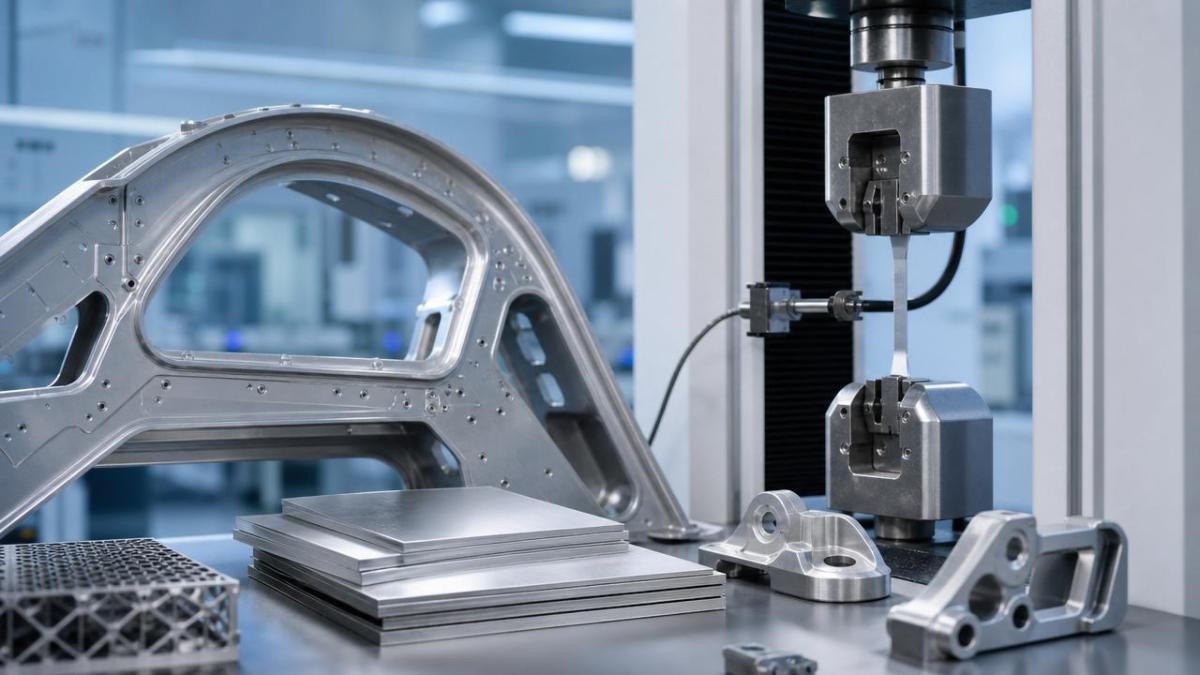
In aerospace programs, the wrong interpretation of yield strength can distort design margins, machining strategy, inspection criteria, and supplier qualification. The number itself is simple. What it tells you in context is not.
Yield strength defines the stress level at which an aluminum alloy begins to deform permanently. Below that point, the material can usually return to its original shape. Above it, dimensional stability is no longer guaranteed.
For airframes, UAV structures, brackets, housings, and precision machined aerospace parts, that distinction affects more than static strength. It influences fatigue behavior, fastener retention, buckling resistance, tolerance control, and repairability.
This is exactly where information researchers often face noise. A supplier may promote high tensile strength, lightweight performance, or aerospace grade labeling, while the actual aerospace aluminum alloy yield strength and temper condition remain vague.
At TechStat Vanguard, the focus is not on adjectives but on engineering truth. A useful material review starts with parameters that drive structural behavior, and yield strength is one of the first numbers that deserves verification.
- It helps estimate when a part stops behaving elastically under operational loads.
- It supports weight optimization by showing whether thinner sections are realistic.
- It improves sourcing decisions by connecting material claims to practical performance risk.
What does yield strength actually tell you beyond a datasheet line?
Aerospace aluminum alloy yield strength tells you how much stress a component can absorb before permanent shape change begins. But in procurement and engineering review, the more useful question is what this means for the finished part.
A high value can support thinner walls, lower mass, or greater load capacity. It can also introduce tradeoffs in forming difficulty, stress-corrosion sensitivity, joining constraints, and machining distortion depending on alloy family and heat treatment.
That is why a single number should never be read in isolation. Aerospace aluminum alloy yield strength gains meaning only when paired with temper designation, product form, thickness, directionality, and expected load path.
Key interpretation points
- Plate, sheet, bar, and extrusion may show different performance even for the same alloy designation.
- Temper matters. A 7075 alloy in one temper may behave very differently from 7075 in another.
- Yield strength does not replace fatigue data, fracture toughness, or corrosion resistance review.
The table below summarizes what aerospace aluminum alloy yield strength can and cannot tell a technical buyer during early-stage screening.
For information researchers, this distinction is critical. If a source only promotes high strength without clarifying fatigue, corrosion, or temper-specific behavior, the material picture is incomplete.
How should you compare common aerospace aluminum alloys?
Most aerospace sourcing conversations eventually narrow to a few common alloy families. The practical comparison is not just stronger versus weaker. It is stronger for what purpose, under which manufacturing route, and with which downstream risks.
The overview below is intentionally directional rather than absolute. Actual values depend on standard, form, thickness, and temper. Still, it helps frame how aerospace aluminum alloy yield strength fits broader selection logic.
Aerospace aluminum alloy yield strength often makes 7075 look attractive at first glance. Yet 6061 may still be the better choice for non-critical structures, complex machining, cost control, or lead-time reliability. Context decides value.
A simple comparison method for researchers
- Define whether the part is stiffness-driven, yield-driven, fatigue-driven, or corrosion-driven.
- Check if the supplier states alloy, temper, product form, and governing standard together.
- Compare yield strength with manufacturability, inspection burden, and total project risk.
Which application scenarios make yield strength a primary filter?
Not every aerospace part needs the highest aerospace aluminum alloy yield strength available. The metric becomes especially important when permanent deformation would compromise aerodynamics, alignment, vibration behavior, or interface geometry.
Scenarios where it strongly influences selection
- UAV airframe members that must stay light while surviving transient gust loads and landing shocks.
- Aircraft brackets and fittings where local yielding could misalign adjacent assemblies or fastener stacks.
- Precision machined housings for aerospace sensors, optics, or edge electronics where shape retention affects calibration.
- Ground support or satellite-adjacent tooling where low weight and dimensional accuracy both matter.
In these cases, a low-cost material with insufficient yield margin can create hidden lifecycle expenses: more rejected parts, thicker sections, heavier assemblies, and longer validation cycles.
TSV’s approach is to evaluate application fit, not just headline performance. A reliable material decision connects load case, tolerance stack, manufacturing route, and compliance requirements into one traceable review path.
What should buyers and engineers verify before trusting a yield strength claim?
For information researchers, the biggest mistake is treating a quoted number as universally valid. Aerospace aluminum alloy yield strength can vary with temper, thickness, direction, and specification source. Verification is not optional.
Procurement checklist
- Request the exact alloy and temper, not just “aerospace aluminum” or “high-strength aluminum.”
- Confirm whether the data comes from sheet, plate, extrusion, forging, or bar product form.
- Check which standard or specification defines the reported value.
- Ask whether the value is minimum guaranteed, typical, or test-sample-based.
- Review related data: elongation, tensile strength, hardness, fatigue information, and corrosion notes.
The matrix below can help teams judge supplier responses when aerospace aluminum alloy yield strength is central to the sourcing decision.
When this information is missing, the risk is not only technical. It also delays internal approval, supplier onboarding, and downstream nonconformance resolution.
Common misconceptions about aerospace aluminum alloy yield strength
Several recurring myths appear in technical media and vendor content. Correcting them can save time and reduce poor-fit sourcing.
Misconception 1: Higher yield strength always means a better aerospace material
Not necessarily. A higher-strength alloy may increase machining stress, reduce formability, or require tighter corrosion management. For some enclosures or support frames, moderate strength with better processing stability is more valuable.
Misconception 2: Yield strength and tensile strength are interchangeable
They are related but not identical. Yield strength marks the onset of permanent deformation. Ultimate tensile strength marks the maximum stress before failure progression. For dimensional integrity, yield strength is often the earlier warning sign.
Misconception 3: If an alloy is called aerospace grade, all products made from it are equivalent
Equivalent labeling does not guarantee equivalent traceability, heat treatment quality, residual stress state, or inspection discipline. A serious review needs process transparency, not naming alone.
FAQ: what do information researchers ask most often?
How do I choose the right aerospace aluminum alloy yield strength for a part?
Start with the actual load case and allowable deformation, not the biggest number available. Then screen alloy families by strength range, fatigue needs, machinability, corrosion exposure, and certification path. If the part is tolerance-sensitive, include residual stress and post-machining stability in the review.
Is higher aerospace aluminum alloy yield strength always worth the extra cost?
Only when it reduces system weight, increases safety margin, or prevents redesign. If the application is not strength-limited, a premium alloy may add procurement cost and process complexity without meaningful functional gain.
Which is more important, yield strength or fatigue resistance?
For repeated flight loads, vibration, or cyclic stress, fatigue resistance can be equally important or more important. Aerospace aluminum alloy yield strength is essential, but it should be interpreted alongside cyclic loading expectations and joint design details.
What documents should I request from a supplier?
Ask for material certification, alloy and temper identification, applicable standard references, product form details, and any available inspection or lot traceability records. For critical programs, request clarification on dimensional control and heat-treatment consistency as well.
Why technical sourcing teams use TSV to cut through noise
In advanced manufacturing, a parameter without context can mislead as easily as a slogan. TSV was built for teams that need engineering-grade clarity across aerospace metrics, machining benchmarks, and supplier comparison work.
When evaluating aerospace aluminum alloy yield strength, our value is not in oversimplifying the answer. It is in helping decision-makers connect strength data to form, process, tolerance, qualification burden, and practical sourcing outcomes.
- We help clarify parameter meaning for spec-sheet drafting and supplier screening.
- We support comparison logic across alloys, manufacturing paths, and application priorities.
- We focus on traceable technical interpretation rather than generic marketing descriptions.
Contact us for parameter-based sourcing support
If you are comparing aerospace alloys, validating aerospace aluminum alloy yield strength claims, or narrowing suppliers for UAV, aircraft, sensor housing, or precision machining projects, TSV can support your review with practical technical guidance.
You can consult us on parameter confirmation, alloy and temper selection, machining suitability, certification-related questions, sample evaluation logic, delivery-risk assessment, and quotation comparison criteria. For teams building or refining spec sheets, that level of clarity can shorten trial-and-error cycles and improve supplier decisions early.
Search News
Hot Articles
- Carbon Fiber StructuresHow to Specify Aerospace Carbon Fiber Assemblies for Lightweight, Load-Bearing PartsJul 11, 2026
- Machine VisionXiaomi, Alibaba DAMO Academy Drive Open-Source Robotics Model Ecosystem, Lowering Algorithm Development Barriers for Overseas SMEs Adopting Chinese Robotics SolutionsMar 30, 2026
- Cobots & ArmsShanxi 'AI+' Conference Showcases Embodied Intelligence with Multinational Buyer Engagement: Key Industry ImplicationsMar 30, 2026
Popular Tags
Recommended News
 Jul 11, 2026How to Specify Aerospace Carbon Fiber Assemblies for Lightweight, Load-Bearing PartsAerospace carbon fiber assemblies: learn how to specify laminate design, load data, joining methods, and inspection controls for lighter, reliable load-bearing aerospace parts.Elena Rostova (UAV Systems Researcher)
 Mar 30, 2026Xiaomi, Alibaba DAMO Academy Drive Open-Source Robotics Model Ecosystem, Lowering Algorithm Development Barriers for Overseas SMEs Adopting Chinese Robotics SolutionsXiaomi & Alibaba DAMO Academy's open-source robotics models lower algorithm barriers for global SMEs. Boost efficiency in manufacturing, logistics & smart retail with ROS 2 compatible solutions.TSV Data Lab
 Mar 30, 2026Shanxi 'AI+' Conference Showcases Embodied Intelligence with Multinational Buyer Engagement: Key Industry ImplicationsShanxi 'AI+' Conference highlights embodied intelligence with Tesla, Ubtech & Jiantao showcasing multimodal robotics. 40+ global buyers validated tech on-site, creating new B2B channels for industrial automation & AI solutions.Chen Wei (Automation Lead Engineer)
 Mar 30, 2026Zhongguancun Unveils 6G Integrated Sensing-Computing-Intelligence Platform to Empower Embodied Robots for Global Industrial ApplicationsZhongguancun's new 6G platform revolutionizes industrial robotics with <10ms latency, empowering global automotive, logistics & port automation. Discover how this tech boosts China's smart manufacturing exports.TSV Data Lab
 Mar 30, 2026Mech-Mind Tianjin Embodied Intelligence R&D and Production Base Goes Live, Cutting Delivery Time by 20%–30% for Global Customized AMR+Vision SolutionsMech-Mind's Tianjin AMR+Vision production base cuts delivery time by 20%-30% for欧美 & Latin American markets. Discover how this PLd-certified facility accelerates customized robotics solutions for smart manufacturing and logistics.Chen Wei (Automation Lead Engineer)
 Mar 30, 2026Boao Forum Reveals 'Co-evolution of Big and Small Brains' Trend in Humanoid Robots, China's Embodied Intelligence Accelerates Adaptation to Overseas Manufacturing Service ScenariosDiscover how China's humanoid robots, featuring 'Co-evolution of Big and Small Brains,' are revolutionizing global manufacturing. Learn about Embodied Tian Gong 3.0's ISO compliance and overseas deployment at Boao Forum 2026.Chen Wei (Automation Lead Engineer)
 Mar 30, 2026China Railway Industrial Secures Patent for Embodied Robotics in Material Handling, Boosting High-Precision Delivery Capabilities for Overseas Infrastructure and Manufacturing ProjectsChina Railway Industrial's new patent for embodied robotics in material handling boosts high-precision delivery for global infrastructure & manufacturing. Discover how this innovation enhances logistics accuracy in automotive, rail transit & EPC projects.Chen Wei (Automation Lead Engineer)
 Oct 04, 2026CAD/CAM Benchmarking in the GCC: What Manufacturers Should Ask a ConsultantCAD CAM benchmark consultant GCC guide: learn the key questions manufacturers should ask to validate post-processors, workflows, machine performance, and production risk.Victor Lin (Chief Software Architect)
 Oct 03, 2026Selecting Automotive Radar Sensor Modules for ADAS Range, Resolution, and IntegrationAutomotive radar sensor module selection guide for ADAS: compare range, resolution, field of view, latency, and integration to build safer, reliable vehicle systems.TSV Data Lab
 Oct 02, 2026How to Qualify Machined Parts Suppliers for Hard Tech ProgramsHard tech supply chain machined parts demand rigorous supplier qualification. Learn how to assess capability, traceability, quality controls, and delivery resilience.Dr. Marcus Vance
 Oct 01, 2026How to Select an Outdoor Security Radar Sensor for Perimeter Detection?Outdoor security radar sensor selection guide: compare range, accuracy, false-alarm control, integration, and field testing for reliable perimeter detection.TSV Data Lab
 Sep 30, 2026How to Evaluate Solid-State LiDAR Hardware for Outdoor Autonomous VehiclesSolid state LiDAR hardware evaluation guide for outdoor autonomous vehicles—compare range, point-cloud quality, environmental resilience, integration, and safety.TSV Data Lab
 Sep 29, 2026ISO 9283 Repeatability: How to Evaluate Cobot Positioning PerformanceISO 9283 cobot repeatability explained: learn how payload, reach, approach direction, and test conditions affect positioning performance and cell capability.Chen Wei (Automation Lead Engineer)
 Oct 03, 2026Is Edge Computing Necessary for Real-Time Quality Inspection?Is industrial edge computing necessary for real-time quality inspection? Explore how latency, data volume, reliability, and control integration shape the right architecture.TSV Data Lab
 Oct 02, 2026What Documents Prove a Precision Machining Supplier Can Hold Tolerance?What documents prove a precision machining supplier can hold tolerance? Explore certificates, FAI reports, calibration, SPC, and traceability evidence to qualify suppliers with confidence.Dr. Marcus Vance
 Oct 01, 2026Can a Machining Supplier Meet Aerospace Fatigue Testing Requirements?Can a machining supplier meet aerospace fatigue testing requirements? Learn the traceability, process control, and test evidence needed for reliable aerospace parts.Dr. Marcus Vance
 Sep 30, 2026Which Industrial Robot Specifications Matter for High-Precision Assembly?Which industrial robot specifications matter most for high-precision assembly? Explore repeatability, accuracy, stiffness, vibration, calibration, and force control for reliable yields.Chen Wei (Automation Lead Engineer)
 Sep 29, 2026How Do You Verify Servo Motor Torque Under Continuous Load?How do I verify servo motor torque under continuous load? Learn RMS torque checks, torque-speed limits, thermal derating, and real-machine testing.Chen Wei (Automation Lead Engineer)
 Oct 02, 2026ZD330 Software Configuration: Verifying Cut-List Import Before PurchaseZD330 software and machine configuration: verify cut-list imports, data mapping, labels, and workflow before purchase to reduce errors and choose with confidence.Victor Lin (Chief Software Architect)
 Sep 28, 2026Spindle Runout Measurement in Germany: DIN Standards, Methods, and Acceptance LimitsSpindle runout measurement Germany: explore DIN standards, proven methods, acceptance limits, and audit-ready practices for reliable machining quality.Dr. Marcus Vance
 Sep 27, 2026How to Select Wall-Mount Edge Devices for Space-Constrained Factory NetworksWall mount edge devices for space-constrained factories: evaluate workload, thermal design, power resilience, cable access, and network reliability for smarter deployments.TSV Data Lab
 Sep 26, 2026Machining Tolerance Analysis: How to Set Limits That Meet Function and Cost TargetsMachining tolerance analysis: learn how to set functional limits, control tolerance stacks, reduce inspection risk, and balance precision with production cost.Dr. Marcus Vance
 Sep 25, 2026How to Evaluate an Industrial Infrastructure Data Platform for Multi-Site OperationsIndustrial infrastructure data platform evaluation guide for multi-site operations: compare data quality, edge resilience, interoperability, governance, and scalable proof-of-value criteria.Victor Lin (Chief Software Architect)
 Sep 24, 2026How to Select Machine Vision Optics for Accurate Inspection at Different Working DistancesMachine vision optics selection guide for accurate inspection at every working distance. Compare FOV, pixel scale, DOF, distortion, lighting, and telecentric options.TSV Data Lab