Medical machining for orthopedic implants: hidden rework risks
Publication Date
author
In medical machining for orthopedic implants, the costliest failures rarely begin with visible scrap.
They begin with hidden rework: subtle dimensional drift, altered surface integrity, and undocumented process variation.
In medical machining for orthopedic implants, these issues affect fit, fatigue life, traceability, and audit confidence.
For data-driven sourcing and engineering review, early detection of hidden rework risks shortens qualification cycles and lowers downstream uncertainty.
When the application scenario changes, medical machining for orthopedic implants changes too
Not every implant program carries the same process sensitivity.
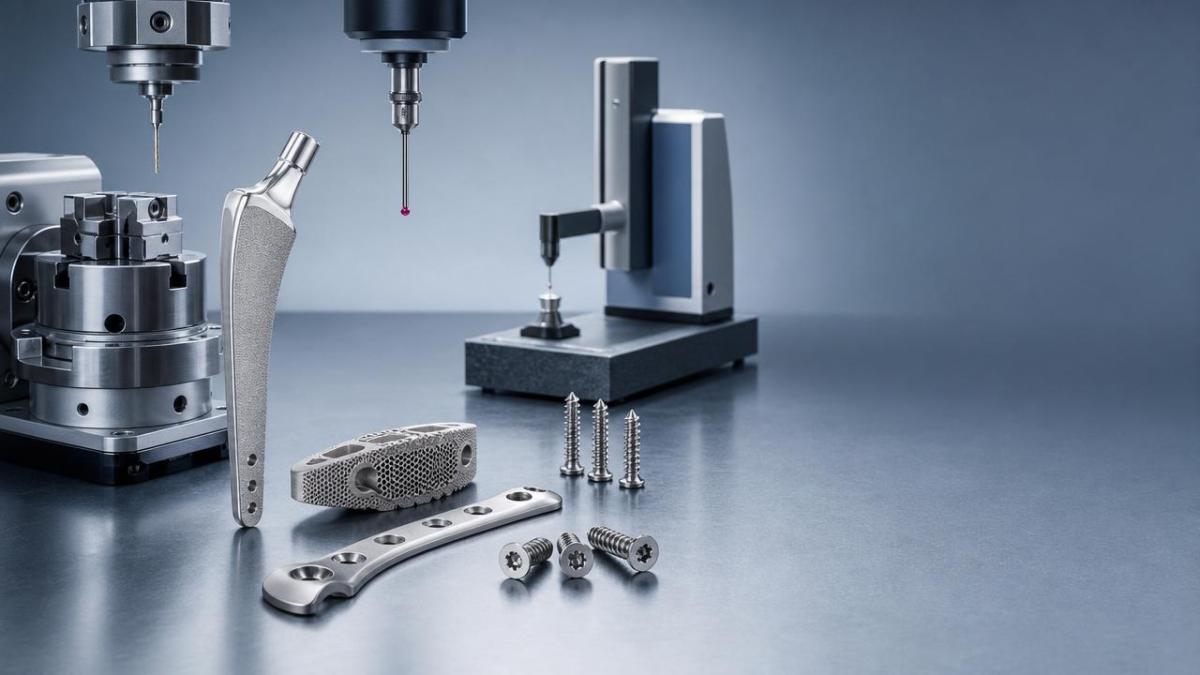
A trauma plate, a spinal cage, and a femoral stem may share alloys and compliance frameworks.
Yet their machining risks differ because geometry, fixation method, loading profile, and surface function differ.
That is why medical machining for orthopedic implants must be judged by scenario, not by generic supplier claims.
A supplier that performs well on simple turned parts may struggle with thin-wall milling, thread consistency, or blended freeform surfaces.
The hidden rework risk often appears when one process capability is assumed to transfer into another use case.
Scenario 1: Joint replacement parts where geometry and surface history must stay stable
In hip and knee systems, medical machining for orthopedic implants faces demanding contour control.
Ball radii, taper interfaces, and mating surfaces cannot rely on post-process compensation alone.
Repeated touch-up polishing may recover appearance while degrading dimensional truth.
This is a classic hidden rework path.
Key judgment points include stock allowance discipline, toolpath repeatability, burr removal control, and surface roughness after every intervention.
If process history is fragmented, fatigue and wear assumptions become less reliable.
What to verify in this scenario
- Whether freeform geometry is measured before and after polishing
- Whether taper interfaces have Cp/Cpk evidence, not only final pass data
- Whether reworked surfaces are traceable in the device history record
- Whether tool wear limits are linked to actual contour drift
Scenario 2: Trauma fixation parts where hole quality and thread integrity dominate risk
For plates, screws, and fixation blocks, medical machining for orthopedic implants often fails at feature level.
A plate may pass overall inspection while hidden rework damages countersinks or threaded holes.
Manual deburring is frequently underestimated.
Too much edge break can change screw seating behavior.
Too little can create particle or tissue irritation concerns.
In this scenario, hidden rework risks center on local geometry, surface tears, thread flank damage, and undocumented recutting.
A polished plate body does not guarantee functional consistency at the fixation interface.
Core judgment points
- Microscope-based review of threads after cleaning and passivation
- Measurement of countersink angle and depth after any rework
- Evidence that burr removal does not alter screw engagement torque
- Lot-level traceability for feature-specific nonconformance trends
Scenario 3: Spinal and porous-contact components where thermal and surface effects become decisive
Spinal implants, cages, and hybrid structures often combine complex profiles with demanding surface function.
Here, medical machining for orthopedic implants becomes sensitive to heat input, recast layers, and microstructural disturbance.
Even when dimensions remain nominal, aggressive finishing can affect osseointegration-facing textures.
Hidden rework may also appear when additively produced blanks need heavy corrective machining.
That usually signals upstream instability, not downstream flexibility.
Review should focus on how much material removal is routine, how heat is managed, and whether final surface intent survives all secondary steps.
How scenario requirements differ in medical machining for orthopedic implants
This comparison shows why medical machining for orthopedic implants should be qualified by function-specific evidence.
A single first article package is rarely enough to expose hidden rework patterns across all implant families.
Scenario-based fit checks that reduce qualification uncertainty
A stronger review model combines dimensional data with process history and surface evidence.
For medical machining for orthopedic implants, practical checks should be scenario-matched.
- Request rework definitions in the quality plan, including cosmetic versus functional interventions
- Compare in-process inspection frequency to the most sensitive feature, not to total part complexity
- Ask for evidence that cleaning, blasting, passivation, and polishing do not mask machining instability
- Review scrap-to-rework ratios by feature type, alloy, and machine platform
- Confirm that NC revision control, tool-life limits, and operator adjustments are recorded consistently
These steps support faster, lower-noise qualification decisions.
They also align with TSV’s principle that parameters and tolerances should drive sourcing confidence.
Common misreads that hide risk in medical machining for orthopedic implants
Several signals are often mistaken for proof of control.
In reality, they can hide expensive instability.
- A perfect visual finish may result from aggressive hand correction
- A pass on final dimensions may ignore surface damage introduced earlier
- Low scrap rates may coexist with high undocumented rework rates
- Strong performance on one implant family may not transfer to another geometry class
- Certification alone does not prove feature-level repeatability
In medical machining for orthopedic implants, hidden rework risk is fundamentally a visibility problem.
The issue is not only whether rework exists.
The issue is whether its engineering impact is measured, classified, and controlled.
Next-step actions for selecting a lower-risk machining path
For better outcomes in medical machining for orthopedic implants, the next step should be evidence mapping.
- List the most function-critical features by implant scenario
- Tie each feature to a likely hidden rework mechanism
- Define what in-process and post-process data must prove control
- Request sample records showing deviations, containment, and disposition logic
- Benchmark suppliers on repeatable evidence, not on marketing language
Medical machining for orthopedic implants is too critical for generic qualification shortcuts.
When scenario-specific risk is made visible, qualification becomes faster, cleaner, and more defensible.
That is the practical path toward lower rework cost, stronger compliance confidence, and better clinical reliability.
Search News
Hot Articles
- Carbon Fiber StructuresHow to Specify Aerospace Carbon Fiber Assemblies for Lightweight, Load-Bearing PartsJul 11, 2026
- Machine VisionXiaomi, Alibaba DAMO Academy Drive Open-Source Robotics Model Ecosystem, Lowering Algorithm Development Barriers for Overseas SMEs Adopting Chinese Robotics SolutionsMar 30, 2026
- Cobots & ArmsShanxi 'AI+' Conference Showcases Embodied Intelligence with Multinational Buyer Engagement: Key Industry ImplicationsMar 30, 2026
Popular Tags
Recommended News
 Jul 11, 2026How to Specify Aerospace Carbon Fiber Assemblies for Lightweight, Load-Bearing PartsAerospace carbon fiber assemblies: learn how to specify laminate design, load data, joining methods, and inspection controls for lighter, reliable load-bearing aerospace parts.Elena Rostova (UAV Systems Researcher)
 Mar 30, 2026Xiaomi, Alibaba DAMO Academy Drive Open-Source Robotics Model Ecosystem, Lowering Algorithm Development Barriers for Overseas SMEs Adopting Chinese Robotics SolutionsXiaomi & Alibaba DAMO Academy's open-source robotics models lower algorithm barriers for global SMEs. Boost efficiency in manufacturing, logistics & smart retail with ROS 2 compatible solutions.TSV Data Lab
 Mar 30, 2026Shanxi 'AI+' Conference Showcases Embodied Intelligence with Multinational Buyer Engagement: Key Industry ImplicationsShanxi 'AI+' Conference highlights embodied intelligence with Tesla, Ubtech & Jiantao showcasing multimodal robotics. 40+ global buyers validated tech on-site, creating new B2B channels for industrial automation & AI solutions.Chen Wei (Automation Lead Engineer)
 Mar 30, 2026Zhongguancun Unveils 6G Integrated Sensing-Computing-Intelligence Platform to Empower Embodied Robots for Global Industrial ApplicationsZhongguancun's new 6G platform revolutionizes industrial robotics with <10ms latency, empowering global automotive, logistics & port automation. Discover how this tech boosts China's smart manufacturing exports.TSV Data Lab
 Mar 30, 2026Mech-Mind Tianjin Embodied Intelligence R&D and Production Base Goes Live, Cutting Delivery Time by 20%–30% for Global Customized AMR+Vision SolutionsMech-Mind's Tianjin AMR+Vision production base cuts delivery time by 20%-30% for欧美 & Latin American markets. Discover how this PLd-certified facility accelerates customized robotics solutions for smart manufacturing and logistics.Chen Wei (Automation Lead Engineer)
 Mar 30, 2026Boao Forum Reveals 'Co-evolution of Big and Small Brains' Trend in Humanoid Robots, China's Embodied Intelligence Accelerates Adaptation to Overseas Manufacturing Service ScenariosDiscover how China's humanoid robots, featuring 'Co-evolution of Big and Small Brains,' are revolutionizing global manufacturing. Learn about Embodied Tian Gong 3.0's ISO compliance and overseas deployment at Boao Forum 2026.Chen Wei (Automation Lead Engineer)
 Mar 30, 2026China Railway Industrial Secures Patent for Embodied Robotics in Material Handling, Boosting High-Precision Delivery Capabilities for Overseas Infrastructure and Manufacturing ProjectsChina Railway Industrial's new patent for embodied robotics in material handling boosts high-precision delivery for global infrastructure & manufacturing. Discover how this innovation enhances logistics accuracy in automotive, rail transit & EPC projects.Chen Wei (Automation Lead Engineer)
 Sep 28, 2026Spindle Runout Measurement in Germany: DIN Standards, Methods, and Acceptance LimitsSpindle runout measurement Germany: explore DIN standards, proven methods, acceptance limits, and audit-ready practices for reliable machining quality.Dr. Marcus Vance
 Sep 27, 2026How to Select Wall-Mount Edge Devices for Space-Constrained Factory NetworksWall mount edge devices for space-constrained factories: evaluate workload, thermal design, power resilience, cable access, and network reliability for smarter deployments.TSV Data Lab
 Sep 26, 2026Machining Tolerance Analysis: How to Set Limits That Meet Function and Cost TargetsMachining tolerance analysis: learn how to set functional limits, control tolerance stacks, reduce inspection risk, and balance precision with production cost.Dr. Marcus Vance
 Sep 25, 2026How to Evaluate an Industrial Infrastructure Data Platform for Multi-Site OperationsIndustrial infrastructure data platform evaluation guide for multi-site operations: compare data quality, edge resilience, interoperability, governance, and scalable proof-of-value criteria.Victor Lin (Chief Software Architect)
 Sep 24, 2026How to Select Machine Vision Optics for Accurate Inspection at Different Working DistancesMachine vision optics selection guide for accurate inspection at every working distance. Compare FOV, pixel scale, DOF, distortion, lighting, and telecentric options.TSV Data Lab
 Sep 23, 2026How to Evaluate a Machine Vision System Integrator for High-Speed Inspection LinesChoose a machine vision system integrator with proven expertise in high-speed inspection, reliable reject timing, robust optics, and measurable acceptance criteria.TSV Data Lab
 Sep 28, 2026When is a SCADA API the right choice for connecting plant systems?SCADA API guide: learn when governed plant data integration improves traceability, security, and scalability—without compromising real-time control.Victor Lin (Chief Software Architect)
 Sep 27, 2026How SCADA data integration improves traceability across production linesSCADA data integration connects production-line data to improve traceability, accelerate quality investigations, and strengthen safety decisions.Victor Lin (Chief Software Architect)
 Sep 26, 2026What to define before starting SCADA integration planningSCADA integration planning starts with clear scope, control boundaries, data models, cybersecurity, and testing. Discover the definitions that reduce risk and costly rework.Victor Lin (Chief Software Architect)
 Sep 25, 2026How a smart factory with Industrial IoT reduces production blind spotsDiscover how a smart factory with Industrial IoT turns real-time machine, quality, and workflow data into actionable insights that reduce production blind spots and delivery risks.Victor Lin (Chief Software Architect)
 Sep 24, 2026When does Industrial IoT make smart manufacturing easier to scale?Smart manufacturing Industrial IoT scales when trusted data, interoperable systems, and secure workflows turn connected assets into measurable gains.TSV Data Lab
 Sep 23, 2026What drives ultra-precision machining cost at 1-micron tolerance?Ultra precision machining cost per part at 1 micron tolerance depends on process, material, metrology, and yield. Learn how to compare quotes confidently.Dr. Marcus Vance
 Sep 22, 2026Drone Engine-T550CC Applications: Build the UAV Power System Around the MissionAn application guide for Drone Engine-T550CC integration, covering payload planning, airframe matching, cooling, fuel, vibration, test procedures, documentation, and service preparation.Elena Rostova (UAV Systems Researcher)
 Sep 22, 2026How to Evaluate Industrial Edge Computing Vendors for Factory DeploymentIndustrial edge computing vendor evaluation guide for factories: compare latency, protocol fit, reliability, security, and lifecycle support before deployment.TSV Data Lab
 Sep 21, 2026Drone Payload Integration: Matching Power, Data, and Center of Gravity for Reliable FlightsDrone payload integration made practical: balance power, data, center of gravity, and endurance to build safer, more reliable mission-ready flights.Elena Rostova (UAV Systems Researcher)
 Sep 20, 2026Autonomous Navigation Pricing: Cost Drivers and Budget Benchmarks for AMR ProjectsAutonomous navigation price explained: compare AMR cost drivers, software, sensors, integration, safety, and lifecycle budgets to build a scalable project plan.Chen Wei (Automation Lead Engineer)
 Sep 19, 2026How to Scope Automation Integration Services for Multi-System Factory ProjectsAutomation integration services: learn how to scope multi-system factory projects with clear workflows, interface contracts, safety boundaries, and acceptance criteria.Victor Lin (Chief Software Architect)