
Medical grade PEEK sterilization test failures after repeat cycles
Publication Date
author
Repeated sterilization can expose hidden failure modes in medical grade PEEK sterilization test programs, especially when dimensional drift, surface degradation, and compliance risk intersect with iso 13485 quality control checklist requirements. For engineers, buyers, and technical decision-makers, understanding why medical grade PEEK sterilization test failures occur after repeat cycles is essential to evaluating material reliability, machining quality, and long-term medical performance.
Why repeated sterilization causes medical grade PEEK failures that early tests miss
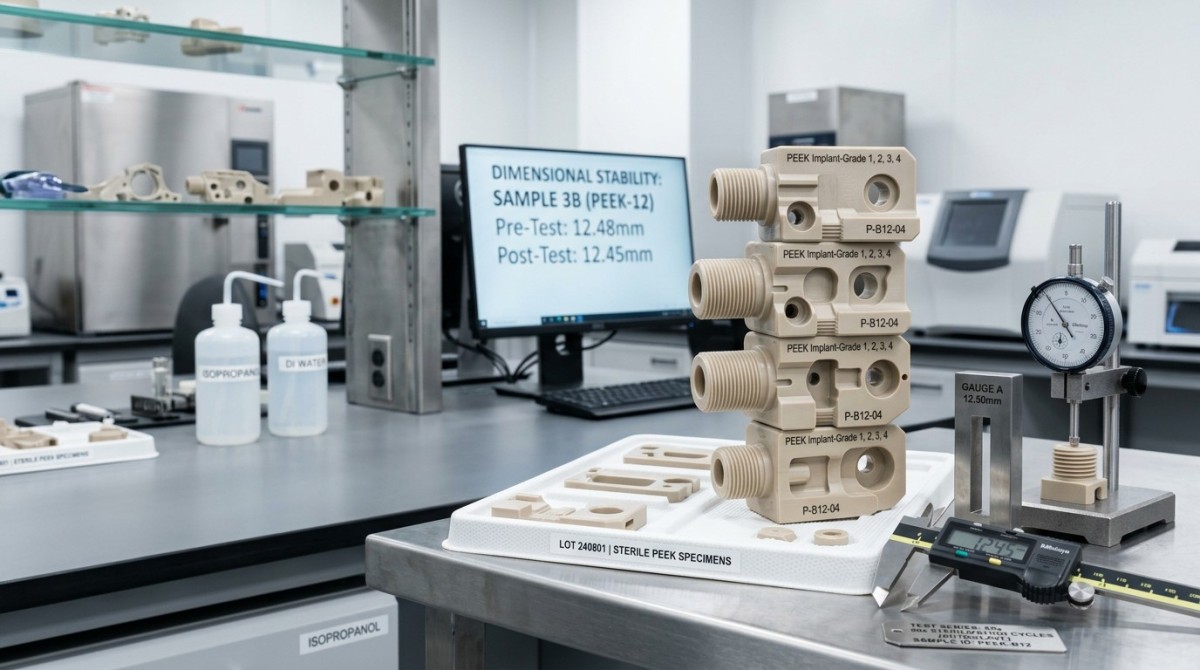
Medical grade PEEK is widely selected for reusable medical components because it combines chemical resistance, thermal stability, and mechanical strength. Yet a single-pass validation rarely reveals the full risk profile. In practice, failure often appears after 10, 25, or 50 repeat sterilization cycles, when cumulative stress begins to alter geometry, surface condition, or assembly fit. That is why a medical grade PEEK sterilization test must be treated as a lifecycle assessment rather than a one-time pass or fail event.
For information researchers and procurement teams, the main problem is not whether PEEK is generally suitable. The real question is whether a specific grade, machining route, and sterilization protocol remain stable under repeated exposure. Steam, gamma, EtO, and plasma do not stress the polymer in the same way. A part that stays functional for 5 cycles in one process may show measurable deformation or surface change after 20 cycles in another.
Operators usually see the issue first at the functional level. A clip no longer locks, a threaded insert becomes loose, a mating interface develops drag, or a sealing surface loses consistency. Decision-makers, however, need the upstream explanation. Failures are often linked to the interaction of 3 variables: resin quality, precision machining tolerance, and sterilization load history. If any one of these variables is weak, repeated cycles amplify the weakness.
At TechStat Vanguard, the focus is not on marketing language but on engineering traceability. Parameters do not lie. When a medical grade PEEK sterilization test fails after repeat cycles, the root cause usually sits in dimensional stability, micro-surface damage, residual stress release, or inconsistent process documentation. These are measurable, auditable, and procurement-relevant issues.
What typically changes across 3 stages of repeat-cycle exposure
In many reusable-device programs, engineers observe a staged behavior pattern rather than sudden catastrophic failure. During the first stage, usually the initial 1–10 cycles, changes may be negligible and remain inside drawing tolerance. During the second stage, often around 10–30 cycles, creep recovery, moisture interaction, or relaxation of machining stress may begin to shift critical dimensions. During the third stage, beyond 30 cycles in demanding protocols, cumulative degradation becomes easier to detect in fit, finish, or load-bearing response.
- Stage 1: baseline confirmation, usually focused on appearance, initial fit, and dimensional reference points.
- Stage 2: drift monitoring, including bore diameter change, flatness variation, thread integrity, and color or gloss shift.
- Stage 3: end-of-life assessment, where mechanical retention, sealing performance, and compliance documentation become critical.
This stage-based view matters because many supplier datasheets emphasize bulk material capability, while real-world failure emerges in finished geometry. For procurement, the safer approach is to request repeat-cycle test framing that mirrors the intended use profile rather than relying on generic material claims.
Which failure modes matter most in a medical grade PEEK sterilization test?
A failed medical grade PEEK sterilization test does not always mean the part cracked. More often, the failure is functional and cumulative. The most common issues include dimensional drift, surface embrittlement, particulate generation from wear interfaces, discoloration that affects inspection, and reduced mechanical retention at assembly features. In regulated manufacturing, a part can fail long before visible breakage if it no longer meets specification after 20–40 sterilization cycles.
Dimensional drift is usually the first procurement-relevant signal. For example, a bore, slot, or flat sealing face may shift by tens of microns, enough to compromise repeatable fit in precision assemblies. If the original machining tolerance is already tight, such as ±0.02 mm to ±0.05 mm on a critical feature, even small cycle-induced movement can cause rejection. This is why supplier capability in both material handling and post-machining inspection matters.
Surface degradation is another underappreciated failure path. Repeated sterilization can alter roughness, gloss, and friction behavior. That may not appear serious in a brochure, but it can directly affect cleaning ease, particulate risk, or repeated contact performance. For device operators, the issue shows up as sticking, inconsistent handling feel, or harder cleaning. For quality teams, it raises documentation and change-control questions.
The table below summarizes the failure modes most often reviewed when reusable PEEK components are qualified for repeated sterilization exposure. It is intended as a decision-support reference for engineering, sourcing, and quality stakeholders working under ISO 13485-aligned controls.
This comparison shows why test failure analysis should not stop at the resin data sheet. In B2B procurement, the practical question is whether the delivered component remains inside tolerance, functional specification, and documentation control after the intended number of reuse cycles. That requires finished-part evidence, not only base-material claims.
Why machining quality often decides whether sterilization results stay stable
Medical grade PEEK sterilization test failures are frequently blamed on the material, but machining history is often the hidden variable. If feeds, speeds, tool wear control, or clamping strategy introduce residual stress, the part may look compliant at day zero yet move after repeated autoclave exposure. This is especially relevant for thin-wall structures, threaded features, and precision interfaces under 2 mm section thickness or with tight geometric tolerances.
TSV’s engineering-centered view is that tolerance discipline matters as much as polymer selection. A supplier that can document feature-level inspection before and after 10, 25, and 50 cycle checkpoints provides stronger decision value than one that only repeats generic statements about heat resistance. For buyers, that distinction can reduce qualification risk and shorten supplier comparison cycles.
How should engineers and buyers evaluate sterilization method, tolerance, and compliance together?
The most reliable procurement decisions are made when sterilization method, functional geometry, and compliance documentation are evaluated as one system. Too many sourcing reviews separate these topics: engineering checks dimensions, quality checks ISO 13485 paperwork, and purchasing compares price. That fragmented approach is exactly where repeat-cycle risk slips through. A part may be affordable and documented, yet still unsuitable for 30-cycle reusable service.
Different sterilization routes load PEEK differently. Steam sterilization introduces repeated temperature and moisture exposure. Gamma may raise concerns about cumulative radiation effects depending on grade and application history. EtO is gentler thermally but adds process and residual management considerations. Plasma can be attractive in certain assemblies, but compatibility still depends on geometry, surface condition, and cleaning flow. Buyers should ask not which method is best in general, but which method best matches the actual device lifecycle.
For reusable components, a practical review often starts with 4 checkpoints: intended cycle count, critical dimensions, surface-contact requirements, and document traceability. If the device target is 20 cycles, validation at only 5 cycles is weak. If sealing depends on flatness within a narrow band, bulk material heat resistance alone is not enough. If supplier records do not map material lot, machining revision, and test batch together, root-cause analysis becomes slow and expensive.
The following table helps teams compare sterilization-related decision factors before approving a medical grade PEEK part for repeated-use programs. It is not a substitute for application validation, but it gives procurement and quality teams a structured screening tool.
A table like this is useful because it keeps the review grounded in evidence. It also reflects TSV’s broader hard-tech philosophy: strip away vague claims and compare what can actually be measured. For CTOs, sourcing managers, and quality leaders, that improves supplier conversations and reduces trial-and-error cost.
A 5-point procurement checklist for repeat-cycle medical grade PEEK parts
- Confirm the exact sterilization route and expected reuse count, not just “sterilizable” status.
- Identify 3–5 critical dimensions that directly affect fit, sealing, locking, or alignment.
- Request before-and-after inspection data at defined cycle checkpoints such as 0, 10, and 25 cycles.
- Review whether the supplier can link material batch, machining revision, and inspection output in one traceable file set.
- Check whether cleaning, packaging, and handling instructions preserve the tested condition through delivery and use.
This checklist is especially valuable when multiple suppliers appear similar on paper. The one with clearer data and tighter process discipline often creates lower lifecycle cost, even if its unit price is not the lowest in the first quotation round.
What do ISO 13485-oriented teams often overlook in repeat-cycle PEEK qualification?
Teams working under ISO 13485 usually understand documentation, but they may still underestimate how sterilization affects design verification and supplier control together. A common oversight is treating material compliance and process validation as separate files with weak linkage. In reality, if a medical grade PEEK sterilization test failure appears after repeat cycles, investigators need fast access to revision history, material traceability, inspection records, and test conditions in one chain.
Another issue is inadequate sampling logic. A component may pass on a small, favorable sample but still show variation across machining lots or geometry families. Practical quality planning often uses at least 3 layers of review: incoming material identity, in-process dimensional verification, and post-cycle functional assessment. The exact sample size depends on risk classification and device context, but the principle is constant: repeat-cycle performance cannot be inferred from a single good specimen.
Change control is equally important. If a supplier changes cutting tools, fixturing, annealing practice, or raw stock source, repeat-cycle behavior may change even when nominal dimensions remain similar. Procurement leaders should therefore ask a direct question: what process changes trigger revalidation or at least comparative review? This is a stronger indicator of maturity than broad quality promises.
For advanced manufacturing supply chains, the lesson is simple. Compliance is not just about passing an audit. It is about preserving engineering truth across specification, machining, sterilization, and delivery. That aligns directly with TSV’s role as a data-driven benchmarking platform focused on measurable thresholds rather than commercial hype.
Common misconceptions that create avoidable failure risk
- “PEEK is high performance, so repeat sterilization is automatically safe.” Material class does not replace part-level validation.
- “If dimensions pass at shipment, long-term fit is covered.” Repeat-cycle drift often appears later, especially in tight interfaces.
- “Any certified quality system guarantees stable reusable performance.” Documentation discipline helps, but it does not eliminate geometry-specific test risk.
- “The lowest-cost machined part is acceptable if the resin is correct.” Hidden cost often appears in requalification, scrap, and delayed approvals.
FAQ: questions frequently raised by engineers, operators, and buyers
The questions below reflect common search intent around medical grade PEEK sterilization test failures after repeat cycles. They are also the kinds of issues that influence supplier screening, validation timing, and total procurement risk.
How many sterilization cycles should be tested for a reusable PEEK part?
The test count should reflect the intended service life with safety margin, not a generic industry number. If a device is expected to see 20 reuse cycles, many teams review checkpoints such as 0, 10, 20, and sometimes 25 or 30 cycles to observe trend behavior. The right number depends on the sterilization route, geometry sensitivity, and consequence of fit loss. A simple visual pass after a few cycles is not enough for critical interfaces.
Is steam sterilization always the toughest condition for medical grade PEEK?
Not always. Steam can be demanding because it combines heat and moisture repeatedly, but the toughest condition depends on part design and performance criteria. Thin-wall parts, precision bores, or latch features may respond differently than bulk sections. Radiation-based or chemically assisted methods can introduce their own long-term effects. The correct evaluation compares actual functional outcomes, not assumptions about one method being universally hardest.
What should buyers request from a supplier before approving a repeat-cycle PEEK component?
At minimum, request 4 items: material traceability, drawing-linked dimensional reports, sterilization cycle definition, and post-cycle functional evidence. If the application is sensitive, also ask for surface observations, change-control practice, and a clear statement of which features were measured at each checkpoint. This makes quotation comparison more meaningful and reduces ambiguity during supplier qualification.
Can a part pass material validation but fail in actual medical use?
Yes, and this is common in repeat-cycle problems. Bulk material properties may look acceptable while the finished component fails due to geometry, tolerance stack-up, machining stress, or assembly interaction. That is why TSV emphasizes benchmarking at the engineering-parameter level. The useful question is not only whether the resin is medical grade, but whether the finished part stays within functional limits throughout its reuse profile.
Why choose a data-driven evaluation partner for PEEK sterilization risk and supplier decisions?
When medical grade PEEK sterilization test failures emerge after repeat cycles, the cost is rarely limited to one nonconforming part. Teams lose time in root-cause investigation, supplier requalification, document revision, and delayed launch schedules. A data-driven evaluation approach reduces that exposure by forcing clarity early: exact cycle assumptions, exact tolerance priorities, exact inspection points, and exact traceability requirements.
TechStat Vanguard is built around that discipline. Our role is to cut through supplier noise and help technical teams compare what actually matters in hard-tech sourcing: tolerance credibility, repeatability, performance evidence, and documentation strength. For medical and precision-manufacturing stakeholders, this means better spec-sheet drafting, stronger supplier filtering, and fewer expensive surprises during qualification.
If your team is reviewing medical grade PEEK for reusable instruments, sterilizable assemblies, or high-precision device interfaces, we can support the decision process in practical terms. Typical discussion topics include parameter confirmation, sterilization-method suitability, tolerance-risk review, sample evaluation logic, supplier comparison criteria, and ISO 13485-oriented documentation expectations. These are the points that materially affect approval speed and lifecycle reliability.
Contact us to discuss 6 concrete items before your next sourcing or validation decision: target cycle count, critical dimensions, sterilization route, sample support, delivery timeline, and quotation scope. If you are comparing multiple vendors, we can also help structure a benchmark matrix so engineering, purchasing, and management review the same evidence set instead of relying on inconsistent claims.
Search News
Hot Articles
- Carbon Fiber StructuresHow to Specify Aerospace Carbon Fiber Assemblies for Lightweight, Load-Bearing PartsJul 11, 2026
- Machine VisionXiaomi, Alibaba DAMO Academy Drive Open-Source Robotics Model Ecosystem, Lowering Algorithm Development Barriers for Overseas SMEs Adopting Chinese Robotics SolutionsMar 30, 2026
- Cobots & ArmsShanxi 'AI+' Conference Showcases Embodied Intelligence with Multinational Buyer Engagement: Key Industry ImplicationsMar 30, 2026
Popular Tags
Recommended News
 Jul 11, 2026How to Specify Aerospace Carbon Fiber Assemblies for Lightweight, Load-Bearing PartsAerospace carbon fiber assemblies: learn how to specify laminate design, load data, joining methods, and inspection controls for lighter, reliable load-bearing aerospace parts.Elena Rostova (UAV Systems Researcher)
 Mar 30, 2026Xiaomi, Alibaba DAMO Academy Drive Open-Source Robotics Model Ecosystem, Lowering Algorithm Development Barriers for Overseas SMEs Adopting Chinese Robotics SolutionsXiaomi & Alibaba DAMO Academy's open-source robotics models lower algorithm barriers for global SMEs. Boost efficiency in manufacturing, logistics & smart retail with ROS 2 compatible solutions.TSV Data Lab
 Mar 30, 2026Shanxi 'AI+' Conference Showcases Embodied Intelligence with Multinational Buyer Engagement: Key Industry ImplicationsShanxi 'AI+' Conference highlights embodied intelligence with Tesla, Ubtech & Jiantao showcasing multimodal robotics. 40+ global buyers validated tech on-site, creating new B2B channels for industrial automation & AI solutions.Chen Wei (Automation Lead Engineer)
 Mar 30, 2026Zhongguancun Unveils 6G Integrated Sensing-Computing-Intelligence Platform to Empower Embodied Robots for Global Industrial ApplicationsZhongguancun's new 6G platform revolutionizes industrial robotics with <10ms latency, empowering global automotive, logistics & port automation. Discover how this tech boosts China's smart manufacturing exports.TSV Data Lab
 Mar 30, 2026Mech-Mind Tianjin Embodied Intelligence R&D and Production Base Goes Live, Cutting Delivery Time by 20%–30% for Global Customized AMR+Vision SolutionsMech-Mind's Tianjin AMR+Vision production base cuts delivery time by 20%-30% for欧美 & Latin American markets. Discover how this PLd-certified facility accelerates customized robotics solutions for smart manufacturing and logistics.Chen Wei (Automation Lead Engineer)
 Mar 30, 2026Boao Forum Reveals 'Co-evolution of Big and Small Brains' Trend in Humanoid Robots, China's Embodied Intelligence Accelerates Adaptation to Overseas Manufacturing Service ScenariosDiscover how China's humanoid robots, featuring 'Co-evolution of Big and Small Brains,' are revolutionizing global manufacturing. Learn about Embodied Tian Gong 3.0's ISO compliance and overseas deployment at Boao Forum 2026.Chen Wei (Automation Lead Engineer)
 Mar 30, 2026China Railway Industrial Secures Patent for Embodied Robotics in Material Handling, Boosting High-Precision Delivery Capabilities for Overseas Infrastructure and Manufacturing ProjectsChina Railway Industrial's new patent for embodied robotics in material handling boosts high-precision delivery for global infrastructure & manufacturing. Discover how this innovation enhances logistics accuracy in automotive, rail transit & EPC projects.Chen Wei (Automation Lead Engineer)
 Oct 27, 2026GXO and Agility Robotics Expand Partnership to Accelerate US Humanoid Robot DeploymentGXO and Agility Robotics plan to expand US humanoid robot deployment with Digit 4 in early 2027. Explore warehouse automation plans, service terms and future Digit 5 upgrades.Chen Wei (Automation Lead Engineer)
 Oct 27, 2026Robotic Automation Costs: Budgeting for Equipment, Integration, and MaintenancePlan your robotics automation cost with confidence. Explore equipment, integration, and maintenance expenses, compare quotes, and build a realistic budget for better ROI.Chen Wei (Automation Lead Engineer)
 Oct 26, 2026AMAXiMAL Releases Open-Source TopMod 3D v3 With Claude AIExplore AMAXiMAL’s free, open-source TopMod 3D v3 with Claude AI assistance, topology-based modeling and plywood fabrication tools that connect complex designs to physical builds.Dr. Marcus Vance
 Oct 26, 2026Choosing a SCADA System Integrator Company: PLC Compatibility and Long-Term SupportChoose a scada system integrator company with proven PLC compatibility and reliable long-term support. Discover what to test, compare, and require before investing.Victor Lin (Chief Software Architect)
 Oct 25, 2026Hesai Leads Global ADAS Main Lidar Shipments in Yole’s 2026 ReportHesai led global ADAS main lidar shipments with a 43% share in 2025, according to Yole’s 2026 report. Explore what this ranking reveals about its automotive market position.TSV Data Lab
 Oct 25, 2026Choosing an Aerospace Materials Manufacturer: Quality and Traceability ChecksChoosing an aerospace materials manufacturer? Learn how to verify certifications, test reports, and lot traceability to qualify suppliers confidently and reduce costly sourcing risks.Dr. Marcus Vance
 Oct 24, 2026Guotai Haitong: Global Entry-Level 3D Printer Shipments Rose 39% in Q1 2026Entry-level 3D printer shipments rose 39% in Q1 2026, Guotai Haitong reports. Explore how AI, multicolor printing and print farms are shaping market growth.Dr. Marcus Vance
 Oct 24, 2026Choosing an Industrial Vision Inspection Supplier: Acceptance Tests That MatterChoose an industrial vision inspection supplier with confidence. Discover acceptance tests for defect detection, false rejects, production speed, and reliable part rejection before you buy.TSV Data Lab
 Oct 23, 2026US Navy Raises Gecko Robotics Contract Ceiling to $300M for Robotic Fleet MaintenanceUS Navy raises Gecko Robotics’ contract ceiling to $300M for Pacific Fleet robotic inspections. Explore potential opportunities for maintenance suppliers and key procurement considerations.Chen Wei (Automation Lead Engineer)
 Oct 23, 2026Choosing Industrial Sensing Systems for Global Plants: Protocol CompatibilityCompare industrial sensing systems international buyers can trust. Explore protocol compatibility, reduce integration risks, and select proven configurations for reliable global plant deployments.TSV Data Lab
 Oct 22, 2026KUKA Showcases Physical AI and iiQKA.AI Vision at NVIDIA GTC BerlinExplore KUKA’s Physical AI showcase at NVIDIA GTC Berlin and discover how iiQKA.AI Vision aims to simplify robotic vision integration and improve 2D and 3D scene recognition.TSV Data Lab
 Oct 22, 2026Robotic Machining of Advanced Composites: What Tolerances Are Achievable?Explore advanced materials machining robotics: discover what drives achievable composite tolerances and how to validate accuracy before investing in your next machining system.Dr. Marcus Vance
 Oct 21, 2026China’s Industrial Robot Exports Near RMB 10 Billion in First Nine Months of 2026China’s industrial robot exports neared RMB 10 billion in January–September 2026, with value rising faster than volume. Explore the data and what it could mean for suppliers.Chen Wei (Automation Lead Engineer)
 Oct 21, 2026Low-Latency Industrial Data Processing: Pricing and Key Cost DriversExplore industrial data latency price drivers, from edge hardware to integration and support. Learn how to compare quotes, verify performance, and avoid unnecessary costs.TSV Data Lab
 Oct 20, 2026KUKA Launches iiQKA.AI Vision to Simplify Industrial Image ProcessingKUKA iiQKA.AI Vision simplifies industrial image processing with controller-based 2D and 3D vision. Explore drag-and-drop setup for vision-guided automation.TSV Data Lab
 Oct 20, 2026Smart Industrial Edge Devices: Key Criteria for Legacy PLC IntegrationChoose smart industrial edge devices for legacy PLC integration. Discover key criteria for compatibility, data quality, security, and reliable collection without disrupting control.TSV Data Lab
 Oct 19, 2026Choosing a Radar Sensor by Application: Range, Resolution, and Field of ViewSimplify radar sensor application based product selection. Compare range, resolution, and field of view to avoid blind spots and choose with confidence. Explore the guide.TSV Data Lab























