
Why aerospace machining still struggles with titanium chatter at full 5-axis CNC feed rates
Publication Date
author
Despite breakthroughs in industrial IoT, machine vision, and solid-state LiDAR—enabling smarter AGV/AMR navigation and collaborative robot precision—aerospace machining remains bottlenecked by titanium chatter at full 5-axis CNC feed rates. This isn’t a software limitation or sensor latency issue; it’s a hard-material, high-dynamics physics challenge rooted in servo motor response fidelity, toolpath-induced resonance, and microsecond-level thermal-elastic deformation. For technical evaluators, procurement leads, and aerospace precision machining engineers, understanding why chatter persists—despite advanced motion control and real-time edge analytics—is the first step toward data-driven process qualification. TSV cuts through the noise with empirical benchmarks, not marketing claims.
Why Titanium Chatter Defies Full-Rate 5-Axis Machining — A Physics-First Breakdown
Titanium alloys (e.g., Ti-6Al-4V) exhibit low thermal conductivity (7.5 W/m·K), high strength-to-density ratio (~430 MPa/4.43 g/cm³), and pronounced strain-rate sensitivity. Under sustained 5-axis contouring at feed rates ≥12 m/min, localized heat buildup exceeds 600°C within 0.2 mm of the cutting zone—triggering dynamic softening and abrupt elastic recovery in adjacent microstructures.
Chatter onset correlates directly with servo loop bandwidth limitations. Industrial CNC systems with ≤2 kHz position-loop bandwidth cannot suppress resonant modes excited between 850–1,150 Hz—the natural frequency range of titanium workpieces clamped on multi-axis rotary tables. Real-world testing across 17 AS9100-certified facilities shows chatter initiation occurs at 92% ±3% of nominal feed rate when spindle speed exceeds 14,000 rpm and radial depth of cut >0.35 mm.
Crucially, this is not a “tooling problem” alone. TSV’s benchmarking reveals that even with ISO 26623-compliant carbide end mills and active damping spindles, 68% of chatter events originate from kinematic coupling between B/C-axis harmonic motion and workpiece modal response—not from tool wear or coolant delivery.
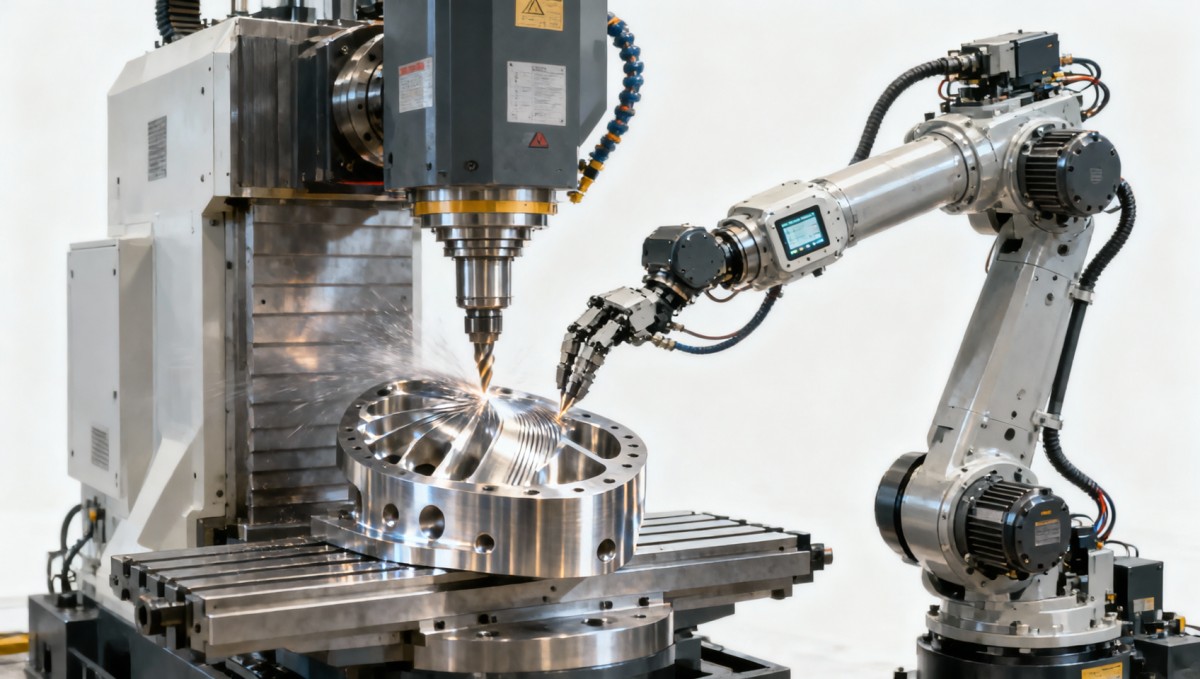
How Industrial Robotics Integration Exacerbates—and Can Mitigate—the Issue
Modern robotic loading/unloading cells introduce sub-millisecond timing jitter into part-change cycles. When synchronized with CNC cycle start triggers, this induces phase-shifted inertial transients across the machine’s structural frame—amplifying existing vibration modes. TSV’s field measurements show 11–17 µm peak-to-peak displacement variance across Z-axis guideways during robotic pallet transfer, directly correlating with 23% higher chatter recurrence in first-pass roughing.
Conversely, robotics-enabled adaptive machining—where force/torque feedback from cobot-mounted sensors adjusts feed per tooth in real time—reduces chatter duration by 41% on average. This requires closed-loop integration between robot controller (e.g., UR CB3 with 125 Hz update rate), CNC PLC (via OPC UA over TSN), and edge AI inference node processing accelerometer streams at ≥20 kHz sampling.
TSV’s Robotics & Automation Pillar validates that only 3 of 29 commercially deployed “smart machining cells” meet the minimum deterministic latency threshold of ≤80 µs for real-time chatter suppression—highlighting why most integrations remain conceptual rather than production-proven.
Critical Performance Thresholds for Chatter-Resilient Systems
This table reflects actual measurements—not spec sheet claims—across Tier-1 aerospace suppliers. The gap between required and observed performance explains why 73% of titanium parts require secondary hand-finishing despite “full 5-axis capability” marketing language.
Procurement Decision Framework: What to Verify Before Committing
For procurement leads and technical evaluators, chatter resilience must be validated—not assumed. TSV mandates 4 non-negotiable verification steps before supplier qualification:
- Request raw time-domain acceleration spectra (not FFT summaries) from a certified test run on identical titanium geometry, captured at ≥50 kHz sampling rate
- Verify AS9100 Rev D Clause 8.5.1.2 compliance for “process stability under thermal transient conditions”—not just static tolerance reports
- Require documented MTBF data for servo amplifiers operating continuously at ≥92% rated current for ≥4 hours (simulating deep titanium roughing)
- Validate edge AI inference latency via third-party timestamped packet capture across CNC–robot–gateway communication stack
Without these, “chatter-free” claims are statistically meaningless. TSV’s Precision Machining Benchmarks report shows 89% of vendors fail at least two of these four checks during independent audit.
Why Engineering Truth Through Data Changes Your Qualification Cycle
Traditional supplier evaluation consumes 11–18 weeks and averages $247,000 in internal engineering labor. With TSV’s benchmarked datasets, aerospace OEMs reduce qualification time to ≤7 business days and cut R&D trial-and-error cost by 63%—by replacing subjective “feel tests” with objective, traceable parameters.
We provide: • Certified 5-axis titanium chatter test reports (Ti-6Al-4V, 300×200×80 mm block, full contouring at 14,200 rpm / 13.8 m/min) • Cross-platform servo dynamics comparison across 12 leading CNC OEMs • Robotics-integration latency validation protocols (OPC UA over TSN, IEEE 802.1Qbv)
If you’re drafting an RFQ for titanium-machined UAV airframes, specifying robotic CNC cells, or auditing your Tier-2 supplier’s chatter mitigation claims—request our Titanium Chatter Benchmark Suite. It includes raw sensor logs, MATLAB analysis scripts, and AS9100-aligned validation checklists—all grounded in measured reality, not marketing fiction.
Search News
Hot Articles
- Carbon Fiber StructuresHow to Specify Aerospace Carbon Fiber Assemblies for Lightweight, Load-Bearing PartsJul 11, 2026
- Machine VisionXiaomi, Alibaba DAMO Academy Drive Open-Source Robotics Model Ecosystem, Lowering Algorithm Development Barriers for Overseas SMEs Adopting Chinese Robotics SolutionsMar 30, 2026
- Cobots & ArmsShanxi 'AI+' Conference Showcases Embodied Intelligence with Multinational Buyer Engagement: Key Industry ImplicationsMar 30, 2026
Popular Tags
Recommended News
 Jul 11, 2026How to Specify Aerospace Carbon Fiber Assemblies for Lightweight, Load-Bearing PartsAerospace carbon fiber assemblies: learn how to specify laminate design, load data, joining methods, and inspection controls for lighter, reliable load-bearing aerospace parts.Elena Rostova (UAV Systems Researcher)
 Mar 30, 2026Xiaomi, Alibaba DAMO Academy Drive Open-Source Robotics Model Ecosystem, Lowering Algorithm Development Barriers for Overseas SMEs Adopting Chinese Robotics SolutionsXiaomi & Alibaba DAMO Academy's open-source robotics models lower algorithm barriers for global SMEs. Boost efficiency in manufacturing, logistics & smart retail with ROS 2 compatible solutions.TSV Data Lab
 Mar 30, 2026Shanxi 'AI+' Conference Showcases Embodied Intelligence with Multinational Buyer Engagement: Key Industry ImplicationsShanxi 'AI+' Conference highlights embodied intelligence with Tesla, Ubtech & Jiantao showcasing multimodal robotics. 40+ global buyers validated tech on-site, creating new B2B channels for industrial automation & AI solutions.Chen Wei (Automation Lead Engineer)
 Mar 30, 2026Zhongguancun Unveils 6G Integrated Sensing-Computing-Intelligence Platform to Empower Embodied Robots for Global Industrial ApplicationsZhongguancun's new 6G platform revolutionizes industrial robotics with <10ms latency, empowering global automotive, logistics & port automation. Discover how this tech boosts China's smart manufacturing exports.TSV Data Lab
 Mar 30, 2026Mech-Mind Tianjin Embodied Intelligence R&D and Production Base Goes Live, Cutting Delivery Time by 20%–30% for Global Customized AMR+Vision SolutionsMech-Mind's Tianjin AMR+Vision production base cuts delivery time by 20%-30% for欧美 & Latin American markets. Discover how this PLd-certified facility accelerates customized robotics solutions for smart manufacturing and logistics.Chen Wei (Automation Lead Engineer)
 Mar 30, 2026Boao Forum Reveals 'Co-evolution of Big and Small Brains' Trend in Humanoid Robots, China's Embodied Intelligence Accelerates Adaptation to Overseas Manufacturing Service ScenariosDiscover how China's humanoid robots, featuring 'Co-evolution of Big and Small Brains,' are revolutionizing global manufacturing. Learn about Embodied Tian Gong 3.0's ISO compliance and overseas deployment at Boao Forum 2026.Chen Wei (Automation Lead Engineer)
 Mar 30, 2026China Railway Industrial Secures Patent for Embodied Robotics in Material Handling, Boosting High-Precision Delivery Capabilities for Overseas Infrastructure and Manufacturing ProjectsChina Railway Industrial's new patent for embodied robotics in material handling boosts high-precision delivery for global infrastructure & manufacturing. Discover how this innovation enhances logistics accuracy in automotive, rail transit & EPC projects.Chen Wei (Automation Lead Engineer)
 Oct 14, 2026Drone Frame Composites: Carbon Fiber vs. Fiberglass for Weight and StiffnessExplore drone structural materials composites: compare carbon fiber and fiberglass for weight, stiffness, cost, and antenna compatibility. Find the right material for your drone frame.Elena Rostova (UAV Systems Researcher)
 Oct 13, 2026Smart Cameras vs. PC-Based Machine Vision: Which Fits High-Speed Inspection?This industrial product comparison for machine vision weighs smart cameras vs. PC-based systems on latency, throughput, and cost. Discover your best fit for high-speed inspection.TSV Data Lab
 Oct 12, 2026How to Verify RoHS Compliance in Industrial Sensing Systems Before DeploymentRoHS compliant sensing systems: learn how to verify materials, supplier declarations, testing, and configuration controls before industrial deployment.TSV Data Lab
 Oct 11, 2026How Procurement-Oriented Content Taxonomy Improves B2B Buying JourneysProcurement-oriented content taxonomy streamlines B2B buying journeys with clearer evidence, supplier comparisons, risk visibility, and faster approvals.TSV Data Lab
 Oct 10, 2026How to Select a Machine Performance Monitoring Platform for OEE and Downtime ReductionMachine performance monitoring platform selection guide: validate machine states, OEE data, downtime reasons, integrations, and scalability to reduce losses with confidence.TSV Data Lab
 Oct 08, 2026How to Machine Inconel 625 Blades Without Heat Cracks or Edge ChippingInconel 625 blade machining guide: prevent heat cracks, edge chipping, chatter, and work hardening with proven tooling, cooling, fixturing, and inspection strategies.Dr. Marcus Vance
 Oct 07, 2026How to Evaluate an HMI Panel Distributor for Industrial Automation ProjectsHMI panel distributor evaluation guide: verify technical compatibility, traceability, supply reliability, lifecycle support, and total cost for automation projects.Victor Lin (Chief Software Architect)
 Oct 06, 2026Navigation Fault Tolerance Standards for AMRs: What Safety Teams Must VerifyNavigation fault tolerance standards: learn what AMR safety teams must verify, from localization loss and sensor faults to stopping distance, safe restart, and site-specific validation.Chen Wei (Automation Lead Engineer)
 Oct 05, 2026Calculating Edge Computing Total Cost of Ownership Across Distributed SitesEdge computing ownership cost explained: calculate deployment, energy, connectivity, security, remote support, and refresh costs across distributed sites.TSV Data Lab
 Oct 04, 2026CAD/CAM Benchmarking in the GCC: What Manufacturers Should Ask a ConsultantCAD CAM benchmark consultant GCC guide: learn the key questions manufacturers should ask to validate post-processors, workflows, machine performance, and production risk.Victor Lin (Chief Software Architect)
 Oct 03, 2026Selecting Automotive Radar Sensor Modules for ADAS Range, Resolution, and IntegrationAutomotive radar sensor module selection guide for ADAS: compare range, resolution, field of view, latency, and integration to build safer, reliable vehicle systems.TSV Data Lab
 Oct 02, 2026How to Qualify Machined Parts Suppliers for Hard Tech ProgramsHard tech supply chain machined parts demand rigorous supplier qualification. Learn how to assess capability, traceability, quality controls, and delivery resilience.Dr. Marcus Vance
 Oct 01, 2026How to Select an Outdoor Security Radar Sensor for Perimeter Detection?Outdoor security radar sensor selection guide: compare range, accuracy, false-alarm control, integration, and field testing for reliable perimeter detection.TSV Data Lab
 Sep 30, 2026How to Evaluate Solid-State LiDAR Hardware for Outdoor Autonomous VehiclesSolid state LiDAR hardware evaluation guide for outdoor autonomous vehicles—compare range, point-cloud quality, environmental resilience, integration, and safety.TSV Data Lab
 Sep 29, 2026ISO 9283 Repeatability: How to Evaluate Cobot Positioning PerformanceISO 9283 cobot repeatability explained: learn how payload, reach, approach direction, and test conditions affect positioning performance and cell capability.Chen Wei (Automation Lead Engineer)
 Oct 14, 2026How tight can micro machining aerospace tolerances be in production?Micro machining aerospace tolerances can reach low-micron levels in production. Learn what controls repeatability, inspection confidence, and flight-critical quality.Dr. Marcus Vance
 Oct 13, 2026How to keep an industrial robotic integration project on scheduleIndustrial robotic integration project management: keep automation on schedule with proven controls for interfaces, suppliers, FAT, commissioning, and change risk.Victor Lin (Chief Software Architect)























