
Medical device parts that benefit most from 5-axis CNC machining
Publication Date
author
In medical manufacturing, not every component demands the same machining strategy. For engineers and sourcing teams evaluating precision, complexity, and compliance, understanding which parts gain the most from 5-axis CNC machining for medical devices is critical. This article examines the geometries, tolerance demands, and production scenarios where 5-axis capability delivers measurable value in performance, consistency, and risk reduction.
What 5-axis CNC machining means in a medical context
5-axis CNC machining refers to a process in which the cutting tool or part moves across five controlled axes, allowing complex surfaces and multiple features to be machined in fewer setups than 3-axis or even many 4-axis processes. In medical manufacturing, that matters because component geometry is rarely simple. Designers often need miniature channels, contoured surfaces, undercuts, angled holes, and polished functional faces within tight dimensional limits.
For regulated sectors such as surgical systems, orthopedic implants, dental components, and diagnostic equipment, part quality is not defined by shape alone. It also depends on repeatability, traceability, burr control, surface integrity, and the ability to maintain tolerance relationships between features. This is why 5-axis CNC machining for medical devices attracts attention not as a luxury process, but as a practical method for reducing cumulative error and improving consistency on demanding parts.
Why the medical industry pays close attention to this process
Medical products sit at the intersection of precision engineering and regulatory accountability. A housing for a diagnostic analyzer may need accurate sealing faces and alignment points. A bone screw driver may require smooth transitions and exact engagement geometry. A spinal implant may combine bio-compatible materials, complex curvature, and highly controlled surface zones. In each case, the machining method influences not only manufacturability but also downstream validation, assembly yield, sterilization performance, and patient safety.
Organizations such as TechStat Vanguard emphasize parameter-based evaluation for good reason: claims of “high quality” mean little without measurable evidence. For suppliers of 5-axis CNC machining for medical devices, the meaningful questions involve positional accuracy, achievable surface finish, toolpath stability, material behavior, inspection capability, and process repeatability under documented controls. The parts that benefit most are those where multi-face precision and geometry complexity directly affect function.
Where 5-axis capability creates the most value
The biggest advantage of 5-axis machining is not simply speed. It is the ability to machine difficult forms in a way that protects datum relationships and reduces repositioning risk. Every additional setup introduces opportunities for stack-up error, witness marks, clamping distortion, and variation between batches. In medical applications, these risks can be expensive because nonconforming parts may trigger inspection delays, validation failures, or scrap of costly titanium, cobalt-chrome, or engineering polymers.
The process is especially valuable when a part has compound curves, angled access features, deep cavities that require tool orientation control, or cosmetic-functional surfaces that must remain free from manual rework. It also supports low- to medium-volume production efficiently, which fits many medical programs where prototypes, pilot builds, and controlled production runs are common.
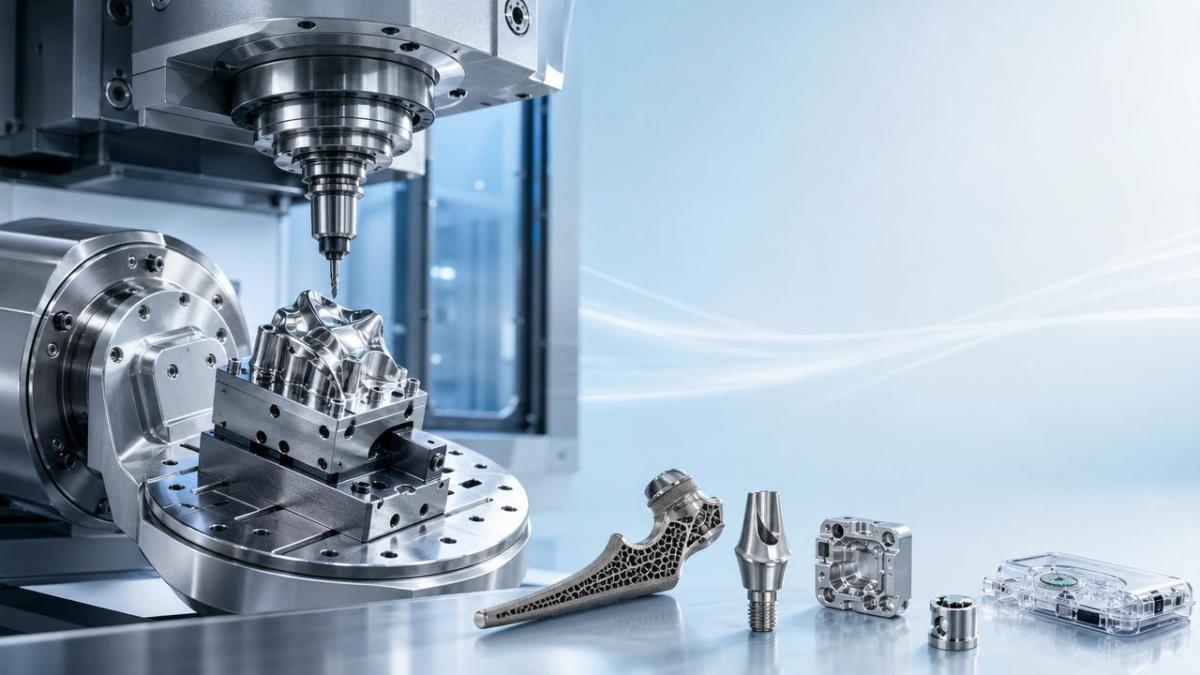
Medical device parts that benefit most from 5-axis CNC machining
Orthopedic implants
Among all categories, orthopedic implants are often the clearest match for 5-axis CNC machining for medical devices. Knee components, spinal implants, trauma plates, and custom fixation parts frequently include organic profiles, chamfered transitions, radiused edges, and angled screw paths. These geometries need to align with anatomy, interface with tools, and sometimes support porous or secondary surface treatments. Machining them in fewer setups helps maintain dimensional relationships while reducing fixture complexity.
This is particularly important for titanium and cobalt-chrome parts, where material cost is high and rework options can be limited. Better access to the cutting zone also supports smoother tool engagement, which can improve surface quality and reduce the likelihood of edge damage.
Surgical instruments with complex working ends
Many surgeons rely on instruments that appear simple externally but contain complex functional details: jaws, serrations, grasping faces, curved interfaces, and ergonomic surfaces. When these features are oriented at different angles, 5-axis machining allows manufacturers to reach them more directly. That improves consistency on cutting edges, mating surfaces, and precision engagement features.
For reusable instruments, burr control and surface integrity matter because poor machining can affect cleaning and sterilization. For disposable instruments, repeatability and production efficiency are often more important than maximizing throughput at any cost. In both cases, 5-axis CNC machining for medical devices supports better functional quality when geometry becomes difficult for conventional setups.
Dental components and small precision parts
Dental abutments, bridges, implant interfaces, and custom prosthetic support parts often combine very small features with high surface and fit requirements. Even a minor deviation can affect seating, load transfer, or patient comfort. These parts benefit from short setup chains, precise tool orientation, and stable machining of complex contours.
Because the scale is small, errors from reclamping become proportionally more significant. A capable 5-axis process can help preserve accuracy while minimizing hand finishing, which is valuable for both quality control and documentation.
Robotic surgery and minimally invasive system components
Robotic and minimally invasive systems use compact, high-value components that often include pockets, mounting interfaces, precision bores, and lightweighted structures. Some parts must fit into tight assemblies while maintaining motion accuracy and low friction. Others need cosmetic cleanliness because they are visible in premium clinical equipment.
5-axis machining becomes especially useful when a part requires multiple critical features around different faces, or when designers want to reduce mass without sacrificing rigidity. In these situations, the process helps balance part complexity with dimensional reliability.
Diagnostic and analytical equipment components
Not every part benefiting from 5-axis capability goes inside the body or touches tissue. Medical analyzers, imaging subsystems, fluid handling modules, and sensor platforms often use machined parts with sealing grooves, alignment surfaces, threaded ports, and thermal management features. These housings and brackets can become strong candidates for 5-axis CNC machining for medical devices when several critical surfaces must be held in relation to one another.
This category matters for sourcing teams because the value is not always obvious from part appearance alone. A rectangular housing may still justify 5-axis machining if it contains angled channels, intersecting holes, or precision references that affect calibration and assembly yield.
When 5-axis machining may be unnecessary
A balanced evaluation is important. Simple spacers, flat plates, basic brackets, and rotationally symmetric parts with limited secondary features do not always need 5-axis processing. If a component can be produced in one or two stable setups on 3-axis or turning equipment without compromising tolerance, finish, or cost, then 5-axis may add complexity without real benefit.
The key question is not whether 5-axis technology is advanced, but whether it meaningfully reduces risk for the specific part. Engineers should connect the machining strategy to actual functional requirements rather than defaulting to the most sophisticated equipment.
How to evaluate part suitability before choosing a supplier
For information researchers, supplier qualification becomes stronger when evaluation starts with the part itself. A practical review should include geometry complexity, required datums, material selection, tolerance bands, cosmetic expectations, lot size, and downstream validation needs. If the drawing includes many features at varying angles, deep cavities, or profile tolerances across contoured surfaces, 5-axis capability should be assessed early.
It is also useful to ask whether the supplier can support inspection methods that match the machining claim. In regulated environments, machining and metrology must work together. Coordinate measuring machines, in-process probing, documented tool management, and clear traceability all contribute to reliable output. This reflects TSV’s broader principle that performance should be proven through engineering evidence, not broad marketing language.
Practical guidance for engineers and sourcing teams
When reviewing 5-axis CNC machining for medical devices, start by identifying the features that drive function, not the machine type itself. Ask which surfaces must relate to each other, which areas are hardest to access, and where setup changes could create measurable variation. This keeps supplier discussions grounded in engineering outcomes.
Next, compare process capability against part risk. High-value, low-volume components with complex geometry often justify 5-axis machining even if nominal cycle time is longer, because the savings come from reduced scrap, less manual blending, and cleaner validation. Finally, look beyond machining alone. The best results come from suppliers that integrate DFM feedback, fixture planning, metrology, and documented process control into one manufacturing approach.
Conclusion
The medical device parts that benefit most from 5-axis CNC machining are those with complex geometry, tight feature relationships, difficult access, and high consequences for dimensional variation. Orthopedic implants, advanced surgical instruments, dental parts, robotic surgery components, and precision diagnostic equipment parts are the strongest examples. For these categories, 5-axis CNC machining for medical devices can improve consistency, reduce setup-related risk, and support a more reliable path from prototype to validated production.
For research-driven teams, the right next step is not to assume every advanced part needs 5-axis machining, but to evaluate where it creates measurable engineering value. When decisions are based on geometry, tolerance logic, material behavior, and inspection readiness, supplier selection becomes clearer and manufacturing risk becomes easier to control.
Search News
Hot Articles
- Carbon Fiber StructuresHow to Specify Aerospace Carbon Fiber Assemblies for Lightweight, Load-Bearing PartsJul 11, 2026
- Machine VisionXiaomi, Alibaba DAMO Academy Drive Open-Source Robotics Model Ecosystem, Lowering Algorithm Development Barriers for Overseas SMEs Adopting Chinese Robotics SolutionsMar 30, 2026
- Cobots & ArmsShanxi 'AI+' Conference Showcases Embodied Intelligence with Multinational Buyer Engagement: Key Industry ImplicationsMar 30, 2026
Popular Tags
Recommended News
 Jul 11, 2026How to Specify Aerospace Carbon Fiber Assemblies for Lightweight, Load-Bearing PartsAerospace carbon fiber assemblies: learn how to specify laminate design, load data, joining methods, and inspection controls for lighter, reliable load-bearing aerospace parts.Elena Rostova (UAV Systems Researcher)
 Mar 30, 2026Xiaomi, Alibaba DAMO Academy Drive Open-Source Robotics Model Ecosystem, Lowering Algorithm Development Barriers for Overseas SMEs Adopting Chinese Robotics SolutionsXiaomi & Alibaba DAMO Academy's open-source robotics models lower algorithm barriers for global SMEs. Boost efficiency in manufacturing, logistics & smart retail with ROS 2 compatible solutions.TSV Data Lab
 Mar 30, 2026Shanxi 'AI+' Conference Showcases Embodied Intelligence with Multinational Buyer Engagement: Key Industry ImplicationsShanxi 'AI+' Conference highlights embodied intelligence with Tesla, Ubtech & Jiantao showcasing multimodal robotics. 40+ global buyers validated tech on-site, creating new B2B channels for industrial automation & AI solutions.Chen Wei (Automation Lead Engineer)
 Mar 30, 2026Zhongguancun Unveils 6G Integrated Sensing-Computing-Intelligence Platform to Empower Embodied Robots for Global Industrial ApplicationsZhongguancun's new 6G platform revolutionizes industrial robotics with <10ms latency, empowering global automotive, logistics & port automation. Discover how this tech boosts China's smart manufacturing exports.TSV Data Lab
 Mar 30, 2026Mech-Mind Tianjin Embodied Intelligence R&D and Production Base Goes Live, Cutting Delivery Time by 20%–30% for Global Customized AMR+Vision SolutionsMech-Mind's Tianjin AMR+Vision production base cuts delivery time by 20%-30% for欧美 & Latin American markets. Discover how this PLd-certified facility accelerates customized robotics solutions for smart manufacturing and logistics.Chen Wei (Automation Lead Engineer)
 Mar 30, 2026Boao Forum Reveals 'Co-evolution of Big and Small Brains' Trend in Humanoid Robots, China's Embodied Intelligence Accelerates Adaptation to Overseas Manufacturing Service ScenariosDiscover how China's humanoid robots, featuring 'Co-evolution of Big and Small Brains,' are revolutionizing global manufacturing. Learn about Embodied Tian Gong 3.0's ISO compliance and overseas deployment at Boao Forum 2026.Chen Wei (Automation Lead Engineer)
 Mar 30, 2026China Railway Industrial Secures Patent for Embodied Robotics in Material Handling, Boosting High-Precision Delivery Capabilities for Overseas Infrastructure and Manufacturing ProjectsChina Railway Industrial's new patent for embodied robotics in material handling boosts high-precision delivery for global infrastructure & manufacturing. Discover how this innovation enhances logistics accuracy in automotive, rail transit & EPC projects.Chen Wei (Automation Lead Engineer)
 Sep 28, 2026Spindle Runout Measurement in Germany: DIN Standards, Methods, and Acceptance LimitsSpindle runout measurement Germany: explore DIN standards, proven methods, acceptance limits, and audit-ready practices for reliable machining quality.Dr. Marcus Vance
 Sep 27, 2026How to Select Wall-Mount Edge Devices for Space-Constrained Factory NetworksWall mount edge devices for space-constrained factories: evaluate workload, thermal design, power resilience, cable access, and network reliability for smarter deployments.TSV Data Lab
 Sep 26, 2026Machining Tolerance Analysis: How to Set Limits That Meet Function and Cost TargetsMachining tolerance analysis: learn how to set functional limits, control tolerance stacks, reduce inspection risk, and balance precision with production cost.Dr. Marcus Vance
 Sep 25, 2026How to Evaluate an Industrial Infrastructure Data Platform for Multi-Site OperationsIndustrial infrastructure data platform evaluation guide for multi-site operations: compare data quality, edge resilience, interoperability, governance, and scalable proof-of-value criteria.Victor Lin (Chief Software Architect)
 Sep 24, 2026How to Select Machine Vision Optics for Accurate Inspection at Different Working DistancesMachine vision optics selection guide for accurate inspection at every working distance. Compare FOV, pixel scale, DOF, distortion, lighting, and telecentric options.TSV Data Lab
 Sep 23, 2026How to Evaluate a Machine Vision System Integrator for High-Speed Inspection LinesChoose a machine vision system integrator with proven expertise in high-speed inspection, reliable reject timing, robust optics, and measurable acceptance criteria.TSV Data Lab
 Sep 28, 2026When is a SCADA API the right choice for connecting plant systems?SCADA API guide: learn when governed plant data integration improves traceability, security, and scalability—without compromising real-time control.Victor Lin (Chief Software Architect)
 Sep 27, 2026How SCADA data integration improves traceability across production linesSCADA data integration connects production-line data to improve traceability, accelerate quality investigations, and strengthen safety decisions.Victor Lin (Chief Software Architect)
 Sep 26, 2026What to define before starting SCADA integration planningSCADA integration planning starts with clear scope, control boundaries, data models, cybersecurity, and testing. Discover the definitions that reduce risk and costly rework.Victor Lin (Chief Software Architect)
 Sep 25, 2026How a smart factory with Industrial IoT reduces production blind spotsDiscover how a smart factory with Industrial IoT turns real-time machine, quality, and workflow data into actionable insights that reduce production blind spots and delivery risks.Victor Lin (Chief Software Architect)
 Sep 24, 2026When does Industrial IoT make smart manufacturing easier to scale?Smart manufacturing Industrial IoT scales when trusted data, interoperable systems, and secure workflows turn connected assets into measurable gains.TSV Data Lab
 Sep 23, 2026What drives ultra-precision machining cost at 1-micron tolerance?Ultra precision machining cost per part at 1 micron tolerance depends on process, material, metrology, and yield. Learn how to compare quotes confidently.Dr. Marcus Vance
 Sep 22, 2026Drone Engine-T550CC Applications: Build the UAV Power System Around the MissionAn application guide for Drone Engine-T550CC integration, covering payload planning, airframe matching, cooling, fuel, vibration, test procedures, documentation, and service preparation.Elena Rostova (UAV Systems Researcher)
 Sep 22, 2026How to Evaluate Industrial Edge Computing Vendors for Factory DeploymentIndustrial edge computing vendor evaluation guide for factories: compare latency, protocol fit, reliability, security, and lifecycle support before deployment.TSV Data Lab
 Sep 21, 2026Drone Payload Integration: Matching Power, Data, and Center of Gravity for Reliable FlightsDrone payload integration made practical: balance power, data, center of gravity, and endurance to build safer, more reliable mission-ready flights.Elena Rostova (UAV Systems Researcher)
 Sep 20, 2026Autonomous Navigation Pricing: Cost Drivers and Budget Benchmarks for AMR ProjectsAutonomous navigation price explained: compare AMR cost drivers, software, sensors, integration, safety, and lifecycle budgets to build a scalable project plan.Chen Wei (Automation Lead Engineer)
 Sep 19, 2026How to Scope Automation Integration Services for Multi-System Factory ProjectsAutomation integration services: learn how to scope multi-system factory projects with clear workflows, interface contracts, safety boundaries, and acceptance criteria.Victor Lin (Chief Software Architect)























