
Custom CNC controller board: build or buy?
Publication Date
author
When evaluating a custom CNC controller board, the real question is not just cost—it is control, integration, and long-term reliability. For engineers, buyers, and manufacturing leaders comparing build-vs-buy paths, the decision often connects with broader automation stacks, from Codesys compatible PLC China options to robotic arm programming software and IoT edge gateway software. This guide cuts through marketing noise to help you assess technical fit, sourcing risk, and scalable performance.
In practice, a CNC controller board is no longer an isolated electronics choice. It sits at the center of motion control, HMI response, fieldbus communication, safety logic, and machine uptime. A poor decision can add 6 to 18 months of redevelopment, create hidden EMC issues, or lock a machine builder into a fragile support model.
For information researchers, operators, procurement teams, and business decision-makers, the build-or-buy question should be evaluated against measurable criteria: axis count, interpolation demands, encoder compatibility, operating temperature range, certification needs, firmware maintainability, and supplier traceability. The right answer depends less on ideology and more on the economics of risk.
What a custom CNC controller board really affects in a production environment
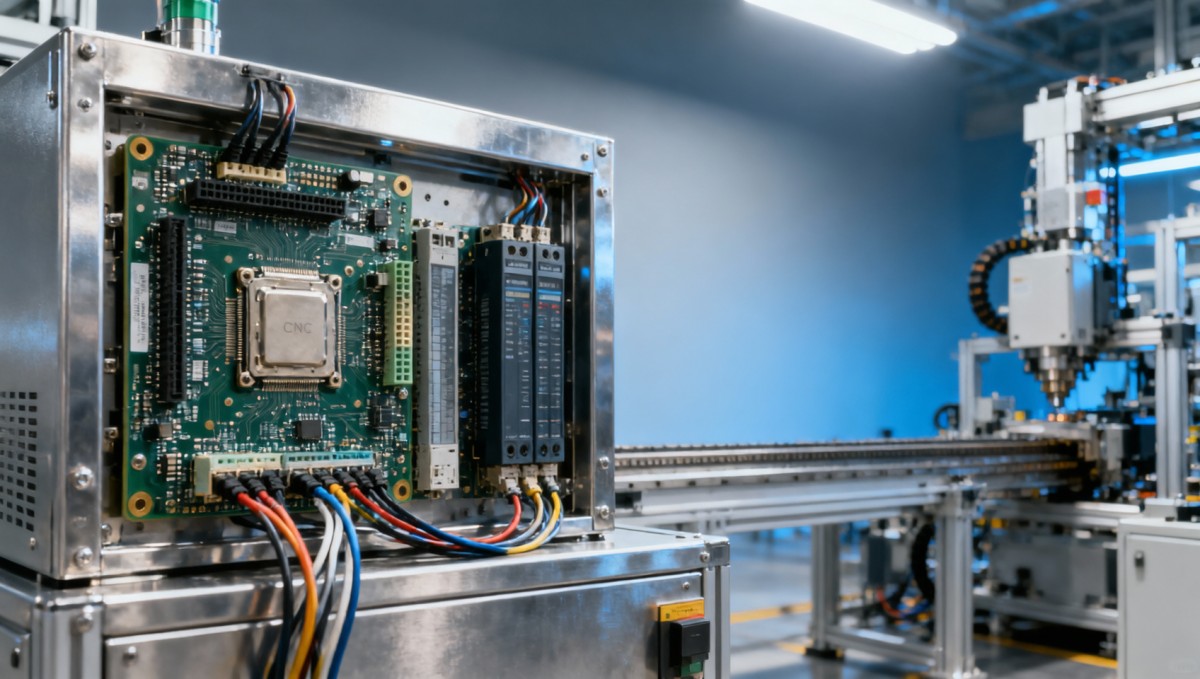
A custom CNC controller board manages more than motion commands. It often governs servo loops, spindle synchronization, digital and analog I/O, emergency stop behavior, tool change logic, and communication with upper-layer systems. In a 3-axis router, the technical burden may be moderate. In a 5-axis machining cell or hybrid robotic platform, the board becomes a mission-critical control node.
This matters because every board decision affects system-level performance. For example, a board with 4 ms communication jitter may be acceptable in a simple feeder, but problematic in contouring applications where surface finish depends on stable interpolation. Likewise, selecting a controller without native EtherCAT, CANopen, or Modbus TCP support can force integrators to build translation layers that increase fault points.
In TSV-style engineering evaluation, the useful question is not “Is custom better?” but “Which approach reduces trial-and-error cost while preserving control over machine behavior?” A custom board can deliver tighter hardware-software alignment, but only if the development team can validate EMC, thermal stability, firmware recovery, and long-cycle component sourcing.
Where controller boards create hidden costs
Many cost comparisons focus only on bill of materials. That is too narrow. A board that saves 15% on hardware can still increase total program cost if debugging takes 10 extra weeks, field failures rise above 2% in the first year, or every firmware patch requires senior engineer intervention. Hidden cost is usually created by integration debt, not by the PCB itself.
The following table shows how controller board choices affect operational outcomes across common B2B manufacturing scenarios.
The key takeaway is that controller board selection is a system architecture decision. If your machine roadmap spans 3 to 5 years and includes remote diagnostics, robot integration, or edge data collection, the board must be judged by lifecycle performance rather than initial price alone.
Build vs buy: a practical decision framework for engineers and buyers
The build path makes sense when the machine has unusual requirements that standard vendors do not serve well. Examples include custom spindle logic, nonstandard encoder interfaces, compact embedded form factors, or mixed control of CNC axes, conveyors, and robotics from one board. If these needs are central to product differentiation, buying a generic controller may create long-term compromise.
The buy path is stronger when the business priority is speed, field reliability, and easier supplier qualification. For many OEMs and retrofit firms, proven commercial boards already support 3 to 8 axes, standard fieldbus stacks, safety relays, and broad software ecosystems. That can reduce commissioning time by 20% to 40% compared with a first-generation custom design.
Decision-makers should also consider organizational maturity. A company with strong embedded firmware, EMC validation, and test automation capability can absorb a custom program more safely. A company without those resources may underestimate the burden of board bring-up, bootloader recovery, revision control, and field support documentation.
Four questions that clarify the right path
- Is your application standard or differentiated? If 70% to 80% of requirements fit existing products, buying usually wins.
- Do you need deep integration with PLC, HMI, edge gateway, or robot software? If yes, protocol openness matters more than board price.
- Can your team support firmware and hardware for at least 36 months? If not, custom ownership can become a liability.
- What is the cost of downtime? In high-mix or aerospace-linked machining, 4 hours of lost production can outweigh months of hardware savings.
Decision matrix by business profile
Different buyer types should weight the decision differently. The table below helps align engineering and procurement priorities before RFQ issuance or design freeze.
A hybrid strategy is often the most practical answer. Some firms buy a proven motion core, then add custom carrier boards, I/O expansions, or software layers. This approach shortens risk exposure while still giving product teams room to differentiate in application logic and machine interface design.
Technical checkpoints before you commit to a custom CNC controller board
Whether building or buying, technical due diligence should be specific. Start with motion architecture. Confirm required axis count, pulse or bus-based control, encoder type, homing method, interpolation cycle, and spindle feedback. A board that performs well at 3 axes may not remain stable at 6 axes plus probing, tool changing, and synchronized spindle control.
Next, verify software and protocol compatibility. Many buyers now expect CNC systems to exchange data with MES, PLCs, machine vision modules, or IoT edge gateway software. If your broader line also uses robotic arm programming software or Codesys-compatible PLC platforms, integration friction can determine total cost faster than raw board performance does.
Environmental and reliability parameters should not be treated as secondary. In industrial use, common thresholds include operating temperatures of 0°C to 50°C, storage temperatures down to -20°C, and vibration exposure linked to cabinet mounting or mobile equipment. Boards intended for harsh electrical environments must also be reviewed for grounding strategy, isolation design, and EMI immunity.
Core engineering checklist
- Processor margin: CPU utilization should leave headroom, ideally 20% to 30% under peak coordinated motion.
- I/O architecture: define digital inputs, relay outputs, analog channels, encoder ports, and safety interlocks before PCB finalization.
- Firmware recovery: require bootloader access, rollback logic, and documented update procedure in fewer than 8 steps.
- Lifecycle planning: check component availability and second-source options for key chips with 24–60 month horizons.
Typical specification ranges to compare
The table below does not represent a universal standard, but it is a practical framework for comparing offers and internal requirements in a disciplined way.
A disciplined spec sheet lowers sourcing noise. It also improves supplier comparison because vendors must respond to measurable requirements instead of broad claims about “high quality” or “industrial grade.” In CNC and automation procurement, clarity in tolerances and interfaces is often the fastest route to lower lifecycle risk.
Procurement, supply chain risk, and long-term support planning
For procurement teams, the most dangerous mistake is treating a controller board as a commodity part. In reality, it is a strategic component with implications for spare stocking, machine certification, service training, and supplier dependency. A low initial quote can become costly if lead time shifts from 4 weeks to 20 weeks or if one discontinued microcontroller blocks production.
Buyers should request a structured response from suppliers covering component lifecycle, firmware ownership, revision management, warranty boundaries, and failure analysis process. A serious supplier should be able to explain what happens if a board fails in month 18, how replacement compatibility is maintained, and whether software images remain backward compatible across hardware revisions.
The same rigor applies to custom development partners. If you outsource a custom CNC controller board, ask who owns schematics, source code, production test fixtures, and manufacturing files. Without those rights defined up front, your business may face a difficult transfer if volumes increase, quality slips, or regional sourcing changes become necessary.
Procurement checklist before PO approval
- Confirm lead time range for prototypes, pilot builds, and repeat orders, such as 2–4 weeks, 6–8 weeks, and 8–12 weeks.
- Request obsolescence and alternate-component policy for core semiconductors and communication chips.
- Define acceptance criteria, including power-on test, communication stability, and I/O validation.
- Clarify after-sales response time, such as 24-hour technical feedback and 72-hour failure analysis intake.
Risk areas that deserve contract attention
A sourcing agreement should capture not only commercial terms but operational continuity. Key areas include software escrow, engineering change notice timing, spare availability, and test record retention. If the board interfaces with aerospace, medical, or regulated production equipment, traceability obligations may be stricter and should be documented from the beginning.
For firms operating globally, regional support coverage also matters. A controller board used in Asia production but serviced by Europe-based engineering teams should have documented remote diagnostics capability, version control discipline, and multilingual technical support procedures. These factors directly affect uptime, especially when operator teams need fast resolution during commissioning or shift change.
Implementation, maintenance, and common mistakes after the decision is made
After selecting a path, success depends on implementation discipline. For custom boards, start with a phased validation plan: bench test, cabinet integration test, drive communication test, and production pilot. A 3-stage process is often more efficient than trying to validate every function at once. Each stage should produce clear pass-fail records and firmware baselines.
For bought boards, avoid assuming plug-and-play success. Even proven hardware can fail in the field if wiring practice, shielding, grounding, or software parameter mapping is inconsistent. Many intermittent faults blamed on the controller actually originate in noisy power supplies, encoder wiring issues, or undocumented changes made during machine assembly.
Maintenance planning should include spare strategy, firmware archive management, and operator training. In many factories, holding 2% to 5% spare board inventory for installed machine base is a practical starting point, adjusted for uptime sensitivity and lead time volatility. A spare board without matching firmware and parameter backup is not a real spare.
Common mistakes to avoid
- Choosing by unit price only and ignoring integration hours, debugging cycles, and field service burden.
- Skipping EMI and thermal validation because the prototype “worked on the bench.”
- Failing to define firmware ownership, update rights, and rollback procedure before launch.
- Underestimating the impact of ecosystem compatibility with PLC, robot, and edge software layers.
FAQ
How long does a custom CNC controller board project usually take?
For a realistic industrial program, 4 to 9 months is common from requirements freeze to validated pilot use. Simpler adaptations may move faster, but projects involving motion firmware, multi-axis synchronization, or harsh-environment validation rarely succeed on compressed schedules without increased risk.
When is buying clearly the better option?
Buying is usually better when the machine uses standard servo protocols, ordinary 3-axis to 5-axis motion, and commercially supported HMI or PLC integration. It is also the better choice when internal embedded engineering bandwidth is limited or when product launch timing is commercially critical.
What should procurement teams ask first?
Start with lead time, component lifecycle, firmware support scope, revision compatibility, failure analysis workflow, and documentation depth. Those six items often reveal more about long-term risk than the first quotation sheet does.
A custom CNC controller board can be a strategic asset or an expensive distraction. The difference depends on whether your application truly needs hardware-level differentiation, whether your team can support the full lifecycle, and whether your sourcing process is grounded in measurable engineering criteria rather than sales language.
For most B2B manufacturers, the strongest decision comes from aligning control requirements, protocol compatibility, validation capacity, and supply continuity. If your automation roadmap also touches PLC interoperability, robotic subsystems, or edge connectivity, evaluate the board as part of the entire machine architecture—not as a standalone component.
If you are comparing build, buy, or hybrid controller strategies, now is the time to define your spec sheet, map your risk points, and review supplier capability in detail. Contact us to discuss your application, get a tailored evaluation framework, and explore a controller strategy built for reliable scale.
Search News
Hot Articles
- Carbon Fiber StructuresHow to Specify Aerospace Carbon Fiber Assemblies for Lightweight, Load-Bearing PartsJul 11, 2026
- Machine VisionXiaomi, Alibaba DAMO Academy Drive Open-Source Robotics Model Ecosystem, Lowering Algorithm Development Barriers for Overseas SMEs Adopting Chinese Robotics SolutionsMar 30, 2026
- Cobots & ArmsShanxi 'AI+' Conference Showcases Embodied Intelligence with Multinational Buyer Engagement: Key Industry ImplicationsMar 30, 2026
Popular Tags
Recommended News
 Jul 11, 2026How to Specify Aerospace Carbon Fiber Assemblies for Lightweight, Load-Bearing PartsAerospace carbon fiber assemblies: learn how to specify laminate design, load data, joining methods, and inspection controls for lighter, reliable load-bearing aerospace parts.Elena Rostova (UAV Systems Researcher)
 Mar 30, 2026Xiaomi, Alibaba DAMO Academy Drive Open-Source Robotics Model Ecosystem, Lowering Algorithm Development Barriers for Overseas SMEs Adopting Chinese Robotics SolutionsXiaomi & Alibaba DAMO Academy's open-source robotics models lower algorithm barriers for global SMEs. Boost efficiency in manufacturing, logistics & smart retail with ROS 2 compatible solutions.TSV Data Lab
 Mar 30, 2026Shanxi 'AI+' Conference Showcases Embodied Intelligence with Multinational Buyer Engagement: Key Industry ImplicationsShanxi 'AI+' Conference highlights embodied intelligence with Tesla, Ubtech & Jiantao showcasing multimodal robotics. 40+ global buyers validated tech on-site, creating new B2B channels for industrial automation & AI solutions.Chen Wei (Automation Lead Engineer)
 Mar 30, 2026Zhongguancun Unveils 6G Integrated Sensing-Computing-Intelligence Platform to Empower Embodied Robots for Global Industrial ApplicationsZhongguancun's new 6G platform revolutionizes industrial robotics with <10ms latency, empowering global automotive, logistics & port automation. Discover how this tech boosts China's smart manufacturing exports.TSV Data Lab
 Mar 30, 2026Mech-Mind Tianjin Embodied Intelligence R&D and Production Base Goes Live, Cutting Delivery Time by 20%–30% for Global Customized AMR+Vision SolutionsMech-Mind's Tianjin AMR+Vision production base cuts delivery time by 20%-30% for欧美 & Latin American markets. Discover how this PLd-certified facility accelerates customized robotics solutions for smart manufacturing and logistics.Chen Wei (Automation Lead Engineer)
 Mar 30, 2026Boao Forum Reveals 'Co-evolution of Big and Small Brains' Trend in Humanoid Robots, China's Embodied Intelligence Accelerates Adaptation to Overseas Manufacturing Service ScenariosDiscover how China's humanoid robots, featuring 'Co-evolution of Big and Small Brains,' are revolutionizing global manufacturing. Learn about Embodied Tian Gong 3.0's ISO compliance and overseas deployment at Boao Forum 2026.Chen Wei (Automation Lead Engineer)
 Mar 30, 2026China Railway Industrial Secures Patent for Embodied Robotics in Material Handling, Boosting High-Precision Delivery Capabilities for Overseas Infrastructure and Manufacturing ProjectsChina Railway Industrial's new patent for embodied robotics in material handling boosts high-precision delivery for global infrastructure & manufacturing. Discover how this innovation enhances logistics accuracy in automotive, rail transit & EPC projects.Chen Wei (Automation Lead Engineer)
 Oct 18, 2026Comparing Material Options for Procurement: Specs, Costs, and Supply RisksExplore procurement oriented technical content on material options, specs, costs, and supply risks. Compare alternatives to cut hidden expenses and make confident sourcing decisions.Dr. Marcus Vance
 Oct 17, 20265-Axis CNC Positioning Accuracy: How to Interpret ISO 230-2 Test ResultsAssess 5 axis CNC machining positioning accuracy with ISO 230-2. Learn to interpret repeatability, reversal error, and test conditions to compare suppliers and make confident acceptance decisions.Dr. Marcus Vance
 Oct 16, 2026Choosing a Rugged Edge AI Box Supplier: Thermal Tests and Lifecycle SupportChoose a rugged edge AI box supplier with proven thermal performance and reliable lifecycle support. Discover the tests and commitments to verify before you buy.TSV Data Lab
 Oct 15, 2026R&D Cost Reduction Services: How to Evaluate Fees, Savings, and ROIEvaluate R&D cost reduction services with confidence. Compare fees, verify savings, and calculate ROI without compromising performance. Discover how to choose a provider that delivers real value.Chen Wei (Automation Lead Engineer)
 Oct 17, 2026How Should You Interpret Industrial Robot Repeatability Specs?Decode industrial robot repeatability specifications, understand ISO 9283 test conditions, and avoid costly selection mistakes. Learn how to verify performance for your process.Chen Wei (Automation Lead Engineer)
 Oct 16, 2026How Can You Fairly Compare MTBF Across Industrial Servo Motors?Make a fair industrial servo motor MTBF comparison with matched operating profiles, failure criteria, and confidence bounds. Discover how to assess reliability beyond advertised numbers.Chen Wei (Automation Lead Engineer)
 Oct 15, 2026How Should You Compare TechStat Vanguard 5-Axis CNC Tolerances?TechStat Vanguard 5-axis CNC tolerance comparison: learn how to verify part accuracy, assess inspection evidence, and choose suppliers that reliably meet your drawing requirements.Dr. Marcus Vance
 Oct 14, 2026Drone Frame Composites: Carbon Fiber vs. Fiberglass for Weight and StiffnessExplore drone structural materials composites: compare carbon fiber and fiberglass for weight, stiffness, cost, and antenna compatibility. Find the right material for your drone frame.Elena Rostova (UAV Systems Researcher)
 Oct 13, 2026Smart Cameras vs. PC-Based Machine Vision: Which Fits High-Speed Inspection?This industrial product comparison for machine vision weighs smart cameras vs. PC-based systems on latency, throughput, and cost. Discover your best fit for high-speed inspection.TSV Data Lab
 Oct 12, 2026How to Verify RoHS Compliance in Industrial Sensing Systems Before DeploymentRoHS compliant sensing systems: learn how to verify materials, supplier declarations, testing, and configuration controls before industrial deployment.TSV Data Lab
 Oct 11, 2026How Procurement-Oriented Content Taxonomy Improves B2B Buying JourneysProcurement-oriented content taxonomy streamlines B2B buying journeys with clearer evidence, supplier comparisons, risk visibility, and faster approvals.TSV Data Lab
 Oct 10, 2026How to Select a Machine Performance Monitoring Platform for OEE and Downtime ReductionMachine performance monitoring platform selection guide: validate machine states, OEE data, downtime reasons, integrations, and scalability to reduce losses with confidence.TSV Data Lab
 Oct 08, 2026How to Machine Inconel 625 Blades Without Heat Cracks or Edge ChippingInconel 625 blade machining guide: prevent heat cracks, edge chipping, chatter, and work hardening with proven tooling, cooling, fixturing, and inspection strategies.Dr. Marcus Vance
 Oct 07, 2026How to Evaluate an HMI Panel Distributor for Industrial Automation ProjectsHMI panel distributor evaluation guide: verify technical compatibility, traceability, supply reliability, lifecycle support, and total cost for automation projects.Victor Lin (Chief Software Architect)
 Oct 06, 2026Navigation Fault Tolerance Standards for AMRs: What Safety Teams Must VerifyNavigation fault tolerance standards: learn what AMR safety teams must verify, from localization loss and sensor faults to stopping distance, safe restart, and site-specific validation.Chen Wei (Automation Lead Engineer)
 Oct 05, 2026Calculating Edge Computing Total Cost of Ownership Across Distributed SitesEdge computing ownership cost explained: calculate deployment, energy, connectivity, security, remote support, and refresh costs across distributed sites.TSV Data Lab
 Oct 04, 2026CAD/CAM Benchmarking in the GCC: What Manufacturers Should Ask a ConsultantCAD CAM benchmark consultant GCC guide: learn the key questions manufacturers should ask to validate post-processors, workflows, machine performance, and production risk.Victor Lin (Chief Software Architect)























