
Why some IP69K HMIs lose touch accuracy over time
Publication Date
author
In harsh washdown environments, many operators notice that an IP69K HMI screen touch sensitivity gradually drifts, causing missed inputs, calibration errors, and slower workflows. For engineers, buyers, and plant managers, this is not just a usability issue but a reliability and lifecycle cost concern. Understanding why some IP69K HMIs lose touch accuracy over time helps separate durable industrial designs from products that only look rugged on paper.
In food processing, pharmaceuticals, packaging, chemical handling, and other high-cleanliness operations, an IP69K HMI is expected to survive repeated high-pressure, high-temperature washdown cycles without losing input precision. Yet field reality shows that ingress protection alone does not guarantee long-term touch accuracy. A panel may pass a short certification event and still degrade after 6 to 24 months of real production exposure.
For technical researchers, operators, procurement teams, and executive decision-makers, the key question is not whether a unit is labeled rugged, but what design choices determine stability over time. The answer usually lies in the interaction between touchscreen technology, enclosure mechanics, sealing materials, thermal stress, mounting method, maintenance practice, and supplier validation discipline.
Why IP69K certification alone does not guarantee long-term touch stability
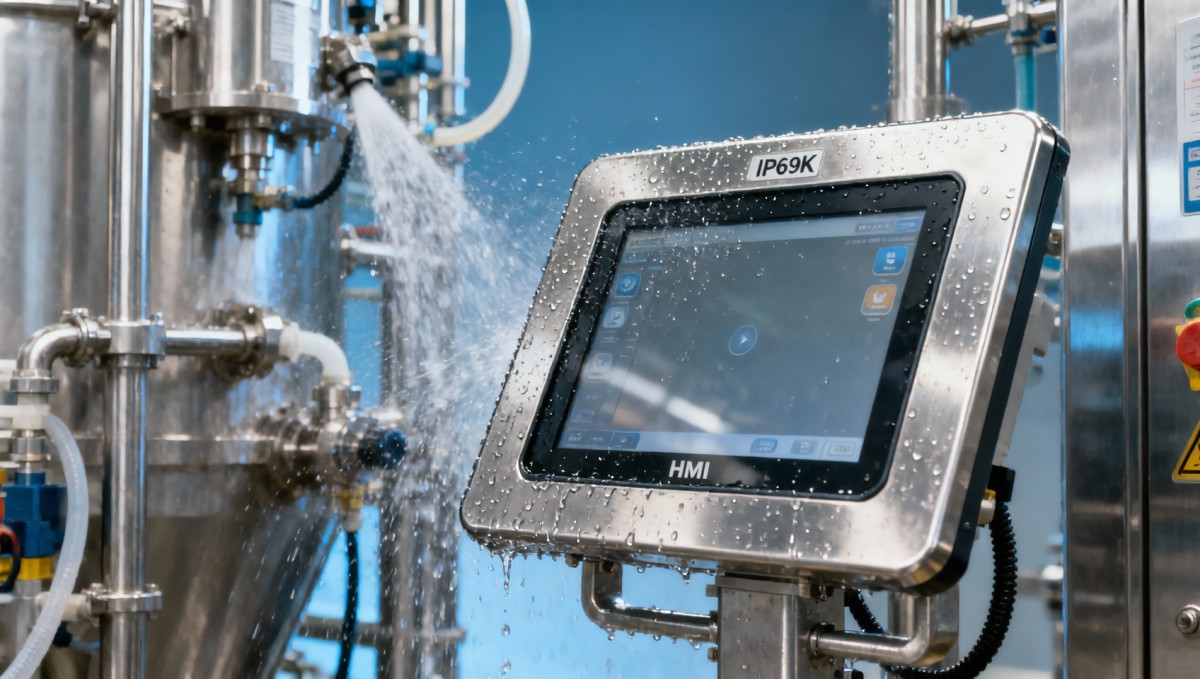
IP69K is a demanding ingress rating, but it is often misunderstood in industrial procurement. It confirms resistance to close-range, high-pressure water jets at elevated temperature under specified test conditions. It does not automatically prove that the touch layer, adhesive stack, controller tuning, and front overlay will maintain the same accuracy after hundreds or thousands of washdown cycles in the field.
A common mismatch appears between certification testing and real operating stress. In production, an HMI may face 2 to 5 washdowns per day, aggressive detergents with pH extremes, sanitizer residue, operator glove use, vibration from nearby machinery, and ambient temperatures swinging from 5°C to 45°C. Over 12 months, these combined loads can far exceed the stress pattern of a single laboratory ingress test.
Touch accuracy drift usually starts as a small offset. Operators press one icon, but the system registers another. At first, recalibration may solve it. Later, the issue returns more frequently, especially near screen edges or corners. This pattern often indicates mechanical shift, moisture-related dielectric changes, film fatigue, or controller instability rather than simple user error.
Where buyers often get misled
Many product listings emphasize front-panel sealing, stainless appearance, or broad temperature claims, while giving little detail about touch technology, lamination process, overlay thickness, controller shielding, or accelerated life testing. For serious industrial sourcing, those omitted details matter more than broad adjectives.
- An IP69K front panel may still suffer touch drift if the sensor stack expands unevenly during thermal shock.
- A chemically resistant bezel does not guarantee the same resistance for adhesives, gaskets, or anti-glare coatings.
- A screen that works well during factory acceptance may fail after 500 to 1,500 cleaning cycles if validation depth was shallow.
The table below shows the difference between what IP69K testing confirms and what long-term touch reliability actually depends on in industrial use.
The practical takeaway is straightforward: IP69K is necessary for washdown-heavy applications, but it is only one screening criterion. Long-term accuracy depends on system engineering, not on ingress rating alone.
The physical mechanisms that cause touch accuracy drift over time
When an IP69K HMI begins missing touches or showing coordinate offset, the root cause usually sits inside the stack-up. Industrial touchscreens are not a single layer. They combine cover glass or film, sensor electrodes, optical bonding or air gap structures, adhesives, gasket interfaces, controller electronics, grounding paths, and firmware compensation. A weakness in any one layer can gradually shift the overall response.
Thermal expansion mismatch
Repeated washdown often creates fast temperature change. A panel surface may jump from ambient to hot spray, then cool again within minutes. If the cover lens, adhesive, and sensor substrate expand at different rates, tiny mechanical stresses build over time. After hundreds of cycles, this may alter the sensor geometry enough to affect touch linearity, especially near corners where stress concentrates.
Moisture intrusion without visible leakage
Not all moisture damage appears as obvious water ingress. Micro-level humidity penetration around edges, cable exits, or vent structures can change capacitance behavior or corrode low-voltage signal paths. Even a slight dielectric shift can reduce stable sensing margins. In projected capacitive systems, that may show up as ghost touches, dead zones, or delayed response after cleaning.
Chemical attack on adhesives and overlays
Caustic foam cleaners, chlorine-based disinfectants, alcohol blends, and acidic detergents can slowly harden, swell, or weaken bonding materials. Once adhesive properties change, the screen stack may no longer remain perfectly uniform. A shift of even fractions of a millimeter can influence accuracy if the original controller calibration had little tolerance reserve.
Mechanical and electrical contributors often combine
In many field failures, touch drift is not caused by one factor alone. It is the interaction of thermal cycling, cleaning chemistry, enclosure flex, cable strain, and electrical noise. A panel mounted on a vibrating machine frame may see both structural deflection and electromagnetic interference. That combination accelerates instability compared with a lab bench environment.
- Thermal cycling frequency: often 1 to 5 times per shift in washdown plants.
- Service life concern window: commonly appears after 6 to 18 months, not necessarily in week 1.
- High-risk zones: edge seal, cable entry, grounding points, and unsupported panel corners.
For engineers evaluating root cause, a drift pattern provides clues. Uniform offset across the screen may point to calibration or firmware behavior. Edge-only inaccuracy often suggests stack distortion or bonding stress. Intermittent false touches after washdown may indicate residual water film sensitivity or weakened shielding.
Touch technology choice matters more than many specifications sheets reveal
One reason some IP69K HMIs age poorly is that the selected touch technology was never ideal for the operating profile. The market often treats “industrial touchscreen” as a single category, but resistive, projected capacitive, and other variants behave very differently under gloves, water film, mechanical wear, and repeated sanitation.
Resistive touch can tolerate certain contaminants and works with many glove types, but its flexible top layer may wear, deform, or lose consistency under repeated cleaning pressure. Projected capacitive touch offers better optical clarity and modern multi-touch behavior, yet it is more sensitive to water films, grounding quality, EMI, and controller tuning. There is no universal winner; suitability depends on process conditions and interface design discipline.
Comparing common HMI touch options in washdown environments
The table below summarizes how major touch approaches typically perform when long-term washdown reliability is the main concern.
For procurement teams, the key lesson is that naming the touch type is not enough. You also need to understand overlay thickness, glove mode behavior, water rejection logic, grounding design, and whether the supplier tested the exact stack-up under washdown repetition rather than under a single demonstration setup.
Questions to ask before purchase
- How many washdown cycles were used in internal durability validation: 100, 500, or more?
- Was touch accuracy verified after chemical exposure, not just after water spray?
- Does the HMI maintain stable input with wet gloves or only with dry bare-hand operation?
- What recalibration frequency is typical in the field over 12 months?
These questions help filter out products that look suitable in catalogs but become expensive when downtime, operator frustration, and early replacement costs are included.
Design, installation, and maintenance factors that accelerate failure
Even a well-designed IP69K HMI can lose touch accuracy faster if installation and maintenance conditions are poor. In real plants, performance is shaped by the full system environment, not only by the panel itself. Mounting stiffness, cable routing, grounding quality, operator cleaning tools, and software update discipline all influence long-term touch stability.
Mechanical mounting and enclosure flex
If the HMI is mounted on a thin arm, flexible bracket, or uneven panel cutout, repeated vibration and operator pressing can introduce slight twisting. Over time, that mechanical stress can warp the touch stack. A deviation too small to see may still alter sensor alignment. Plants with high-speed packaging or filling equipment often face this issue more than expected.
Cleaning practices that exceed design intent
Some failures are caused by procedure drift on the factory floor. Operators may spray at closer than recommended distance, hold the nozzle on one corner for too long, or use brushes that scratch the surface. Over 3 shifts and 7 days a week, these small deviations accumulate. A rugged HMI still needs cleaning practices within the intended operating envelope.
Electrical noise and grounding instability
Projected capacitive systems are especially sensitive to noisy electrical environments. Variable frequency drives, servo systems, poor shielding, and inconsistent grounding can reduce signal integrity. If the controller already has reduced sensing margin because of moisture or aging, EMI can push it into unstable behavior. This is why some touch issues appear only during machine operation, not during maintenance shutdown.
The following table helps teams identify operational factors that often shorten touch accuracy life in industrial washdown settings.
For maintenance leaders, the cost implication is significant. A touch issue that seems minor can add 10 to 30 seconds per interaction, force manual workarounds, or trigger unnecessary panel replacement. Over multiple operators and shifts, that becomes an operational loss rather than a simple interface annoyance.
How engineers and buyers should evaluate IP69K HMI durability before committing
A better buying process starts with defining the real stress profile of the application. Ask how often the panel is washed, which chemicals are used, what glove types operators wear, whether the area has high EMI, and what service life target is expected. A plant washing 3 times per day with alkaline foam needs a different HMI strategy from a line washed once weekly with mild detergent.
A practical 5-point evaluation framework
- Check the touch technology and whether it matches wet, gloved, and frequent-cleaning operation.
- Review durability validation depth, including thermal cycling, chemical resistance, and post-test accuracy retention.
- Inspect enclosure mechanics, mounting tolerance requirements, and cable sealing design.
- Assess controller robustness in noisy environments and whether grounding recommendations are documented.
- Confirm service support: recalibration process, spare part availability, and expected field maintenance intervals.
For strategic sourcing, it is useful to ask suppliers for test evidence structured around lifecycle performance rather than marketing language. Useful evidence includes pre- and post-cycle touch accuracy maps, chemical exposure compatibility by concentration range, drift thresholds after thermal shock, and installation constraints that affect warranty or reliability.
What decision-makers should prioritize
The cheapest HMI on a unit-price basis may become the most expensive option over 24 months if it causes unplanned stoppages, operator slowdowns, and repeated replacement. Procurement should compare total cost of ownership, not just purchase price. Even a 10% to 20% higher initial cost can be justified if it reduces service calls, process interruptions, and retraining.
Signals of a more credible supplier discussion
- They can describe how touch performance changes after repeated washdown cycles, not only that the unit is IP69K rated.
- They discuss approved chemicals, nozzle distance guidance, and mounting rigidity requirements in concrete terms.
- They explain failure modes and limits openly instead of promising unrealistic zero-failure outcomes.
This data-first approach aligns with how engineering-led organizations reduce trial-and-error costs. It also helps cross-functional teams—from line operators to CTOs—evaluate the same device through a shared reliability lens.
FAQ: common questions about long-term touch accuracy in IP69K HMIs
How quickly can touch accuracy degradation appear?
It depends on washdown frequency, chemistry, mechanical stress, and design margin. In harsh continuous-use plants, early symptoms may appear within 6 to 12 months. In lighter-duty applications, stable performance may continue for several years. The important point is to evaluate cycle exposure, not calendar time alone.
Does recalibration solve the problem permanently?
Not always. Recalibration can temporarily correct coordinate offset, but if the root cause is adhesive degradation, structural flex, moisture-related sensing instability, or controller noise margin loss, the drift usually returns. Frequent recalibration is often a symptom of a deeper reliability issue.
Are projected capacitive HMIs unsuitable for washdown areas?
No. They can perform very well if the stack-up, controller tuning, grounding, and moisture rejection are designed for the application. Problems arise when consumer-style capacitive assumptions are transferred into industrial washdown use without enough validation. Engineering quality matters more than the label alone.
What should maintenance teams monitor during operation?
Track repeated mis-touch zones, response changes after cleaning, visible edge lifting, screen haze, and whether faults occur only when nearby drives are active. A simple monthly inspection routine and operator feedback log can identify drift before it affects output quality or line efficiency.
Some IP69K HMIs lose touch accuracy over time because their design only addresses ingress resistance, not lifecycle stability under thermal shock, chemical exposure, enclosure stress, and noisy industrial operation. For engineering teams and buyers, the right evaluation method is to look beyond the rating badge and examine the full touch system: technology choice, materials, mounting, validation depth, and field support.
At TechStat Vanguard, we focus on separating specification-sheet claims from engineering reality. If your team is comparing industrial HMIs for washdown environments, evaluating long-term reliability risk, or building a more rigorous supplier shortlist, now is the right time to get a data-driven review. Contact us to discuss your application, request a tailored evaluation framework, or explore more hard-tech benchmarking insights.
Search News
Hot Articles
- Carbon Fiber StructuresHow to Specify Aerospace Carbon Fiber Assemblies for Lightweight, Load-Bearing PartsJul 11, 2026
- Machine VisionXiaomi, Alibaba DAMO Academy Drive Open-Source Robotics Model Ecosystem, Lowering Algorithm Development Barriers for Overseas SMEs Adopting Chinese Robotics SolutionsMar 30, 2026
- Cobots & ArmsShanxi 'AI+' Conference Showcases Embodied Intelligence with Multinational Buyer Engagement: Key Industry ImplicationsMar 30, 2026
Popular Tags
Recommended News
 Jul 11, 2026How to Specify Aerospace Carbon Fiber Assemblies for Lightweight, Load-Bearing PartsAerospace carbon fiber assemblies: learn how to specify laminate design, load data, joining methods, and inspection controls for lighter, reliable load-bearing aerospace parts.Elena Rostova (UAV Systems Researcher)
 Mar 30, 2026Xiaomi, Alibaba DAMO Academy Drive Open-Source Robotics Model Ecosystem, Lowering Algorithm Development Barriers for Overseas SMEs Adopting Chinese Robotics SolutionsXiaomi & Alibaba DAMO Academy's open-source robotics models lower algorithm barriers for global SMEs. Boost efficiency in manufacturing, logistics & smart retail with ROS 2 compatible solutions.TSV Data Lab
 Mar 30, 2026Shanxi 'AI+' Conference Showcases Embodied Intelligence with Multinational Buyer Engagement: Key Industry ImplicationsShanxi 'AI+' Conference highlights embodied intelligence with Tesla, Ubtech & Jiantao showcasing multimodal robotics. 40+ global buyers validated tech on-site, creating new B2B channels for industrial automation & AI solutions.Chen Wei (Automation Lead Engineer)
 Mar 30, 2026Zhongguancun Unveils 6G Integrated Sensing-Computing-Intelligence Platform to Empower Embodied Robots for Global Industrial ApplicationsZhongguancun's new 6G platform revolutionizes industrial robotics with <10ms latency, empowering global automotive, logistics & port automation. Discover how this tech boosts China's smart manufacturing exports.TSV Data Lab
 Mar 30, 2026Mech-Mind Tianjin Embodied Intelligence R&D and Production Base Goes Live, Cutting Delivery Time by 20%–30% for Global Customized AMR+Vision SolutionsMech-Mind's Tianjin AMR+Vision production base cuts delivery time by 20%-30% for欧美 & Latin American markets. Discover how this PLd-certified facility accelerates customized robotics solutions for smart manufacturing and logistics.Chen Wei (Automation Lead Engineer)
 Mar 30, 2026Boao Forum Reveals 'Co-evolution of Big and Small Brains' Trend in Humanoid Robots, China's Embodied Intelligence Accelerates Adaptation to Overseas Manufacturing Service ScenariosDiscover how China's humanoid robots, featuring 'Co-evolution of Big and Small Brains,' are revolutionizing global manufacturing. Learn about Embodied Tian Gong 3.0's ISO compliance and overseas deployment at Boao Forum 2026.Chen Wei (Automation Lead Engineer)
 Mar 30, 2026China Railway Industrial Secures Patent for Embodied Robotics in Material Handling, Boosting High-Precision Delivery Capabilities for Overseas Infrastructure and Manufacturing ProjectsChina Railway Industrial's new patent for embodied robotics in material handling boosts high-precision delivery for global infrastructure & manufacturing. Discover how this innovation enhances logistics accuracy in automotive, rail transit & EPC projects.Chen Wei (Automation Lead Engineer)
 Oct 17, 20265-Axis CNC Positioning Accuracy: How to Interpret ISO 230-2 Test ResultsAssess 5 axis CNC machining positioning accuracy with ISO 230-2. Learn to interpret repeatability, reversal error, and test conditions to compare suppliers and make confident acceptance decisions.Dr. Marcus Vance
 Oct 16, 2026Choosing a Rugged Edge AI Box Supplier: Thermal Tests and Lifecycle SupportChoose a rugged edge AI box supplier with proven thermal performance and reliable lifecycle support. Discover the tests and commitments to verify before you buy.TSV Data Lab
 Oct 15, 2026R&D Cost Reduction Services: How to Evaluate Fees, Savings, and ROIEvaluate R&D cost reduction services with confidence. Compare fees, verify savings, and calculate ROI without compromising performance. Discover how to choose a provider that delivers real value.Chen Wei (Automation Lead Engineer)
 Oct 16, 2026How Can You Fairly Compare MTBF Across Industrial Servo Motors?Make a fair industrial servo motor MTBF comparison with matched operating profiles, failure criteria, and confidence bounds. Discover how to assess reliability beyond advertised numbers.Chen Wei (Automation Lead Engineer)
 Oct 15, 2026How Should You Compare TechStat Vanguard 5-Axis CNC Tolerances?TechStat Vanguard 5-axis CNC tolerance comparison: learn how to verify part accuracy, assess inspection evidence, and choose suppliers that reliably meet your drawing requirements.Dr. Marcus Vance
 Oct 14, 2026Drone Frame Composites: Carbon Fiber vs. Fiberglass for Weight and StiffnessExplore drone structural materials composites: compare carbon fiber and fiberglass for weight, stiffness, cost, and antenna compatibility. Find the right material for your drone frame.Elena Rostova (UAV Systems Researcher)
 Oct 13, 2026Smart Cameras vs. PC-Based Machine Vision: Which Fits High-Speed Inspection?This industrial product comparison for machine vision weighs smart cameras vs. PC-based systems on latency, throughput, and cost. Discover your best fit for high-speed inspection.TSV Data Lab
 Oct 12, 2026How to Verify RoHS Compliance in Industrial Sensing Systems Before DeploymentRoHS compliant sensing systems: learn how to verify materials, supplier declarations, testing, and configuration controls before industrial deployment.TSV Data Lab
 Oct 11, 2026How Procurement-Oriented Content Taxonomy Improves B2B Buying JourneysProcurement-oriented content taxonomy streamlines B2B buying journeys with clearer evidence, supplier comparisons, risk visibility, and faster approvals.TSV Data Lab
 Oct 10, 2026How to Select a Machine Performance Monitoring Platform for OEE and Downtime ReductionMachine performance monitoring platform selection guide: validate machine states, OEE data, downtime reasons, integrations, and scalability to reduce losses with confidence.TSV Data Lab
 Oct 08, 2026How to Machine Inconel 625 Blades Without Heat Cracks or Edge ChippingInconel 625 blade machining guide: prevent heat cracks, edge chipping, chatter, and work hardening with proven tooling, cooling, fixturing, and inspection strategies.Dr. Marcus Vance
 Oct 07, 2026How to Evaluate an HMI Panel Distributor for Industrial Automation ProjectsHMI panel distributor evaluation guide: verify technical compatibility, traceability, supply reliability, lifecycle support, and total cost for automation projects.Victor Lin (Chief Software Architect)
 Oct 06, 2026Navigation Fault Tolerance Standards for AMRs: What Safety Teams Must VerifyNavigation fault tolerance standards: learn what AMR safety teams must verify, from localization loss and sensor faults to stopping distance, safe restart, and site-specific validation.Chen Wei (Automation Lead Engineer)
 Oct 05, 2026Calculating Edge Computing Total Cost of Ownership Across Distributed SitesEdge computing ownership cost explained: calculate deployment, energy, connectivity, security, remote support, and refresh costs across distributed sites.TSV Data Lab
 Oct 04, 2026CAD/CAM Benchmarking in the GCC: What Manufacturers Should Ask a ConsultantCAD CAM benchmark consultant GCC guide: learn the key questions manufacturers should ask to validate post-processors, workflows, machine performance, and production risk.Victor Lin (Chief Software Architect)
 Oct 03, 2026Selecting Automotive Radar Sensor Modules for ADAS Range, Resolution, and IntegrationAutomotive radar sensor module selection guide for ADAS: compare range, resolution, field of view, latency, and integration to build safer, reliable vehicle systems.TSV Data Lab
 Oct 02, 2026How to Qualify Machined Parts Suppliers for Hard Tech ProgramsHard tech supply chain machined parts demand rigorous supplier qualification. Learn how to assess capability, traceability, quality controls, and delivery resilience.Dr. Marcus Vance























