Modular Rack PLC Selection Guide: I/O Capacity, Expansion Limits, and Network Compatibility
Publication Date
author
Modular Rack PLC Selection Guide: I/O Capacity, Expansion Limits, and Network Compatibility
Choosing the right modular rack PLC shapes how far a control system can grow without costly redesign.
The immediate question is rarely just price, CPU speed, or brand reputation.
A better starting point is system fit.
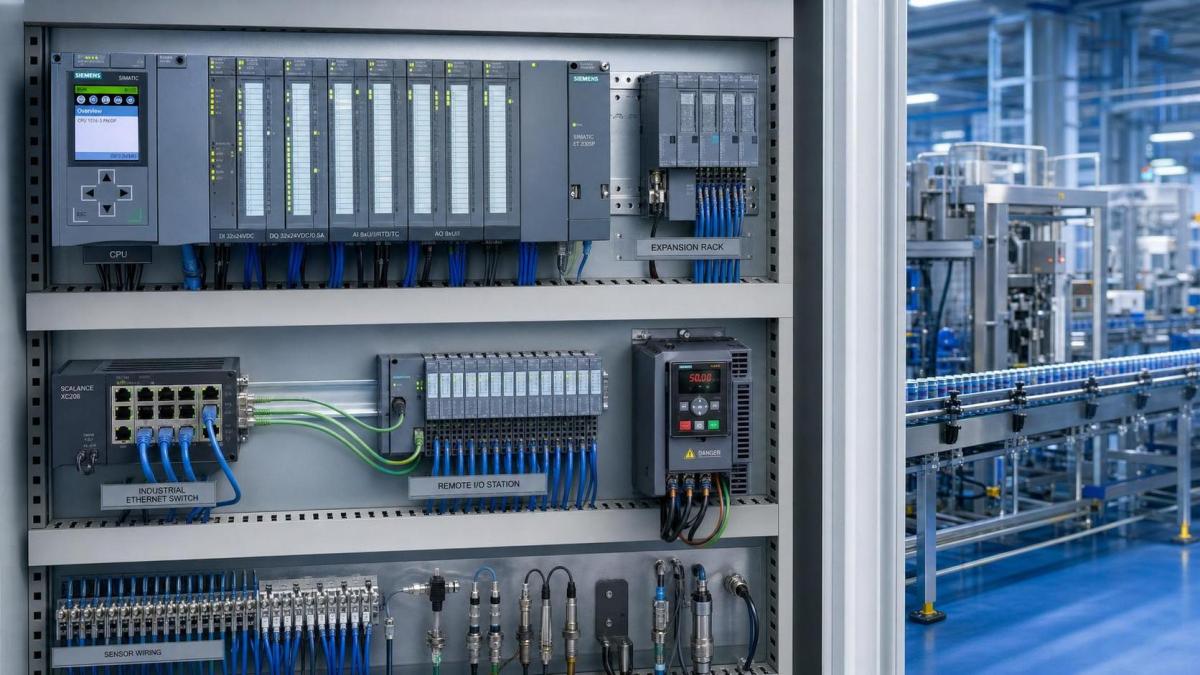
That means checking whether the modular rack PLC can handle present I/O, future expansion, and network demands without creating hidden limits.
In real projects, these limits often appear late.
A line starts with enough points, then adds inspection cameras, VFDs, safety devices, and remote stations.
What looked flexible on paper becomes a bottleneck during commissioning.
This guide focuses on three decision areas that matter most: I/O capacity, rack expansion limits, and network compatibility.
The goal is simple.
Select a modular rack PLC that supports current control logic and stays stable as the plant evolves.
Why Modular Rack PLC Decisions Fail Late
Most selection mistakes happen because teams size hardware around today's panel, not tomorrow's process changes.
That sounds manageable early on, but the cost arrives later through retrofit work, extra gateways, and software remapping.
A modular rack PLC is supposed to reduce that risk.
Its value comes from configurable slots, mixed modules, and scalable architecture.
Still, scalability has boundaries.
Each platform has limits on local rack slots, backplane bandwidth, remote I/O nodes, supported protocols, and CPU memory for tag handling.
The more obvious signal is this: a modular rack PLC should be evaluated like a system platform, not a standalone controller.
That also means procurement and engineering need the same technical checklist from the beginning.
Start With Real I/O Capacity, Not Nameplate Counts
I/O capacity is usually the first filter in a modular rack PLC selection process.
But total point count alone is not enough.
You need to map signal types, scan expectations, and distribution across local and remote racks.
A practical I/O review should cover:
- Digital inputs and outputs by voltage class
- Analog inputs and outputs by resolution and update rate
- High-speed counters and motion-related signals
- Temperature, load cell, and specialty process modules
- Safety I/O requirements and isolation needs
This matters because a modular rack PLC may support many total points but only limited specialty modules per rack.
That becomes critical in packaging, process skids, and high-mix assembly lines.
Another common issue is spare capacity planning.
For most brownfield or phased projects, keeping 15% to 30% spare I/O is more realistic than sizing exactly to the current drawing set.
That reserve should include spare slots, not just unused terminal points.
Questions That Expose Hidden I/O Risk
When reviewing a modular rack PLC, ask a few direct questions.
- How many mixed I/O modules can the local rack support before performance drops?
- Are there limitations on analog density or specialty card combinations?
- Does the CPU scan time remain acceptable at full projected I/O load?
- Will future equipment require distributed I/O instead of local rack additions?
Those answers often separate a scalable modular rack PLC from one that only fits the first project phase.
Understand Rack Expansion Limits Before They Become Layout Problems
Expansion limits are where many otherwise capable platforms become awkward.
A modular rack PLC may advertise expansion, but the real constraint sits in the architecture details.
Check the number of racks per CPU, maximum distance between racks, supported expansion adapters, and total module count.
Power loading across the backplane also deserves attention.
High-density analog or communication modules can consume rack power faster than expected.
That can force a different rack layout even when slot count still looks sufficient.
In practical terms, rack expansion planning should answer two separate needs.
First, can the modular rack PLC scale inside the original control panel?
Second, can it scale across process areas without creating latency or maintenance confusion?
Local Expansion vs Remote Expansion
Local expansion is usually easier to configure and troubleshoot.
It suits compact machines, packaged systems, and tightly grouped process equipment.
Remote expansion makes more sense when devices are physically distributed.
That includes conveyor zones, water treatment basins, utility corridors, and multi-cell lines.
The tradeoff is that remote architectures depend heavily on network performance and diagnostic visibility.
So the modular rack PLC must be assessed together with switch topology, redundancy plans, and failure recovery behavior.
Network Compatibility Is Now a Core PLC Decision
A modular rack PLC no longer lives in an isolated cabinet.
It usually connects to drives, HMIs, SCADA, historians, MES platforms, safety controllers, and sometimes cloud gateways.
That is why network compatibility should be treated as a primary selection criterion.
Protocol support alone is only the first layer.
The stronger test is interoperability under real operating conditions.
For example, a modular rack PLC may support EtherNet/IP, PROFINET, Modbus TCP, OPC UA, or MQTT.
But supported does not always mean equally mature, equally fast, or equally easy to diagnose.
What to Check Beyond Protocol Names
- Native support versus add-on communication cards
- Maximum concurrent device connections
- Update rate consistency under full traffic load
- Time synchronization support for coordinated systems
- Cybersecurity features such as user roles, encryption, and secure remote access
- Diagnostics available for failed links, packet loss, or device replacement
From a lifecycle view, network compatibility also affects vendor flexibility.
A modular rack PLC tied too tightly to one ecosystem may complicate future equipment integration.
That is especially relevant when facilities standardize mechanically but source subsystems from different OEMs.
How to Match the Modular Rack PLC to Project Reality
The most effective selection method is scenario-based sizing.
Instead of asking which modular rack PLC is best in general, define the operating model first.
A few examples make the point clearer.
For a single machine with moderate I/O and limited future changes, local rack simplicity may matter more than broad protocol depth.
For a phased plant upgrade, spare rack capacity and remote I/O scaling usually matter more than the lowest initial hardware cost.
For multi-vendor production lines, open network compatibility and device diagnostics become higher priority.
In each case, the modular rack PLC should be scored against actual constraints, not catalog promises.
A Practical Evaluation Sequence
- Define current and planned I/O by type, not just total quantity.
- Map panel layout, rack count, and area distribution.
- List every required network and software interface.
- Check CPU loading, scan time, and memory with future growth included.
- Review power, environmental ratings, and maintenance access.
- Validate vendor support, migration path, and spare parts continuity.
That sequence keeps the modular rack PLC decision tied to integration risk, not marketing language.
Common Procurement Mistakes and How to Avoid Them
Several mistakes repeat across automation projects.
The first is selecting a modular rack PLC only from a preferred vendor list without checking platform fit.
The second is treating expansion as unlimited because the product line is called modular.
The third is underestimating protocol complexity when OEM equipment enters the system later.
A more disciplined approach is to request evidence in three forms.
- A validated I/O architecture drawing
- A documented expansion ceiling by rack and network node
- A compatibility matrix covering present and planned third-party devices
This is where a data-first mindset helps.
As TechStat Vanguard argues, engineering decisions improve when parameters replace vague claims.
A modular rack PLC should be justified by measurable limits, not broad positioning statements.
Final Selection Criteria That Hold Up Over Time
A strong modular rack PLC choice stays useful after commissioning, line changes, and supplier turnover.
That usually happens when three conditions are met.
The platform has realistic I/O headroom.
Its expansion model fits the physical plant layout.
And its network compatibility supports both present control needs and future integration paths.
If a modular rack PLC scores well in all three areas, procurement confidence rises and redesign risk drops.
That is the practical standard worth using.
Before approving the final platform, compare each shortlisted modular rack PLC against a future-state architecture sheet.
That final cross-check often reveals whether the system will scale cleanly or become the next expensive constraint.
Search News
Hot Articles
- Carbon Fiber StructuresHow to Specify Aerospace Carbon Fiber Assemblies for Lightweight, Load-Bearing PartsJul 11, 2026
- Machine VisionXiaomi, Alibaba DAMO Academy Drive Open-Source Robotics Model Ecosystem, Lowering Algorithm Development Barriers for Overseas SMEs Adopting Chinese Robotics SolutionsMar 30, 2026
- Cobots & ArmsShanxi 'AI+' Conference Showcases Embodied Intelligence with Multinational Buyer Engagement: Key Industry ImplicationsMar 30, 2026
Popular Tags
Recommended News
 Jul 11, 2026How to Specify Aerospace Carbon Fiber Assemblies for Lightweight, Load-Bearing PartsAerospace carbon fiber assemblies: learn how to specify laminate design, load data, joining methods, and inspection controls for lighter, reliable load-bearing aerospace parts.Elena Rostova (UAV Systems Researcher)
 Mar 30, 2026Xiaomi, Alibaba DAMO Academy Drive Open-Source Robotics Model Ecosystem, Lowering Algorithm Development Barriers for Overseas SMEs Adopting Chinese Robotics SolutionsXiaomi & Alibaba DAMO Academy's open-source robotics models lower algorithm barriers for global SMEs. Boost efficiency in manufacturing, logistics & smart retail with ROS 2 compatible solutions.TSV Data Lab
 Mar 30, 2026Shanxi 'AI+' Conference Showcases Embodied Intelligence with Multinational Buyer Engagement: Key Industry ImplicationsShanxi 'AI+' Conference highlights embodied intelligence with Tesla, Ubtech & Jiantao showcasing multimodal robotics. 40+ global buyers validated tech on-site, creating new B2B channels for industrial automation & AI solutions.Chen Wei (Automation Lead Engineer)
 Mar 30, 2026Zhongguancun Unveils 6G Integrated Sensing-Computing-Intelligence Platform to Empower Embodied Robots for Global Industrial ApplicationsZhongguancun's new 6G platform revolutionizes industrial robotics with <10ms latency, empowering global automotive, logistics & port automation. Discover how this tech boosts China's smart manufacturing exports.TSV Data Lab
 Mar 30, 2026Mech-Mind Tianjin Embodied Intelligence R&D and Production Base Goes Live, Cutting Delivery Time by 20%–30% for Global Customized AMR+Vision SolutionsMech-Mind's Tianjin AMR+Vision production base cuts delivery time by 20%-30% for欧美 & Latin American markets. Discover how this PLd-certified facility accelerates customized robotics solutions for smart manufacturing and logistics.Chen Wei (Automation Lead Engineer)
 Mar 30, 2026Boao Forum Reveals 'Co-evolution of Big and Small Brains' Trend in Humanoid Robots, China's Embodied Intelligence Accelerates Adaptation to Overseas Manufacturing Service ScenariosDiscover how China's humanoid robots, featuring 'Co-evolution of Big and Small Brains,' are revolutionizing global manufacturing. Learn about Embodied Tian Gong 3.0's ISO compliance and overseas deployment at Boao Forum 2026.Chen Wei (Automation Lead Engineer)
 Mar 30, 2026China Railway Industrial Secures Patent for Embodied Robotics in Material Handling, Boosting High-Precision Delivery Capabilities for Overseas Infrastructure and Manufacturing ProjectsChina Railway Industrial's new patent for embodied robotics in material handling boosts high-precision delivery for global infrastructure & manufacturing. Discover how this innovation enhances logistics accuracy in automotive, rail transit & EPC projects.Chen Wei (Automation Lead Engineer)
 Sep 30, 2026How to Evaluate Solid-State LiDAR Hardware for Outdoor Autonomous VehiclesSolid state LiDAR hardware evaluation guide for outdoor autonomous vehicles—compare range, point-cloud quality, environmental resilience, integration, and safety.TSV Data Lab
 Sep 29, 2026ISO 9283 Repeatability: How to Evaluate Cobot Positioning PerformanceISO 9283 cobot repeatability explained: learn how payload, reach, approach direction, and test conditions affect positioning performance and cell capability.Chen Wei (Automation Lead Engineer)
 Sep 30, 2026Which Industrial Robot Specifications Matter for High-Precision Assembly?Which industrial robot specifications matter most for high-precision assembly? Explore repeatability, accuracy, stiffness, vibration, calibration, and force control for reliable yields.Chen Wei (Automation Lead Engineer)
 Sep 29, 2026How Do You Verify Servo Motor Torque Under Continuous Load?How do I verify servo motor torque under continuous load? Learn RMS torque checks, torque-speed limits, thermal derating, and real-machine testing.Chen Wei (Automation Lead Engineer)
 Sep 28, 2026Spindle Runout Measurement in Germany: DIN Standards, Methods, and Acceptance LimitsSpindle runout measurement Germany: explore DIN standards, proven methods, acceptance limits, and audit-ready practices for reliable machining quality.Dr. Marcus Vance
 Sep 27, 2026How to Select Wall-Mount Edge Devices for Space-Constrained Factory NetworksWall mount edge devices for space-constrained factories: evaluate workload, thermal design, power resilience, cable access, and network reliability for smarter deployments.TSV Data Lab
 Sep 26, 2026Machining Tolerance Analysis: How to Set Limits That Meet Function and Cost TargetsMachining tolerance analysis: learn how to set functional limits, control tolerance stacks, reduce inspection risk, and balance precision with production cost.Dr. Marcus Vance
 Sep 25, 2026How to Evaluate an Industrial Infrastructure Data Platform for Multi-Site OperationsIndustrial infrastructure data platform evaluation guide for multi-site operations: compare data quality, edge resilience, interoperability, governance, and scalable proof-of-value criteria.Victor Lin (Chief Software Architect)
 Sep 24, 2026How to Select Machine Vision Optics for Accurate Inspection at Different Working DistancesMachine vision optics selection guide for accurate inspection at every working distance. Compare FOV, pixel scale, DOF, distortion, lighting, and telecentric options.TSV Data Lab
 Sep 23, 2026How to Evaluate a Machine Vision System Integrator for High-Speed Inspection LinesChoose a machine vision system integrator with proven expertise in high-speed inspection, reliable reject timing, robust optics, and measurable acceptance criteria.TSV Data Lab
 Sep 30, 2026How much does warehouse automation cost for a growing distribution center?How much does warehouse automation cost? Explore equipment, integration, facility upgrades, lifecycle expenses, and ROI factors for a growing distribution center.Chen Wei (Automation Lead Engineer)
 Sep 29, 2026How MES and OEE work together to identify production lossesMES and OEE work together to uncover hidden production losses, connect downtime, speed, and quality data, and drive smarter shop-floor improvements.Victor Lin (Chief Software Architect)
 Sep 28, 2026When is a SCADA API the right choice for connecting plant systems?SCADA API guide: learn when governed plant data integration improves traceability, security, and scalability—without compromising real-time control.Victor Lin (Chief Software Architect)
 Sep 27, 2026How SCADA data integration improves traceability across production linesSCADA data integration connects production-line data to improve traceability, accelerate quality investigations, and strengthen safety decisions.Victor Lin (Chief Software Architect)
 Sep 26, 2026What to define before starting SCADA integration planningSCADA integration planning starts with clear scope, control boundaries, data models, cybersecurity, and testing. Discover the definitions that reduce risk and costly rework.Victor Lin (Chief Software Architect)
 Sep 25, 2026How a smart factory with Industrial IoT reduces production blind spotsDiscover how a smart factory with Industrial IoT turns real-time machine, quality, and workflow data into actionable insights that reduce production blind spots and delivery risks.Victor Lin (Chief Software Architect)
 Sep 24, 2026When does Industrial IoT make smart manufacturing easier to scale?Smart manufacturing Industrial IoT scales when trusted data, interoperable systems, and secure workflows turn connected assets into measurable gains.TSV Data Lab