How to Evaluate an OEM PLC Supplier: Lead Time, Support, Certification, and Lifecycle Risk
Publication Date
author
Why does choosing an OEM PLC supplier affect more than purchase price?
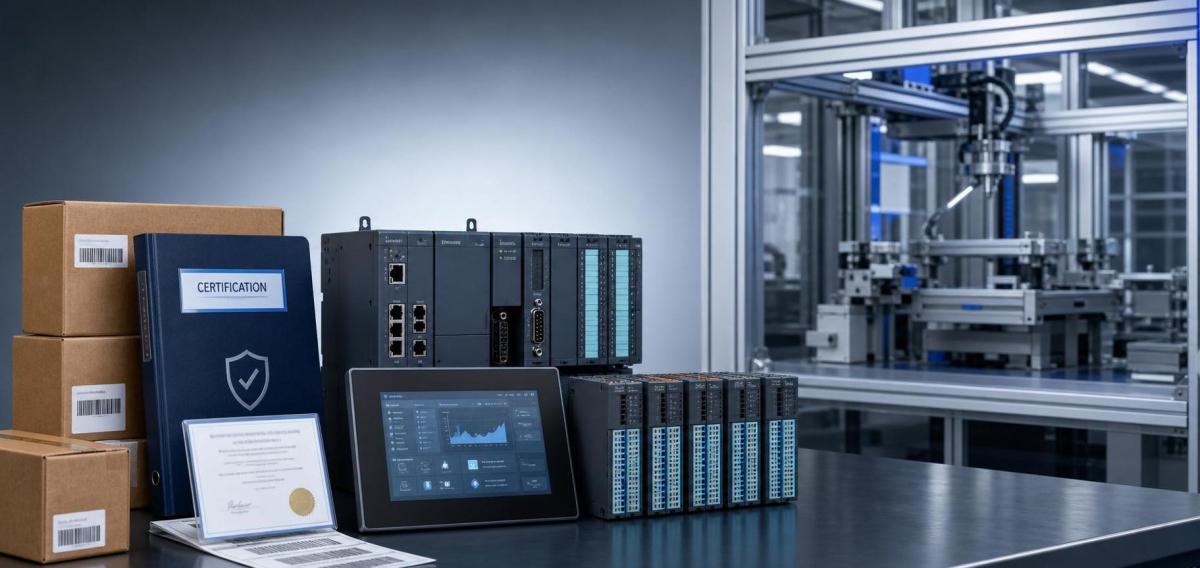
An OEM PLC supplier influences far more than the initial quote. The real impact appears later, in commissioning speed, spare part availability, and unexpected production interruptions.
A low unit cost can look attractive during sourcing. Yet one delayed shipment or one unresolved firmware issue can erase that saving within a single shutdown window.
That is why the better question is not, “Who is cheapest?” It is, “Which OEM PLC supplier reduces operational uncertainty over the full equipment lifecycle?”
In practical terms, the evaluation should include lead time stability, engineering support, certification integrity, obsolescence policy, and traceable quality control.
This data-first approach aligns with the broader hard-tech view promoted by TechStat Vanguard. Parameters, revision control, and lifecycle evidence matter more than polished claims.
For automation projects across packaging, process control, aerospace tooling, machine building, and edge-connected manufacturing, the same rule applies. The weakest supply variable often decides the total cost.
When comparing suppliers, which signals actually reveal reliability?
A credible OEM PLC supplier usually leaves measurable evidence. Marketing language is easy to copy. Supply discipline is not.
Start with a simple check: can the supplier provide documented production lead times for standard and configured models, not just verbal estimates?
Then examine how they handle variation. Short average lead time means little if delivery swings from three weeks to fourteen.
More telling signals often include the following:
- Published product revision history and firmware traceability.
- Clear replacement policy for discontinued PLC modules.
- Regional inventory visibility for urgent spare parts.
- Named technical contacts with response-time commitments.
- Evidence of compliance testing tied to exact model numbers.
A dependable OEM PLC supplier also understands application context. Support expectations differ between a conveyor retrofit and a safety-critical motion platform.
If every answer stays generic, that is usually a warning sign. Strong suppliers discuss environmental ratings, communication protocols, expansion limits, and failure recovery procedures without hesitation.
How should lead time be evaluated beyond the promised delivery date?
Lead time is often treated as a single number. In reality, it has at least four layers: quoted lead time, actual lead time, variability, and recovery speed after disruption.
An OEM PLC supplier with an eight-week average may outperform one quoting five weeks if the eight-week schedule is consistent and transparent.
Ask for shipment history by product family. Break it into CPUs, I/O modules, HMIs, power supplies, and communication cards. Bottlenecks rarely affect all categories equally.
It also helps to separate factory production time from export handling, customs exposure, and local stocking practices. Delays are often hidden in those interfaces.
The table below shows a practical screening framework.
This kind of comparison gives a more accurate picture of OEM PLC supplier performance than a quote sheet alone.
What does good technical support look like before and after the PO?
Support quality is easy to overestimate during sales discussions. The real test is how the OEM PLC supplier behaves when documentation is incomplete or integration problems appear under schedule pressure.
Before the purchase order, useful support usually includes application review, protocol clarification, I/O sizing, and compatibility checks with drives, sensors, and SCADA layers.
After delivery, the support burden changes. Firmware updates, boot issues, fieldbus conflicts, and replacement module setup become more important.
A capable OEM PLC supplier should be able to answer questions such as:
- How quickly can a failed CPU be restored in the field?
- Are software licenses transferable during hardware replacement?
- Which communication stacks are validated, and under what firmware version?
- Is there a documented escalation path for unresolved faults?
In actual projects, response speed matters less than response quality. A fast reply that avoids root cause analysis still creates downtime risk.
For complex automation environments, it is sensible to request sample support records or anonymized case handling timelines. That reveals process maturity better than broad service promises.
Are certifications enough, or should they be checked more closely?
Certifications matter, but only when they match the exact application, geography, and product revision under consideration.
An OEM PLC supplier may present ISO certificates, CE declarations, UL marks, or RoHS statements. Those documents are relevant, yet they do not automatically confirm full suitability.
The closer review should focus on scope. Does the certificate cover the plant, the family, or the precise controller model in the quote?
That distinction becomes critical in sectors with strict validation expectations, including food processing, pharmaceuticals, energy systems, aerospace tooling, and cross-border machine exports.
More importantly, certification should connect to traceability. If a nonconformance appears, can the OEM PLC supplier identify the production batch, test record, and approved revision?
This is where data-driven screening becomes useful. The same philosophy behind TSV research applies here: documented thresholds and traceable records carry more weight than reputation alone.
A practical review checklist includes:
- Certificate issue date and expiration date.
- Certification body and regional recognition.
- Model-level coverage and exclusions.
- EMC, safety, and environmental testing references.
- Material compliance and conflict mineral disclosure, when relevant.
How do you spot lifecycle risk before a PLC line becomes a problem?
Lifecycle risk is one of the most underestimated parts of choosing an OEM PLC supplier. It rarely appears in headline pricing, but it strongly shapes maintenance cost and retrofit timing.
The first issue is obsolescence visibility. A supplier should clearly separate active, mature, limited, and end-of-life product stages.
The second issue is migration support. When a legacy module is retired, is there a tested replacement path, or only a generic recommendation?
The third issue is software continuity. Hardware replacement is manageable. Forced engineering software changes across installed assets can become much more expensive.
A useful way to judge lifecycle risk is to ask for the supplier’s policy on these points:
- Minimum notice period before discontinuation.
- Last-time-buy terms and volume constraints.
- Availability of repair, refurbishment, or certified surplus channels.
- Compatibility of new modules with existing programming environments.
- Migration kits, data conversion tools, and validation support.
A mature OEM PLC supplier treats lifecycle planning as part of the commercial discussion, not as an afterthought once the installed base becomes difficult to support.
What is a practical final shortlist method for an OEM PLC supplier?
When several options look similar, a weighted scorecard helps. It keeps the comparison disciplined and reduces the influence of polished presentations.
One sensible model is to score lead time stability, support capability, certification fit, lifecycle policy, and total landed cost separately.
Do not collapse everything into price. A slightly higher quote from a stronger OEM PLC supplier can be the lower-risk option over three to seven years.
Before making the final decision, confirm three items in writing: approved part numbers, escalation contacts, and end-of-life communication policy.
That small discipline often prevents the largest downstream disputes.
In short, the best OEM PLC supplier is usually the one that offers predictable delivery, application-grade support, credible certifications, and transparent lifecycle planning.
The next step is straightforward: define the exact operating environment, build a comparison matrix, and test every supplier claim against documented evidence.
That is the most reliable way to control cost, reduce qualification time, and protect long-term supply continuity.
Search News
Hot Articles
- Carbon Fiber StructuresHow to Specify Aerospace Carbon Fiber Assemblies for Lightweight, Load-Bearing PartsJul 11, 2026
- Machine VisionXiaomi, Alibaba DAMO Academy Drive Open-Source Robotics Model Ecosystem, Lowering Algorithm Development Barriers for Overseas SMEs Adopting Chinese Robotics SolutionsMar 30, 2026
- Cobots & ArmsShanxi 'AI+' Conference Showcases Embodied Intelligence with Multinational Buyer Engagement: Key Industry ImplicationsMar 30, 2026
Popular Tags
Recommended News
 Jul 11, 2026How to Specify Aerospace Carbon Fiber Assemblies for Lightweight, Load-Bearing PartsAerospace carbon fiber assemblies: learn how to specify laminate design, load data, joining methods, and inspection controls for lighter, reliable load-bearing aerospace parts.Elena Rostova (UAV Systems Researcher)
 Mar 30, 2026Xiaomi, Alibaba DAMO Academy Drive Open-Source Robotics Model Ecosystem, Lowering Algorithm Development Barriers for Overseas SMEs Adopting Chinese Robotics SolutionsXiaomi & Alibaba DAMO Academy's open-source robotics models lower algorithm barriers for global SMEs. Boost efficiency in manufacturing, logistics & smart retail with ROS 2 compatible solutions.TSV Data Lab
 Mar 30, 2026Shanxi 'AI+' Conference Showcases Embodied Intelligence with Multinational Buyer Engagement: Key Industry ImplicationsShanxi 'AI+' Conference highlights embodied intelligence with Tesla, Ubtech & Jiantao showcasing multimodal robotics. 40+ global buyers validated tech on-site, creating new B2B channels for industrial automation & AI solutions.Chen Wei (Automation Lead Engineer)
 Mar 30, 2026Zhongguancun Unveils 6G Integrated Sensing-Computing-Intelligence Platform to Empower Embodied Robots for Global Industrial ApplicationsZhongguancun's new 6G platform revolutionizes industrial robotics with <10ms latency, empowering global automotive, logistics & port automation. Discover how this tech boosts China's smart manufacturing exports.TSV Data Lab
 Mar 30, 2026Mech-Mind Tianjin Embodied Intelligence R&D and Production Base Goes Live, Cutting Delivery Time by 20%–30% for Global Customized AMR+Vision SolutionsMech-Mind's Tianjin AMR+Vision production base cuts delivery time by 20%-30% for欧美 & Latin American markets. Discover how this PLd-certified facility accelerates customized robotics solutions for smart manufacturing and logistics.Chen Wei (Automation Lead Engineer)
 Mar 30, 2026Boao Forum Reveals 'Co-evolution of Big and Small Brains' Trend in Humanoid Robots, China's Embodied Intelligence Accelerates Adaptation to Overseas Manufacturing Service ScenariosDiscover how China's humanoid robots, featuring 'Co-evolution of Big and Small Brains,' are revolutionizing global manufacturing. Learn about Embodied Tian Gong 3.0's ISO compliance and overseas deployment at Boao Forum 2026.Chen Wei (Automation Lead Engineer)
 Mar 30, 2026China Railway Industrial Secures Patent for Embodied Robotics in Material Handling, Boosting High-Precision Delivery Capabilities for Overseas Infrastructure and Manufacturing ProjectsChina Railway Industrial's new patent for embodied robotics in material handling boosts high-precision delivery for global infrastructure & manufacturing. Discover how this innovation enhances logistics accuracy in automotive, rail transit & EPC projects.Chen Wei (Automation Lead Engineer)
 Sep 30, 2026How to Evaluate Solid-State LiDAR Hardware for Outdoor Autonomous VehiclesSolid state LiDAR hardware evaluation guide for outdoor autonomous vehicles—compare range, point-cloud quality, environmental resilience, integration, and safety.TSV Data Lab
 Sep 29, 2026ISO 9283 Repeatability: How to Evaluate Cobot Positioning PerformanceISO 9283 cobot repeatability explained: learn how payload, reach, approach direction, and test conditions affect positioning performance and cell capability.Chen Wei (Automation Lead Engineer)
 Sep 30, 2026Which Industrial Robot Specifications Matter for High-Precision Assembly?Which industrial robot specifications matter most for high-precision assembly? Explore repeatability, accuracy, stiffness, vibration, calibration, and force control for reliable yields.Chen Wei (Automation Lead Engineer)
 Sep 29, 2026How Do You Verify Servo Motor Torque Under Continuous Load?How do I verify servo motor torque under continuous load? Learn RMS torque checks, torque-speed limits, thermal derating, and real-machine testing.Chen Wei (Automation Lead Engineer)
 Sep 28, 2026Spindle Runout Measurement in Germany: DIN Standards, Methods, and Acceptance LimitsSpindle runout measurement Germany: explore DIN standards, proven methods, acceptance limits, and audit-ready practices for reliable machining quality.Dr. Marcus Vance
 Sep 27, 2026How to Select Wall-Mount Edge Devices for Space-Constrained Factory NetworksWall mount edge devices for space-constrained factories: evaluate workload, thermal design, power resilience, cable access, and network reliability for smarter deployments.TSV Data Lab
 Sep 26, 2026Machining Tolerance Analysis: How to Set Limits That Meet Function and Cost TargetsMachining tolerance analysis: learn how to set functional limits, control tolerance stacks, reduce inspection risk, and balance precision with production cost.Dr. Marcus Vance
 Sep 25, 2026How to Evaluate an Industrial Infrastructure Data Platform for Multi-Site OperationsIndustrial infrastructure data platform evaluation guide for multi-site operations: compare data quality, edge resilience, interoperability, governance, and scalable proof-of-value criteria.Victor Lin (Chief Software Architect)
 Sep 24, 2026How to Select Machine Vision Optics for Accurate Inspection at Different Working DistancesMachine vision optics selection guide for accurate inspection at every working distance. Compare FOV, pixel scale, DOF, distortion, lighting, and telecentric options.TSV Data Lab
 Sep 23, 2026How to Evaluate a Machine Vision System Integrator for High-Speed Inspection LinesChoose a machine vision system integrator with proven expertise in high-speed inspection, reliable reject timing, robust optics, and measurable acceptance criteria.TSV Data Lab
 Sep 30, 2026How much does warehouse automation cost for a growing distribution center?How much does warehouse automation cost? Explore equipment, integration, facility upgrades, lifecycle expenses, and ROI factors for a growing distribution center.Chen Wei (Automation Lead Engineer)
 Sep 29, 2026How MES and OEE work together to identify production lossesMES and OEE work together to uncover hidden production losses, connect downtime, speed, and quality data, and drive smarter shop-floor improvements.Victor Lin (Chief Software Architect)
 Sep 28, 2026When is a SCADA API the right choice for connecting plant systems?SCADA API guide: learn when governed plant data integration improves traceability, security, and scalability—without compromising real-time control.Victor Lin (Chief Software Architect)
 Sep 27, 2026How SCADA data integration improves traceability across production linesSCADA data integration connects production-line data to improve traceability, accelerate quality investigations, and strengthen safety decisions.Victor Lin (Chief Software Architect)
 Sep 26, 2026What to define before starting SCADA integration planningSCADA integration planning starts with clear scope, control boundaries, data models, cybersecurity, and testing. Discover the definitions that reduce risk and costly rework.Victor Lin (Chief Software Architect)
 Sep 25, 2026How a smart factory with Industrial IoT reduces production blind spotsDiscover how a smart factory with Industrial IoT turns real-time machine, quality, and workflow data into actionable insights that reduce production blind spots and delivery risks.Victor Lin (Chief Software Architect)
 Sep 24, 2026When does Industrial IoT make smart manufacturing easier to scale?Smart manufacturing Industrial IoT scales when trusted data, interoperable systems, and secure workflows turn connected assets into measurable gains.TSV Data Lab