
What separates reliable medical implant machining wholesale partners
Publication Date
author
Choosing reliable medical implant machining wholesale partners means looking beyond claims to measurable proof: micro machining tolerance limits, ISO 13485 quality control checklist compliance, medical grade PEEK sterilization test results, and 5 axis CNC surface finish Ra performance. For procurement teams, engineers, and decision-makers, the right supplier reduces risk, shortens validation cycles, and delivers consistent precision where patient safety and long-term device reliability depend on every micron.
In the medical implant supply chain, the difference between a usable supplier and a dependable wholesale machining partner is rarely found in sales language. It is found in process discipline, traceable data, material controls, and the ability to repeat the same result over 100, 1,000, or 10,000 parts without drifting outside specification. This is especially important for orthopedic implants, dental components, spinal systems, trauma plates, and surgical instrument-adjacent implant parts where tolerance, finish, and biocompatibility directly affect downstream validation.
For B2B buyers, the evaluation process must connect technical benchmarks with commercial reliability. A supplier may quote competitive pricing and a 3–5 week lead time, but if documentation is incomplete, process capability is unstable, or sterilization-related material behavior is not understood, the hidden cost appears later in nonconformance reports, delayed approvals, and costly supplier switching. Reliable partners separate themselves by reducing those risks before production begins.
Why reliability matters more than low quoted pricing
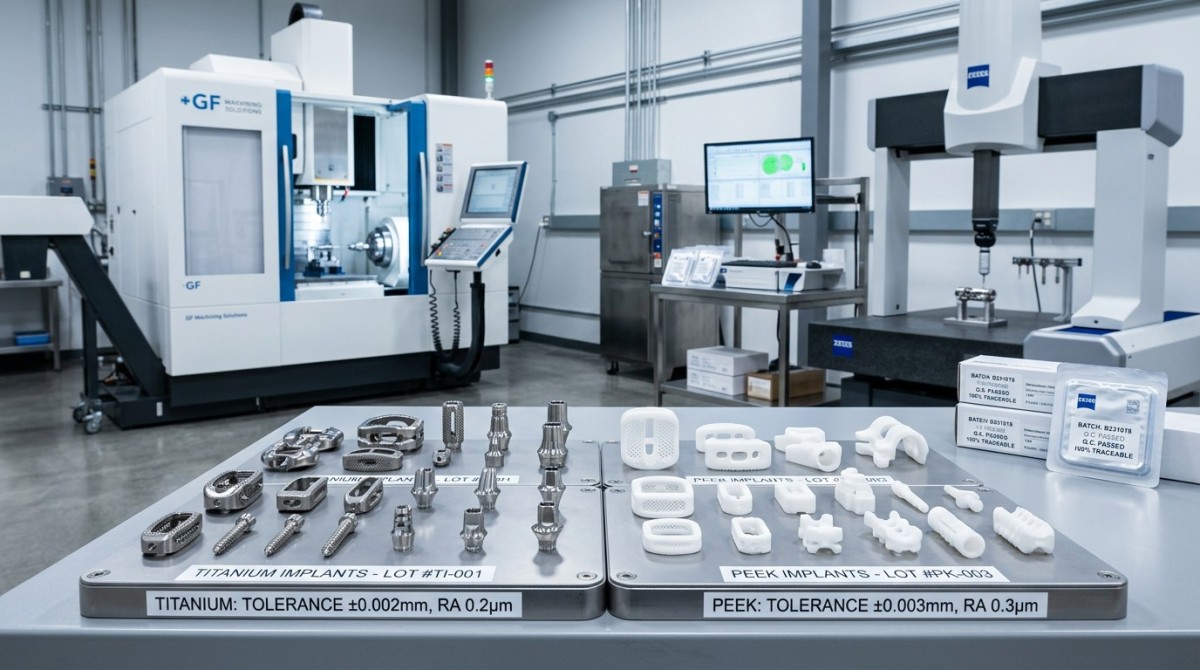
Medical implant machining wholesale is not a commodity purchasing category. A price gap of 8%–15% between two suppliers may look attractive during sourcing, but a single batch deviation in thread geometry, burr control, or surface finish can trigger inspection delays, additional validation work, or rejected assemblies. In implant programs, the real cost metric is not unit price alone. It is the combined impact of scrap rate, requalification time, documentation quality, and on-time delivery performance.
Reliable partners understand that precision machining for medical use is a system, not a standalone machining event. That system includes incoming material verification, fixture repeatability, cutting tool management, in-process inspection, final release control, packaging protection, and lot traceability. If one link is weak, the final part may still look acceptable visually while failing dimensional, fatigue, or cleanliness requirements later.
For engineers and operators, supplier reliability also affects manufacturability feedback. A mature partner flags sharp internal corners, difficult deep-pocket tool paths, or unrealistic wall thickness before sampling begins. This can reduce first article revision cycles from 3 rounds to 1–2 rounds in many standard implant component projects. That time saving matters when development schedules are tight and regulatory milestones are fixed.
For procurement leaders and enterprise decision-makers, the strongest suppliers are those that make risk visible. They do not hide behind generic terms such as “high precision.” Instead, they define what “high precision” means in measurable language, such as ±0.005 mm on critical diameters, Ra 0.2–0.8 μm on specified surfaces, or documented process inspection at first-off, mid-run, and final release stages.
The commercial risks behind weak supplier selection
A weak wholesale partner often introduces risk in areas that are not obvious during quoting. Common failures include inconsistent lot records, poor revision control, overreliance on manual inspection, and inability to maintain capability across different machine cells. These weaknesses can delay PPAP-like internal approvals, increase audit findings, and create supply instability during scale-up.
- Dimensional drift between prototype and production lots, often visible after 200–500 pieces rather than in the first 20 samples.
- Surface finish inconsistency caused by tool wear management gaps or unstable coolant and polishing processes.
- Material mix-up risk when titanium, cobalt-chrome, stainless steel, and medical grade polymers are handled without strict segregation and traceability.
- Late delivery caused by poor scheduling discipline, especially when 5 axis CNC capacity is shared across multiple industries.
The table below shows how buyers can compare short-term price perception against long-term program cost exposure.
The key takeaway is simple: in implant machining, reliability protects margins. It shortens qualification cycles, lowers quality incidents, and supports a smoother transition from sample to volume supply.
Technical signals that separate dependable partners from marketing-driven suppliers
A reliable supplier can explain technical capability with process-level clarity. In medical implant machining, that often starts with achievable tolerances by feature type, not one generic number applied to every geometry. For example, a supplier may hold ±0.003 mm to ±0.01 mm on certain critical turned or milled features, while assigning wider but controlled tolerances to non-critical surfaces. This nuance shows engineering maturity.
Surface finish control is another dividing line. For bone-contacting or mating features, the partner should be able to discuss how machine parameters, cutting strategy, polishing method, and inspection method contribute to final Ra outcomes. If a supplier simply says “smooth finish available” without specifying whether Ra 0.4 μm, Ra 0.8 μm, or another target is achievable on the actual material and geometry, buyers should ask deeper questions.
Material behavior matters just as much as machine capability. Titanium alloys, stainless steels, cobalt-chrome, and medical grade PEEK each respond differently to heat, tool pressure, chip evacuation, and secondary finishing. A strong partner understands not only cutting conditions but also how repeated sterilization exposure, cleaning chemistry, and packaging conditions may influence dimensional stability or surface condition over time.
Documentation quality is often the fastest way to assess technical seriousness. Suppliers serving implant programs should be comfortable providing material certificates, inspection records, controlled drawings, revision history, and lot-specific traceability. This is especially important when buyers need a clear audit trail across 3 core stages: incoming material control, in-process inspection, and final release.
What to ask during technical evaluation
The best technical questions reveal whether the supplier can support your part family beyond initial samples. A serious partner should answer in practical, measurable language rather than in general promises.
- What tolerance range can you hold on critical diameters, threads, slots, and freeform 5 axis surfaces over a full batch?
- How do you verify surface finish, and what Ra range is realistic for the specified material and geometry?
- What is your tool life control method, and how often are tools changed during long production runs?
- How do you separate and trace lots for titanium, stainless steel, cobalt-chrome, and medical grade PEEK?
- Can you share a standard ISO 13485 quality control checklist structure used during release?
Practical benchmark areas
When comparing suppliers, buyers should benchmark at least 4 dimensions: dimensional capability, finish capability, documentation depth, and response speed to engineering changes. These four areas usually predict performance better than broad company introductions or trade-show claims.
The following table summarizes practical technical indicators that procurement and engineering teams can use during supplier screening.
These indicators help separate credible manufacturing capability from generic vendor positioning. For implant programs, detailed answers are a positive sign; vague answers are an early warning.
Quality systems, sterilization compatibility, and traceability controls
A dependable medical implant machining wholesale partner does not treat quality as a final inspection activity. Quality must be built into the full production route. That begins with document control and extends through operator training, machine maintenance, calibration scheduling, lot segregation, and nonconformance handling. ISO 13485 alignment is especially relevant because it supports process discipline in a regulated medical manufacturing environment.
Procurement teams should verify how the supplier uses quality checklists in daily operations. A robust ISO 13485 quality control checklist typically includes drawing revision verification, raw material certificate review, first article dimensional confirmation, in-process control points, final inspection release, and packaging condition checks. If these six checkpoints are informal or inconsistently applied, the risk of hidden deviations rises.
Sterilization compatibility is another major separator. For metal implants and medical grade PEEK components, the supplier should understand how steam, gamma, EtO, or other sterilization methods may interact with material behavior, packaging, and surface condition. Even when the machining supplier is not the sterilization provider, they should know how machining stress, residual burrs, trapped contaminants, or poor packaging can undermine later sterilization validation.
Traceability should also work in both directions. A buyer should be able to trace a finished lot back to material batch, machine route, operator or shift records where applicable, and inspection release data. During containment events, response time matters. A supplier that can isolate affected lots within 24–48 hours is significantly more useful than one that needs several days to reconstruct basic records.
Core control points buyers should verify
- Document control discipline for drawings, work instructions, and revision changes across all active implant SKUs.
- Calibration schedules for measuring instruments, especially when tolerances fall below 0.01 mm on critical features.
- Defined containment and CAPA procedures for dimensional, finish, or material nonconformance.
- Lot-based packaging and labeling that preserve identification through warehouse handling and international shipment.
Example of a practical supplier review matrix
The table below can be used during qualification audits or remote supplier review. It focuses on process evidence rather than presentation quality.
This type of review framework helps teams compare suppliers on execution quality, not just certification claims or quotation speed.
How wholesale buyers should assess production capacity and delivery stability
Reliable implant machining partners must prove not only that they can make a part, but that they can keep making it consistently as demand changes. For many medical device programs, the sourcing path moves from prototype quantities under 20 pieces to pilot runs of 50–200 pieces and then to recurring production lots in the hundreds or low thousands. Capacity planning should support that ramp without a drop in capability.
One common mistake is to evaluate only the number of CNC machines. Machine count alone says little about actual usable capacity. Buyers should ask about machine type mix, 5 axis scheduling load, fixture availability, validated process routes, inspection bottlenecks, and preventive maintenance intervals. A supplier with fewer but better-managed assets can outperform a larger shop with unstable planning.
Lead time should also be dissected into stages. For example, a realistic schedule may include 3–7 days for engineering review, 7–14 days for sample machining depending on complexity, and 2–4 weeks for full production once materials and process approval are in place. Suppliers who promise unusually short timelines without discussing inspection and documentation are often transferring risk downstream.
International buyers should also look at logistics readiness. Export packaging, customs documentation support, buffer stock options, and communication cadence all affect stability. In practice, a supplier who gives weekly status updates and identifies schedule risks 5–7 days early is more valuable than one who remains silent until the ship date is missed.
A practical 5-step sourcing and qualification flow
- Define critical-to-quality features, materials, annual volume bands, and required documents before RFQ release.
- Review supplier responses for manufacturability feedback, not just price and lead time.
- Run a controlled sample phase with dimensional and finish verification on critical features.
- Audit traceability, quality records, and capacity planning before moving to repeat orders.
- Set review intervals every 3 or 6 months for delivery, quality trends, and change control performance.
Signs of a stable delivery model
Stable partners usually show disciplined order management: clear order acknowledgment, revision confirmation, milestone tracking, and escalation protocols. They can explain what happens if a machine goes down, if material is delayed, or if inspection identifies a trend issue mid-batch. Contingency thinking is a reliability signal.
For enterprise buyers managing multiple part numbers, supplier scorecards are useful. Tracking on-time delivery, NCR frequency, response time, and documentation completeness over a 90-day or 180-day window creates a better decision basis than relying on isolated good shipments.
Common selection mistakes, buyer questions, and the right next step
Many sourcing teams still select implant machining suppliers based on three incomplete signals: low quotation, fast sample promise, and polished presentation materials. None of those metrics confirms long-run process capability. A better approach is to combine commercial review with technical evidence, traceability depth, and communication quality. This is especially important when suppliers serve both medical and non-medical sectors and may not apply the same controls across all jobs.
Another frequent mistake is failing to define critical features early. If the drawing package does not clearly identify critical tolerances, surface finish expectations, thread requirements, or inspection format, even capable suppliers may quote on different assumptions. That creates comparison noise and makes supplier selection less reliable. Clear RFQ packages reduce this problem significantly.
Decision-makers should also watch for suppliers that rely too heavily on verbal assurance. In precision medical manufacturing, strong partners put key commitments into controlled documents: tolerance assumptions, inspection plans, packaging methods, and delivery milestones. Written clarity helps engineering, quality, and purchasing teams stay aligned through the full program cycle.
For organizations following a data-first sourcing model, the ideal wholesale partner is one that helps reduce uncertainty. That means measurable process capability, transparent quality systems, realistic lead times, and consistent communication from prototype through repeat production.
FAQ: what buyers ask most often
How many suppliers should be shortlisted for implant machining RFQ?
In most cases, 3–5 qualified suppliers is a practical range. Fewer than 3 can limit comparison depth, while more than 5 often increases review workload without improving decision quality. The key is to pre-screen for medical manufacturing fit before requesting full quotations.
What lead time is realistic for precision medical implant parts?
Typical ranges vary by geometry, material, and documentation needs. Simple samples may move in 1–2 weeks, while more complex 5 axis parts with full inspection packages can require 3–5 weeks. Production repeat orders may stabilize once routing, tooling, and inspection plans are proven.
Which documents matter most during supplier qualification?
At minimum, buyers should review material certificates, inspection records, drawing revision control, lot traceability structure, and quality workflow evidence. If sterilization or cleaning conditions affect the part, related process understanding should also be discussed early.
What is the best first step after reading a supplier quote?
Do not compare prices immediately. First, verify assumptions: material grade, tolerances, finish targets, quantity breaks, inspection scope, and delivery basis. Once those items are aligned, commercial comparison becomes much more meaningful.
Reliable medical implant machining wholesale partners are separated by evidence, not adjectives. They show process control, lot traceability, realistic machining limits, documented quality routines, and stable delivery planning. For information researchers, operators, procurement teams, and business leaders, that evidence translates directly into lower sourcing risk and faster program execution.
If your team is evaluating machining suppliers for implant-grade components, the smartest next move is a structured technical review built around measurable criteria rather than broad claims. Contact us to discuss your drawings, quality requirements, and sourcing priorities, or request a tailored evaluation framework to compare potential partners with greater confidence.
Search News
Hot Articles
- Carbon Fiber StructuresHow to Specify Aerospace Carbon Fiber Assemblies for Lightweight, Load-Bearing PartsJul 11, 2026
- Machine VisionXiaomi, Alibaba DAMO Academy Drive Open-Source Robotics Model Ecosystem, Lowering Algorithm Development Barriers for Overseas SMEs Adopting Chinese Robotics SolutionsMar 30, 2026
- Cobots & ArmsShanxi 'AI+' Conference Showcases Embodied Intelligence with Multinational Buyer Engagement: Key Industry ImplicationsMar 30, 2026
Popular Tags
Recommended News
 Jul 11, 2026How to Specify Aerospace Carbon Fiber Assemblies for Lightweight, Load-Bearing PartsAerospace carbon fiber assemblies: learn how to specify laminate design, load data, joining methods, and inspection controls for lighter, reliable load-bearing aerospace parts.Elena Rostova (UAV Systems Researcher)
 Mar 30, 2026Xiaomi, Alibaba DAMO Academy Drive Open-Source Robotics Model Ecosystem, Lowering Algorithm Development Barriers for Overseas SMEs Adopting Chinese Robotics SolutionsXiaomi & Alibaba DAMO Academy's open-source robotics models lower algorithm barriers for global SMEs. Boost efficiency in manufacturing, logistics & smart retail with ROS 2 compatible solutions.TSV Data Lab
 Mar 30, 2026Shanxi 'AI+' Conference Showcases Embodied Intelligence with Multinational Buyer Engagement: Key Industry ImplicationsShanxi 'AI+' Conference highlights embodied intelligence with Tesla, Ubtech & Jiantao showcasing multimodal robotics. 40+ global buyers validated tech on-site, creating new B2B channels for industrial automation & AI solutions.Chen Wei (Automation Lead Engineer)
 Mar 30, 2026Zhongguancun Unveils 6G Integrated Sensing-Computing-Intelligence Platform to Empower Embodied Robots for Global Industrial ApplicationsZhongguancun's new 6G platform revolutionizes industrial robotics with <10ms latency, empowering global automotive, logistics & port automation. Discover how this tech boosts China's smart manufacturing exports.TSV Data Lab
 Mar 30, 2026Mech-Mind Tianjin Embodied Intelligence R&D and Production Base Goes Live, Cutting Delivery Time by 20%–30% for Global Customized AMR+Vision SolutionsMech-Mind's Tianjin AMR+Vision production base cuts delivery time by 20%-30% for欧美 & Latin American markets. Discover how this PLd-certified facility accelerates customized robotics solutions for smart manufacturing and logistics.Chen Wei (Automation Lead Engineer)
 Mar 30, 2026Boao Forum Reveals 'Co-evolution of Big and Small Brains' Trend in Humanoid Robots, China's Embodied Intelligence Accelerates Adaptation to Overseas Manufacturing Service ScenariosDiscover how China's humanoid robots, featuring 'Co-evolution of Big and Small Brains,' are revolutionizing global manufacturing. Learn about Embodied Tian Gong 3.0's ISO compliance and overseas deployment at Boao Forum 2026.Chen Wei (Automation Lead Engineer)
 Mar 30, 2026China Railway Industrial Secures Patent for Embodied Robotics in Material Handling, Boosting High-Precision Delivery Capabilities for Overseas Infrastructure and Manufacturing ProjectsChina Railway Industrial's new patent for embodied robotics in material handling boosts high-precision delivery for global infrastructure & manufacturing. Discover how this innovation enhances logistics accuracy in automotive, rail transit & EPC projects.Chen Wei (Automation Lead Engineer)
 Oct 27, 2026GXO and Agility Robotics Expand Partnership to Accelerate US Humanoid Robot DeploymentGXO and Agility Robotics plan to expand US humanoid robot deployment with Digit 4 in early 2027. Explore warehouse automation plans, service terms and future Digit 5 upgrades.Chen Wei (Automation Lead Engineer)
 Oct 27, 2026Robotic Automation Costs: Budgeting for Equipment, Integration, and MaintenancePlan your robotics automation cost with confidence. Explore equipment, integration, and maintenance expenses, compare quotes, and build a realistic budget for better ROI.Chen Wei (Automation Lead Engineer)
 Oct 26, 2026AMAXiMAL Releases Open-Source TopMod 3D v3 With Claude AIExplore AMAXiMAL’s free, open-source TopMod 3D v3 with Claude AI assistance, topology-based modeling and plywood fabrication tools that connect complex designs to physical builds.Dr. Marcus Vance
 Oct 26, 2026Choosing a SCADA System Integrator Company: PLC Compatibility and Long-Term SupportChoose a scada system integrator company with proven PLC compatibility and reliable long-term support. Discover what to test, compare, and require before investing.Victor Lin (Chief Software Architect)
 Oct 25, 2026Hesai Leads Global ADAS Main Lidar Shipments in Yole’s 2026 ReportHesai led global ADAS main lidar shipments with a 43% share in 2025, according to Yole’s 2026 report. Explore what this ranking reveals about its automotive market position.TSV Data Lab
 Oct 25, 2026Choosing an Aerospace Materials Manufacturer: Quality and Traceability ChecksChoosing an aerospace materials manufacturer? Learn how to verify certifications, test reports, and lot traceability to qualify suppliers confidently and reduce costly sourcing risks.Dr. Marcus Vance
 Oct 24, 2026Guotai Haitong: Global Entry-Level 3D Printer Shipments Rose 39% in Q1 2026Entry-level 3D printer shipments rose 39% in Q1 2026, Guotai Haitong reports. Explore how AI, multicolor printing and print farms are shaping market growth.Dr. Marcus Vance
 Oct 24, 2026Choosing an Industrial Vision Inspection Supplier: Acceptance Tests That MatterChoose an industrial vision inspection supplier with confidence. Discover acceptance tests for defect detection, false rejects, production speed, and reliable part rejection before you buy.TSV Data Lab
 Oct 23, 2026US Navy Raises Gecko Robotics Contract Ceiling to $300M for Robotic Fleet MaintenanceUS Navy raises Gecko Robotics’ contract ceiling to $300M for Pacific Fleet robotic inspections. Explore potential opportunities for maintenance suppliers and key procurement considerations.Chen Wei (Automation Lead Engineer)
 Oct 23, 2026Choosing Industrial Sensing Systems for Global Plants: Protocol CompatibilityCompare industrial sensing systems international buyers can trust. Explore protocol compatibility, reduce integration risks, and select proven configurations for reliable global plant deployments.TSV Data Lab
 Oct 22, 2026KUKA Showcases Physical AI and iiQKA.AI Vision at NVIDIA GTC BerlinExplore KUKA’s Physical AI showcase at NVIDIA GTC Berlin and discover how iiQKA.AI Vision aims to simplify robotic vision integration and improve 2D and 3D scene recognition.TSV Data Lab
 Oct 22, 2026Robotic Machining of Advanced Composites: What Tolerances Are Achievable?Explore advanced materials machining robotics: discover what drives achievable composite tolerances and how to validate accuracy before investing in your next machining system.Dr. Marcus Vance
 Oct 21, 2026China’s Industrial Robot Exports Near RMB 10 Billion in First Nine Months of 2026China’s industrial robot exports neared RMB 10 billion in January–September 2026, with value rising faster than volume. Explore the data and what it could mean for suppliers.Chen Wei (Automation Lead Engineer)
 Oct 21, 2026Low-Latency Industrial Data Processing: Pricing and Key Cost DriversExplore industrial data latency price drivers, from edge hardware to integration and support. Learn how to compare quotes, verify performance, and avoid unnecessary costs.TSV Data Lab
 Oct 20, 2026KUKA Launches iiQKA.AI Vision to Simplify Industrial Image ProcessingKUKA iiQKA.AI Vision simplifies industrial image processing with controller-based 2D and 3D vision. Explore drag-and-drop setup for vision-guided automation.TSV Data Lab
 Oct 20, 2026Smart Industrial Edge Devices: Key Criteria for Legacy PLC IntegrationChoose smart industrial edge devices for legacy PLC integration. Discover key criteria for compatibility, data quality, security, and reliable collection without disrupting control.TSV Data Lab
 Oct 19, 2026Choosing a Radar Sensor by Application: Range, Resolution, and Field of ViewSimplify radar sensor application based product selection. Compare range, resolution, and field of view to avoid blind spots and choose with confidence. Explore the guide.TSV Data Lab























