What makes one trampoline park supplier easier to trust
Publication Date
author
Choosing a trampoline park supplier is not just about price or product variety—it is about reducing risk in procurement. For buyers evaluating safety, compliance, durability, and delivery reliability, trust is built through verified data rather than promotional claims. This article examines what makes one trampoline park supplier easier to trust, helping procurement teams identify measurable signals that support faster qualification and more confident purchasing decisions.
Why procurement teams should use a checklist first
When buyers compare one trampoline park supplier with another, the biggest mistake is starting with catalogs, renderings, or discount offers. Those materials may help with early screening, but they rarely answer the questions that matter most in commercial procurement: Will the equipment pass local inspection? Will the structure perform consistently under repeated use? Can the supplier document materials, testing, installation support, and after-sales accountability?
A checklist-driven evaluation process helps procurement teams move from subjective impressions to evidence-based qualification. It also aligns engineering, operations, finance, and safety stakeholders around the same decision criteria. In practice, a trusted trampoline park supplier is easier to work with because the supplier reduces uncertainty at every stage: specification review, budget validation, factory verification, shipping coordination, installation planning, and post-opening maintenance.
For buyers, trust should be observable. It should appear in documents, response quality, test data, project references, compliance readiness, and the supplier’s willingness to discuss limitations as clearly as strengths. That is why the following checklist focuses on measurable trust signals rather than branding language.
The core checklist: what to verify before shortlisting a trampoline park supplier
Use the following checks before moving any trampoline park supplier into final commercial negotiation. If several items remain vague, qualification risk is still high.
- Safety standards and compliance evidence: Ask which standards the equipment is designed to meet, such as ASTM, EN, or applicable local indoor amusement requirements. A reliable supplier should provide test reports, material certificates, and clear explanations of how the design aligns with jurisdiction-specific compliance expectations.
- Engineering drawings and specification transparency: A trustworthy trampoline park supplier shares detailed layouts, frame dimensions, padding specifications, spring or springless system details, load assumptions, and recommended installation conditions. If key technical details are missing, comparison becomes guesswork.
- Material traceability: Verify steel grade, foam density, fabric properties, protective pad construction, netting strength, and surface treatment for corrosion resistance. Strong suppliers can connect components to batch records or supplier certifications instead of offering only generic descriptions.
- Manufacturing consistency: Ask whether production is standardized, what quality checkpoints are used, and how nonconforming parts are handled. A dependable trampoline park supplier will explain incoming inspection, welding inspection, dimensional checks, and packaging control.
- Project reference quality: References should include projects similar in scale, user age mix, daily throughput, and regional compliance demands. Good references are not just logos; they include outcomes, operating duration, and support history.
- Installation and commissioning support: Confirm whether the supplier provides install manuals, supervisor support, training, punch-list resolution, and opening readiness checks. Procurement risk rises when installation responsibilities are poorly defined.
- After-sales response structure: Trust improves when a trampoline park supplier has a named support workflow for spare parts, warranty claims, maintenance guidance, and urgent safety issues.
- Lead time realism: Reliable suppliers explain engineering lead time, production windows, packaging sequence, export preparation, and contingency planning. Unrealistically short promises often become delayed openings.
If a trampoline park supplier performs well across these points, procurement can move forward with deeper technical and commercial review instead of spending time decoding basic credibility gaps.
How to judge trust through documents, not marketing language
One of the fastest ways to distinguish a dependable trampoline park supplier is to examine the quality of its documents. Trust is easier when documentation is organized, consistent, and decision-ready. Procurement teams should request a standard document pack and compare suppliers side by side.
A strong document pack usually includes a preliminary layout, bill of materials, specification sheet, compliance statements, sample maintenance guidance, warranty terms, logistics assumptions, and a list of exclusions. The exclusions matter. A credible supplier openly states what is not included, such as civil works, local permits, ceiling modifications, flooring beyond the activity zone, or third-party inspections.
By contrast, a weak trampoline park supplier often provides polished visuals but avoids specifics. Buyers then discover late-stage cost additions, unsupported customization, or technical mismatches with the site. The more complete the document package, the easier it is to trust the supplier’s planning discipline.
A practical comparison table for procurement review
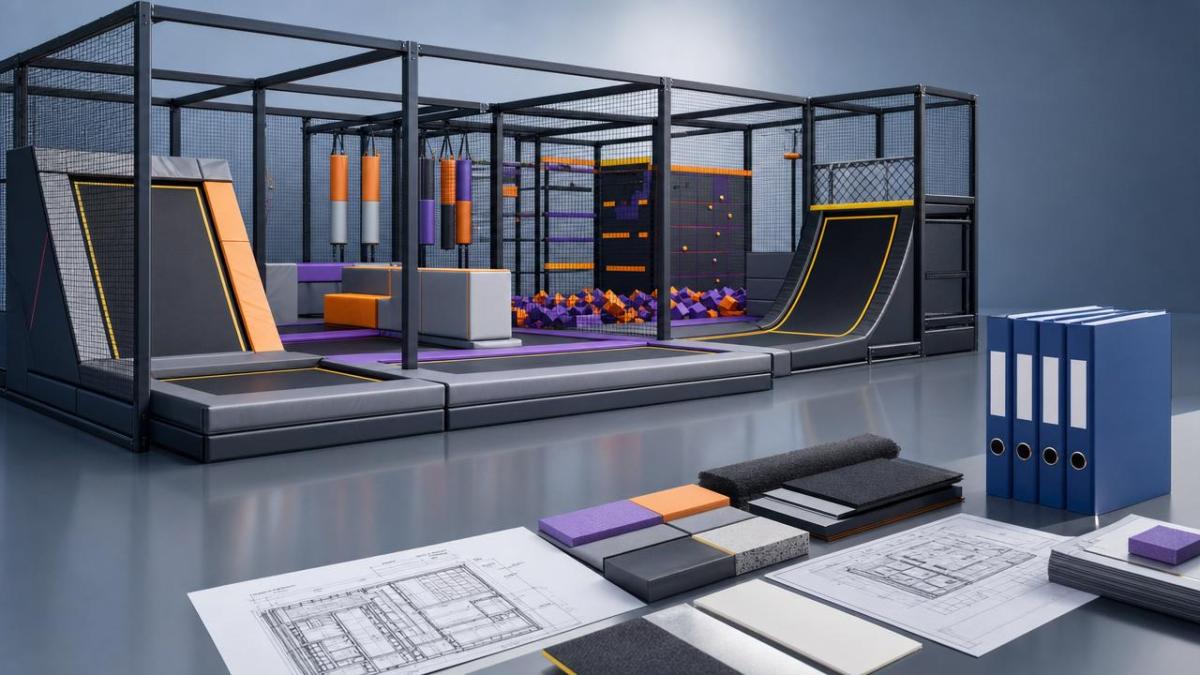
The table below can help buyers compare each trampoline park supplier using procurement-oriented trust criteria instead of sales impressions alone.
Different buying scenarios require different trust checks
Not every buyer should evaluate a trampoline park supplier in the same way. The right checklist depends on project type, operational model, and regional risk exposure.
For new trampoline park projects
First-time operators should prioritize design guidance, layout efficiency, safety zoning, and total project coordination. In this case, the most trusted trampoline park supplier is often the one that can identify hidden site constraints early, such as column interference, ceiling height limits, evacuation path conflicts, or local inspection issues.
For expansion of an existing indoor park
Existing operators should focus more on compatibility, maintenance burden, spare-part continuity, and downtime impact. A supplier becomes easier to trust when it can show how new equipment integrates with current guest flow, staffing patterns, and inspection routines.
For cross-border procurement
International buyers should increase scrutiny on export packaging, labeling, document accuracy, customs readiness, language clarity, and remote installation support. Here, a trampoline park supplier earns trust by demonstrating process maturity, not only product quality.
Commonly overlooked issues that reduce supplier trust
Many procurement teams focus heavily on price, structure size, and visual appeal while underestimating smaller details that later cause delays, disputes, or operating problems. These are common blind spots worth checking early.
- Ambiguous warranty language: Buyers should verify what components are covered, what usage assumptions apply, and how claims are processed.
- Insufficient maintenance planning: A trampoline park supplier should outline inspection frequency, replacement cycles for wear components, and operator responsibilities.
- Unclear site responsibility split: Civil preparation, anchor conditions, floor flatness, power access, and unloading requirements must be clearly assigned.
- Over-customization without validation: Unique themed features can increase appeal, but they also raise engineering, lead-time, and spare-part risks if not properly documented.
- Weak revision control: If drawings, quotations, and material lists change frequently without version discipline, trust should decrease immediately.
Execution advice: how to qualify a trampoline park supplier step by step
A practical sourcing process helps procurement teams avoid delays and makes supplier comparison more objective. The following approach is especially useful when several stakeholders must approve the final vendor.
- Step 1: Define internal requirements. Confirm venue dimensions, target age groups, expected throughput, budget range, compliance location, and opening deadline.
- Step 2: Request a standardized information pack. Send the same checklist to each trampoline park supplier so responses can be compared fairly.
- Step 3: Score evidence quality. Do not score only on price. Score document completeness, testability of claims, case relevance, and delivery realism.
- Step 4: Conduct a technical clarification round. Review drawings, exclusions, material options, and installation assumptions with engineering or operations stakeholders.
- Step 5: Validate operational support. Ask how the supplier handles spare parts, emergency response, training, and periodic safety advice after handover.
- Step 6: Finalize commercial terms only after technical alignment. Negotiating too early often hides unresolved specification issues.
FAQ: quick answers buyers often need
Is the lowest quotation from a trampoline park supplier usually the best deal?
Not necessarily. The lowest initial price may exclude compliance support, freight assumptions, installation supervision, replacement parts, or site-specific modifications. Total procurement risk matters more than the headline number.
How many references should a buyer ask for?
At least three relevant references are helpful, but relevance is more important than quantity. Ask for projects similar in region, operational scale, and attraction mix.
What makes a trampoline park supplier easier to trust during communication?
Clear response times, technically precise answers, transparency about limits, and willingness to document assumptions all indicate a mature supplier. Fast replies alone are not enough; the content of the reply is what matters.
Final decision guide for procurement teams
In the end, one trampoline park supplier becomes easier to trust when the supplier consistently reduces uncertainty. That means fewer vague claims, more verified documentation, better engineering transparency, clearer responsibility boundaries, and stronger post-sale support. Buyers should not ask only whether the supplier can build an attractive park. They should ask whether the supplier can prove safety readiness, delivery discipline, lifecycle support, and operational fit.
If your team is preparing to qualify a trampoline park supplier, the most productive next step is to organize a structured request covering five topics: exact technical parameters, compliance documents, site adaptation assumptions, delivery schedule detail, and after-sales support process. Once these items are clear, procurement can move from uncertainty to a confident and defensible buying decision.
Search News
Hot Articles
- Carbon Fiber StructuresHow to Specify Aerospace Carbon Fiber Assemblies for Lightweight, Load-Bearing PartsJul 11, 2026
- Machine VisionXiaomi, Alibaba DAMO Academy Drive Open-Source Robotics Model Ecosystem, Lowering Algorithm Development Barriers for Overseas SMEs Adopting Chinese Robotics SolutionsMar 30, 2026
- Cobots & ArmsShanxi 'AI+' Conference Showcases Embodied Intelligence with Multinational Buyer Engagement: Key Industry ImplicationsMar 30, 2026
Popular Tags
Recommended News
 Jul 11, 2026How to Specify Aerospace Carbon Fiber Assemblies for Lightweight, Load-Bearing PartsAerospace carbon fiber assemblies: learn how to specify laminate design, load data, joining methods, and inspection controls for lighter, reliable load-bearing aerospace parts.Elena Rostova (UAV Systems Researcher)
 Mar 30, 2026Xiaomi, Alibaba DAMO Academy Drive Open-Source Robotics Model Ecosystem, Lowering Algorithm Development Barriers for Overseas SMEs Adopting Chinese Robotics SolutionsXiaomi & Alibaba DAMO Academy's open-source robotics models lower algorithm barriers for global SMEs. Boost efficiency in manufacturing, logistics & smart retail with ROS 2 compatible solutions.TSV Data Lab
 Mar 30, 2026Shanxi 'AI+' Conference Showcases Embodied Intelligence with Multinational Buyer Engagement: Key Industry ImplicationsShanxi 'AI+' Conference highlights embodied intelligence with Tesla, Ubtech & Jiantao showcasing multimodal robotics. 40+ global buyers validated tech on-site, creating new B2B channels for industrial automation & AI solutions.Chen Wei (Automation Lead Engineer)
 Mar 30, 2026Zhongguancun Unveils 6G Integrated Sensing-Computing-Intelligence Platform to Empower Embodied Robots for Global Industrial ApplicationsZhongguancun's new 6G platform revolutionizes industrial robotics with <10ms latency, empowering global automotive, logistics & port automation. Discover how this tech boosts China's smart manufacturing exports.TSV Data Lab
 Mar 30, 2026Mech-Mind Tianjin Embodied Intelligence R&D and Production Base Goes Live, Cutting Delivery Time by 20%–30% for Global Customized AMR+Vision SolutionsMech-Mind's Tianjin AMR+Vision production base cuts delivery time by 20%-30% for欧美 & Latin American markets. Discover how this PLd-certified facility accelerates customized robotics solutions for smart manufacturing and logistics.Chen Wei (Automation Lead Engineer)
 Mar 30, 2026Boao Forum Reveals 'Co-evolution of Big and Small Brains' Trend in Humanoid Robots, China's Embodied Intelligence Accelerates Adaptation to Overseas Manufacturing Service ScenariosDiscover how China's humanoid robots, featuring 'Co-evolution of Big and Small Brains,' are revolutionizing global manufacturing. Learn about Embodied Tian Gong 3.0's ISO compliance and overseas deployment at Boao Forum 2026.Chen Wei (Automation Lead Engineer)
 Mar 30, 2026China Railway Industrial Secures Patent for Embodied Robotics in Material Handling, Boosting High-Precision Delivery Capabilities for Overseas Infrastructure and Manufacturing ProjectsChina Railway Industrial's new patent for embodied robotics in material handling boosts high-precision delivery for global infrastructure & manufacturing. Discover how this innovation enhances logistics accuracy in automotive, rail transit & EPC projects.Chen Wei (Automation Lead Engineer)
 Sep 28, 2026Spindle Runout Measurement in Germany: DIN Standards, Methods, and Acceptance LimitsSpindle runout measurement Germany: explore DIN standards, proven methods, acceptance limits, and audit-ready practices for reliable machining quality.Dr. Marcus Vance
 Sep 27, 2026How to Select Wall-Mount Edge Devices for Space-Constrained Factory NetworksWall mount edge devices for space-constrained factories: evaluate workload, thermal design, power resilience, cable access, and network reliability for smarter deployments.TSV Data Lab
 Sep 26, 2026Machining Tolerance Analysis: How to Set Limits That Meet Function and Cost TargetsMachining tolerance analysis: learn how to set functional limits, control tolerance stacks, reduce inspection risk, and balance precision with production cost.Dr. Marcus Vance
 Sep 25, 2026How to Evaluate an Industrial Infrastructure Data Platform for Multi-Site OperationsIndustrial infrastructure data platform evaluation guide for multi-site operations: compare data quality, edge resilience, interoperability, governance, and scalable proof-of-value criteria.Victor Lin (Chief Software Architect)
 Sep 24, 2026How to Select Machine Vision Optics for Accurate Inspection at Different Working DistancesMachine vision optics selection guide for accurate inspection at every working distance. Compare FOV, pixel scale, DOF, distortion, lighting, and telecentric options.TSV Data Lab
 Sep 23, 2026How to Evaluate a Machine Vision System Integrator for High-Speed Inspection LinesChoose a machine vision system integrator with proven expertise in high-speed inspection, reliable reject timing, robust optics, and measurable acceptance criteria.TSV Data Lab
 Sep 28, 2026When is a SCADA API the right choice for connecting plant systems?SCADA API guide: learn when governed plant data integration improves traceability, security, and scalability—without compromising real-time control.Victor Lin (Chief Software Architect)
 Sep 27, 2026How SCADA data integration improves traceability across production linesSCADA data integration connects production-line data to improve traceability, accelerate quality investigations, and strengthen safety decisions.Victor Lin (Chief Software Architect)
 Sep 26, 2026What to define before starting SCADA integration planningSCADA integration planning starts with clear scope, control boundaries, data models, cybersecurity, and testing. Discover the definitions that reduce risk and costly rework.Victor Lin (Chief Software Architect)
 Sep 25, 2026How a smart factory with Industrial IoT reduces production blind spotsDiscover how a smart factory with Industrial IoT turns real-time machine, quality, and workflow data into actionable insights that reduce production blind spots and delivery risks.Victor Lin (Chief Software Architect)
 Sep 24, 2026When does Industrial IoT make smart manufacturing easier to scale?Smart manufacturing Industrial IoT scales when trusted data, interoperable systems, and secure workflows turn connected assets into measurable gains.TSV Data Lab
 Sep 23, 2026What drives ultra-precision machining cost at 1-micron tolerance?Ultra precision machining cost per part at 1 micron tolerance depends on process, material, metrology, and yield. Learn how to compare quotes confidently.Dr. Marcus Vance
 Sep 22, 2026Drone Engine-T550CC Applications: Build the UAV Power System Around the MissionAn application guide for Drone Engine-T550CC integration, covering payload planning, airframe matching, cooling, fuel, vibration, test procedures, documentation, and service preparation.Elena Rostova (UAV Systems Researcher)
 Sep 22, 2026How to Evaluate Industrial Edge Computing Vendors for Factory DeploymentIndustrial edge computing vendor evaluation guide for factories: compare latency, protocol fit, reliability, security, and lifecycle support before deployment.TSV Data Lab
 Sep 21, 2026Drone Payload Integration: Matching Power, Data, and Center of Gravity for Reliable FlightsDrone payload integration made practical: balance power, data, center of gravity, and endurance to build safer, more reliable mission-ready flights.Elena Rostova (UAV Systems Researcher)
 Sep 20, 2026Autonomous Navigation Pricing: Cost Drivers and Budget Benchmarks for AMR ProjectsAutonomous navigation price explained: compare AMR cost drivers, software, sensors, integration, safety, and lifecycle budgets to build a scalable project plan.Chen Wei (Automation Lead Engineer)
 Sep 19, 2026How to Scope Automation Integration Services for Multi-System Factory ProjectsAutomation integration services: learn how to scope multi-system factory projects with clear workflows, interface contracts, safety boundaries, and acceptance criteria.Victor Lin (Chief Software Architect)