Trampoline park safety upgrades that matter more than new attractions
Publication Date
author
In trampoline park operations, the upgrades that protect uptime, reputation, and long-term profitability are not always the most visible. For enterprise decision-makers evaluating trampoline park safety, the real advantage lies in engineered improvements such as impact attenuation, frame integrity, sensor-based monitoring, and maintenance traceability—measures that reduce risk more effectively than headline-grabbing new attractions.
Why a checklist approach works better than attraction-led planning
For owners, operators, investors, and procurement leaders, trampoline park safety should be reviewed as a system, not as a branding feature. New attractions can increase ticket demand, but they also add new loads, user behaviors, maintenance variables, and liability exposure. A checklist-based review helps decision-makers prioritize the upgrades that reduce incident frequency, lower insurance pressure, improve staff response, and support more stable operating performance.
This matters because safety investments are often misallocated. Parks may spend heavily on visible enhancements while delaying less glamorous work such as pad replacement cycles, anchor inspections, net tension verification, slip-resistance testing, or digital maintenance logging. From a business perspective, the best trampoline park safety upgrades are usually the ones that improve risk control per dollar spent and produce measurable reductions in downtime, claims, and emergency closures.
Start with the core decision checklist: what to verify first
Before comparing new play concepts, leadership teams should validate whether the existing facility already meets a stronger operational baseline. The following checklist identifies the first items that deserve executive review when assessing trampoline park safety performance.
- Impact attenuation quality: Confirm whether pads, deck materials, wall protection, and landing zones still meet intended shock absorption performance rather than only passing a visual inspection.
- Frame and structural integrity: Review weld condition, corrosion exposure, fastener torque retention, frame alignment, and any deformation around high-cycle use zones.
- Bed and spring condition: Track wear patterns, elongation, attachment point stress, fabric fatigue, and replacement intervals based on actual usage rather than calendar assumptions alone.
- Separation and containment controls: Evaluate net systems, divider layouts, queue barriers, spectator protection, and the ability to keep incompatible user groups apart.
- Monitoring capability: Check whether the park uses CCTV coverage, occupancy counting, staff line-of-sight planning, and sensor-based alerts in the highest-risk zones.
- Maintenance traceability: Verify whether every inspection, repair, replacement, and shutdown decision is digitally logged and reviewable for compliance and insurance defense.
- Emergency readiness: Assess first-aid kit placement, spinal injury protocols, communication pathways, evacuation routes, and incident reporting speed.
If any of these basics are weak, adding a new attraction will usually increase exposure faster than revenue resilience. That is why trampoline park safety should be treated as infrastructure first and entertainment expansion second.
The safety upgrades that usually outperform new attractions
1. Higher-performance impact attenuation
Among all trampoline park safety priorities, impact management is one of the most cost-effective. Pads that appear intact may still have degraded foam density, compressed cores, split seams, or poor edge coverage. Upgrading to better-tested padding systems, thicker protection in collision zones, and more durable cover materials can materially reduce injury severity. Decision-makers should request performance data, replacement life expectations, and cleaning compatibility, not just color and finish options.
2. Frame reinforcement and connection-point upgrades
Frames absorb repetitive loads every operating hour. Over time, stress concentrates around welds, joints, anchors, and hardware interfaces. A reinforcement program may include upgraded brackets, corrosion-resistant components, torque verification procedures, or redesigned connection details in known failure areas. This is less marketable than a new foam feature, but it directly supports trampoline park safety, asset longevity, and reduced unplanned closure risk.
3. Sensor-based monitoring and occupancy control
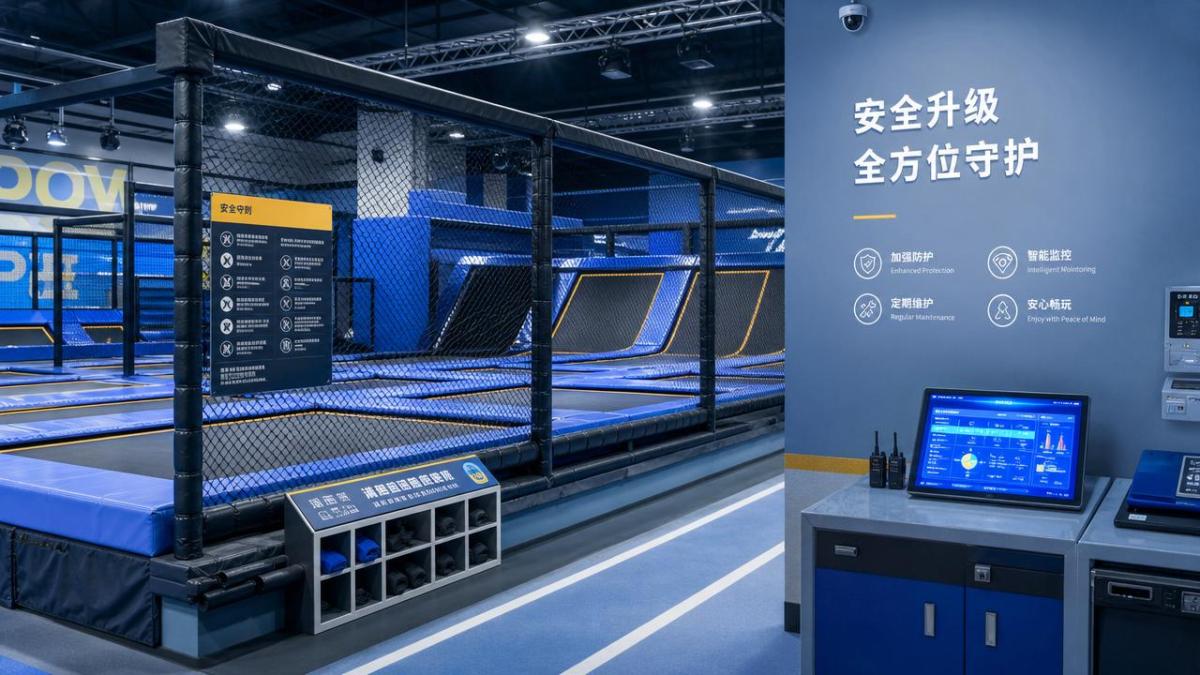
Parks are increasingly using monitoring technology to supplement staff supervision. Occupancy sensors, zone counters, camera analytics, and automated alerts can help identify overcapacity, unauthorized access, or risky crowding patterns before incidents occur. For enterprise operators managing multiple sites, this data becomes even more valuable because it supports benchmarking, staffing optimization, and defensible trampoline park safety governance across the portfolio.
4. Smarter maintenance traceability systems
One of the most overlooked safety upgrades is digital maintenance traceability. Paper logs are easy to lose, hard to audit, and often inconsistent across shifts. A digital record system can document inspection frequency, defect categories, replacement history, technician notes, and escalation timing. In practical terms, this improves trampoline park safety because issues are detected earlier, recurring faults are visible, and management can prove that preventive controls were actually executed.
5. Traffic-flow redesign in high-risk zones
Many incidents are linked not to equipment failure but to poor movement design. Entry bottlenecks, unclear transitions between activities, mixed-skill user overlap, and weak queuing controls all increase collision risk. Simple redesign measures—clear circulation lanes, better zone signage, physical separation, one-way access points, and improved staff positioning—often create a stronger trampoline park safety result than adding one more attraction element.
A practical evaluation table for executive review
Use the following decision table to compare upgrade categories by business impact, not just by customer visibility.
What to check by park type and operating scenario
Trampoline park safety priorities vary by customer mix, facility age, and operating model. A single checklist is useful, but decision-makers should also review scenario-specific risks.
Family-focused parks
These sites should prioritize age-group separation, visibility for guardians, soft boundary design, and strict control of mixed-skill interactions. Younger users are more vulnerable to unpredictable collisions, so containment and supervision density matter more than novelty.
High-volume urban venues
Crowd management becomes central. Operators should focus on occupancy analytics, queue architecture, turnover speed, anti-slip surfaces in transition areas, and rapid-response staffing layouts. In these environments, trampoline park safety failures often begin with congestion rather than with the jump equipment itself.
Older facilities undergoing refresh
Aesthetic renovation should not come before structural review. Hidden corrosion, pad aging, bed fatigue, and outdated maintenance documentation can create significant liabilities. Older sites usually gain more from a deep safety retrofit than from cosmetic attraction expansion.
Commonly ignored issues that weaken trampoline park safety
- Assuming visual condition equals safe condition. Foam, springs, and fasteners can degrade before damage is obvious.
- Treating staff training as a one-time event. Response quality declines without scenario drills and refresher cycles.
- Ignoring near-miss data. Minor incidents and repeated behavioral violations often reveal where a major event could occur.
- Failing to align procurement with maintenance. Buying lower-cost replacement parts without performance verification can undermine the entire risk-control system.
- Adding attractions before validating load paths, traffic interaction, and supervision requirements. This is a common source of avoidable complexity.
Execution guidance: how to prioritize upgrades in the next planning cycle
A disciplined execution plan for trampoline park safety should begin with evidence, not assumptions. First, assemble incident data, near-miss records, maintenance logs, closure history, and insurance feedback from the last 12 to 24 months. Second, segment issues into structural risk, operational risk, user-flow risk, and documentation risk. Third, rank upgrades by three factors: potential severity reduction, implementation speed, and effect on uptime.
In many cases, the smartest sequence is to complete structural and impact-related corrections first, then implement digital monitoring and traceability, then review traffic flow and staffing design, and only after that reconsider attraction additions. This sequence protects both trampoline park safety and capital efficiency because it strengthens the operating platform before introducing more complexity.
FAQ for decision-makers reviewing trampoline park safety investments
Should safety upgrades be justified only by compliance?
No. Compliance is the minimum threshold. Strong trampoline park safety investments should also be evaluated by claim reduction potential, operational continuity, brand protection, and customer confidence.
When does monitoring technology add real value?
It adds the most value in high-volume or multi-site operations where manual supervision alone cannot consistently detect crowding patterns, off-limit use, or recurring risk behaviors.
Is a new attraction ever the right priority?
Yes, but only after baseline trampoline park safety controls are validated. If pads, frames, logs, and supervision systems are underperforming, attraction expansion should wait.
Final action checklist before you approve the next budget
If your team is preparing a capex or facility improvement plan, prioritize these questions: Which existing components have the highest injury or shutdown potential? Where is maintenance visibility weakest? Which risk areas lack objective monitoring? How current is your replacement-cycle data? Are suppliers providing verifiable performance specifications or only sales claims? These are the questions that keep trampoline park safety aligned with enterprise-level decision quality.
For organizations that want to move from reactive fixes to engineered control, the next step is to gather baseline parameters, incident trends, component condition data, inspection methods, expected service life, budget range, and implementation timing. With those inputs, decision-makers can compare upgrade paths based on measurable risk reduction rather than attraction visibility alone. In trampoline park safety, the investments that matter most are often the ones customers never notice—but operators, insurers, and long-term owners absolutely will.
Search News
Hot Articles
- Carbon Fiber StructuresHow to Specify Aerospace Carbon Fiber Assemblies for Lightweight, Load-Bearing PartsJul 11, 2026
- Machine VisionXiaomi, Alibaba DAMO Academy Drive Open-Source Robotics Model Ecosystem, Lowering Algorithm Development Barriers for Overseas SMEs Adopting Chinese Robotics SolutionsMar 30, 2026
- Cobots & ArmsShanxi 'AI+' Conference Showcases Embodied Intelligence with Multinational Buyer Engagement: Key Industry ImplicationsMar 30, 2026
Popular Tags
Recommended News
 Jul 11, 2026How to Specify Aerospace Carbon Fiber Assemblies for Lightweight, Load-Bearing PartsAerospace carbon fiber assemblies: learn how to specify laminate design, load data, joining methods, and inspection controls for lighter, reliable load-bearing aerospace parts.Elena Rostova (UAV Systems Researcher)
 Mar 30, 2026Xiaomi, Alibaba DAMO Academy Drive Open-Source Robotics Model Ecosystem, Lowering Algorithm Development Barriers for Overseas SMEs Adopting Chinese Robotics SolutionsXiaomi & Alibaba DAMO Academy's open-source robotics models lower algorithm barriers for global SMEs. Boost efficiency in manufacturing, logistics & smart retail with ROS 2 compatible solutions.TSV Data Lab
 Mar 30, 2026Shanxi 'AI+' Conference Showcases Embodied Intelligence with Multinational Buyer Engagement: Key Industry ImplicationsShanxi 'AI+' Conference highlights embodied intelligence with Tesla, Ubtech & Jiantao showcasing multimodal robotics. 40+ global buyers validated tech on-site, creating new B2B channels for industrial automation & AI solutions.Chen Wei (Automation Lead Engineer)
 Mar 30, 2026Zhongguancun Unveils 6G Integrated Sensing-Computing-Intelligence Platform to Empower Embodied Robots for Global Industrial ApplicationsZhongguancun's new 6G platform revolutionizes industrial robotics with <10ms latency, empowering global automotive, logistics & port automation. Discover how this tech boosts China's smart manufacturing exports.TSV Data Lab
 Mar 30, 2026Mech-Mind Tianjin Embodied Intelligence R&D and Production Base Goes Live, Cutting Delivery Time by 20%–30% for Global Customized AMR+Vision SolutionsMech-Mind's Tianjin AMR+Vision production base cuts delivery time by 20%-30% for欧美 & Latin American markets. Discover how this PLd-certified facility accelerates customized robotics solutions for smart manufacturing and logistics.Chen Wei (Automation Lead Engineer)
 Mar 30, 2026Boao Forum Reveals 'Co-evolution of Big and Small Brains' Trend in Humanoid Robots, China's Embodied Intelligence Accelerates Adaptation to Overseas Manufacturing Service ScenariosDiscover how China's humanoid robots, featuring 'Co-evolution of Big and Small Brains,' are revolutionizing global manufacturing. Learn about Embodied Tian Gong 3.0's ISO compliance and overseas deployment at Boao Forum 2026.Chen Wei (Automation Lead Engineer)
 Mar 30, 2026China Railway Industrial Secures Patent for Embodied Robotics in Material Handling, Boosting High-Precision Delivery Capabilities for Overseas Infrastructure and Manufacturing ProjectsChina Railway Industrial's new patent for embodied robotics in material handling boosts high-precision delivery for global infrastructure & manufacturing. Discover how this innovation enhances logistics accuracy in automotive, rail transit & EPC projects.Chen Wei (Automation Lead Engineer)
 Sep 28, 2026Spindle Runout Measurement in Germany: DIN Standards, Methods, and Acceptance LimitsSpindle runout measurement Germany: explore DIN standards, proven methods, acceptance limits, and audit-ready practices for reliable machining quality.Dr. Marcus Vance
 Sep 27, 2026How to Select Wall-Mount Edge Devices for Space-Constrained Factory NetworksWall mount edge devices for space-constrained factories: evaluate workload, thermal design, power resilience, cable access, and network reliability for smarter deployments.TSV Data Lab
 Sep 26, 2026Machining Tolerance Analysis: How to Set Limits That Meet Function and Cost TargetsMachining tolerance analysis: learn how to set functional limits, control tolerance stacks, reduce inspection risk, and balance precision with production cost.Dr. Marcus Vance
 Sep 25, 2026How to Evaluate an Industrial Infrastructure Data Platform for Multi-Site OperationsIndustrial infrastructure data platform evaluation guide for multi-site operations: compare data quality, edge resilience, interoperability, governance, and scalable proof-of-value criteria.Victor Lin (Chief Software Architect)
 Sep 24, 2026How to Select Machine Vision Optics for Accurate Inspection at Different Working DistancesMachine vision optics selection guide for accurate inspection at every working distance. Compare FOV, pixel scale, DOF, distortion, lighting, and telecentric options.TSV Data Lab
 Sep 23, 2026How to Evaluate a Machine Vision System Integrator for High-Speed Inspection LinesChoose a machine vision system integrator with proven expertise in high-speed inspection, reliable reject timing, robust optics, and measurable acceptance criteria.TSV Data Lab
 Sep 28, 2026When is a SCADA API the right choice for connecting plant systems?SCADA API guide: learn when governed plant data integration improves traceability, security, and scalability—without compromising real-time control.Victor Lin (Chief Software Architect)
 Sep 27, 2026How SCADA data integration improves traceability across production linesSCADA data integration connects production-line data to improve traceability, accelerate quality investigations, and strengthen safety decisions.Victor Lin (Chief Software Architect)
 Sep 26, 2026What to define before starting SCADA integration planningSCADA integration planning starts with clear scope, control boundaries, data models, cybersecurity, and testing. Discover the definitions that reduce risk and costly rework.Victor Lin (Chief Software Architect)
 Sep 25, 2026How a smart factory with Industrial IoT reduces production blind spotsDiscover how a smart factory with Industrial IoT turns real-time machine, quality, and workflow data into actionable insights that reduce production blind spots and delivery risks.Victor Lin (Chief Software Architect)
 Sep 24, 2026When does Industrial IoT make smart manufacturing easier to scale?Smart manufacturing Industrial IoT scales when trusted data, interoperable systems, and secure workflows turn connected assets into measurable gains.TSV Data Lab
 Sep 23, 2026What drives ultra-precision machining cost at 1-micron tolerance?Ultra precision machining cost per part at 1 micron tolerance depends on process, material, metrology, and yield. Learn how to compare quotes confidently.Dr. Marcus Vance
 Sep 22, 2026Drone Engine-T550CC Applications: Build the UAV Power System Around the MissionAn application guide for Drone Engine-T550CC integration, covering payload planning, airframe matching, cooling, fuel, vibration, test procedures, documentation, and service preparation.Elena Rostova (UAV Systems Researcher)
 Sep 22, 2026How to Evaluate Industrial Edge Computing Vendors for Factory DeploymentIndustrial edge computing vendor evaluation guide for factories: compare latency, protocol fit, reliability, security, and lifecycle support before deployment.TSV Data Lab
 Sep 21, 2026Drone Payload Integration: Matching Power, Data, and Center of Gravity for Reliable FlightsDrone payload integration made practical: balance power, data, center of gravity, and endurance to build safer, more reliable mission-ready flights.Elena Rostova (UAV Systems Researcher)
 Sep 20, 2026Autonomous Navigation Pricing: Cost Drivers and Budget Benchmarks for AMR ProjectsAutonomous navigation price explained: compare AMR cost drivers, software, sensors, integration, safety, and lifecycle budgets to build a scalable project plan.Chen Wei (Automation Lead Engineer)
 Sep 19, 2026How to Scope Automation Integration Services for Multi-System Factory ProjectsAutomation integration services: learn how to scope multi-system factory projects with clear workflows, interface contracts, safety boundaries, and acceptance criteria.Victor Lin (Chief Software Architect)