Trampoline park accessories that improve play without clutter
Publication Date
author
The best trampoline park accessories make play safer, smoother, and more exciting—without turning your space into a mess. From smart storage solutions to low-profile safety add-ons, the right choices can improve movement, comfort, and fun while keeping the park visually clean. In this guide, we explore trampoline park accessories that help families and operators create a better play experience with less clutter.
Why accessories matter more in some play scenarios than others
Not every trampoline zone needs the same add-ons. A backyard-style family court, a busy indoor freestyle area, a toddler section, and a birthday-party corner all create different movement patterns, safety concerns, and storage challenges. That is why choosing trampoline park accessories should start with the question of use case, not decoration. The wrong extras can block walkways, create visual noise, and distract jumpers. The right ones can support better flow, cleaner supervision lines, and more confident play.
For end consumers comparing parks, accessories often shape the real experience more than they expect. Parents notice where shoes pile up, whether foam blocks are scattered, how easy it is to find water, and whether younger children have appropriately scaled support items. Operators notice whether staff spend too much time cleaning, resetting loose equipment, or responding to avoidable slips and collisions. In both cases, the ideal trampoline park accessories are the ones that add function without adding clutter.
A quick scenario map: which trampoline park accessories fit which environment?
Before buying anything, it helps to match accessories to the way the space is actually used. Some products work best in high-turnover public settings, while others are better for lower-traffic family use or age-specific zones. The table below gives a practical starting point.
Scenario 1: Accessories for family-friendly trampoline parks
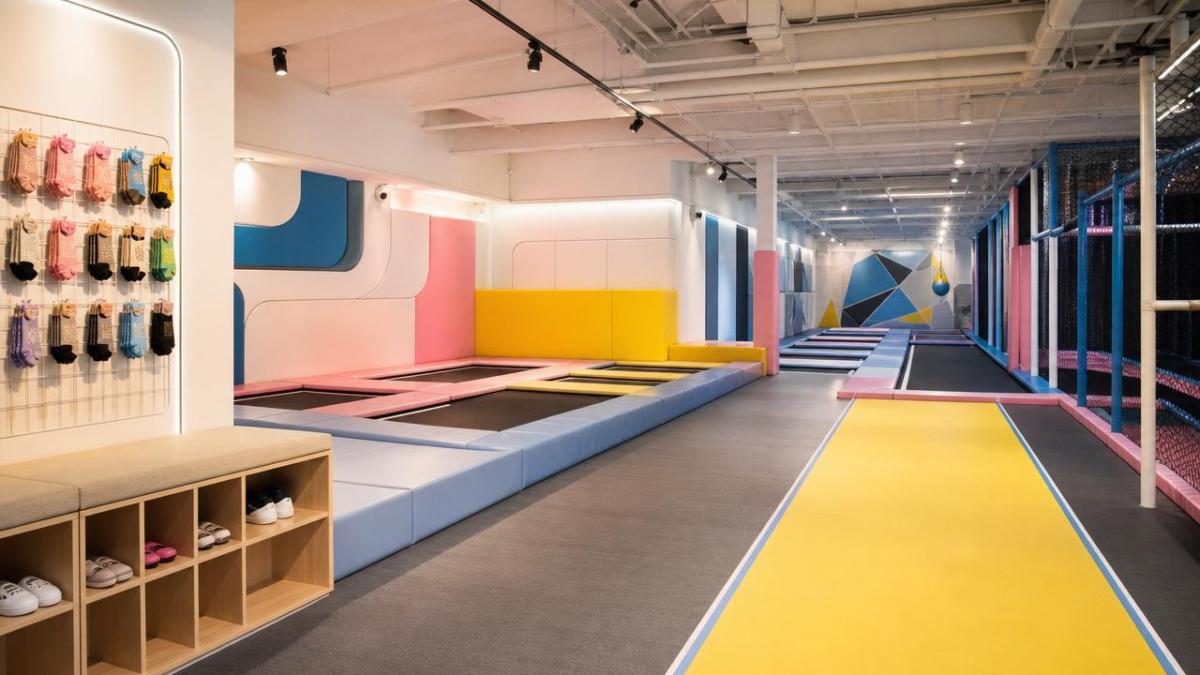
When families visit a trampoline park, they rarely judge the space only by jump height or game variety. They look at comfort, visibility, and how easy it is to manage children before and after play. In this setting, the most effective trampoline park accessories are often the least flashy: organized cubbies, bench seating with hidden storage, clearly marked sock stations, and soft perimeter mats that reduce transition hazards.
For parents, clutter is a stress amplifier. If shoes, water bottles, and jackets are spread across the floor, the environment instantly feels less safe. Accessories that create “drop zones” solve this problem without taking over the room. Low-profile storage benches, vertical wall hooks, and labeled bins allow families to store belongings quickly and return to supervision. These items improve the experience because they reduce decision friction, especially during busy weekend sessions.
Another useful choice in this scenario is compact visual guidance. Instead of large freestanding signs, parks can use slim wall-mounted rule boards, lane markers, and color-coded sections. This keeps the space tidy while helping first-time visitors understand where to go.
Scenario 2: Accessories for high-energy freestyle zones
Freestyle courts need a very different approach. Here, movement speed is higher, older children and teens use more space, and visual distractions can become physical obstacles. In this setting, trampoline park accessories should support flow first. Anything loose, bulky, or easy to drag into the jumping area becomes a problem.
The most useful accessories in freestyle environments are mounted or fixed solutions. Think wall racks for training aids, recessed storage for cleaning tools, hydration stations placed outside the action zone, and simple timer or queue displays for skill stations. These upgrades make the park feel more organized without interrupting movement.
This is also where low-profile safety accessories make a major difference. Corner protectors, flush edge padding, anti-slip walkway strips, and durable soft barriers around non-jump surfaces all help reduce injury risk while preserving a clean look. Consumers may not notice these details individually, but they feel the result: a park that seems professionally run and easier to navigate.
Scenario 3: Accessories for toddler areas and beginner jumpers
Young children need accessories that guide behavior as much as they support safety. In toddler sections, the goal is not to add more things. It is to reduce confusion and encourage calm, predictable play. Good trampoline park accessories for this audience include mini soft barriers, color paths, simple balance shapes, padded hand-support zones, and clearly separated shoe-and-bag storage near the entrance.
One common mistake is filling children’s areas with too many movable toys. While these can look playful, they often create tripping points and cleanup burdens. A better choice is fewer, multi-use accessories that stay in defined positions. For example, one padded climbing wedge may be more valuable than several scattered foam items. One labeled bin for soft props is better than five mixed baskets that children overturn every ten minutes.
For caregivers, visual order equals trust. If the toddler zone looks controlled, adults feel more comfortable letting children explore. That makes compact, easy-to-sanitize accessories especially valuable in this scenario.
Scenario 4: Accessories for birthday parties and event-based use
Party traffic creates a unique challenge because the issue is not just jumping. It is also gifts, food, shoes, jackets, and group coordination. In event settings, the best trampoline park accessories are those that create temporary order without requiring permanent floor crowding.
Useful examples include stackable but neatly stored trays, designated gift shelves, wipe-clean seating, movable dividers used only outside jump lanes, and numbered cubbies for groups. These accessories help hosts stay organized while preventing party belongings from spilling into common areas. Parks that ignore this often end up with cluttered transition spaces, even if the trampolines themselves are well maintained.
If you are choosing between two venues as a parent, ask where party items go, where guests change footwear, and whether staff have a dedicated system for storage. The answers reveal whether the trampoline park accessories are practical or simply decorative.
What to prioritize when you want more function and less clutter
Across almost every scenario, the same buying logic applies. Choose accessories that do at least one of three jobs: improve safety, improve flow, or improve storage. If an item does none of these clearly, it may not deserve space in the park.
- Prefer wall-mounted, fold-away, or under-bench storage over free-standing units.
- Choose accessories with wipeable surfaces and simple shapes for fast cleaning.
- Use color coding to organize zones without adding bulky barriers.
- Limit movable props to items with clear supervision value.
- Keep hydration, shoes, and personal belongings outside core landing paths.
- Select low-profile safety upgrades that blend into the environment instead of crowding it.
Common mistakes people make when choosing trampoline park accessories
A frequent mistake is buying accessories based on appearance alone. Bright extras may look exciting online, but they can overwhelm a real play area. Another mistake is adding too many “just in case” items. If an accessory is not used often and has no fixed place, it usually becomes clutter.
Some buyers also underestimate transition zones. The area where people remove shoes, wait for turns, or exit a party room can become more dangerous than the trampoline bed itself if it lacks proper organization. Accessories for these spaces—shoe shelves, benches, hooks, and clear directional signs—are not secondary. They are essential.
Finally, many people treat all users the same. But the right trampoline park accessories for toddlers are not the same as those for teen freestyle users or event guests. Matching the accessory to the user group is the simplest way to reduce waste and improve satisfaction.
How end consumers can judge a park before booking
If you are visiting as a family or planning an event, you do not need technical expertise to assess whether accessories are helping or hurting the space. Look for a few practical indicators. Are personal items stored neatly? Are signs visible without blocking movement? Are children’s props contained and age-appropriate? Is there enough seating and organization near the entrance? Do safety features feel integrated rather than improvised?
A well-run venue usually uses trampoline park accessories to make the environment feel calmer, not busier. You should be able to understand where to go, where to put your things, and how different zones are used within the first few minutes. If that happens naturally, the accessories are doing their job.
FAQ: choosing the right trampoline park accessories
Which accessories improve safety without taking up much space?
Flush edge pads, anti-slip strips, slim rule signage, corner guards, and mounted storage are among the best low-clutter options. They provide protection or guidance without reducing usable play space.
What accessories are most useful for family visits?
Families benefit most from shoe storage, benches, cubbies, grip sock organization, and clearly separated toddler-friendly support items. These features reduce stress and make supervision easier.
Are more accessories always better in a trampoline park?
No. Too many accessories can interrupt movement, complicate cleaning, and create visual clutter. The best trampoline park accessories are selective, purposeful, and matched to the play scenario.
What should party hosts ask before booking a park?
Ask where guests store shoes and gifts, whether there is dedicated seating, and how the park manages traffic between party rooms and jump zones. These details often determine whether the event feels organized.
Final takeaway: choose accessories by scenario, not by quantity
The smartest trampoline park accessories are the ones that serve a clear purpose in a specific setting. In toddler zones, that means soft guidance and simple structure. In freestyle areas, it means open flow and fixed safety elements. In family and party settings, it means storage, comfort, and clean transitions. When accessories are selected by scenario instead of impulse, the result is better play, easier supervision, and a space that feels organized rather than crowded.
If you are comparing venues or planning a setup, start by identifying who will use the space most, where congestion happens, and which items truly support safety or convenience. That is the most reliable way to choose trampoline park accessories that improve the experience without adding clutter.
Search News
Hot Articles
- Carbon Fiber StructuresHow to Specify Aerospace Carbon Fiber Assemblies for Lightweight, Load-Bearing PartsJul 11, 2026
- Machine VisionXiaomi, Alibaba DAMO Academy Drive Open-Source Robotics Model Ecosystem, Lowering Algorithm Development Barriers for Overseas SMEs Adopting Chinese Robotics SolutionsMar 30, 2026
- Cobots & ArmsShanxi 'AI+' Conference Showcases Embodied Intelligence with Multinational Buyer Engagement: Key Industry ImplicationsMar 30, 2026
Popular Tags
Recommended News
 Jul 11, 2026How to Specify Aerospace Carbon Fiber Assemblies for Lightweight, Load-Bearing PartsAerospace carbon fiber assemblies: learn how to specify laminate design, load data, joining methods, and inspection controls for lighter, reliable load-bearing aerospace parts.Elena Rostova (UAV Systems Researcher)
 Mar 30, 2026Xiaomi, Alibaba DAMO Academy Drive Open-Source Robotics Model Ecosystem, Lowering Algorithm Development Barriers for Overseas SMEs Adopting Chinese Robotics SolutionsXiaomi & Alibaba DAMO Academy's open-source robotics models lower algorithm barriers for global SMEs. Boost efficiency in manufacturing, logistics & smart retail with ROS 2 compatible solutions.TSV Data Lab
 Mar 30, 2026Shanxi 'AI+' Conference Showcases Embodied Intelligence with Multinational Buyer Engagement: Key Industry ImplicationsShanxi 'AI+' Conference highlights embodied intelligence with Tesla, Ubtech & Jiantao showcasing multimodal robotics. 40+ global buyers validated tech on-site, creating new B2B channels for industrial automation & AI solutions.Chen Wei (Automation Lead Engineer)
 Mar 30, 2026Zhongguancun Unveils 6G Integrated Sensing-Computing-Intelligence Platform to Empower Embodied Robots for Global Industrial ApplicationsZhongguancun's new 6G platform revolutionizes industrial robotics with <10ms latency, empowering global automotive, logistics & port automation. Discover how this tech boosts China's smart manufacturing exports.TSV Data Lab
 Mar 30, 2026Mech-Mind Tianjin Embodied Intelligence R&D and Production Base Goes Live, Cutting Delivery Time by 20%–30% for Global Customized AMR+Vision SolutionsMech-Mind's Tianjin AMR+Vision production base cuts delivery time by 20%-30% for欧美 & Latin American markets. Discover how this PLd-certified facility accelerates customized robotics solutions for smart manufacturing and logistics.Chen Wei (Automation Lead Engineer)
 Mar 30, 2026Boao Forum Reveals 'Co-evolution of Big and Small Brains' Trend in Humanoid Robots, China's Embodied Intelligence Accelerates Adaptation to Overseas Manufacturing Service ScenariosDiscover how China's humanoid robots, featuring 'Co-evolution of Big and Small Brains,' are revolutionizing global manufacturing. Learn about Embodied Tian Gong 3.0's ISO compliance and overseas deployment at Boao Forum 2026.Chen Wei (Automation Lead Engineer)
 Mar 30, 2026China Railway Industrial Secures Patent for Embodied Robotics in Material Handling, Boosting High-Precision Delivery Capabilities for Overseas Infrastructure and Manufacturing ProjectsChina Railway Industrial's new patent for embodied robotics in material handling boosts high-precision delivery for global infrastructure & manufacturing. Discover how this innovation enhances logistics accuracy in automotive, rail transit & EPC projects.Chen Wei (Automation Lead Engineer)
 Sep 29, 2026ISO 9283 Repeatability: How to Evaluate Cobot Positioning PerformanceISO 9283 cobot repeatability explained: learn how payload, reach, approach direction, and test conditions affect positioning performance and cell capability.Chen Wei (Automation Lead Engineer)
 Sep 28, 2026Spindle Runout Measurement in Germany: DIN Standards, Methods, and Acceptance LimitsSpindle runout measurement Germany: explore DIN standards, proven methods, acceptance limits, and audit-ready practices for reliable machining quality.Dr. Marcus Vance
 Sep 27, 2026How to Select Wall-Mount Edge Devices for Space-Constrained Factory NetworksWall mount edge devices for space-constrained factories: evaluate workload, thermal design, power resilience, cable access, and network reliability for smarter deployments.TSV Data Lab
 Sep 26, 2026Machining Tolerance Analysis: How to Set Limits That Meet Function and Cost TargetsMachining tolerance analysis: learn how to set functional limits, control tolerance stacks, reduce inspection risk, and balance precision with production cost.Dr. Marcus Vance
 Sep 25, 2026How to Evaluate an Industrial Infrastructure Data Platform for Multi-Site OperationsIndustrial infrastructure data platform evaluation guide for multi-site operations: compare data quality, edge resilience, interoperability, governance, and scalable proof-of-value criteria.Victor Lin (Chief Software Architect)
 Sep 24, 2026How to Select Machine Vision Optics for Accurate Inspection at Different Working DistancesMachine vision optics selection guide for accurate inspection at every working distance. Compare FOV, pixel scale, DOF, distortion, lighting, and telecentric options.TSV Data Lab
 Sep 23, 2026How to Evaluate a Machine Vision System Integrator for High-Speed Inspection LinesChoose a machine vision system integrator with proven expertise in high-speed inspection, reliable reject timing, robust optics, and measurable acceptance criteria.TSV Data Lab
 Sep 28, 2026When is a SCADA API the right choice for connecting plant systems?SCADA API guide: learn when governed plant data integration improves traceability, security, and scalability—without compromising real-time control.Victor Lin (Chief Software Architect)
 Sep 27, 2026How SCADA data integration improves traceability across production linesSCADA data integration connects production-line data to improve traceability, accelerate quality investigations, and strengthen safety decisions.Victor Lin (Chief Software Architect)
 Sep 26, 2026What to define before starting SCADA integration planningSCADA integration planning starts with clear scope, control boundaries, data models, cybersecurity, and testing. Discover the definitions that reduce risk and costly rework.Victor Lin (Chief Software Architect)
 Sep 25, 2026How a smart factory with Industrial IoT reduces production blind spotsDiscover how a smart factory with Industrial IoT turns real-time machine, quality, and workflow data into actionable insights that reduce production blind spots and delivery risks.Victor Lin (Chief Software Architect)
 Sep 24, 2026When does Industrial IoT make smart manufacturing easier to scale?Smart manufacturing Industrial IoT scales when trusted data, interoperable systems, and secure workflows turn connected assets into measurable gains.TSV Data Lab
 Sep 23, 2026What drives ultra-precision machining cost at 1-micron tolerance?Ultra precision machining cost per part at 1 micron tolerance depends on process, material, metrology, and yield. Learn how to compare quotes confidently.Dr. Marcus Vance
 Sep 22, 2026Drone Engine-T550CC Applications: Build the UAV Power System Around the MissionAn application guide for Drone Engine-T550CC integration, covering payload planning, airframe matching, cooling, fuel, vibration, test procedures, documentation, and service preparation.Elena Rostova (UAV Systems Researcher)
 Sep 22, 2026How to Evaluate Industrial Edge Computing Vendors for Factory DeploymentIndustrial edge computing vendor evaluation guide for factories: compare latency, protocol fit, reliability, security, and lifecycle support before deployment.TSV Data Lab
 Sep 21, 2026Drone Payload Integration: Matching Power, Data, and Center of Gravity for Reliable FlightsDrone payload integration made practical: balance power, data, center of gravity, and endurance to build safer, more reliable mission-ready flights.Elena Rostova (UAV Systems Researcher)
 Sep 20, 2026Autonomous Navigation Pricing: Cost Drivers and Budget Benchmarks for AMR ProjectsAutonomous navigation price explained: compare AMR cost drivers, software, sensors, integration, safety, and lifecycle budgets to build a scalable project plan.Chen Wei (Automation Lead Engineer)