A trampoline park maintenance plan that reduces downtime
Publication Date
author
A reliable trampoline park maintenance plan is more than a safety checklist—it is a practical strategy for reducing downtime, protecting equipment life, and keeping daily operations smooth. For operators and on-site users, a structured maintenance routine helps identify wear early, prevent unexpected closures, and maintain a consistent guest experience while supporting safer, more efficient park performance.
In a facility where dozens of users may rotate through high-impact zones every hour, maintenance is not a background task. It directly affects utilization, labor efficiency, revenue continuity, and the credibility of the operating team. For site supervisors, floor staff, and operations managers, the right trampoline park maintenance approach should combine inspection discipline, replacement planning, cleaning control, and fast issue escalation.
This article outlines a practical maintenance framework built for day-to-day operators. It focuses on measurable routines, common failure points, downtime reduction methods, and documentation practices that help parks keep equipment available for 7-day operations without relying on vague “best practice” language.
Why a Structured Maintenance Plan Reduces Downtime
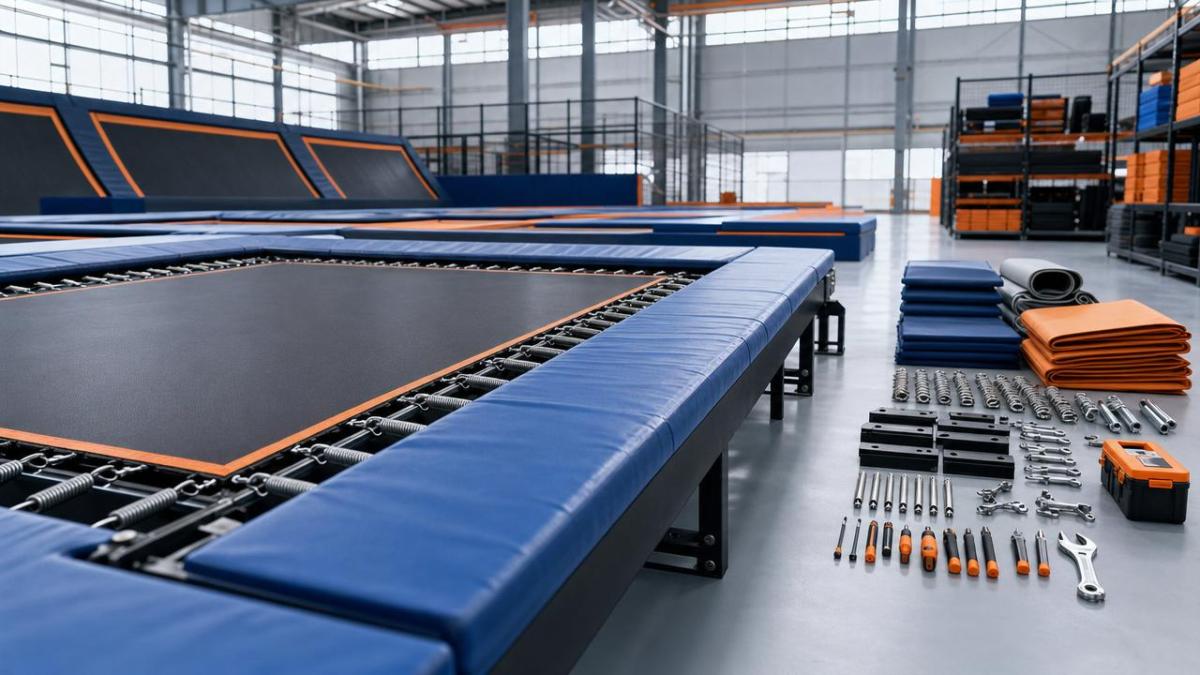
A trampoline park maintenance plan works best when it is treated as an operational control system rather than a reactive repair list. In many facilities, unplanned closures happen because wear indicators are missed for 2 to 4 weeks, replacement parts are not stocked, or inspection responsibility is spread too loosely across shifts.
The most common downtime triggers are predictable: torn jump mats, overstretched springs, loose frame connections, pad separation, foam pit contamination, and netting damage. None of these issues usually appear without warning. Most show visible or tactile signs 7 to 30 days before they become closure-level problems.
The operational cost of delayed maintenance
Even a single closed attraction zone can create a chain reaction. Queue times increase, staff redistribution becomes necessary, and guest flow shifts to neighboring areas that may already be operating at 80% to 90% of intended capacity. That extra load often accelerates wear in secondary zones as well.
For operators, the real cost is not only repair labor. It includes lost session slots, rushed emergency procurement, supervisor time, and reputational risk. A planned 30-minute morning inspection is almost always cheaper than a same-day partial shutdown lasting 3 to 6 hours.
What a maintenance plan should cover
A functional plan should divide responsibilities into daily, weekly, monthly, and quarterly actions. It should also separate user-facing checks from technical checks. Floor teams can identify visible defects, while maintenance leads or external technicians handle tension, anchoring, frame integrity, and component replacement decisions.
- Daily checks before opening and after closing
- Weekly hardware tightening and pad condition review
- Monthly deep inspection of springs, stitching, and frame contact points
- Quarterly parts planning, usage trend review, and vendor coordination
The table below shows how operators can map common park assets to recommended inspection frequency and likely downtime risk if action is delayed.
The key takeaway is that the highest-risk components are also the easiest to monitor routinely. A disciplined trampoline park maintenance schedule reduces surprises because it targets the 4 main failure categories before they affect safe operation or customer access.
Building a Maintenance Schedule Operators Can Actually Follow
A maintenance plan only works when it matches staffing reality. Parks with 10 to 25 attraction elements and multiple shift changes need routines that can be completed in 15 minutes, 45 minutes, or 2-hour blocks depending on urgency. If the process is too complex, it will fail during peak weekends.
Daily inspection workflow
Daily inspections should happen twice: once before opening and once after the last session. The opening check confirms readiness, while the closing check identifies wear caused during the day. This two-point method creates a 12 to 14 hour feedback loop instead of waiting until the next weekly review.
5-step opening routine
- Walk every lane and activity zone for visible tears, exposed metal, or displaced pads.
- Press-test pads and edge covers for compression loss, shifting, or split seams.
- Listen for unusual spring noise during low-load bounce testing.
- Check access stairs, railings, socks policy stations, and signage visibility.
- Record defects by zone and assign one of 3 statuses: open, restricted, or closed pending repair.
Weekly and monthly technical actions
Weekly reviews should go beyond visual checks. Hardware torque checks, spring alignment review, frame contact inspection, and sanitation around foam pits or airbag edges should be scheduled in lower-traffic windows. Monthly checks should include wear pattern analysis, especially in the top 20% of lanes with the highest usage.
If your park uses color-coded zones, apply the same coding to maintenance logs. For example, red can mean immediate closure, amber can mean repair within 24 hours, and green can mean monitored but safe for continued use. This removes ambiguity between operators, supervisors, and outsourced service providers.
The schedule matrix below helps operators assign realistic maintenance windows without overloading frontline staff.
This structure keeps inspection work practical. It also helps parks balance staff utilization with preventive action, which is the main objective of any downtime-focused trampoline park maintenance strategy.
Priority Components and Replacement Planning
Not all components deserve the same replacement logic. High-contact, high-fatigue parts should be monitored by cycle intensity, not just calendar time. In a busy park, two visually similar zones may age very differently if one hosts dodgeball, advanced jumping, or near-continuous weekend traffic.
Components that deserve tighter control
- Jump mats with visible fraying, surface thinning, or seam stress
- Springs showing deformation, corrosion, or inconsistent rebound
- Safety pads with compression loss greater than normal feel threshold
- Netting and enclosure points exposed to repeated contact
- Foam pit cubes or soft-landing media with hygiene or compaction issues
Operators should maintain a minimum spare inventory for fast-wear parts. A common practice is to keep enough stock for 2% to 5% of mat positions, a small reserve of springs, and replacement pad sections for the most heavily used perimeter zones. The exact quantity depends on park size, supplier lead time, and seasonal demand peaks.
How to avoid procurement-related downtime
Many parks lose more time waiting for parts than performing repairs. If lead times are 2 to 6 weeks, ordering only after failure is a high-risk practice. Procurement planning should review the previous 90 days of component wear, compare failure patterns by zone, and forecast the next quarter’s replacement needs.
For B2B buyers and operational decision-makers, vendor selection should not focus only on unit price. Availability consistency, material specification clarity, dimensional compatibility, and support for scheduled replenishment often matter more when uptime is the performance target.
Key sourcing criteria for maintenance parts
- Clear specification matching for size, attachment type, and intended zone use
- Reliable replenishment cycle, ideally within an agreed 7–21 day window
- Consistent product quality across repeat orders
- Support for batch documentation and receiving inspection
A data-minded trampoline park maintenance plan aligns replacement decisions with actual wear patterns. That is a more sustainable model than replacing everything on a fixed calendar or delaying everything until visible damage becomes unavoidable.
Documentation, Training, and Escalation Control
Maintenance quality depends on documentation quality. If records are incomplete, staff turnover will erase pattern recognition and repeat the same preventable failures. A useful log does not need to be complex, but it should capture date, zone, issue type, action taken, parts used, and return-to-service decision.
What operators should record every time
At minimum, maintenance records should include 6 fields: time, inspector name, zone identifier, defect description, risk level, and corrective action. If a zone remains open with restrictions, that should be explicitly documented along with the review deadline, such as 24 hours or the next opening shift.
Photo-based logging can improve consistency, especially for stitch wear, pad displacement, and frame abrasion points. A simple three-photo standard—overview, close-up, and repaired condition—helps supervisors verify repairs and identify recurring failure trends over 30-, 60-, and 90-day periods.
Training frontline users to spot early issues
Operators do not need engineering backgrounds to support a strong maintenance culture. They need a clear escalation checklist. Training should take 30 to 45 minutes for new staff and cover what to look for, what to touch, what noises matter, and when to stop guest access immediately.
- Visible cuts, loose seams, or exposed internal components
- Abnormal bounce feel compared with surrounding lanes
- Shifting pads or newly visible frame edges
- Loose rails, damaged netting, or unstable steps
- Contamination in foam or landing areas affecting hygiene or traction
Escalation rules that shorten closures
The best escalation systems use simple thresholds. For example, level 1 may allow same-shift correction, level 2 may require supervisor sign-off before reopening, and level 3 may require isolation and external technical review. A 3-tier model reduces confusion and limits the number of borderline cases left unresolved during busy periods.
When teams know exactly who approves a repair and what evidence is required, downtime becomes shorter and more predictable. That consistency is one of the most practical benefits of a well-run trampoline park maintenance process.
Common Maintenance Mistakes and How to Avoid Them
Many parks do not fail because they ignore maintenance completely. They fail because maintenance is inconsistent, undocumented, or focused only on visible surface issues. Operators can reduce risk significantly by avoiding a few recurring mistakes.
Mistake 1: Treating cleaning as separate from maintenance
Cleaning teams often spot early damage first, especially around pads, landing zones, and foam pits. If cleaning and maintenance logs are separated, useful defect information gets lost. A shared reporting process can improve issue detection within the same shift.
Mistake 2: Reopening too quickly after temporary fixes
Temporary repairs may restore appearance without restoring durability. If a patch, reattachment, or hardware adjustment is used as an interim step, the zone should have a specific follow-up review window, such as 24 hours, 72 hours, or after the next peak weekend.
Mistake 3: Buying replacement parts without compatibility checks
Small differences in dimensions, fastening style, or material thickness can create new wear points. Procurement teams should confirm compatibility before ordering, especially when using multiple suppliers or replacing components in older installations.
Mistake 4: Ignoring usage concentration
Traffic is rarely evenly distributed. The most popular 10% to 20% of zones may consume a disproportionate share of maintenance resources. If logs are not organized by zone, operators miss the chance to rotate use, plan replacements early, or rebalance programming to reduce fatigue concentration.
A strong trampoline park maintenance plan is most effective when it combines routine inspection, realistic staffing, spare part readiness, and simple escalation rules. For operators and on-site teams, that means fewer surprise closures, more consistent attraction availability, and better control over maintenance workload across daily and seasonal peaks.
For organizations evaluating maintenance systems, replacement parts, or operational support processes, the most valuable solutions are the ones that deliver measurable uptime, clearer documentation, and easier implementation at the site level. If you want to improve inspection consistency, reduce repair delays, or build a more dependable maintenance workflow, contact us to discuss a tailored solution, request technical guidance, or learn more about practical support options for your facility.
Search News
Hot Articles
- Carbon Fiber StructuresHow to Specify Aerospace Carbon Fiber Assemblies for Lightweight, Load-Bearing PartsJul 11, 2026
- Machine VisionXiaomi, Alibaba DAMO Academy Drive Open-Source Robotics Model Ecosystem, Lowering Algorithm Development Barriers for Overseas SMEs Adopting Chinese Robotics SolutionsMar 30, 2026
- Cobots & ArmsShanxi 'AI+' Conference Showcases Embodied Intelligence with Multinational Buyer Engagement: Key Industry ImplicationsMar 30, 2026
Popular Tags
Recommended News
 Jul 11, 2026How to Specify Aerospace Carbon Fiber Assemblies for Lightweight, Load-Bearing PartsAerospace carbon fiber assemblies: learn how to specify laminate design, load data, joining methods, and inspection controls for lighter, reliable load-bearing aerospace parts.Elena Rostova (UAV Systems Researcher)
 Mar 30, 2026Xiaomi, Alibaba DAMO Academy Drive Open-Source Robotics Model Ecosystem, Lowering Algorithm Development Barriers for Overseas SMEs Adopting Chinese Robotics SolutionsXiaomi & Alibaba DAMO Academy's open-source robotics models lower algorithm barriers for global SMEs. Boost efficiency in manufacturing, logistics & smart retail with ROS 2 compatible solutions.TSV Data Lab
 Mar 30, 2026Shanxi 'AI+' Conference Showcases Embodied Intelligence with Multinational Buyer Engagement: Key Industry ImplicationsShanxi 'AI+' Conference highlights embodied intelligence with Tesla, Ubtech & Jiantao showcasing multimodal robotics. 40+ global buyers validated tech on-site, creating new B2B channels for industrial automation & AI solutions.Chen Wei (Automation Lead Engineer)
 Mar 30, 2026Zhongguancun Unveils 6G Integrated Sensing-Computing-Intelligence Platform to Empower Embodied Robots for Global Industrial ApplicationsZhongguancun's new 6G platform revolutionizes industrial robotics with <10ms latency, empowering global automotive, logistics & port automation. Discover how this tech boosts China's smart manufacturing exports.TSV Data Lab
 Mar 30, 2026Mech-Mind Tianjin Embodied Intelligence R&D and Production Base Goes Live, Cutting Delivery Time by 20%–30% for Global Customized AMR+Vision SolutionsMech-Mind's Tianjin AMR+Vision production base cuts delivery time by 20%-30% for欧美 & Latin American markets. Discover how this PLd-certified facility accelerates customized robotics solutions for smart manufacturing and logistics.Chen Wei (Automation Lead Engineer)
 Mar 30, 2026Boao Forum Reveals 'Co-evolution of Big and Small Brains' Trend in Humanoid Robots, China's Embodied Intelligence Accelerates Adaptation to Overseas Manufacturing Service ScenariosDiscover how China's humanoid robots, featuring 'Co-evolution of Big and Small Brains,' are revolutionizing global manufacturing. Learn about Embodied Tian Gong 3.0's ISO compliance and overseas deployment at Boao Forum 2026.Chen Wei (Automation Lead Engineer)
 Mar 30, 2026China Railway Industrial Secures Patent for Embodied Robotics in Material Handling, Boosting High-Precision Delivery Capabilities for Overseas Infrastructure and Manufacturing ProjectsChina Railway Industrial's new patent for embodied robotics in material handling boosts high-precision delivery for global infrastructure & manufacturing. Discover how this innovation enhances logistics accuracy in automotive, rail transit & EPC projects.Chen Wei (Automation Lead Engineer)
 Sep 29, 2026ISO 9283 Repeatability: How to Evaluate Cobot Positioning PerformanceISO 9283 cobot repeatability explained: learn how payload, reach, approach direction, and test conditions affect positioning performance and cell capability.Chen Wei (Automation Lead Engineer)
 Sep 28, 2026Spindle Runout Measurement in Germany: DIN Standards, Methods, and Acceptance LimitsSpindle runout measurement Germany: explore DIN standards, proven methods, acceptance limits, and audit-ready practices for reliable machining quality.Dr. Marcus Vance
 Sep 27, 2026How to Select Wall-Mount Edge Devices for Space-Constrained Factory NetworksWall mount edge devices for space-constrained factories: evaluate workload, thermal design, power resilience, cable access, and network reliability for smarter deployments.TSV Data Lab
 Sep 26, 2026Machining Tolerance Analysis: How to Set Limits That Meet Function and Cost TargetsMachining tolerance analysis: learn how to set functional limits, control tolerance stacks, reduce inspection risk, and balance precision with production cost.Dr. Marcus Vance
 Sep 25, 2026How to Evaluate an Industrial Infrastructure Data Platform for Multi-Site OperationsIndustrial infrastructure data platform evaluation guide for multi-site operations: compare data quality, edge resilience, interoperability, governance, and scalable proof-of-value criteria.Victor Lin (Chief Software Architect)
 Sep 24, 2026How to Select Machine Vision Optics for Accurate Inspection at Different Working DistancesMachine vision optics selection guide for accurate inspection at every working distance. Compare FOV, pixel scale, DOF, distortion, lighting, and telecentric options.TSV Data Lab
 Sep 23, 2026How to Evaluate a Machine Vision System Integrator for High-Speed Inspection LinesChoose a machine vision system integrator with proven expertise in high-speed inspection, reliable reject timing, robust optics, and measurable acceptance criteria.TSV Data Lab
 Sep 28, 2026When is a SCADA API the right choice for connecting plant systems?SCADA API guide: learn when governed plant data integration improves traceability, security, and scalability—without compromising real-time control.Victor Lin (Chief Software Architect)
 Sep 27, 2026How SCADA data integration improves traceability across production linesSCADA data integration connects production-line data to improve traceability, accelerate quality investigations, and strengthen safety decisions.Victor Lin (Chief Software Architect)
 Sep 26, 2026What to define before starting SCADA integration planningSCADA integration planning starts with clear scope, control boundaries, data models, cybersecurity, and testing. Discover the definitions that reduce risk and costly rework.Victor Lin (Chief Software Architect)
 Sep 25, 2026How a smart factory with Industrial IoT reduces production blind spotsDiscover how a smart factory with Industrial IoT turns real-time machine, quality, and workflow data into actionable insights that reduce production blind spots and delivery risks.Victor Lin (Chief Software Architect)
 Sep 24, 2026When does Industrial IoT make smart manufacturing easier to scale?Smart manufacturing Industrial IoT scales when trusted data, interoperable systems, and secure workflows turn connected assets into measurable gains.TSV Data Lab
 Sep 23, 2026What drives ultra-precision machining cost at 1-micron tolerance?Ultra precision machining cost per part at 1 micron tolerance depends on process, material, metrology, and yield. Learn how to compare quotes confidently.Dr. Marcus Vance
 Sep 22, 2026Drone Engine-T550CC Applications: Build the UAV Power System Around the MissionAn application guide for Drone Engine-T550CC integration, covering payload planning, airframe matching, cooling, fuel, vibration, test procedures, documentation, and service preparation.Elena Rostova (UAV Systems Researcher)
 Sep 22, 2026How to Evaluate Industrial Edge Computing Vendors for Factory DeploymentIndustrial edge computing vendor evaluation guide for factories: compare latency, protocol fit, reliability, security, and lifecycle support before deployment.TSV Data Lab
 Sep 21, 2026Drone Payload Integration: Matching Power, Data, and Center of Gravity for Reliable FlightsDrone payload integration made practical: balance power, data, center of gravity, and endurance to build safer, more reliable mission-ready flights.Elena Rostova (UAV Systems Researcher)
 Sep 20, 2026Autonomous Navigation Pricing: Cost Drivers and Budget Benchmarks for AMR ProjectsAutonomous navigation price explained: compare AMR cost drivers, software, sensors, integration, safety, and lifecycle budgets to build a scalable project plan.Chen Wei (Automation Lead Engineer)