Supply Chain Traceability in North America: Key Requirements for Food and Industrial Imports
Publication Date
author
Supply chain traceability North America has moved far beyond routine recordkeeping. For food and industrial imports, it now shapes customs clearance, supplier credibility, recall readiness, and even long-term market access.
That shift matters because North American import controls are becoming more data-driven. Authorities, buyers, and compliance teams increasingly expect verifiable origin, process history, lot linkage, and labeling accuracy instead of broad supplier claims.
In practice, traceability is where regulatory compliance meets commercial risk. A shipment may be technically sellable, yet still become expensive if its records are incomplete, inconsistent, or impossible to validate quickly.
Why traceability now sits at the center of import decisions
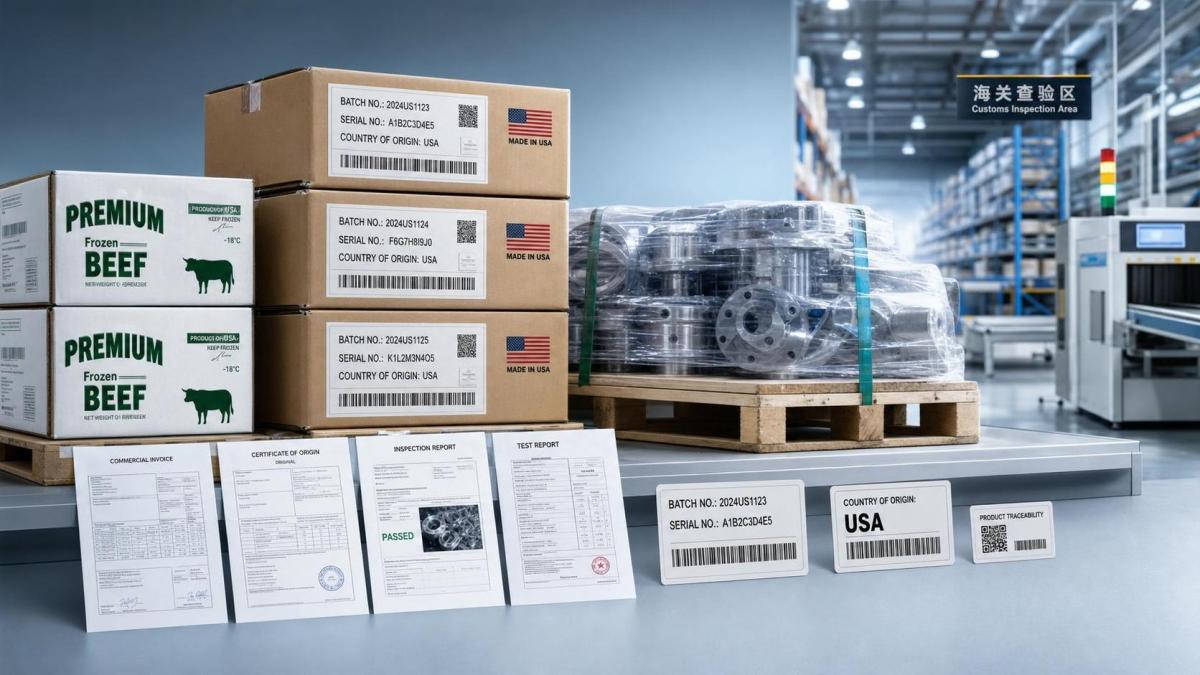
A clearer view of documentation flow helps explain why supply chain traceability North America has become a strategic issue, not just an operational one.
North American supply chains are under pressure from several directions. Regulatory agencies want faster access to source data. Buyers want stronger proof of quality. Logistics networks want fewer disputes at handoff points.
Food imports face obvious scrutiny because public health is involved. Industrial imports face a different, but equally serious, challenge: nonconforming parts, restricted materials, labeling mistakes, and undocumented process changes can disrupt production.
For organizations working with advanced manufacturing, this is especially relevant. TechStat Vanguard’s data-first perspective fits here well: reliable sourcing depends less on marketing language and more on parameters, records, tolerances, and controlled data lineage.
Simple claims such as “high quality” do not help when a lot must be isolated, a bill of materials must be verified, or a customs inquiry requires immediate supporting evidence.
What supply chain traceability North America really means
At its core, traceability is the ability to follow a product through sourcing, processing, packaging, shipping, import entry, storage, and downstream distribution.
That sounds straightforward, but the real issue is data continuity. North American traceability expectations usually depend on whether each transaction, transformation, and transfer can be linked without gaps.
For food, the chain often includes farm or ingredient source, processing facility, batch or lot code, packaging date, transport conditions, and consignee records.
For industrial goods, the chain may include raw material certificates, country of origin, heat or lot numbers, subcomponent genealogy, inspection reports, revision control, and shipment identity.
In both cases, supply chain traceability North America is only useful when records are searchable, consistent across documents, and available fast enough to support a real business decision.
Key requirements that often determine whether records hold up
The exact legal obligations vary by product type and destination. Still, several requirements appear repeatedly across food and industrial import programs.
1. Origin and entity identification
The importer should be able to identify who made the product, where it was produced, and which parties handled it before arrival.
This includes supplier names, facility addresses, manufacturer details, and, where relevant, importer of record information and customs entry references.
2. Lot, batch, or serial linkage
A traceability system breaks down quickly when batch identifiers are inconsistent. Labels, invoices, test reports, packing lists, and warehouse records must point to the same unit history.
For industrial assemblies, serial-level linkage may be necessary. For food, lot-level visibility is often the minimum workable standard.
3. Labeling and product description accuracy
Mislabeling creates more than branding risk. It can trigger customs delays, storage holds, rework costs, and credibility damage.
Descriptions should match the goods, declared origin, handling requirements, and documentation language used in trade and compliance records.
4. Supporting compliance evidence
Traceability is stronger when commercial documents are backed by technical evidence. Examples include certificates of analysis, material test reports, sanitation records, inspection data, and controlled revision histories.
This is where a data-oriented review becomes valuable. The question is not whether paperwork exists, but whether the paperwork proves the claimed product state.
Food and industrial imports do not fail in the same way
The same traceability concept applies across sectors, but failure points differ. Looking at them together helps sharpen evaluation standards.
Food traceability often centers on speed during containment and recall. Industrial traceability often centers on proof during qualification, warranty disputes, or production failure analysis.
That distinction matters because supply chain traceability North America should be evaluated by consequence, not by document count alone.
Where business evaluation usually uncovers real risk
Many suppliers can provide documents. Fewer can provide a traceable narrative that remains coherent across product changes, shipments, and audits.
The most useful review often starts with friction points rather than policy statements.
- Batch codes on cartons do not match codes on quality records.
- Certificates exist, but cannot be linked to a shipped quantity.
- Country-of-origin declarations change across invoice, label, and customs documents.
- Process revisions are informal and never reflected in controlled records.
- Supplier sub-tier sources are unknown or weakly documented.
- Digital systems store records, but retrieval takes too long during exceptions.
These gaps are especially costly in hard-tech and precision manufacturing environments. When tolerance, fatigue performance, sensor reliability, or compliance status matters, incomplete lineage becomes a technical risk, not just an administrative issue.
That is why TSV’s broader philosophy is relevant here. Engineering truth depends on traceable evidence chains, not presentation quality.
A practical framework for reviewing traceability strength
A useful evaluation should test whether the traceability system works under pressure. Routine paperwork reviews are rarely enough.
Follow one shipment end to end
Pick a recent import and trace it backward from receipt to source. Check every handoff, every identifier, and every supporting quality record.
Test exception handling
Ask how the supplier isolates affected lots, corrects labels, or proves material substitution controls. Real resilience appears during deviations, not normal flow.
Verify data granularity
Some categories need lot-level control. Others require serial-level genealogy, parameter logs, or linked inspection outputs. Granularity should match operational risk.
Check retrieval speed
Supply chain traceability North America often becomes urgent only after a hold, claim, or recall event. If documents take days to assemble, the system is weak.
Separate declarations from proof
A supplier statement may be accurate, but it should still be supported by objective records. This is particularly important for regulated food and high-spec industrial parts.
How to turn traceability into a stronger import strategy
The most effective approach is to make traceability part of sourcing design, not an afterthought during customs filing or audit preparation.
That usually means defining minimum evidence requirements before supplier approval, aligning document fields across quality and trade records, and setting escalation rules for mismatches.
It also helps to classify imports by consequence. A shelf-stable consumer food item, a carbon fiber aerospace component, and an industrial sensor gateway should not share the same review depth.
For organizations comparing cross-border suppliers, supply chain traceability North America becomes a useful ranking tool. It reveals who can support long-cycle trust, not just low initial price.
The next step is straightforward: map the data points that must survive every transfer, test one high-risk import lane against that map, and identify where evidence breaks. That exercise usually shows whether the supply base is merely compliant on paper or genuinely verifiable in operation.
Search News
Hot Articles
- Carbon Fiber StructuresHow to Specify Aerospace Carbon Fiber Assemblies for Lightweight, Load-Bearing PartsJul 11, 2026
- Machine VisionXiaomi, Alibaba DAMO Academy Drive Open-Source Robotics Model Ecosystem, Lowering Algorithm Development Barriers for Overseas SMEs Adopting Chinese Robotics SolutionsMar 30, 2026
- Cobots & ArmsShanxi 'AI+' Conference Showcases Embodied Intelligence with Multinational Buyer Engagement: Key Industry ImplicationsMar 30, 2026
Popular Tags
Recommended News
 Jul 11, 2026How to Specify Aerospace Carbon Fiber Assemblies for Lightweight, Load-Bearing PartsAerospace carbon fiber assemblies: learn how to specify laminate design, load data, joining methods, and inspection controls for lighter, reliable load-bearing aerospace parts.Elena Rostova (UAV Systems Researcher)
 Mar 30, 2026Xiaomi, Alibaba DAMO Academy Drive Open-Source Robotics Model Ecosystem, Lowering Algorithm Development Barriers for Overseas SMEs Adopting Chinese Robotics SolutionsXiaomi & Alibaba DAMO Academy's open-source robotics models lower algorithm barriers for global SMEs. Boost efficiency in manufacturing, logistics & smart retail with ROS 2 compatible solutions.TSV Data Lab
 Mar 30, 2026Shanxi 'AI+' Conference Showcases Embodied Intelligence with Multinational Buyer Engagement: Key Industry ImplicationsShanxi 'AI+' Conference highlights embodied intelligence with Tesla, Ubtech & Jiantao showcasing multimodal robotics. 40+ global buyers validated tech on-site, creating new B2B channels for industrial automation & AI solutions.Chen Wei (Automation Lead Engineer)
 Mar 30, 2026Zhongguancun Unveils 6G Integrated Sensing-Computing-Intelligence Platform to Empower Embodied Robots for Global Industrial ApplicationsZhongguancun's new 6G platform revolutionizes industrial robotics with <10ms latency, empowering global automotive, logistics & port automation. Discover how this tech boosts China's smart manufacturing exports.TSV Data Lab
 Mar 30, 2026Mech-Mind Tianjin Embodied Intelligence R&D and Production Base Goes Live, Cutting Delivery Time by 20%–30% for Global Customized AMR+Vision SolutionsMech-Mind's Tianjin AMR+Vision production base cuts delivery time by 20%-30% for欧美 & Latin American markets. Discover how this PLd-certified facility accelerates customized robotics solutions for smart manufacturing and logistics.Chen Wei (Automation Lead Engineer)
 Mar 30, 2026Boao Forum Reveals 'Co-evolution of Big and Small Brains' Trend in Humanoid Robots, China's Embodied Intelligence Accelerates Adaptation to Overseas Manufacturing Service ScenariosDiscover how China's humanoid robots, featuring 'Co-evolution of Big and Small Brains,' are revolutionizing global manufacturing. Learn about Embodied Tian Gong 3.0's ISO compliance and overseas deployment at Boao Forum 2026.Chen Wei (Automation Lead Engineer)
 Mar 30, 2026China Railway Industrial Secures Patent for Embodied Robotics in Material Handling, Boosting High-Precision Delivery Capabilities for Overseas Infrastructure and Manufacturing ProjectsChina Railway Industrial's new patent for embodied robotics in material handling boosts high-precision delivery for global infrastructure & manufacturing. Discover how this innovation enhances logistics accuracy in automotive, rail transit & EPC projects.Chen Wei (Automation Lead Engineer)
 Oct 11, 2026How Procurement-Oriented Content Taxonomy Improves B2B Buying JourneysProcurement-oriented content taxonomy streamlines B2B buying journeys with clearer evidence, supplier comparisons, risk visibility, and faster approvals.TSV Data Lab
 Oct 10, 2026How to Select a Machine Performance Monitoring Platform for OEE and Downtime ReductionMachine performance monitoring platform selection guide: validate machine states, OEE data, downtime reasons, integrations, and scalability to reduce losses with confidence.TSV Data Lab
 Oct 08, 2026How to Machine Inconel 625 Blades Without Heat Cracks or Edge ChippingInconel 625 blade machining guide: prevent heat cracks, edge chipping, chatter, and work hardening with proven tooling, cooling, fixturing, and inspection strategies.Dr. Marcus Vance
 Oct 07, 2026How to Evaluate an HMI Panel Distributor for Industrial Automation ProjectsHMI panel distributor evaluation guide: verify technical compatibility, traceability, supply reliability, lifecycle support, and total cost for automation projects.Victor Lin (Chief Software Architect)
 Oct 06, 2026Navigation Fault Tolerance Standards for AMRs: What Safety Teams Must VerifyNavigation fault tolerance standards: learn what AMR safety teams must verify, from localization loss and sensor faults to stopping distance, safe restart, and site-specific validation.Chen Wei (Automation Lead Engineer)
 Oct 05, 2026Calculating Edge Computing Total Cost of Ownership Across Distributed SitesEdge computing ownership cost explained: calculate deployment, energy, connectivity, security, remote support, and refresh costs across distributed sites.TSV Data Lab
 Oct 04, 2026CAD/CAM Benchmarking in the GCC: What Manufacturers Should Ask a ConsultantCAD CAM benchmark consultant GCC guide: learn the key questions manufacturers should ask to validate post-processors, workflows, machine performance, and production risk.Victor Lin (Chief Software Architect)
 Oct 03, 2026Selecting Automotive Radar Sensor Modules for ADAS Range, Resolution, and IntegrationAutomotive radar sensor module selection guide for ADAS: compare range, resolution, field of view, latency, and integration to build safer, reliable vehicle systems.TSV Data Lab
 Oct 02, 2026How to Qualify Machined Parts Suppliers for Hard Tech ProgramsHard tech supply chain machined parts demand rigorous supplier qualification. Learn how to assess capability, traceability, quality controls, and delivery resilience.Dr. Marcus Vance
 Oct 01, 2026How to Select an Outdoor Security Radar Sensor for Perimeter Detection?Outdoor security radar sensor selection guide: compare range, accuracy, false-alarm control, integration, and field testing for reliable perimeter detection.TSV Data Lab
 Sep 30, 2026How to Evaluate Solid-State LiDAR Hardware for Outdoor Autonomous VehiclesSolid state LiDAR hardware evaluation guide for outdoor autonomous vehicles—compare range, point-cloud quality, environmental resilience, integration, and safety.TSV Data Lab
 Sep 29, 2026ISO 9283 Repeatability: How to Evaluate Cobot Positioning PerformanceISO 9283 cobot repeatability explained: learn how payload, reach, approach direction, and test conditions affect positioning performance and cell capability.Chen Wei (Automation Lead Engineer)
 Oct 11, 2026How payload and reach change the cost of an industrial robotCost of industrial robot systems depends heavily on payload and reach. Learn how sizing, torque, tooling, safety, and lifecycle factors shape smarter automation investments.Chen Wei (Automation Lead Engineer)
 Oct 10, 2026When does the cost of industrial robots pay back in high-volume production?Cost of industrial robots: discover how high-volume manufacturers calculate payback through uptime, cycle time, labor, quality, and integration before investing.Chen Wei (Automation Lead Engineer)
 Oct 09, 2026What does a manufacturing robot really cost beyond the purchase price?Manufacturing robot cost goes far beyond the purchase price. Explore integration, tooling, safety, uptime, and total ownership factors for smarter automation investments.Chen Wei (Automation Lead Engineer)
 Oct 08, 2026AGV vs. AMR: Which Is Better for Frequently Changing Routes?Which is better for changing routes? Compare AGVs and AMRs for flexible navigation, docking precision, traffic control, and faster facility reconfiguration.Chen Wei (Automation Lead Engineer)
 Oct 07, 2026How Much Does an Automated Guided Vehicle Cost in 2026?How much does an automated guided vehicle cost in 2026? Explore AGV price ranges, hidden deployment costs, and smart buying factors for stronger ROI.Chen Wei (Automation Lead Engineer)