Is a trampoline park for sale worth the retrofit cost
Publication Date
author
Evaluating a trampoline park for sale goes far beyond purchase price: the real question is whether retrofit costs can unlock safer operations, stronger compliance, and higher long-term returns. For business evaluators, a disciplined review of structural upgrades, equipment replacement cycles, insurance implications, and market repositioning potential is essential before deciding if the asset is a turnaround opportunity or a capital-intensive risk.
Why the evaluation logic around a trampoline park for sale is changing
The market view of a trampoline park for sale has shifted in recent years. Buyers once focused mainly on location, square footage, and headline revenue. Today, the more important question is whether the property can be upgraded into a safer, more efficient, and more insurable operation without destroying return on invested capital. This change matters because indoor entertainment assets are no longer judged only as leisure venues; they are being assessed as operational risk platforms with heavy compliance exposure.
Several signals explain this transition. Insurance carriers have tightened underwriting standards. Consumers increasingly expect cleaner facilities, visible safety controls, and digital booking convenience. Municipal inspectors are more attentive to occupancy rules, emergency access, fire systems, and structural modifications. At the same time, competition from family entertainment centers, immersive attractions, and mixed-use recreation venues has raised the bar for guest experience. In that environment, a trampoline park for sale may look inexpensive upfront but still require a significant retrofit before it can compete.
For evaluators, this means retrofit cost is no longer a side note in due diligence. It is often the central variable that determines whether the asset is undervalued, fairly priced, or fundamentally mispriced.
The strongest trend signals buyers should not ignore
A serious review of any trampoline park for sale should begin with the external changes shaping future performance. The most important signals are not speculative; they are operational realities that directly affect cash flow, reopening timelines, and capex planning.
These shifts make one point clear: the value of a trampoline park for sale is increasingly linked to the cost and speed of modernization. A property that can be retrofitted efficiently may become a strong local asset. A property with hidden structural, legal, or mechanical issues may consume capital far beyond its apparent bargain price.
What is actually driving retrofit costs higher
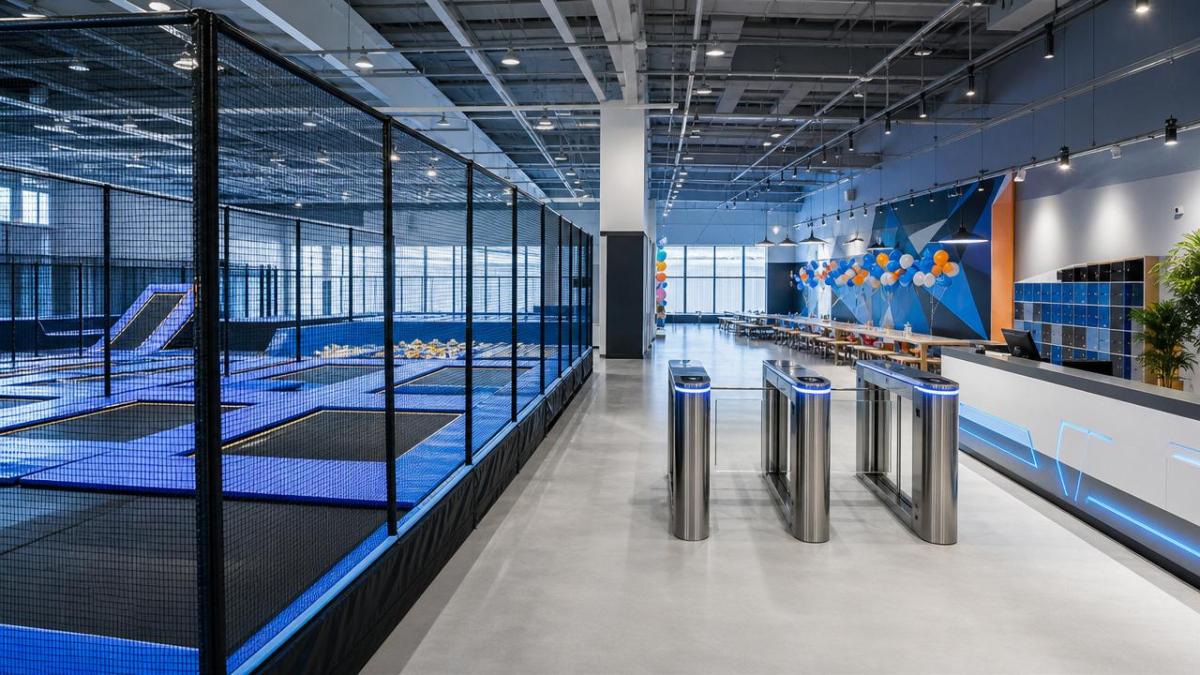
Retrofit budgets are rising because the definition of “good enough” has changed. In the past, a buyer might have accepted cosmetic wear and planned gradual improvements. That approach is less practical now. Buyers often need to solve multiple issues before relaunch: replacing worn mats, refreshing foam pits or airbag systems, upgrading HVAC, improving restroom capacity, reworking party spaces, and modernizing front-desk software. If the building was not originally designed for this use, structural adaptation can push costs up quickly.
Another cost driver is downtime. When evaluating a trampoline park for sale, the true retrofit burden includes not just construction expense but also the revenue lost while permits, inspections, vendor scheduling, and repairs delay opening. That is why experienced evaluators separate capex into direct cost, timing risk, and reopening risk. A cheaper purchase with a six-month delay can underperform a more expensive asset that can reopen in sixty days.
There is also a strategic driver: older trampoline parks often need concept reinvention, not just maintenance. If nearby competitors already offer climbing walls, ninja courses, interactive projection games, or premium birthday packages, then a simple replacement of worn parts may not be enough. The retrofit question becomes commercial as well as technical: are you restoring an old model, or funding a more competitive one?
How retrofit economics affect different decision-makers
Not every stakeholder sees a trampoline park for sale through the same lens. A useful evaluation framework maps the likely impact by role, because purchase decisions often fail when one team underestimates a risk that another team later has to absorb.
For this reason, the best acquisition reviews treat a trampoline park for sale as a cross-functional diligence case. Finance, operations, property, legal, and risk management should all review the same site before a final bid is made.
The new evaluation standard: from purchase price to total repositioning cost
A common mistake is comparing asking price against trailing revenue without properly calculating repositioning cost. In today’s market, the more realistic measure is total cost to operational readiness. That figure should include acquisition price, retrofit capex, code remediation, initial inventory, staffing ramp, insurance deposits, technology updates, marketing relaunch, and working capital through stabilization.
Search News
Hot Articles
- Carbon Fiber StructuresHow to Specify Aerospace Carbon Fiber Assemblies for Lightweight, Load-Bearing PartsJul 11, 2026
- Machine VisionXiaomi, Alibaba DAMO Academy Drive Open-Source Robotics Model Ecosystem, Lowering Algorithm Development Barriers for Overseas SMEs Adopting Chinese Robotics SolutionsMar 30, 2026
- Cobots & ArmsShanxi 'AI+' Conference Showcases Embodied Intelligence with Multinational Buyer Engagement: Key Industry ImplicationsMar 30, 2026
Popular Tags
Recommended News
 Jul 11, 2026How to Specify Aerospace Carbon Fiber Assemblies for Lightweight, Load-Bearing PartsAerospace carbon fiber assemblies: learn how to specify laminate design, load data, joining methods, and inspection controls for lighter, reliable load-bearing aerospace parts.Elena Rostova (UAV Systems Researcher)
 Mar 30, 2026Xiaomi, Alibaba DAMO Academy Drive Open-Source Robotics Model Ecosystem, Lowering Algorithm Development Barriers for Overseas SMEs Adopting Chinese Robotics SolutionsXiaomi & Alibaba DAMO Academy's open-source robotics models lower algorithm barriers for global SMEs. Boost efficiency in manufacturing, logistics & smart retail with ROS 2 compatible solutions.TSV Data Lab
 Mar 30, 2026Shanxi 'AI+' Conference Showcases Embodied Intelligence with Multinational Buyer Engagement: Key Industry ImplicationsShanxi 'AI+' Conference highlights embodied intelligence with Tesla, Ubtech & Jiantao showcasing multimodal robotics. 40+ global buyers validated tech on-site, creating new B2B channels for industrial automation & AI solutions.Chen Wei (Automation Lead Engineer)
 Mar 30, 2026Zhongguancun Unveils 6G Integrated Sensing-Computing-Intelligence Platform to Empower Embodied Robots for Global Industrial ApplicationsZhongguancun's new 6G platform revolutionizes industrial robotics with <10ms latency, empowering global automotive, logistics & port automation. Discover how this tech boosts China's smart manufacturing exports.TSV Data Lab
 Mar 30, 2026Mech-Mind Tianjin Embodied Intelligence R&D and Production Base Goes Live, Cutting Delivery Time by 20%–30% for Global Customized AMR+Vision SolutionsMech-Mind's Tianjin AMR+Vision production base cuts delivery time by 20%-30% for欧美 & Latin American markets. Discover how this PLd-certified facility accelerates customized robotics solutions for smart manufacturing and logistics.Chen Wei (Automation Lead Engineer)
 Mar 30, 2026Boao Forum Reveals 'Co-evolution of Big and Small Brains' Trend in Humanoid Robots, China's Embodied Intelligence Accelerates Adaptation to Overseas Manufacturing Service ScenariosDiscover how China's humanoid robots, featuring 'Co-evolution of Big and Small Brains,' are revolutionizing global manufacturing. Learn about Embodied Tian Gong 3.0's ISO compliance and overseas deployment at Boao Forum 2026.Chen Wei (Automation Lead Engineer)
 Mar 30, 2026China Railway Industrial Secures Patent for Embodied Robotics in Material Handling, Boosting High-Precision Delivery Capabilities for Overseas Infrastructure and Manufacturing ProjectsChina Railway Industrial's new patent for embodied robotics in material handling boosts high-precision delivery for global infrastructure & manufacturing. Discover how this innovation enhances logistics accuracy in automotive, rail transit & EPC projects.Chen Wei (Automation Lead Engineer)
 Sep 28, 2026Spindle Runout Measurement in Germany: DIN Standards, Methods, and Acceptance LimitsSpindle runout measurement Germany: explore DIN standards, proven methods, acceptance limits, and audit-ready practices for reliable machining quality.Dr. Marcus Vance
 Sep 27, 2026How to Select Wall-Mount Edge Devices for Space-Constrained Factory NetworksWall mount edge devices for space-constrained factories: evaluate workload, thermal design, power resilience, cable access, and network reliability for smarter deployments.TSV Data Lab
 Sep 26, 2026Machining Tolerance Analysis: How to Set Limits That Meet Function and Cost TargetsMachining tolerance analysis: learn how to set functional limits, control tolerance stacks, reduce inspection risk, and balance precision with production cost.Dr. Marcus Vance
 Sep 25, 2026How to Evaluate an Industrial Infrastructure Data Platform for Multi-Site OperationsIndustrial infrastructure data platform evaluation guide for multi-site operations: compare data quality, edge resilience, interoperability, governance, and scalable proof-of-value criteria.Victor Lin (Chief Software Architect)
 Sep 24, 2026How to Select Machine Vision Optics for Accurate Inspection at Different Working DistancesMachine vision optics selection guide for accurate inspection at every working distance. Compare FOV, pixel scale, DOF, distortion, lighting, and telecentric options.TSV Data Lab
 Sep 23, 2026How to Evaluate a Machine Vision System Integrator for High-Speed Inspection LinesChoose a machine vision system integrator with proven expertise in high-speed inspection, reliable reject timing, robust optics, and measurable acceptance criteria.TSV Data Lab
 Sep 28, 2026When is a SCADA API the right choice for connecting plant systems?SCADA API guide: learn when governed plant data integration improves traceability, security, and scalability—without compromising real-time control.Victor Lin (Chief Software Architect)
 Sep 27, 2026How SCADA data integration improves traceability across production linesSCADA data integration connects production-line data to improve traceability, accelerate quality investigations, and strengthen safety decisions.Victor Lin (Chief Software Architect)
 Sep 26, 2026What to define before starting SCADA integration planningSCADA integration planning starts with clear scope, control boundaries, data models, cybersecurity, and testing. Discover the definitions that reduce risk and costly rework.Victor Lin (Chief Software Architect)
 Sep 25, 2026How a smart factory with Industrial IoT reduces production blind spotsDiscover how a smart factory with Industrial IoT turns real-time machine, quality, and workflow data into actionable insights that reduce production blind spots and delivery risks.Victor Lin (Chief Software Architect)
 Sep 24, 2026When does Industrial IoT make smart manufacturing easier to scale?Smart manufacturing Industrial IoT scales when trusted data, interoperable systems, and secure workflows turn connected assets into measurable gains.TSV Data Lab
 Sep 23, 2026What drives ultra-precision machining cost at 1-micron tolerance?Ultra precision machining cost per part at 1 micron tolerance depends on process, material, metrology, and yield. Learn how to compare quotes confidently.Dr. Marcus Vance
 Sep 22, 2026Drone Engine-T550CC Applications: Build the UAV Power System Around the MissionAn application guide for Drone Engine-T550CC integration, covering payload planning, airframe matching, cooling, fuel, vibration, test procedures, documentation, and service preparation.Elena Rostova (UAV Systems Researcher)
 Sep 22, 2026How to Evaluate Industrial Edge Computing Vendors for Factory DeploymentIndustrial edge computing vendor evaluation guide for factories: compare latency, protocol fit, reliability, security, and lifecycle support before deployment.TSV Data Lab
 Sep 21, 2026Drone Payload Integration: Matching Power, Data, and Center of Gravity for Reliable FlightsDrone payload integration made practical: balance power, data, center of gravity, and endurance to build safer, more reliable mission-ready flights.Elena Rostova (UAV Systems Researcher)
 Sep 20, 2026Autonomous Navigation Pricing: Cost Drivers and Budget Benchmarks for AMR ProjectsAutonomous navigation price explained: compare AMR cost drivers, software, sensors, integration, safety, and lifecycle budgets to build a scalable project plan.Chen Wei (Automation Lead Engineer)
 Sep 19, 2026How to Scope Automation Integration Services for Multi-System Factory ProjectsAutomation integration services: learn how to scope multi-system factory projects with clear workflows, interface contracts, safety boundaries, and acceptance criteria.Victor Lin (Chief Software Architect)