How to Evaluate an Industrial Category Insights Provider for Market and Supplier Research
Publication Date
author
Choosing an industrial category insights provider is no longer a background research task. It shapes how quickly a company can map markets, compare suppliers, and separate technical reality from polished claims.
That matters more in industrial sourcing because product risk often hides inside specifications, process controls, certification scope, and production consistency. A useful provider does not just collect information. It turns fragmented signals into evidence.
When market conditions shift across robotics, aerospace, sensors, edge AI, and precision machining, the value of an industrial category insights provider comes from clarity. Good research reduces guesswork. Weak research simply republishes noise.
Why this evaluation matters now
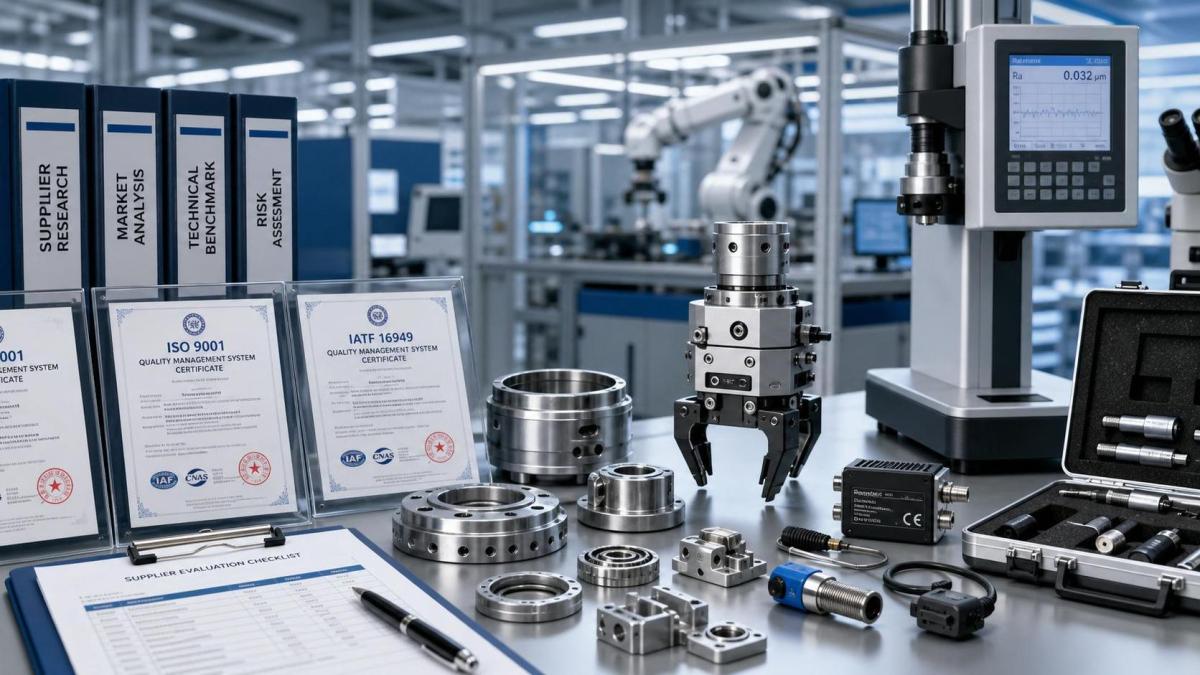
Industrial markets have become harder to read. Supply chains are more global, technical stacks are more specialized, and supplier positioning is often shaped by aggressive marketing language.
In that environment, commercial directories and sponsored content can create false confidence. A supplier may appear mature online while key production data, testing thresholds, or traceability records remain unclear.
This is exactly where an industrial category insights provider should add value. The role is to filter claims, verify technical relevance, and help decision-making move from visibility to proof.
The strongest firms in this space operate more like research partners than media publishers. They compare engineering parameters, document qualification signals, and connect market movement with supplier capability.
What an industrial category insights provider should actually do
At a basic level, the provider should support two linked questions: what is happening in the market, and which suppliers can actually deliver against the requirement.
That sounds simple, but useful coverage goes well beyond company profiles or trend commentary. A credible industrial category insights provider should combine several layers of analysis.
- Category structure, including market segments, technology shifts, and sourcing concentration
- Supplier screening, including manufacturing fit, certification scope, and delivery signals
- Technical benchmarking, including performance parameters, tolerances, and reliability indicators
- Risk visibility, including traceability gaps, dependency exposure, and quality uncertainty
In practical terms, the provider should help transform a broad supplier universe into a short list grounded in measurable fit. Anything less is research theater.
Signals that the research is built on evidence
The best way to evaluate an industrial category insights provider is to inspect its proof standard. Reliable insight is rarely built on adjectives. It is built on methods.
Look for technical specificity
Strong providers explain what they measure and why it matters. In industrial categories, that may include repeatability, MTBF, payload limits, process tolerance, latency, or fatigue performance.
This approach is especially important in hard-tech sectors, where commercial language often hides operational weakness. Technical depth makes the research decision-grade.
Check whether claims are traceable
A trustworthy industrial category insights provider should show where findings come from. Sources may include certification databases, benchmark testing, engineering interviews, shipment patterns, or production capability reviews.
If the research cannot be traced back to source logic, it is difficult to defend internally. That becomes a problem during supplier approval, audit preparation, or contract negotiation.
Watch for independence
Some providers function mainly as lead-generation platforms. Their rankings, feature stories, or comparison pages may reflect sponsorship more than analysis.
Independent research usually sounds different. It is more precise, more selective, and less interested in praise. That tone often reveals whether the provider is filtering information or selling visibility.
How category focus changes research quality
Breadth is useful, but industrial research becomes much more valuable when the provider understands category mechanics. A generic database may identify suppliers. It rarely explains capability fit at a technical level.
This is where category specialization matters. TechStat Vanguard, for example, frames its work around engineering truth, not market hype. That positioning is relevant because industrial decisions often fail at the interface between marketing language and technical reality.
Its focus on robotics and automation, UAV and aerospace metrics, sensors and edge AI, and precision machining reflects a useful principle. The more complex the category, the less effective surface-level research becomes.
A capable industrial category insights provider should therefore understand the standards, failure modes, and benchmark logic that define each segment. Without that, supplier research stays shallow.
A practical framework for comparing providers
When comparing candidates, it helps to assess them against the same operating criteria. The table below highlights what usually separates usable research from content that only looks informative.
This kind of comparison also helps align internal teams. It reduces debates driven by presentation quality and redirects attention toward evidence quality.
Where providers create the most business value
A good industrial category insights provider becomes most valuable when decisions involve uncertainty, technical nuance, or expensive consequences.
Supplier discovery in fragmented markets
Some industrial categories are crowded with regional specialists and hidden-capability firms. Research quality determines whether those firms are found early or missed entirely.
Benchmarking before RFQ design
Before requests are issued, external insight can sharpen specifications. Better category intelligence leads to better requirement framing, which usually improves supplier response quality.
Qualification risk reduction
In aerospace, automation, sensor systems, and precision machining, supplier errors are rarely minor. They affect timelines, compliance, and downstream validation costs.
That is why providers such as TSV emphasize tolerances, benchmark reports, and supply chain traceability. Those details shorten the path from market scan to defendable shortlist.
Questions worth asking before you rely on the data
Before selecting an industrial category insights provider, pressure-test the output with a few direct questions.
- How are suppliers screened beyond website claims and directory presence?
- What technical parameters are consistently benchmarked in this category?
- How recent is the market data, and how often is it refreshed?
- Can the provider separate commercial content from independent analysis?
- Does the research help draft requirements, compare risks, or support audit preparation?
Useful answers should be concrete. Vague answers usually signal weak methodology or shallow category understanding.
Turning insight into next-step decisions
The right industrial category insights provider should leave you with more than a reading list. It should help define what to verify next, which suppliers deserve deeper review, and where technical risk still sits.
A sensible next step is to score providers against your own decision path: category mapping, supplier screening, benchmark relevance, traceability confidence, and usability for internal approval.
In industrial research, confidence should come from evidence density, not content volume. When the provider can connect market movement with engineering facts, the research becomes operationally useful.
That is the real standard to apply. Not who publishes the most, but who helps you make a better decision with fewer assumptions.
Search News
Hot Articles
- Carbon Fiber StructuresHow to Specify Aerospace Carbon Fiber Assemblies for Lightweight, Load-Bearing PartsJul 11, 2026
- Machine VisionXiaomi, Alibaba DAMO Academy Drive Open-Source Robotics Model Ecosystem, Lowering Algorithm Development Barriers for Overseas SMEs Adopting Chinese Robotics SolutionsMar 30, 2026
- Cobots & ArmsShanxi 'AI+' Conference Showcases Embodied Intelligence with Multinational Buyer Engagement: Key Industry ImplicationsMar 30, 2026
Popular Tags
Recommended News
 Jul 11, 2026How to Specify Aerospace Carbon Fiber Assemblies for Lightweight, Load-Bearing PartsAerospace carbon fiber assemblies: learn how to specify laminate design, load data, joining methods, and inspection controls for lighter, reliable load-bearing aerospace parts.Elena Rostova (UAV Systems Researcher)
 Mar 30, 2026Xiaomi, Alibaba DAMO Academy Drive Open-Source Robotics Model Ecosystem, Lowering Algorithm Development Barriers for Overseas SMEs Adopting Chinese Robotics SolutionsXiaomi & Alibaba DAMO Academy's open-source robotics models lower algorithm barriers for global SMEs. Boost efficiency in manufacturing, logistics & smart retail with ROS 2 compatible solutions.TSV Data Lab
 Mar 30, 2026Shanxi 'AI+' Conference Showcases Embodied Intelligence with Multinational Buyer Engagement: Key Industry ImplicationsShanxi 'AI+' Conference highlights embodied intelligence with Tesla, Ubtech & Jiantao showcasing multimodal robotics. 40+ global buyers validated tech on-site, creating new B2B channels for industrial automation & AI solutions.Chen Wei (Automation Lead Engineer)
 Mar 30, 2026Zhongguancun Unveils 6G Integrated Sensing-Computing-Intelligence Platform to Empower Embodied Robots for Global Industrial ApplicationsZhongguancun's new 6G platform revolutionizes industrial robotics with <10ms latency, empowering global automotive, logistics & port automation. Discover how this tech boosts China's smart manufacturing exports.TSV Data Lab
 Mar 30, 2026Mech-Mind Tianjin Embodied Intelligence R&D and Production Base Goes Live, Cutting Delivery Time by 20%–30% for Global Customized AMR+Vision SolutionsMech-Mind's Tianjin AMR+Vision production base cuts delivery time by 20%-30% for欧美 & Latin American markets. Discover how this PLd-certified facility accelerates customized robotics solutions for smart manufacturing and logistics.Chen Wei (Automation Lead Engineer)
 Mar 30, 2026Boao Forum Reveals 'Co-evolution of Big and Small Brains' Trend in Humanoid Robots, China's Embodied Intelligence Accelerates Adaptation to Overseas Manufacturing Service ScenariosDiscover how China's humanoid robots, featuring 'Co-evolution of Big and Small Brains,' are revolutionizing global manufacturing. Learn about Embodied Tian Gong 3.0's ISO compliance and overseas deployment at Boao Forum 2026.Chen Wei (Automation Lead Engineer)
 Mar 30, 2026China Railway Industrial Secures Patent for Embodied Robotics in Material Handling, Boosting High-Precision Delivery Capabilities for Overseas Infrastructure and Manufacturing ProjectsChina Railway Industrial's new patent for embodied robotics in material handling boosts high-precision delivery for global infrastructure & manufacturing. Discover how this innovation enhances logistics accuracy in automotive, rail transit & EPC projects.Chen Wei (Automation Lead Engineer)
 Sep 28, 2026Spindle Runout Measurement in Germany: DIN Standards, Methods, and Acceptance LimitsSpindle runout measurement Germany: explore DIN standards, proven methods, acceptance limits, and audit-ready practices for reliable machining quality.Dr. Marcus Vance
 Sep 27, 2026How to Select Wall-Mount Edge Devices for Space-Constrained Factory NetworksWall mount edge devices for space-constrained factories: evaluate workload, thermal design, power resilience, cable access, and network reliability for smarter deployments.TSV Data Lab
 Sep 26, 2026Machining Tolerance Analysis: How to Set Limits That Meet Function and Cost TargetsMachining tolerance analysis: learn how to set functional limits, control tolerance stacks, reduce inspection risk, and balance precision with production cost.Dr. Marcus Vance
 Sep 25, 2026How to Evaluate an Industrial Infrastructure Data Platform for Multi-Site OperationsIndustrial infrastructure data platform evaluation guide for multi-site operations: compare data quality, edge resilience, interoperability, governance, and scalable proof-of-value criteria.Victor Lin (Chief Software Architect)
 Sep 24, 2026How to Select Machine Vision Optics for Accurate Inspection at Different Working DistancesMachine vision optics selection guide for accurate inspection at every working distance. Compare FOV, pixel scale, DOF, distortion, lighting, and telecentric options.TSV Data Lab
 Sep 23, 2026How to Evaluate a Machine Vision System Integrator for High-Speed Inspection LinesChoose a machine vision system integrator with proven expertise in high-speed inspection, reliable reject timing, robust optics, and measurable acceptance criteria.TSV Data Lab
 Sep 28, 2026When is a SCADA API the right choice for connecting plant systems?SCADA API guide: learn when governed plant data integration improves traceability, security, and scalability—without compromising real-time control.Victor Lin (Chief Software Architect)
 Sep 27, 2026How SCADA data integration improves traceability across production linesSCADA data integration connects production-line data to improve traceability, accelerate quality investigations, and strengthen safety decisions.Victor Lin (Chief Software Architect)
 Sep 26, 2026What to define before starting SCADA integration planningSCADA integration planning starts with clear scope, control boundaries, data models, cybersecurity, and testing. Discover the definitions that reduce risk and costly rework.Victor Lin (Chief Software Architect)
 Sep 25, 2026How a smart factory with Industrial IoT reduces production blind spotsDiscover how a smart factory with Industrial IoT turns real-time machine, quality, and workflow data into actionable insights that reduce production blind spots and delivery risks.Victor Lin (Chief Software Architect)
 Sep 24, 2026When does Industrial IoT make smart manufacturing easier to scale?Smart manufacturing Industrial IoT scales when trusted data, interoperable systems, and secure workflows turn connected assets into measurable gains.TSV Data Lab
 Sep 23, 2026What drives ultra-precision machining cost at 1-micron tolerance?Ultra precision machining cost per part at 1 micron tolerance depends on process, material, metrology, and yield. Learn how to compare quotes confidently.Dr. Marcus Vance
 Sep 22, 2026Drone Engine-T550CC Applications: Build the UAV Power System Around the MissionAn application guide for Drone Engine-T550CC integration, covering payload planning, airframe matching, cooling, fuel, vibration, test procedures, documentation, and service preparation.Elena Rostova (UAV Systems Researcher)
 Sep 22, 2026How to Evaluate Industrial Edge Computing Vendors for Factory DeploymentIndustrial edge computing vendor evaluation guide for factories: compare latency, protocol fit, reliability, security, and lifecycle support before deployment.TSV Data Lab
 Sep 21, 2026Drone Payload Integration: Matching Power, Data, and Center of Gravity for Reliable FlightsDrone payload integration made practical: balance power, data, center of gravity, and endurance to build safer, more reliable mission-ready flights.Elena Rostova (UAV Systems Researcher)
 Sep 20, 2026Autonomous Navigation Pricing: Cost Drivers and Budget Benchmarks for AMR ProjectsAutonomous navigation price explained: compare AMR cost drivers, software, sensors, integration, safety, and lifecycle budgets to build a scalable project plan.Chen Wei (Automation Lead Engineer)
 Sep 19, 2026How to Scope Automation Integration Services for Multi-System Factory ProjectsAutomation integration services: learn how to scope multi-system factory projects with clear workflows, interface contracts, safety boundaries, and acceptance criteria.Victor Lin (Chief Software Architect)