How an embedded ai module supplier impacts deployment
Publication Date
author
Choosing the right embedded ai module supplier can determine whether an engineering project scales smoothly or stalls in testing, integration, and procurement review. For project managers and technical leads, deployment success depends on more than claimed performance—it requires verified latency, thermal stability, interface compatibility, and long-term supply consistency. This article examines how supplier selection directly shapes deployment speed, risk control, and measurable project outcomes.
Why does an embedded AI module supplier influence deployment more than teams expect?
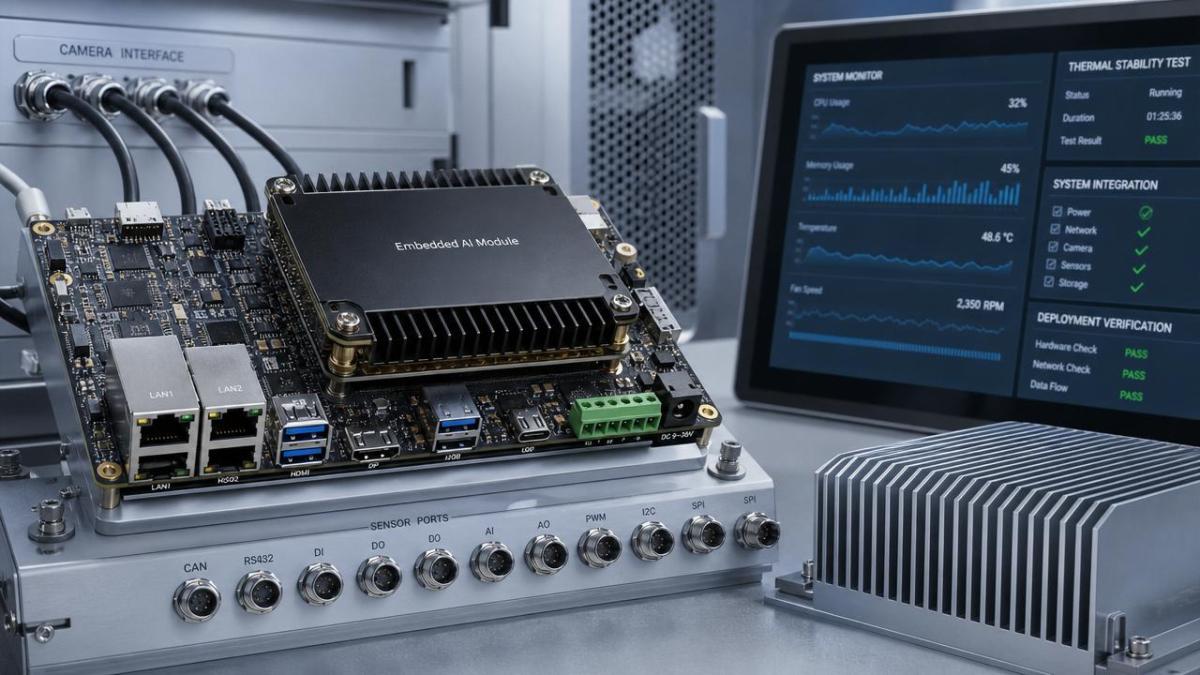
In many engineering programs, the embedded AI module is treated as a component decision. In practice, the embedded ai module supplier becomes a deployment variable that affects schedule, validation effort, integration burden, and post-launch maintainability.
That matters across robotics, industrial automation, UAV payloads, smart vision nodes, and edge gateways. A module may benchmark well in a lab, yet still fail a project if the supplier cannot support thermal tuning, firmware adaptation, or stable revision control.
For project managers, the risk rarely appears on day one. It shows up later as delayed driver support, undocumented interface changes, inconsistent lead times, or a procurement review blocked by incomplete compliance data.
This is exactly where a data-driven view matters. TSV’s approach is aligned with engineering fundamentals: parameters over slogans, traceability over marketing, and deployment evidence over brochure claims.
- A strong supplier shortens proof-of-concept to pilot by offering validated SDKs, stable BSP support, and documented reference designs.
- A weak supplier increases hidden cost through rework, power redesign, thermal mitigation, and repeated field tests.
- A scalable supplier supports not only module delivery, but lifecycle continuity, quality records, and engineering communication.
What project managers should evaluate before selecting an embedded ai module supplier
A project lead should evaluate the supplier as a deployment partner, not just a board vendor. The key question is simple: can this supplier reduce engineering uncertainty from prototype through mass deployment?
The table below helps translate that question into operational checkpoints. It is particularly useful when teams compare multiple embedded ai module supplier options across industrial and edge AI programs.
A common mistake is to compare only raw compute figures. Deployment success depends on sustained, documented, and supported performance. If a supplier cannot provide evidence around these checkpoints, the project inherits preventable risk.
The five supplier signals that usually predict smoother implementation
- They provide workload-specific benchmark data rather than isolated peak numbers.
- They document environmental limits, including ambient temperature, shock, vibration, and EMC considerations.
- They maintain stable hardware revision notes and firmware release histories.
- They support engineering review with pinout clarity, integration diagrams, and debug procedures.
- They can discuss lifecycle planning, not just immediate sample availability.
How supplier quality affects latency, thermals, and system integration
An embedded ai module supplier shapes technical outcomes because edge AI is a system-level discipline. Inference speed depends not only on the chip, but also on memory design, data pipeline efficiency, camera input handling, and software optimization.
Thermal behavior is another decisive factor. A module that delivers acceptable burst performance may throttle under continuous industrial vision, autonomous navigation, or multi-sensor fusion workloads. That gap creates failures in pilot deployments and undermines project confidence.
Technical areas that should be checked during qualification
- Sustained inference under realistic duty cycles, not just one-minute demo tests.
- Power draw across idle, nominal, and peak load states for battery or thermal planning.
- Camera and sensor synchronization performance, especially where timing affects control decisions.
- Storage and memory headroom for logs, model updates, and future firmware expansion.
- Recovery behavior after brownout, reboot, or interrupted model deployment.
TSV’s engineering perspective is useful here because procurement language often hides these details. Teams need evidence such as latency bands, thermal thresholds, and IO behavior under stress. Those are the values that determine whether deployment is repeatable.
Which embedded AI deployment scenarios demand stricter supplier screening?
Not every edge AI project requires the same level of supplier scrutiny. However, the more demanding the environment, the more important the embedded ai module supplier becomes as a risk-control partner rather than a simple parts source.
The following scenario map can help project managers decide where deeper supplier qualification is necessary.
When the module sits close to production-critical decisions, supplier weakness becomes operational risk. For example, an undocumented firmware update can disrupt a machine vision line just as easily as a hardware defect.
How to compare embedded ai module supplier options without getting trapped by marketing claims
Teams often receive attractive proposals with similar datasheets and very different real-world outcomes. A better comparison method is to evaluate suppliers across engineering evidence, service readiness, and supply-chain discipline.
A practical comparison framework
- Ask for workload-specific latency and thermal data, including test conditions.
- Check whether the supplier can support your exact camera, sensor, or fieldbus interfaces.
- Review software stack maturity, including model deployment tools and patch cadence.
- Evaluate communication quality during technical review. Slow or vague responses usually scale poorly during deployment.
- Verify lead-time transparency, engineering change notification practice, and end-of-life planning.
This is where TSV’s benchmarking mindset adds value. Instead of accepting broad claims like high performance or industrial grade, buyers should translate requirements into measurable criteria. Parameters do not lie; tolerance and repeatability decide project outcomes.
What procurement teams should ask before issuing an RFQ
A well-structured RFQ can prevent weeks of avoidable back-and-forth. For an embedded ai module supplier, the most useful RFQ is one that combines application context, operating conditions, software expectations, and forecast assumptions.
RFQ checklist for project managers and engineering leads
- Define the AI workload clearly: object detection, classification, segmentation, sensor fusion, or predictive analytics.
- State the target latency, throughput, frame rate, and acceptable power envelope.
- List required interfaces, storage, networking, and operating system constraints.
- Describe environmental conditions such as ambient temperature, vibration, dust exposure, and enclosure limitations.
- Request lifecycle information, expected support period, and revision notification process.
- Ask for sample availability, debug support terms, and estimated volume lead times.
Suppliers that answer these questions precisely are usually easier to work with in later phases. Suppliers that respond with only generic PDFs often push integration risk back onto the customer team.
Cost, risk, and the hidden price of choosing the wrong supplier
The lowest module price rarely equals the lowest deployment cost. A cheaper embedded ai module supplier may trigger expensive redesigns, extended test cycles, field failures, or second-source emergency sourcing.
For project owners, the financial impact often appears in four places: engineering labor, schedule slip, validation repetition, and production disruption. These costs are harder to see during quotation review, but they are usually larger than the unit-price gap.
- If thermal instability forces a heatsink redesign, mechanical and validation cost rises.
- If firmware support is weak, software teams lose time on low-level debugging instead of application delivery.
- If supply continuity is unclear, procurement must hold extra inventory or accept production exposure.
- If compliance documents are incomplete, approval cycles slow down and customer audits become harder.
The better purchasing question is not who offers the lowest quote, but which embedded ai module supplier minimizes the cost of uncertainty across the full deployment lifecycle.
What standards and compliance topics should be reviewed?
Compliance requirements differ by product class and market, but project managers should still verify common baseline items early. Even in general industry applications, missing documentation can delay sourcing approval and customer acceptance.
When assessing an embedded ai module supplier, focus on whether the supplier can support your regulatory path with traceable documents and engineering responses, not just a generic compliance statement.
- Environmental and material declarations relevant to target markets.
- EMC-related integration guidance for system-level certification planning.
- Product revision traceability and batch identification for quality investigations.
- Cybersecurity maintenance policy where connected edge devices are deployed.
For regulated sectors such as aerospace-adjacent systems, medical support devices, or critical infrastructure, supplier discipline around documentation becomes even more significant. Early diligence reduces later qualification friction.
FAQ: common questions about choosing an embedded ai module supplier
How do I know if an embedded ai module supplier is suitable for industrial deployment?
Look for evidence beyond the datasheet. Ask for sustained load results, operating temperature data, interface validation records, software support scope, and lifecycle communication policy. Industrial suitability is proven through repeatable behavior under realistic conditions.
What is the most overlooked factor during supplier selection?
Software and support maturity. Many teams focus on compute capability but underestimate the time required for BSP tuning, camera integration, security patch handling, and model deployment tooling. Weak support can delay launch more than modest hardware limitations.
Are peak TOPS numbers enough to compare suppliers?
No. Peak TOPS can be useful for initial screening, but deployment decisions should depend on task-specific throughput, sustained latency, thermal stability, memory efficiency, and framework compatibility. Real applications rarely behave like synthetic benchmarks.
How long should qualification take for a new embedded ai module supplier?
The timeline depends on risk level, application criticality, and documentation readiness. A simple pilot may move quickly, while industrial or mobile systems usually require deeper verification of thermals, interfaces, firmware behavior, and supply-chain consistency before approval.
Why choose us for embedded AI supplier evaluation and sourcing insight?
TechStat Vanguard supports engineering-led sourcing decisions by filtering out vague commercial language and focusing on technical truth. For teams evaluating an embedded ai module supplier, that means clearer parameter interpretation, sharper comparison logic, and better alignment between procurement and deployment realities.
We are especially relevant when your project cannot afford ambiguity. If you need help translating product claims into engineering checkpoints, TSV can support your evaluation with a data-driven perspective rooted in sensors, edge AI, robotics, UAV systems, and advanced industrial infrastructure.
What you can contact us about
- Parameter confirmation for latency, thermal behavior, interface fit, and workload matching.
- Supplier comparison support for product selection, risk screening, and deployment readiness review.
- Delivery-cycle discussion, lifecycle continuity checks, and sourcing planning questions.
- Custom solution evaluation for robotics, machine vision, UAV payloads, and edge gateway applications.
- Compliance and documentation review, sample-stage assessment, and quotation communication preparation.
If your team is comparing embedded ai module supplier options and wants a more rigorous basis for decision-making, TSV helps turn specification uncertainty into a structured engineering judgment. In complex deployments, that difference can protect schedule, budget, and long-term reliability.
Search News
Hot Articles
- Carbon Fiber StructuresHow to Specify Aerospace Carbon Fiber Assemblies for Lightweight, Load-Bearing PartsJul 11, 2026
- Machine VisionXiaomi, Alibaba DAMO Academy Drive Open-Source Robotics Model Ecosystem, Lowering Algorithm Development Barriers for Overseas SMEs Adopting Chinese Robotics SolutionsMar 30, 2026
- Cobots & ArmsShanxi 'AI+' Conference Showcases Embodied Intelligence with Multinational Buyer Engagement: Key Industry ImplicationsMar 30, 2026
Popular Tags
Recommended News
 Jul 11, 2026How to Specify Aerospace Carbon Fiber Assemblies for Lightweight, Load-Bearing PartsAerospace carbon fiber assemblies: learn how to specify laminate design, load data, joining methods, and inspection controls for lighter, reliable load-bearing aerospace parts.Elena Rostova (UAV Systems Researcher)
 Mar 30, 2026Xiaomi, Alibaba DAMO Academy Drive Open-Source Robotics Model Ecosystem, Lowering Algorithm Development Barriers for Overseas SMEs Adopting Chinese Robotics SolutionsXiaomi & Alibaba DAMO Academy's open-source robotics models lower algorithm barriers for global SMEs. Boost efficiency in manufacturing, logistics & smart retail with ROS 2 compatible solutions.TSV Data Lab
 Mar 30, 2026Shanxi 'AI+' Conference Showcases Embodied Intelligence with Multinational Buyer Engagement: Key Industry ImplicationsShanxi 'AI+' Conference highlights embodied intelligence with Tesla, Ubtech & Jiantao showcasing multimodal robotics. 40+ global buyers validated tech on-site, creating new B2B channels for industrial automation & AI solutions.Chen Wei (Automation Lead Engineer)
 Mar 30, 2026Zhongguancun Unveils 6G Integrated Sensing-Computing-Intelligence Platform to Empower Embodied Robots for Global Industrial ApplicationsZhongguancun's new 6G platform revolutionizes industrial robotics with <10ms latency, empowering global automotive, logistics & port automation. Discover how this tech boosts China's smart manufacturing exports.TSV Data Lab
 Mar 30, 2026Mech-Mind Tianjin Embodied Intelligence R&D and Production Base Goes Live, Cutting Delivery Time by 20%–30% for Global Customized AMR+Vision SolutionsMech-Mind's Tianjin AMR+Vision production base cuts delivery time by 20%-30% for欧美 & Latin American markets. Discover how this PLd-certified facility accelerates customized robotics solutions for smart manufacturing and logistics.Chen Wei (Automation Lead Engineer)
 Mar 30, 2026Boao Forum Reveals 'Co-evolution of Big and Small Brains' Trend in Humanoid Robots, China's Embodied Intelligence Accelerates Adaptation to Overseas Manufacturing Service ScenariosDiscover how China's humanoid robots, featuring 'Co-evolution of Big and Small Brains,' are revolutionizing global manufacturing. Learn about Embodied Tian Gong 3.0's ISO compliance and overseas deployment at Boao Forum 2026.Chen Wei (Automation Lead Engineer)
 Mar 30, 2026China Railway Industrial Secures Patent for Embodied Robotics in Material Handling, Boosting High-Precision Delivery Capabilities for Overseas Infrastructure and Manufacturing ProjectsChina Railway Industrial's new patent for embodied robotics in material handling boosts high-precision delivery for global infrastructure & manufacturing. Discover how this innovation enhances logistics accuracy in automotive, rail transit & EPC projects.Chen Wei (Automation Lead Engineer)
 Oct 03, 2026Selecting Automotive Radar Sensor Modules for ADAS Range, Resolution, and IntegrationAutomotive radar sensor module selection guide for ADAS: compare range, resolution, field of view, latency, and integration to build safer, reliable vehicle systems.TSV Data Lab
 Oct 02, 2026How to Qualify Machined Parts Suppliers for Hard Tech ProgramsHard tech supply chain machined parts demand rigorous supplier qualification. Learn how to assess capability, traceability, quality controls, and delivery resilience.Dr. Marcus Vance
 Oct 01, 2026How to Select an Outdoor Security Radar Sensor for Perimeter Detection?Outdoor security radar sensor selection guide: compare range, accuracy, false-alarm control, integration, and field testing for reliable perimeter detection.TSV Data Lab
 Sep 30, 2026How to Evaluate Solid-State LiDAR Hardware for Outdoor Autonomous VehiclesSolid state LiDAR hardware evaluation guide for outdoor autonomous vehicles—compare range, point-cloud quality, environmental resilience, integration, and safety.TSV Data Lab
 Sep 29, 2026ISO 9283 Repeatability: How to Evaluate Cobot Positioning PerformanceISO 9283 cobot repeatability explained: learn how payload, reach, approach direction, and test conditions affect positioning performance and cell capability.Chen Wei (Automation Lead Engineer)
 Oct 03, 2026Is Edge Computing Necessary for Real-Time Quality Inspection?Is industrial edge computing necessary for real-time quality inspection? Explore how latency, data volume, reliability, and control integration shape the right architecture.TSV Data Lab
 Oct 02, 2026What Documents Prove a Precision Machining Supplier Can Hold Tolerance?What documents prove a precision machining supplier can hold tolerance? Explore certificates, FAI reports, calibration, SPC, and traceability evidence to qualify suppliers with confidence.Dr. Marcus Vance
 Oct 01, 2026Can a Machining Supplier Meet Aerospace Fatigue Testing Requirements?Can a machining supplier meet aerospace fatigue testing requirements? Learn the traceability, process control, and test evidence needed for reliable aerospace parts.Dr. Marcus Vance
 Sep 30, 2026Which Industrial Robot Specifications Matter for High-Precision Assembly?Which industrial robot specifications matter most for high-precision assembly? Explore repeatability, accuracy, stiffness, vibration, calibration, and force control for reliable yields.Chen Wei (Automation Lead Engineer)
 Sep 29, 2026How Do You Verify Servo Motor Torque Under Continuous Load?How do I verify servo motor torque under continuous load? Learn RMS torque checks, torque-speed limits, thermal derating, and real-machine testing.Chen Wei (Automation Lead Engineer)
 Oct 02, 2026ZD330 Software Configuration: Verifying Cut-List Import Before PurchaseZD330 software and machine configuration: verify cut-list imports, data mapping, labels, and workflow before purchase to reduce errors and choose with confidence.Victor Lin (Chief Software Architect)
 Sep 28, 2026Spindle Runout Measurement in Germany: DIN Standards, Methods, and Acceptance LimitsSpindle runout measurement Germany: explore DIN standards, proven methods, acceptance limits, and audit-ready practices for reliable machining quality.Dr. Marcus Vance
 Sep 27, 2026How to Select Wall-Mount Edge Devices for Space-Constrained Factory NetworksWall mount edge devices for space-constrained factories: evaluate workload, thermal design, power resilience, cable access, and network reliability for smarter deployments.TSV Data Lab
 Sep 26, 2026Machining Tolerance Analysis: How to Set Limits That Meet Function and Cost TargetsMachining tolerance analysis: learn how to set functional limits, control tolerance stacks, reduce inspection risk, and balance precision with production cost.Dr. Marcus Vance
 Sep 25, 2026How to Evaluate an Industrial Infrastructure Data Platform for Multi-Site OperationsIndustrial infrastructure data platform evaluation guide for multi-site operations: compare data quality, edge resilience, interoperability, governance, and scalable proof-of-value criteria.Victor Lin (Chief Software Architect)
 Sep 24, 2026How to Select Machine Vision Optics for Accurate Inspection at Different Working DistancesMachine vision optics selection guide for accurate inspection at every working distance. Compare FOV, pixel scale, DOF, distortion, lighting, and telecentric options.TSV Data Lab
 Sep 23, 2026How to Evaluate a Machine Vision System Integrator for High-Speed Inspection LinesChoose a machine vision system integrator with proven expertise in high-speed inspection, reliable reject timing, robust optics, and measurable acceptance criteria.TSV Data Lab