
Food Plants Often Oversize an Automated Palletizing System
Publication Date
author
Food manufacturers often oversize an automated palletizing system for food industry projects, driving up capital costs, floor-space demands, and integration complexity. This article examines how to right-size capacity through smarter cobot palletizing layout planning, smart factory automation solutions, and agv integration with erp wms—helping operators, buyers, and decision-makers match throughput, safety, and ROI with real engineering data.
In food processing and packaging environments, palletizing is rarely an isolated end-of-line task. It sits between upstream fillers, case packers, labelers, quality inspection stations, stretch wrappers, warehouse dispatch logic, and often cold-chain or traceability requirements. When this final transfer point is oversized, the hidden costs go beyond the robot itself: conveyor length increases, guarding expands, software mapping becomes heavier, and future line balancing gets harder.
For information researchers, operators, procurement teams, and enterprise decision-makers, the key question is not whether to automate palletizing. The key question is how to size an automated palletizing system with engineering discipline. At TechStat Vanguard, the practical view is simple: parameters matter more than slogans. A food plant should buy for verified throughput windows, carton variability, uptime assumptions, and integration readiness—not for inflated peak numbers that rarely occur in daily production.
Why Food Plants Commonly Oversize Palletizing Capacity
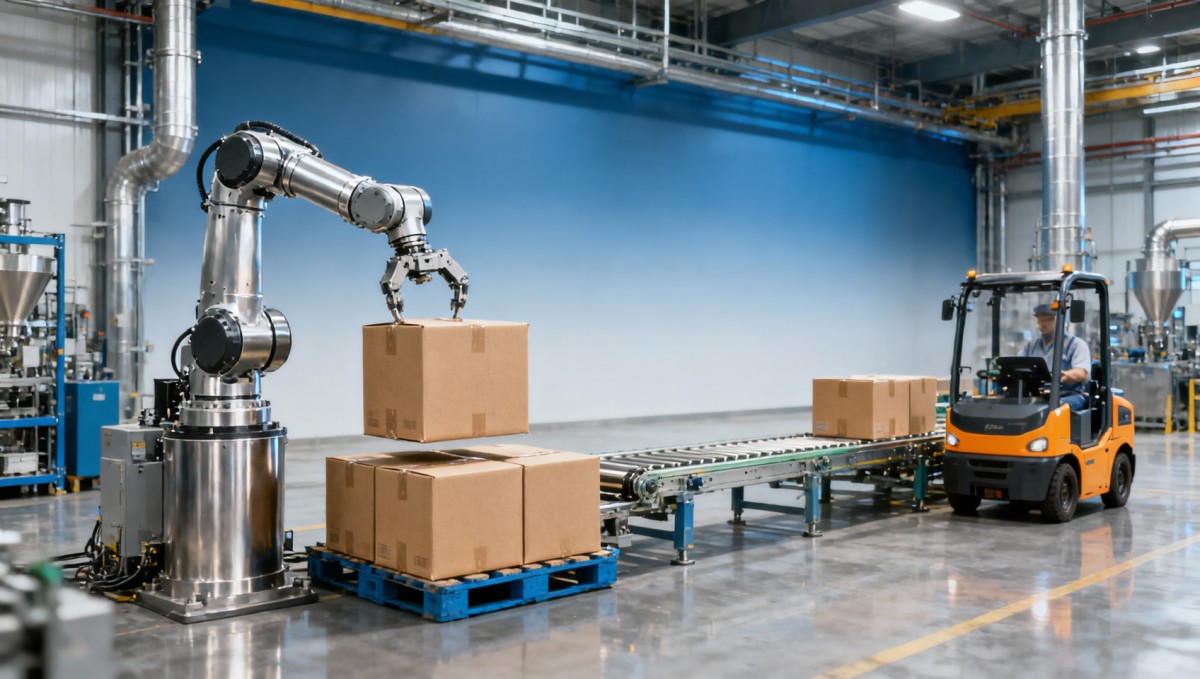
Oversizing usually starts with a reasonable fear: no plant wants the palletizer to become a bottleneck. If a line is designed for 18 cases per minute, teams may request a system rated for 25 to 30 cases per minute “for safety.” On paper, that sounds prudent. In practice, many food lines operate at variable speeds due to product changeovers, sanitation windows, film replacement, carton quality variation, and warehouse dispatch delays. The average sustained rate may be only 12 to 16 cases per minute across a full shift.
Another reason is procurement behavior. Buyers often compare supplier quotations by maximum payload, maximum reach, and headline cycle rate. Those metrics matter, but they do not reveal whether the system is correctly matched to case dimensions, pallet pattern complexity, or product fragility. A palletizing robot rated at 20 cycles per minute may still underperform if the line needs frequent SKU changes, dual infeed logic, or label-out orientation control.
Integration uncertainty also pushes plants toward larger systems. When an engineering team does not yet know whether the facility will add a second packaging lane in 12 to 24 months, it may select a bigger palletizer “just in case.” The problem is that speculative growth often raises upfront capital by 20% to 40%, while the actual expansion may require a different conveyor route, different pallet heights, or different warehouse software logic later.
In food environments, hygiene design can further distort sizing decisions. If washdown-rated components, stainless contact surfaces, and sealed electrical enclosures are required, every increment of larger footprint becomes more expensive than in a dry industrial setting. A larger safeguarded cell can consume several extra square meters, affect cleaning paths, and complicate forklift or AGV circulation.
The Most Frequent Sizing Mistakes
- Using peak theoretical line speed instead of sustained 8-hour or 16-hour production averages.
- Ignoring changeover frequency, which can reduce effective throughput by 10% to 25%.
- Assuming all cartons are stable enough for high-speed acceleration and stacking.
- Buying for a possible future line addition without confirming layout and software architecture.
- Underestimating floor-space cost, safety zone expansion, and sanitation access requirements.
Operational Signals That a System Is Oversized
Plants can often identify oversizing after commissioning. Common signals include robot utilization below 50% during standard shifts, conveyors idling for long intervals, excessive waiting for pallet release, and line operators bypassing advanced functions because the installed system is more complex than daily demand requires. If system availability is high but actual pallet output per shift remains far below design capacity, the specification likely overshot reality.
The following comparison shows how engineering inputs differ from marketing-driven assumptions when selecting an automated palletizing system for food manufacturing.
The engineering conclusion is straightforward: the best palletizing solution is not the biggest one. It is the one that can maintain required throughput with stable stacking, safe operation, and manageable integration effort across real production conditions.
How to Right-Size a Cobot Palletizing Layout
A cobot palletizing layout is often the most practical option for food plants running low-to-medium case rates, frequent SKU changes, or limited floor area. In many applications, a collaborative system handling 8 to 15 picks per minute can outperform a larger conventional cell from a total-cost perspective, especially when the plant values shorter deployment, simpler operator training, and easier relocation.
Right-sizing starts with four measurable inputs: case dimensions, case weight, target pallet pattern count per hour, and required uptime. For example, a line producing cartons between 6 kg and 14 kg with a target of 12 cases per minute may not need a high-speed multi-axis gantry. A single cobot with a properly engineered gripper, slip-sheet handling option, and compact accumulation zone may be enough if the effective utilization remains below 75%.
The layout should also be designed around movement economy. Every extra 300 to 500 mm of unnecessary robot travel affects cycle time. Likewise, poor infeed orientation can force additional alignment motions. In a food plant where three to five pallet patterns are common, motion simplification can improve real throughput more effectively than simply buying a larger robot arm.
Operators should be involved early in the layout review. Their feedback on pallet replenishment, corner board handling, jam access, and washdown clearance often exposes inefficiencies that are not obvious in a CAD drawing. A system that saves 2 seconds per pallet exchange or 15 minutes per shift in cleaning access can materially improve the business case over a 3-year period.
Key Layout Parameters to Verify
- Robot reach versus pallet footprint, including top-layer placement at full stack height.
- Gripper suitability for boxes, trays, shrink bundles, or mixed secondary packaging.
- Buffer length required to absorb upstream micro-stoppages of 30 to 90 seconds.
- Safe human access for pallet change, rework, and sanitation tasks.
- Changeover logic for at least 3 to 10 SKU patterns if the product mix is dynamic.
When a Cobot Is Usually a Better Fit
Collaborative palletizing is typically attractive when annual production requires flexibility more than extreme speed. That includes seasonal food products, co-packing operations, bakery packaging, snack cartons, and multi-SKU dispatch environments. If the line runs 1 or 2 shifts rather than 24/7 heavy output, the lower integration burden can offset the lower peak speed.
The table below summarizes common layout choices and where each one fits best in food automation projects.
The practical insight is that layout selection should follow demand shape, not just demand size. If product mix, sanitation, and labor support matter more than maximum cycle rate, a compact cobot palletizing system can be the more efficient engineering choice.
The Real Cost of Oversizing: Capex, Floor Space, and Integration Burden
The financial impact of oversizing an automated palletizing system is often underestimated because teams focus on robot purchase price alone. In reality, the total installed cost includes end-of-arm tooling, conveyor accumulation, guarding, safety devices, controls, programming, ERP/WMS data exchange, site acceptance work, and sometimes civil or utility modifications. A larger system can raise total project cost far beyond the delta seen on the equipment quote.
Floor space is equally strategic in food plants. An additional 8 to 15 square meters consumed by an oversized cell may not sound dramatic, but in facilities with fixed hygiene corridors, forklift lanes, and packing support zones, that space can affect future packaging lines or AGV traffic. Once installed, a badly sized palletizing area can constrain expansion for 5 to 10 years.
Integration complexity grows with every extra conveyor branch, pallet magazine, barcode checkpoint, and software exception path. If a plant ties palletizing to batch release status, warehouse slot assignment, and dispatch sequencing, each extra layer of hardware can require more PLC logic and more failure modes. For procurement teams, that means longer commissioning, more operator training, and a larger spare parts list.
A disciplined ROI model should therefore compare not only labor savings but also utilization rate, sanitation time, system availability, and future reconfiguration cost. In many food projects, the right-sized system reaches a more attractive payback window because it is easier to stabilize and cheaper to support.
Cost Elements Buyers Should Break Out
- Core equipment cost versus total installed cost.
- Required floor area in square meters, including maintenance and cleaning clearance.
- Commissioning duration, often 2 to 6 weeks depending on interface count.
- Expected training time for operators, maintenance staff, and supervisors.
- Spare parts exposure for grippers, sensors, drives, belts, and safety components.
A Practical Procurement Lens
When evaluating proposals, purchasers should request three capacity views: theoretical maximum, validated sustained throughput, and throughput under changeover-heavy conditions. These three numbers tell a far more honest story than one headline speed figure. They also help compare a compact cobot palletizer against a larger conventional cell on an equal basis.
The next table can be used as a shortlist tool when comparing vendors or system concepts for a food industry project.
If a proposal scores high on peak speed but weak on sustained throughput, software simplicity, and access design, it may be oversized in exactly the way food plants later regret.
Smart Factory Automation and AGV Integration with ERP/WMS
Right-sizing is not only about the robot cell. It is also about how the palletizing system connects to the rest of the factory. In modern food operations, smart factory automation solutions increasingly tie pallet release, pallet ID, warehouse routing, and production reporting into one digital flow. A smaller, well-integrated palletizer can outperform a larger isolated one because it reduces waiting time and exception handling.
AGV integration with ERP/WMS is especially important where finished pallets must move to stretch wrapping, cold storage, or dispatch lanes without manual forklift intervention. If the automated palletizing system can signal pallet completion, weight status, SKU identity, and destination logic in real time, warehouse transfer becomes smoother. That can reduce staging congestion and cut non-value-added transport steps from 3 or 4 down to 1 or 2.
However, digital integration must be scoped carefully. Not every plant needs full smart-factory orchestration on day one. Some facilities benefit from a phased model: start with line-side PLC integration, add WMS handshakes in phase 2, and introduce AGV dispatch optimization later. This approach protects capital while keeping the architecture open for expansion within 12 to 36 months.
For decision-makers, the main engineering question is whether the data exchanged is necessary, reliable, and actionable. A system that produces dozens of unused data tags is not more advanced. The better design is one that transmits the few operational signals that truly reduce downtime, misrouting, and manual intervention.
Recommended Integration Layers
- Machine layer: sensors, robot status, gripper feedback, pallet presence, and alarms.
- Line control layer: case tracking, recipe selection, pallet pattern logic, and reject handling.
- Execution layer: batch traceability, pallet ID generation, and production order matching.
- Warehouse layer: AGV call, destination assignment, queue management, and WMS confirmation.
What to Standardize Before Integration
Before software mapping begins, the plant should standardize naming conventions, alarm categories, pallet ID rules, and recipe ownership. A large share of commissioning delay comes from inconsistent data structures rather than hardware defects. In practical terms, defining 20 to 30 critical signals clearly can save far more time than attempting to connect 200 poorly defined tags.
For operators and maintenance staff, the ideal result is simple: clear HMI screens, fast fault isolation, and predictable pallet release behavior. For buyers and executives, the value is measurable in lower manual handling, shorter qualification cycles, and a more credible path to scalable automation.
Implementation Roadmap, Common Risks, and Buyer FAQ
Even a well-sized automated palletizing system can disappoint if implementation discipline is weak. The most reliable projects follow a staged process: baseline data capture, concept validation, layout and interface definition, factory acceptance, site commissioning, and post-start optimization. Depending on project scope, this often spans 8 to 20 weeks from approved specification to stable operation.
A common implementation risk is underestimating product variability. In food plants, carton compression strength, wrap tension, or ambient humidity can affect stack stability. Another risk is assuming that operators will instantly adopt recipe management or alarm-driven workflows. Training should therefore cover not only machine operation but also pallet quality inspection, restart logic, and exception handling.
From a procurement perspective, acceptance criteria should be documented early. These may include throughput range, stack integrity after transport, barcode readability, alarm response behavior, and changeover time. Without written thresholds, the project can drift into subjective debate at commissioning.
The following checklist helps cross-functional teams align technical, operational, and commercial expectations before purchase approval.
- Confirm average and peak cases per minute using at least 2 to 4 weeks of line data.
- Define acceptable utilization target, commonly 60% to 80% rather than 95% theoretical loading.
- Document pallet types, stack heights, slip-sheet needs, and load stability requirements.
- Map all required interfaces to PLC, ERP, WMS, barcode, and AGV systems before coding starts.
- Set acceptance tests for throughput, uptime, safety interlocks, and changeover performance.
FAQ: How do you know if a food plant needs a cobot palletizer or a larger system?
Start with actual sustained throughput, not marketing speed. If the line consistently runs in the 6 to 15 cases per minute range, SKU changes are frequent, and floor space is limited, a cobot palletizing layout is often sufficient. If the plant needs 20+ continuous cases per minute with low product variation, a larger industrial system may be justified.
FAQ: What payback window is realistic for food palletizing automation?
Payback depends on labor cost, shift structure, uptime, and the level of integration required. In many B2B food applications, a practical review horizon is 18 to 36 months rather than an aggressive short-term promise. Plants with high manual palletizing labor, ergonomic risk, or warehouse congestion may see faster returns if the system is correctly sized.
FAQ: How long does deployment typically take?
A compact end-of-line palletizing project may take roughly 8 to 12 weeks for engineering, fabrication, and commissioning. More complex installations with AGV integration, ERP/WMS mapping, and multiple pallet patterns can extend to 16 to 20 weeks. Clear specifications and early interface definition usually shorten deployment more effectively than rushing equipment selection.
FAQ: What should buyers request from suppliers before approval?
Request a throughput model, layout drawing, access plan, interface list, changeover logic description, and acceptance test proposal. Ask suppliers to distinguish theoretical, validated, and expected sustained performance. That level of detail aligns with TSV’s engineering-first approach: measurable parameters are more useful than generalized claims.
Food plants do not gain resilience by automatically buying the biggest automated palletizing system available. They gain resilience by matching capacity to verified production reality, building a layout around sanitation and access, and integrating pallet flow intelligently with warehouse and business systems. In many projects, the right answer is a modular, right-sized solution rather than an oversized one.
For operators, that means easier daily use and clearer fault handling. For procurement teams, it means better control of total installed cost and lifecycle support. For enterprise decision-makers, it means automation that supports ROI, scalability, and operational discipline. If you are evaluating cobot palletizing layout options, smart factory automation solutions, or AGV integration with ERP/WMS for a food facility, now is the right time to benchmark your line data and define a specification based on engineering truth.
Contact us to discuss your application, obtain a tailored palletizing assessment, or explore a right-sized automation roadmap built around throughput, safety, and long-term factory performance.
Search News
Hot Articles
- Carbon Fiber StructuresHow to Specify Aerospace Carbon Fiber Assemblies for Lightweight, Load-Bearing PartsJul 11, 2026
- Machine VisionXiaomi, Alibaba DAMO Academy Drive Open-Source Robotics Model Ecosystem, Lowering Algorithm Development Barriers for Overseas SMEs Adopting Chinese Robotics SolutionsMar 30, 2026
- Cobots & ArmsShanxi 'AI+' Conference Showcases Embodied Intelligence with Multinational Buyer Engagement: Key Industry ImplicationsMar 30, 2026
Popular Tags
Recommended News
 Jul 11, 2026How to Specify Aerospace Carbon Fiber Assemblies for Lightweight, Load-Bearing PartsAerospace carbon fiber assemblies: learn how to specify laminate design, load data, joining methods, and inspection controls for lighter, reliable load-bearing aerospace parts.Elena Rostova (UAV Systems Researcher)
 Mar 30, 2026Xiaomi, Alibaba DAMO Academy Drive Open-Source Robotics Model Ecosystem, Lowering Algorithm Development Barriers for Overseas SMEs Adopting Chinese Robotics SolutionsXiaomi & Alibaba DAMO Academy's open-source robotics models lower algorithm barriers for global SMEs. Boost efficiency in manufacturing, logistics & smart retail with ROS 2 compatible solutions.TSV Data Lab
 Mar 30, 2026Shanxi 'AI+' Conference Showcases Embodied Intelligence with Multinational Buyer Engagement: Key Industry ImplicationsShanxi 'AI+' Conference highlights embodied intelligence with Tesla, Ubtech & Jiantao showcasing multimodal robotics. 40+ global buyers validated tech on-site, creating new B2B channels for industrial automation & AI solutions.Chen Wei (Automation Lead Engineer)
 Mar 30, 2026Zhongguancun Unveils 6G Integrated Sensing-Computing-Intelligence Platform to Empower Embodied Robots for Global Industrial ApplicationsZhongguancun's new 6G platform revolutionizes industrial robotics with <10ms latency, empowering global automotive, logistics & port automation. Discover how this tech boosts China's smart manufacturing exports.TSV Data Lab
 Mar 30, 2026Mech-Mind Tianjin Embodied Intelligence R&D and Production Base Goes Live, Cutting Delivery Time by 20%–30% for Global Customized AMR+Vision SolutionsMech-Mind's Tianjin AMR+Vision production base cuts delivery time by 20%-30% for欧美 & Latin American markets. Discover how this PLd-certified facility accelerates customized robotics solutions for smart manufacturing and logistics.Chen Wei (Automation Lead Engineer)
 Mar 30, 2026Boao Forum Reveals 'Co-evolution of Big and Small Brains' Trend in Humanoid Robots, China's Embodied Intelligence Accelerates Adaptation to Overseas Manufacturing Service ScenariosDiscover how China's humanoid robots, featuring 'Co-evolution of Big and Small Brains,' are revolutionizing global manufacturing. Learn about Embodied Tian Gong 3.0's ISO compliance and overseas deployment at Boao Forum 2026.Chen Wei (Automation Lead Engineer)
 Mar 30, 2026China Railway Industrial Secures Patent for Embodied Robotics in Material Handling, Boosting High-Precision Delivery Capabilities for Overseas Infrastructure and Manufacturing ProjectsChina Railway Industrial's new patent for embodied robotics in material handling boosts high-precision delivery for global infrastructure & manufacturing. Discover how this innovation enhances logistics accuracy in automotive, rail transit & EPC projects.Chen Wei (Automation Lead Engineer)
 Oct 15, 2026R&D Cost Reduction Services: How to Evaluate Fees, Savings, and ROIEvaluate R&D cost reduction services with confidence. Compare fees, verify savings, and calculate ROI without compromising performance. Discover how to choose a provider that delivers real value.Chen Wei (Automation Lead Engineer)
 Oct 15, 2026How Should You Compare TechStat Vanguard 5-Axis CNC Tolerances?TechStat Vanguard 5-axis CNC tolerance comparison: learn how to verify part accuracy, assess inspection evidence, and choose suppliers that reliably meet your drawing requirements.Dr. Marcus Vance
 Oct 14, 2026Drone Frame Composites: Carbon Fiber vs. Fiberglass for Weight and StiffnessExplore drone structural materials composites: compare carbon fiber and fiberglass for weight, stiffness, cost, and antenna compatibility. Find the right material for your drone frame.Elena Rostova (UAV Systems Researcher)
 Oct 13, 2026Smart Cameras vs. PC-Based Machine Vision: Which Fits High-Speed Inspection?This industrial product comparison for machine vision weighs smart cameras vs. PC-based systems on latency, throughput, and cost. Discover your best fit for high-speed inspection.TSV Data Lab
 Oct 12, 2026How to Verify RoHS Compliance in Industrial Sensing Systems Before DeploymentRoHS compliant sensing systems: learn how to verify materials, supplier declarations, testing, and configuration controls before industrial deployment.TSV Data Lab
 Oct 11, 2026How Procurement-Oriented Content Taxonomy Improves B2B Buying JourneysProcurement-oriented content taxonomy streamlines B2B buying journeys with clearer evidence, supplier comparisons, risk visibility, and faster approvals.TSV Data Lab
 Oct 10, 2026How to Select a Machine Performance Monitoring Platform for OEE and Downtime ReductionMachine performance monitoring platform selection guide: validate machine states, OEE data, downtime reasons, integrations, and scalability to reduce losses with confidence.TSV Data Lab
 Oct 08, 2026How to Machine Inconel 625 Blades Without Heat Cracks or Edge ChippingInconel 625 blade machining guide: prevent heat cracks, edge chipping, chatter, and work hardening with proven tooling, cooling, fixturing, and inspection strategies.Dr. Marcus Vance
 Oct 07, 2026How to Evaluate an HMI Panel Distributor for Industrial Automation ProjectsHMI panel distributor evaluation guide: verify technical compatibility, traceability, supply reliability, lifecycle support, and total cost for automation projects.Victor Lin (Chief Software Architect)
 Oct 06, 2026Navigation Fault Tolerance Standards for AMRs: What Safety Teams Must VerifyNavigation fault tolerance standards: learn what AMR safety teams must verify, from localization loss and sensor faults to stopping distance, safe restart, and site-specific validation.Chen Wei (Automation Lead Engineer)
 Oct 05, 2026Calculating Edge Computing Total Cost of Ownership Across Distributed SitesEdge computing ownership cost explained: calculate deployment, energy, connectivity, security, remote support, and refresh costs across distributed sites.TSV Data Lab
 Oct 04, 2026CAD/CAM Benchmarking in the GCC: What Manufacturers Should Ask a ConsultantCAD CAM benchmark consultant GCC guide: learn the key questions manufacturers should ask to validate post-processors, workflows, machine performance, and production risk.Victor Lin (Chief Software Architect)
 Oct 03, 2026Selecting Automotive Radar Sensor Modules for ADAS Range, Resolution, and IntegrationAutomotive radar sensor module selection guide for ADAS: compare range, resolution, field of view, latency, and integration to build safer, reliable vehicle systems.TSV Data Lab
 Oct 02, 2026How to Qualify Machined Parts Suppliers for Hard Tech ProgramsHard tech supply chain machined parts demand rigorous supplier qualification. Learn how to assess capability, traceability, quality controls, and delivery resilience.Dr. Marcus Vance
 Oct 01, 2026How to Select an Outdoor Security Radar Sensor for Perimeter Detection?Outdoor security radar sensor selection guide: compare range, accuracy, false-alarm control, integration, and field testing for reliable perimeter detection.TSV Data Lab
 Sep 30, 2026How to Evaluate Solid-State LiDAR Hardware for Outdoor Autonomous VehiclesSolid state LiDAR hardware evaluation guide for outdoor autonomous vehicles—compare range, point-cloud quality, environmental resilience, integration, and safety.TSV Data Lab
 Sep 29, 2026ISO 9283 Repeatability: How to Evaluate Cobot Positioning PerformanceISO 9283 cobot repeatability explained: learn how payload, reach, approach direction, and test conditions affect positioning performance and cell capability.Chen Wei (Automation Lead Engineer)























