Energy efficiency claims for industrial robots, tested fairly
Publication Date
author
Energy efficiency claims can heavily influence robot sourcing decisions, but not every comparison is tested on equal terms. For business evaluators navigating complex procurement choices, this industrial robots energy efficiency comparison introduces a fair, data-driven framework that cuts through marketing language and focuses on measurable performance, operating conditions, and real-world cost impact.
Why a checklist approach is the safest way to evaluate energy claims
For procurement, technical review, and supplier qualification teams, the biggest risk is not missing a flashy specification. The real risk is comparing two industrial robots under different assumptions and then treating the result as if it were objective. One vendor may present standby power, another may highlight average cycle power, and a third may report energy use under a light payload with short travel. All three figures can look favorable while describing very different realities.
That is why an industrial robots energy efficiency comparison should begin with a structured checklist. A checklist forces the evaluator to verify test boundaries, duty cycle, payload, motion profile, tooling mass, controller settings, and environmental conditions before accepting any claim. This is especially important when robot energy use affects total cost of ownership, plant utility planning, carbon reporting, and long-term operating margin.
At TechStat Vanguard, the principle is simple: parameters do not lie when test conditions are disclosed completely. A fair comparison does not ask which brochure sounds stronger. It asks whether the robots were tested on equal terms and whether the result still holds in the application that matters to your business.
Start here: the core checklist for a fair industrial robots energy efficiency comparison
Before you review any supplier claim, confirm the following items. If more than two are missing, the comparison should be treated as incomplete rather than competitive.
- Verify the robot category: 6-axis articulated, SCARA, delta, palletizing, or collaborative robot. Energy performance should only be compared within the same functional class.
- Confirm rated payload and actual test payload. A robot tested with 5 kg cannot be fairly compared with one tested at 10 kg, even if both have similar maximum payload ratings.
- Check reach, stroke, and motion envelope. Longer travel distances and larger rotational moves materially change energy consumption.
- Request the exact duty cycle: acceleration, deceleration, dwell time, pick-and-place frequency, and idle percentage.
- Ask whether end-of-arm tooling, cables, dress packs, and grippers were included in the moving mass.
- Confirm measurement scope: robot arm only, controller only, or full system including safety devices, vision, vacuum, and peripherals.
- Review controller mode and optimization settings. Eco mode, motion smoothing, and reduced speed profiles can distort headline numbers if not standardized.
- Check line voltage, ambient temperature, and plant air usage if pneumatic systems are part of the cycle.
- Require test duration long enough to include startup, warm-up, steady production, and idle intervals.
- Request data output in kWh per hour, kWh per 1,000 cycles, and kWh per unit produced. One metric alone is rarely sufficient.
The five measurement standards that matter most
A practical industrial robots energy efficiency comparison should convert supplier language into measurable review points. These five standards create a strong baseline for business evaluators.
1. Compare energy per productive output, not just average power
Average power can mislead when throughput differs. If Robot A uses slightly more power but completes significantly more parts per hour, it may be more efficient in economic terms. Ask for energy per cycle, per part, or per pallet moved. This connects directly to production value.
2. Separate idle, standby, and active motion consumption
Many facilities run robots with uneven utilization. A robot with low active energy but high idle draw may underperform in mixed-shift operations. For plants with frequent pauses, changeovers, or upstream bottlenecks, idle energy can become a material cost driver.
3. Normalize for payload ratio
A 20 kg robot moving 5 kg is operating very differently from a 10 kg robot moving 5 kg. Review actual payload as a percentage of rated payload. Oversized robots often sacrifice energy efficiency for capability that the line may never use.
4. Include acceleration-heavy cycles
Energy use is strongly influenced by starts, stops, and rapid directional changes. Suppliers may showcase smooth cycles that look efficient but do not reflect packaging, electronics handling, machine tending, or sorting applications. Request a realistic motion profile based on your own takt time.
5. Evaluate full-cell energy, not robot-only energy
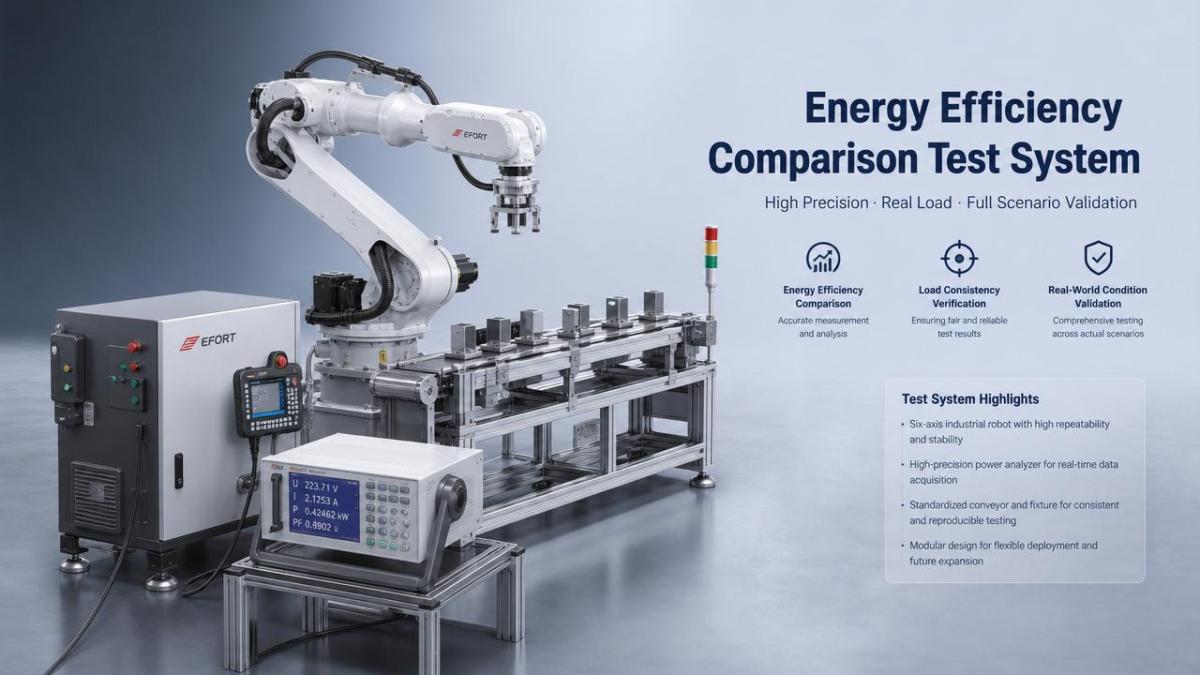
In many projects, the robot is only one part of the electrical load. Vision lighting, feeders, conveyors, compressors, cooling, and safety systems can outweigh differences between robot brands. A fair industrial robots energy efficiency comparison should therefore include both robot-only and cell-level data.
A decision table business evaluators can use immediately
The table below helps translate technical readings into procurement relevance.
Application-specific checks: what changes by use case
Not every plant should weigh energy variables the same way. The strongest industrial robots energy efficiency comparison is always linked to the target application.
Machine tending
Focus on idle and wait-state power because the robot may pause for CNC door cycles, spindle completion, or inspection. Also check whether the robot is oversized relative to the part family, since many machine tending cells carry hidden energy penalties from overcapacity selection.
Pick-and-place and packaging
Prioritize acceleration-heavy cycle tests and throughput-normalized metrics. Here, a robot with slightly higher peak draw may still be superior if it maintains takt time with lower energy per 1,000 picks.
Welding and dispensing
Do not isolate the robot from process loads. Arc systems, wire feeders, pumps, and temperature controls can dominate total energy consumption. Evaluate process quality stability alongside energy use, because rework often costs more than power savings.
Collaborative assembly
Include safety speed limits, human interaction pauses, and lower utilization realities. Cobots are often marketed as efficient, but actual results depend heavily on duty cycle and stop-start behavior in operator-shared workspaces.
Common blind spots that distort energy claims
Business evaluators regularly encounter the same omissions. These are the most important risk reminders to flag during supplier review.
- Comparing different payload classes because headline energy numbers look attractive.
- Ignoring tooling weight, especially vacuum EOAT, weld torches, and cable management systems.
- Using lab data that excludes startup peaks, production interruptions, and line imbalance.
- Accepting annual savings estimates without local electricity tariff assumptions.
- Missing the tradeoff between energy savings and slower throughput or lower precision.
- Failing to ask whether software updates or maintenance state influenced measured performance.
How to run a fair supplier evaluation in practice
If your team is moving from shortlist to detailed review, use a simple execution process. First, create one standard test script based on your expected payload, path, cycle time, and shift pattern. Second, require every supplier to run against that same script or simulate it transparently with disclosed assumptions. Third, request raw time-series power data rather than summary slides only. Fourth, calculate both energy cost and output-adjusted cost over one year and over the full ownership horizon.
It is also smart to define an acceptance band rather than a single winner-takes-all metric. For example, if two robots fall within a narrow energy range, then uptime, repeatability, maintainability, and spare parts support may matter more financially than minor electrical differences. This prevents over-optimizing for one visible KPI while ignoring broader operational risk.
What information to prepare before asking vendors for proof
To make an industrial robots energy efficiency comparison credible, buyers should prepare their own baseline requirements first. Provide the expected part weight range, tooling concept, required reach, target cycle time, daily utilization, annual production volume, and any quality constraints that may limit speed optimization. Also define whether your objective is lower operating cost, carbon reduction, electrical capacity planning, or broader total cost of ownership improvement.
The more precise the input, the less room there is for selective benchmarking. This aligns with a data-first sourcing approach: specify the operating truth first, then ask the market to prove performance under those conditions.
FAQ for business-focused evaluation teams
Is lower wattage always the better choice?
No. Lower wattage without throughput context can lead to higher energy per part and weaker production economics.
Should we trust vendor simulations?
Simulations are useful if assumptions are fully disclosed and matched across suppliers. They should not replace measured validation for high-value purchases.
How important is cell-level energy versus robot-only energy?
For many applications, cell-level energy is more decision-relevant because peripherals can drive a large share of total consumption.
Final decision guidance
A useful industrial robots energy efficiency comparison is not a marketing scoreboard. It is a controlled evaluation of how efficiently a robot produces output under your real operating conditions. For business evaluators, the priority is clear: confirm equal test boundaries, normalize for payload and throughput, include idle behavior, and check full-cell impact before turning energy claims into sourcing conclusions.
If you need to move the discussion forward with suppliers or internal stakeholders, start by requesting five items: the exact test script, the measurement boundary, the output-normalized energy metric, the control settings used during testing, and the annual cost model assumptions. Those questions will quickly reveal whether a claimed advantage is engineered truth or presentation bias.
Search News
Hot Articles
- Carbon Fiber StructuresHow to Specify Aerospace Carbon Fiber Assemblies for Lightweight, Load-Bearing PartsJul 11, 2026
- Machine VisionXiaomi, Alibaba DAMO Academy Drive Open-Source Robotics Model Ecosystem, Lowering Algorithm Development Barriers for Overseas SMEs Adopting Chinese Robotics SolutionsMar 30, 2026
- Cobots & ArmsShanxi 'AI+' Conference Showcases Embodied Intelligence with Multinational Buyer Engagement: Key Industry ImplicationsMar 30, 2026
Popular Tags
Recommended News
 Jul 11, 2026How to Specify Aerospace Carbon Fiber Assemblies for Lightweight, Load-Bearing PartsAerospace carbon fiber assemblies: learn how to specify laminate design, load data, joining methods, and inspection controls for lighter, reliable load-bearing aerospace parts.Elena Rostova (UAV Systems Researcher)
 Mar 30, 2026Xiaomi, Alibaba DAMO Academy Drive Open-Source Robotics Model Ecosystem, Lowering Algorithm Development Barriers for Overseas SMEs Adopting Chinese Robotics SolutionsXiaomi & Alibaba DAMO Academy's open-source robotics models lower algorithm barriers for global SMEs. Boost efficiency in manufacturing, logistics & smart retail with ROS 2 compatible solutions.TSV Data Lab
 Mar 30, 2026Shanxi 'AI+' Conference Showcases Embodied Intelligence with Multinational Buyer Engagement: Key Industry ImplicationsShanxi 'AI+' Conference highlights embodied intelligence with Tesla, Ubtech & Jiantao showcasing multimodal robotics. 40+ global buyers validated tech on-site, creating new B2B channels for industrial automation & AI solutions.Chen Wei (Automation Lead Engineer)
 Mar 30, 2026Zhongguancun Unveils 6G Integrated Sensing-Computing-Intelligence Platform to Empower Embodied Robots for Global Industrial ApplicationsZhongguancun's new 6G platform revolutionizes industrial robotics with <10ms latency, empowering global automotive, logistics & port automation. Discover how this tech boosts China's smart manufacturing exports.TSV Data Lab
 Mar 30, 2026Mech-Mind Tianjin Embodied Intelligence R&D and Production Base Goes Live, Cutting Delivery Time by 20%–30% for Global Customized AMR+Vision SolutionsMech-Mind's Tianjin AMR+Vision production base cuts delivery time by 20%-30% for欧美 & Latin American markets. Discover how this PLd-certified facility accelerates customized robotics solutions for smart manufacturing and logistics.Chen Wei (Automation Lead Engineer)
 Mar 30, 2026Boao Forum Reveals 'Co-evolution of Big and Small Brains' Trend in Humanoid Robots, China's Embodied Intelligence Accelerates Adaptation to Overseas Manufacturing Service ScenariosDiscover how China's humanoid robots, featuring 'Co-evolution of Big and Small Brains,' are revolutionizing global manufacturing. Learn about Embodied Tian Gong 3.0's ISO compliance and overseas deployment at Boao Forum 2026.Chen Wei (Automation Lead Engineer)
 Mar 30, 2026China Railway Industrial Secures Patent for Embodied Robotics in Material Handling, Boosting High-Precision Delivery Capabilities for Overseas Infrastructure and Manufacturing ProjectsChina Railway Industrial's new patent for embodied robotics in material handling boosts high-precision delivery for global infrastructure & manufacturing. Discover how this innovation enhances logistics accuracy in automotive, rail transit & EPC projects.Chen Wei (Automation Lead Engineer)
 Sep 28, 2026Spindle Runout Measurement in Germany: DIN Standards, Methods, and Acceptance LimitsSpindle runout measurement Germany: explore DIN standards, proven methods, acceptance limits, and audit-ready practices for reliable machining quality.Dr. Marcus Vance
 Sep 27, 2026How to Select Wall-Mount Edge Devices for Space-Constrained Factory NetworksWall mount edge devices for space-constrained factories: evaluate workload, thermal design, power resilience, cable access, and network reliability for smarter deployments.TSV Data Lab
 Sep 26, 2026Machining Tolerance Analysis: How to Set Limits That Meet Function and Cost TargetsMachining tolerance analysis: learn how to set functional limits, control tolerance stacks, reduce inspection risk, and balance precision with production cost.Dr. Marcus Vance
 Sep 25, 2026How to Evaluate an Industrial Infrastructure Data Platform for Multi-Site OperationsIndustrial infrastructure data platform evaluation guide for multi-site operations: compare data quality, edge resilience, interoperability, governance, and scalable proof-of-value criteria.Victor Lin (Chief Software Architect)
 Sep 24, 2026How to Select Machine Vision Optics for Accurate Inspection at Different Working DistancesMachine vision optics selection guide for accurate inspection at every working distance. Compare FOV, pixel scale, DOF, distortion, lighting, and telecentric options.TSV Data Lab
 Sep 23, 2026How to Evaluate a Machine Vision System Integrator for High-Speed Inspection LinesChoose a machine vision system integrator with proven expertise in high-speed inspection, reliable reject timing, robust optics, and measurable acceptance criteria.TSV Data Lab
 Sep 28, 2026When is a SCADA API the right choice for connecting plant systems?SCADA API guide: learn when governed plant data integration improves traceability, security, and scalability—without compromising real-time control.Victor Lin (Chief Software Architect)
 Sep 27, 2026How SCADA data integration improves traceability across production linesSCADA data integration connects production-line data to improve traceability, accelerate quality investigations, and strengthen safety decisions.Victor Lin (Chief Software Architect)
 Sep 26, 2026What to define before starting SCADA integration planningSCADA integration planning starts with clear scope, control boundaries, data models, cybersecurity, and testing. Discover the definitions that reduce risk and costly rework.Victor Lin (Chief Software Architect)
 Sep 25, 2026How a smart factory with Industrial IoT reduces production blind spotsDiscover how a smart factory with Industrial IoT turns real-time machine, quality, and workflow data into actionable insights that reduce production blind spots and delivery risks.Victor Lin (Chief Software Architect)
 Sep 24, 2026When does Industrial IoT make smart manufacturing easier to scale?Smart manufacturing Industrial IoT scales when trusted data, interoperable systems, and secure workflows turn connected assets into measurable gains.TSV Data Lab
 Sep 23, 2026What drives ultra-precision machining cost at 1-micron tolerance?Ultra precision machining cost per part at 1 micron tolerance depends on process, material, metrology, and yield. Learn how to compare quotes confidently.Dr. Marcus Vance
 Sep 22, 2026Drone Engine-T550CC Applications: Build the UAV Power System Around the MissionAn application guide for Drone Engine-T550CC integration, covering payload planning, airframe matching, cooling, fuel, vibration, test procedures, documentation, and service preparation.Elena Rostova (UAV Systems Researcher)
 Sep 22, 2026How to Evaluate Industrial Edge Computing Vendors for Factory DeploymentIndustrial edge computing vendor evaluation guide for factories: compare latency, protocol fit, reliability, security, and lifecycle support before deployment.TSV Data Lab
 Sep 21, 2026Drone Payload Integration: Matching Power, Data, and Center of Gravity for Reliable FlightsDrone payload integration made practical: balance power, data, center of gravity, and endurance to build safer, more reliable mission-ready flights.Elena Rostova (UAV Systems Researcher)
 Sep 20, 2026Autonomous Navigation Pricing: Cost Drivers and Budget Benchmarks for AMR ProjectsAutonomous navigation price explained: compare AMR cost drivers, software, sensors, integration, safety, and lifecycle budgets to build a scalable project plan.Chen Wei (Automation Lead Engineer)
 Sep 19, 2026How to Scope Automation Integration Services for Multi-System Factory ProjectsAutomation integration services: learn how to scope multi-system factory projects with clear workflows, interface contracts, safety boundaries, and acceptance criteria.Victor Lin (Chief Software Architect)