
Edge AI for smart manufacturing is useful only if latency really matters
Publication Date
author
Edge AI for smart manufacturing creates value only when latency is a measurable production constraint, not a marketing slogan. For engineers, buyers, and decision-makers evaluating industrial IoT data collection architecture, machine vision for defect detection, LiDAR for AGV obstacle avoidance, or an IoT gateway for CNC machine monitoring, the real question is simple: does moving inference to the edge improve cycle time, reliability, and cost enough to justify deployment?
The short answer is no, not always. In many factories, local inference is useful because of bandwidth limits, privacy, or resilience, but it is only mission-critical when milliseconds directly affect safety, throughput, scrap rate, or machine stability. If latency is not tied to a real production loss, cloud or hybrid architectures may deliver better economics and simpler maintenance. For smart manufacturing teams, the right decision is not “edge AI vs. cloud” in the abstract. It is matching compute placement to the physics, timing, and failure modes of the process.
When does latency actually matter in smart manufacturing?
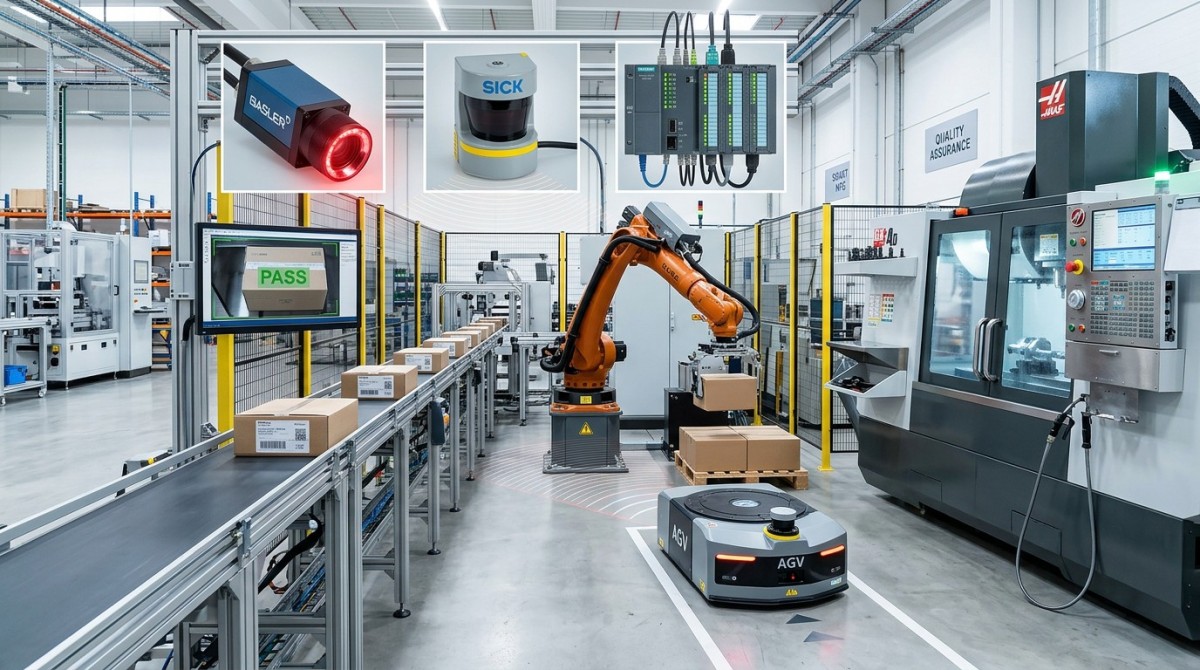
This is the first question serious buyers and engineering teams should ask. “Low latency” sounds impressive, but in industrial environments the important issue is whether response delay changes the outcome of the process.
Latency matters when a delayed decision causes one or more of the following:
- Missed control windows in fast production lines
- Unsafe motion for robots, AGVs, or autonomous material handling systems
- Defect escape in machine vision inspection
- Tool wear or process drift that must be corrected before the next cycle
- Data loss or unstable feedback in industrial IoT monitoring loops
For example, machine vision for defect detection on a high-speed packaging line may require sub-second or even much tighter decision timing if reject mechanisms must trigger before the product leaves the station. LiDAR for AGV obstacle avoidance is another clear case: if inference is too slow, stopping distance grows and collision risk increases. In contrast, IoT gateway for CNC machine monitoring often supports condition monitoring, OEE analysis, or predictive maintenance. Those use cases can benefit from local preprocessing, but they do not always require ultra-low-latency AI inference.
A practical way to think about it is this: if the process can tolerate seconds of delay without affecting output, quality, or safety, edge AI is probably not being justified by latency alone.
How to tell whether edge AI is worth deploying
Decision-makers should evaluate edge AI using production metrics, not architecture trends. A good assessment framework includes five questions.
1. What is the real response-time budget?
Start from the process itself. Measure how much time exists between sensing an event and the latest possible useful action. This may be the interval between image capture and reject actuation, or between LiDAR detection and AGV braking. If the timing budget is tight and network round-trip variance is high, edge deployment becomes more compelling.
2. What is the cost of a delayed decision?
Translate delay into business impact. A few hundred milliseconds may mean nothing in one system and major losses in another. The key variables include:
- Scrap or rework cost per defect missed
- Downtime cost per interrupted line minute
- Safety risk and compliance exposure
- Reduced throughput from conservative operating speeds
- Maintenance costs caused by late anomaly detection
3. Is connectivity stable enough for centralized inference?
Many factories still have uneven wireless coverage, segmented networks, and mixed legacy equipment. If a use case must continue operating through WAN interruption, local inference may be justified even when the absolute latency requirement is moderate. In that case, resilience is the value driver, not speed alone.
4. How much data is being generated?
Industrial cameras, LiDAR, and high-frequency sensors can produce large data streams. If sending everything to the cloud is expensive or impractical, edge AI can filter, compress, or classify data at the source. This can make industrial IoT data collection architecture much more efficient, especially when only events, anomalies, or summaries need to be transmitted upstream.
5. What is the lifecycle cost of maintaining AI at the edge?
Edge AI is not free. It adds device management, model deployment, version control, cybersecurity surface area, thermal constraints, and hardware replacement planning. Many projects look attractive in pilot phase but become difficult at scale when 50, 200, or 1,000 distributed endpoints must be updated and validated.
If your team cannot quantify the value of faster local decisions against these operational costs, the business case is not mature yet.
Where edge AI clearly makes sense in manufacturing
Some industrial scenarios have a strong and defensible edge AI case because timing and autonomy are directly tied to performance.
Machine vision for defect detection on fast lines
When inspection is part of an in-line quality gate, inference delay can determine whether a part is correctly rejected, sorted, or passed downstream. Here, local inference may reduce defect escape, lower false rejects through faster feedback tuning, and support stable throughput. This is especially true in electronics assembly, packaging, food processing, and precision parts manufacturing.
LiDAR for AGV obstacle avoidance
AGVs and AMRs need consistent perception and fast reaction near people, racks, forklifts, and dynamic obstacles. Cloud dependency is usually a poor fit for safety-relevant obstacle handling. Local edge processing improves reaction determinism and reduces dependence on network conditions.
Closed-loop process correction
In applications such as robotic guidance, adaptive machining, or dynamic positioning, edge inference can support corrections within the cycle itself. If waiting for remote analysis means the part is already processed incorrectly, latency has real operational cost.
Remote or connectivity-constrained sites
Factories, yards, energy facilities, and logistics environments with unreliable backhaul often benefit from edge AI for autonomy and continuity. Here, local execution prevents data pipeline gaps and preserves minimum functionality during outages.
Where edge AI is often oversold
Not every smart manufacturing problem needs intelligence at the edge. In many cases, “edge AI” is simply being used as a premium label for workloads that can run centrally or in a hybrid stack.
CNC machine monitoring for historical analysis
If the goal is trend analysis, utilization reporting, maintenance forecasting, or multi-site benchmarking, the system may only need local buffering and protocol conversion at the gateway layer. Full inference at the edge may add complexity without improving outcomes.
Batch quality analytics
When decisions are made after a production run, cloud-based analytics often provide easier scaling, better model retraining workflows, and lower distributed hardware cost.
Dashboard-heavy projects with no control action
If the output is mostly visualization and reporting rather than real-time intervention, the architecture should prioritize clean data pipelines, interoperability, and data quality before expensive edge inference hardware.
This is a common problem in industrial IoT data collection architecture: teams overinvest in AI compute before fixing sensor calibration, tagging, sampling consistency, or MES/SCADA integration.
What buyers, engineers, and plant leaders should measure before making a decision
To avoid architecture decisions based on hype, use a measurable evaluation checklist.
- End-to-end decision latency: sensor capture to action execution
- Jitter: not just average latency, but consistency under load
- Cycle-time impact: whether local inference changes throughput
- False positive and false negative cost: especially in inspection and safety use cases
- Bandwidth consumption: raw stream vs filtered event transmission
- Uptime during network degradation: can the process continue safely?
- Total cost of ownership: hardware, orchestration, updates, support, and cybersecurity
- Integration burden: PLCs, OPC UA, industrial protocols, MES, historians, and ERP interfaces
For procurement teams, these metrics are more useful than generic vendor claims about “real-time intelligence.” Ask suppliers to provide tested latency ranges, operating conditions, hardware specifications, and failure recovery behavior. TSV’s engineering-first view is simple: parameters matter more than slogans.
A practical architecture rule: edge first only when timing or resilience demands it
In most factories, the best answer is not purely edge or purely cloud. It is a layered design.
A practical architecture may look like this:
- At the device or edge gateway: local filtering, event detection, safety-relevant inference, buffering, and protocol normalization
- At the plant level: orchestration, local dashboards, historian integration, and deterministic control interfaces
- In the cloud or central platform: fleet analytics, retraining, cross-site benchmarking, long-term storage, and enterprise reporting
This hybrid approach is often the most defensible for smart manufacturing because it keeps urgent decisions close to the process while preserving centralized visibility and model improvement.
Final verdict: edge AI is valuable when it solves a timing problem, not when it decorates a system diagram
Edge AI for smart manufacturing is useful only if latency really matters—or if local autonomy, bandwidth reduction, or resilience clearly justify deployment. For machine vision for defect detection, LiDAR for AGV obstacle avoidance, and certain closed-loop production tasks, edge inference can materially improve safety, throughput, and quality. For many CNC monitoring and plant analytics workloads, however, the value may come more from good industrial IoT data collection architecture than from distributing AI everywhere.
The strongest projects begin with a hard question: what production metric gets better if inference moves closer to the machine? If the answer is measurable in cycle time, scrap, uptime, or safety margin, edge AI deserves serious consideration. If not, a cloud or hybrid model is often the more rational choice.
In advanced manufacturing, architecture should follow process physics, not marketing language. That is where real ROI starts.
Search News
Hot Articles
- Carbon Fiber StructuresHow to Specify Aerospace Carbon Fiber Assemblies for Lightweight, Load-Bearing PartsJul 11, 2026
- Machine VisionXiaomi, Alibaba DAMO Academy Drive Open-Source Robotics Model Ecosystem, Lowering Algorithm Development Barriers for Overseas SMEs Adopting Chinese Robotics SolutionsMar 30, 2026
- Cobots & ArmsShanxi 'AI+' Conference Showcases Embodied Intelligence with Multinational Buyer Engagement: Key Industry ImplicationsMar 30, 2026
Popular Tags
Recommended News
 Jul 11, 2026How to Specify Aerospace Carbon Fiber Assemblies for Lightweight, Load-Bearing PartsAerospace carbon fiber assemblies: learn how to specify laminate design, load data, joining methods, and inspection controls for lighter, reliable load-bearing aerospace parts.Elena Rostova (UAV Systems Researcher)
 Mar 30, 2026Xiaomi, Alibaba DAMO Academy Drive Open-Source Robotics Model Ecosystem, Lowering Algorithm Development Barriers for Overseas SMEs Adopting Chinese Robotics SolutionsXiaomi & Alibaba DAMO Academy's open-source robotics models lower algorithm barriers for global SMEs. Boost efficiency in manufacturing, logistics & smart retail with ROS 2 compatible solutions.TSV Data Lab
 Mar 30, 2026Shanxi 'AI+' Conference Showcases Embodied Intelligence with Multinational Buyer Engagement: Key Industry ImplicationsShanxi 'AI+' Conference highlights embodied intelligence with Tesla, Ubtech & Jiantao showcasing multimodal robotics. 40+ global buyers validated tech on-site, creating new B2B channels for industrial automation & AI solutions.Chen Wei (Automation Lead Engineer)
 Mar 30, 2026Zhongguancun Unveils 6G Integrated Sensing-Computing-Intelligence Platform to Empower Embodied Robots for Global Industrial ApplicationsZhongguancun's new 6G platform revolutionizes industrial robotics with <10ms latency, empowering global automotive, logistics & port automation. Discover how this tech boosts China's smart manufacturing exports.TSV Data Lab
 Mar 30, 2026Mech-Mind Tianjin Embodied Intelligence R&D and Production Base Goes Live, Cutting Delivery Time by 20%–30% for Global Customized AMR+Vision SolutionsMech-Mind's Tianjin AMR+Vision production base cuts delivery time by 20%-30% for欧美 & Latin American markets. Discover how this PLd-certified facility accelerates customized robotics solutions for smart manufacturing and logistics.Chen Wei (Automation Lead Engineer)
 Mar 30, 2026Boao Forum Reveals 'Co-evolution of Big and Small Brains' Trend in Humanoid Robots, China's Embodied Intelligence Accelerates Adaptation to Overseas Manufacturing Service ScenariosDiscover how China's humanoid robots, featuring 'Co-evolution of Big and Small Brains,' are revolutionizing global manufacturing. Learn about Embodied Tian Gong 3.0's ISO compliance and overseas deployment at Boao Forum 2026.Chen Wei (Automation Lead Engineer)
 Mar 30, 2026China Railway Industrial Secures Patent for Embodied Robotics in Material Handling, Boosting High-Precision Delivery Capabilities for Overseas Infrastructure and Manufacturing ProjectsChina Railway Industrial's new patent for embodied robotics in material handling boosts high-precision delivery for global infrastructure & manufacturing. Discover how this innovation enhances logistics accuracy in automotive, rail transit & EPC projects.Chen Wei (Automation Lead Engineer)
 Oct 27, 2026GXO and Agility Robotics Expand Partnership to Accelerate US Humanoid Robot DeploymentGXO and Agility Robotics plan to expand US humanoid robot deployment with Digit 4 in early 2027. Explore warehouse automation plans, service terms and future Digit 5 upgrades.Chen Wei (Automation Lead Engineer)
 Oct 27, 2026Robotic Automation Costs: Budgeting for Equipment, Integration, and MaintenancePlan your robotics automation cost with confidence. Explore equipment, integration, and maintenance expenses, compare quotes, and build a realistic budget for better ROI.Chen Wei (Automation Lead Engineer)
 Oct 26, 2026AMAXiMAL Releases Open-Source TopMod 3D v3 With Claude AIExplore AMAXiMAL’s free, open-source TopMod 3D v3 with Claude AI assistance, topology-based modeling and plywood fabrication tools that connect complex designs to physical builds.Dr. Marcus Vance
 Oct 26, 2026Choosing a SCADA System Integrator Company: PLC Compatibility and Long-Term SupportChoose a scada system integrator company with proven PLC compatibility and reliable long-term support. Discover what to test, compare, and require before investing.Victor Lin (Chief Software Architect)
 Oct 25, 2026Hesai Leads Global ADAS Main Lidar Shipments in Yole’s 2026 ReportHesai led global ADAS main lidar shipments with a 43% share in 2025, according to Yole’s 2026 report. Explore what this ranking reveals about its automotive market position.TSV Data Lab
 Oct 25, 2026Choosing an Aerospace Materials Manufacturer: Quality and Traceability ChecksChoosing an aerospace materials manufacturer? Learn how to verify certifications, test reports, and lot traceability to qualify suppliers confidently and reduce costly sourcing risks.Dr. Marcus Vance
 Oct 24, 2026Guotai Haitong: Global Entry-Level 3D Printer Shipments Rose 39% in Q1 2026Entry-level 3D printer shipments rose 39% in Q1 2026, Guotai Haitong reports. Explore how AI, multicolor printing and print farms are shaping market growth.Dr. Marcus Vance
 Oct 24, 2026Choosing an Industrial Vision Inspection Supplier: Acceptance Tests That MatterChoose an industrial vision inspection supplier with confidence. Discover acceptance tests for defect detection, false rejects, production speed, and reliable part rejection before you buy.TSV Data Lab
 Oct 23, 2026US Navy Raises Gecko Robotics Contract Ceiling to $300M for Robotic Fleet MaintenanceUS Navy raises Gecko Robotics’ contract ceiling to $300M for Pacific Fleet robotic inspections. Explore potential opportunities for maintenance suppliers and key procurement considerations.Chen Wei (Automation Lead Engineer)
 Oct 23, 2026Choosing Industrial Sensing Systems for Global Plants: Protocol CompatibilityCompare industrial sensing systems international buyers can trust. Explore protocol compatibility, reduce integration risks, and select proven configurations for reliable global plant deployments.TSV Data Lab
 Oct 22, 2026KUKA Showcases Physical AI and iiQKA.AI Vision at NVIDIA GTC BerlinExplore KUKA’s Physical AI showcase at NVIDIA GTC Berlin and discover how iiQKA.AI Vision aims to simplify robotic vision integration and improve 2D and 3D scene recognition.TSV Data Lab
 Oct 22, 2026Robotic Machining of Advanced Composites: What Tolerances Are Achievable?Explore advanced materials machining robotics: discover what drives achievable composite tolerances and how to validate accuracy before investing in your next machining system.Dr. Marcus Vance
 Oct 21, 2026China’s Industrial Robot Exports Near RMB 10 Billion in First Nine Months of 2026China’s industrial robot exports neared RMB 10 billion in January–September 2026, with value rising faster than volume. Explore the data and what it could mean for suppliers.Chen Wei (Automation Lead Engineer)
 Oct 21, 2026Low-Latency Industrial Data Processing: Pricing and Key Cost DriversExplore industrial data latency price drivers, from edge hardware to integration and support. Learn how to compare quotes, verify performance, and avoid unnecessary costs.TSV Data Lab
 Oct 20, 2026KUKA Launches iiQKA.AI Vision to Simplify Industrial Image ProcessingKUKA iiQKA.AI Vision simplifies industrial image processing with controller-based 2D and 3D vision. Explore drag-and-drop setup for vision-guided automation.TSV Data Lab
 Oct 20, 2026Smart Industrial Edge Devices: Key Criteria for Legacy PLC IntegrationChoose smart industrial edge devices for legacy PLC integration. Discover key criteria for compatibility, data quality, security, and reliable collection without disrupting control.TSV Data Lab
 Oct 19, 2026Choosing a Radar Sensor by Application: Range, Resolution, and Field of ViewSimplify radar sensor application based product selection. Compare range, resolution, and field of view to avoid blind spots and choose with confidence. Explore the guide.TSV Data Lab























