Tethered UAV Continuous Flight Time: Key Limits, Power Options, and Deployment Trade-Offs
Publication Date
author
Why tethered uav continuous flight time matters in real operations
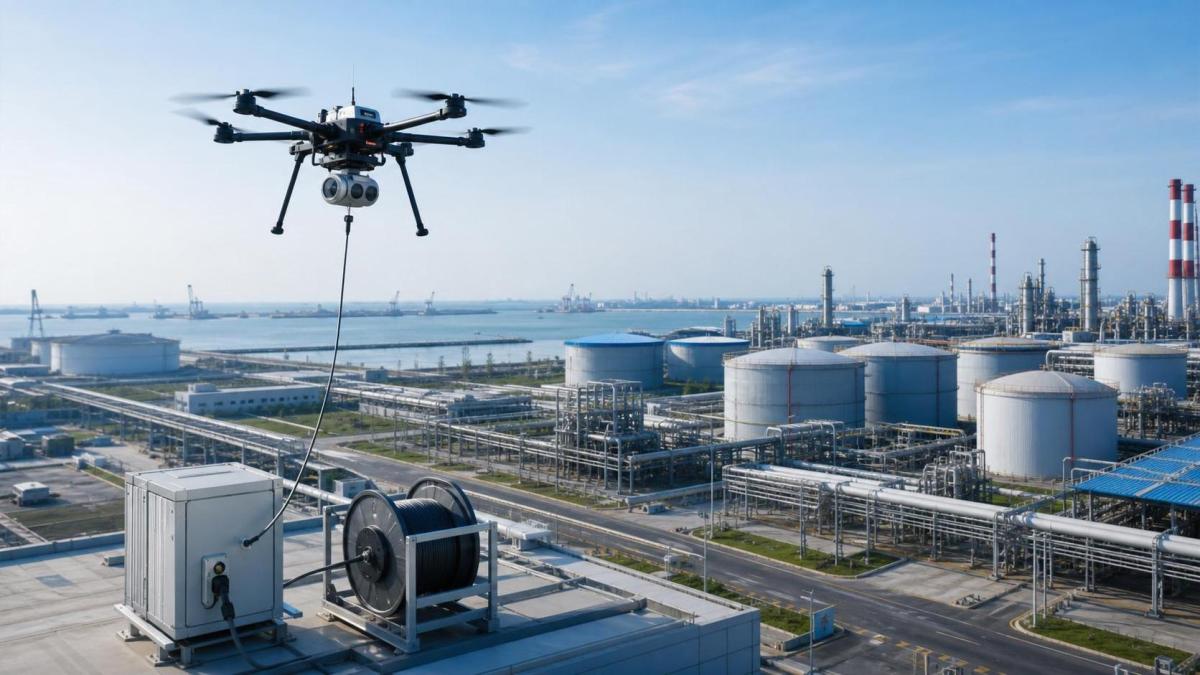
Persistent aerial coverage sounds simple until the mission must stay airborne for hours, days, or longer without losing video, sensing quality, or positional stability.
That is why tethered uav continuous flight time deserves closer scrutiny than headline endurance claims. It affects surveillance continuity, incident response rhythm, and the practical size of a monitored zone.
In practice, the question is rarely whether a platform can hover continuously. The more useful question is under which load, weather, cable length, and power condition it can keep delivering usable output.
This distinction matters across industrial security, disaster command, temporary communications, maritime observation, and infrastructure inspection. Similar missions can demand very different power margins and operational tolerances.
A data-first evaluation also fits the TSV approach. Parameters do not lie, and continuous flight claims mean little without electrical limits, payload constraints, and environmental derating.
Different sites create different endurance requirements
Not every deployment needs maximum tethered uav continuous flight time. Some sites need eight stable hours during a shift. Others need persistent overwatch for multiple days with scheduled maintenance windows.
A refinery perimeter, for example, often values stable electro-optical coverage and low airspace complexity. A wildfire command post cares more about rapid relocation, wind tolerance, and safe generator-backed power continuity.
Urban temporary security introduces another layer. Rooftop access, cable routing, electromagnetic noise, and local restrictions can limit what looks feasible on paper.
More often than not, the real comparison is between persistent visibility and deployment burden. Longer endurance is useful only when the tether station, power source, and crew process can support it reliably.
What usually changes from one site to another
- Required altitude and cable length
- Payload type, especially gimbals, radios, or thermal sensors
- Wind profile, dust, salt, rain, and temperature swing
- Primary power quality and backup architecture
- Redeployment frequency and crew skill level
Where continuous flight time creates real value
At fixed industrial sites, tethered uav continuous flight time usually replaces repeated launch cycles. That reduces battery handling, shortens blind intervals, and stabilizes sensor availability during long monitoring periods.
The value is strongest when the observation point must stay elevated continuously. Tank farms, ports, substations, and logistics hubs often benefit because the mission is repetitive and the protected footprint is predictable.
Emergency response uses the same principle differently. Here, endurance is less about routine persistence and more about keeping an uninterrupted aerial picture while teams, vehicles, and risks are moving below.
Communications relay is another case. If the aircraft carries a radio package, endurance must be judged together with power draw, heat dissipation, and the consequence of a short outage.
Typical decision differences by use case
Power options look simple until deployment begins
Most tethered systems rely on ground power transmitted through a lightweight cable, but the choice behind that setup changes field performance more than many brochures admit.
Grid-fed stations are attractive for permanent sites. They support long tethered uav continuous flight time with lower fuel logistics, but they also inherit local voltage instability and outage risk.
Generator-backed systems fit remote deployments better. They add mobility and resilience, though acoustic signature, refueling, vibration, and maintenance burden become part of the mission equation.
Hybrid architectures often make more sense than either extreme. A battery buffer or UPS can bridge transitions, smooth voltage events, and prevent a brief power dip from causing a mission-ending descent.
The right answer depends on whether the site prioritizes permanence, transportability, or resilience against unstable infrastructure.
Power architecture checks worth verifying early
- Input voltage range and tolerance to transient drops
- Cable power loss at operational altitude
- Emergency descent behavior during ground power failure
- Backup runtime for controlled recovery or handover
- Service interval for generators, reels, and connectors
The main technical limits behind tethered uav continuous flight time
Continuous flight is always bounded, even when there is no battery countdown. The limit simply shifts from onboard energy to system stress, electrical conversion, and environmental exposure.
Payload mass is the first filter. A heavier gimbal, LTE node, spotlight, or radar package pushes rotor demand upward and narrows safe operating margin in gusts.
Tether length also changes the picture. More cable can extend viewing geometry, yet extra mass, drag, and transmission loss may reduce practical stability or usable altitude.
Thermal management is another quiet constraint. Power electronics, motors, and onboard processors may stay within spec in mild weather, then derate sharply in hot, dusty, or high-humidity conditions.
This is why TSV-style benchmarking matters. A true endurance assessment should specify ambient conditions, payload draw, hover altitude, and fault recovery behavior, not just headline hours.
Common misreads when comparing similar deployments
One frequent mistake is treating tethered uav continuous flight time as a standalone metric. Endurance without sensor clarity, stable data links, or safe recovery logic can create false confidence.
Another is assuming two security sites need the same system because both require persistent overwatch. One may face high crosswinds and long cable runs, while the other mainly needs quiet rooftop operation.
Cost is often misread as well. A lower acquisition price can be offset by higher generator servicing, connector wear, crew workload, or downtime after repeated field handling.
It is also easy to overlook interoperability. Video standards, edge analytics compatibility, and command system integration can matter as much as airborne endurance.
A more reliable comparison method
Compare systems using mission hours delivered per month, not only maximum hover time. Then map that result against payload profile, maintenance windows, and expected site interruptions.
That approach usually reveals whether the platform is truly suited to persistent operations or only optimized for controlled demonstrations.
How to match deployment style with the right system trade-off
For fixed infrastructure, prioritize power conditioning, reel durability, and integration with existing surveillance or control networks. Here, tethered uav continuous flight time should support predictable service schedules.
For mobile command or emergency use, a slightly lower theoretical endurance may be acceptable if setup time, transport footprint, and recovery procedures are stronger.
For mixed-use environments, look for modularity. Swappable payloads, configurable power input, and clear derating data usually matter more than chasing the longest published endurance figure.
A practical selection path is to document three numbers early: required hover altitude, actual payload draw, and acceptable downtime during power events. Those values anchor every meaningful comparison.
From there, validate cable management, backup behavior, weather limits, and maintenance intervals under realistic operating assumptions. That is the fastest way to separate engineering truth from marketing noise.
If the goal is dependable persistent aerial coverage, the next step is not chasing the highest claim. It is defining the exact scene, checking the limiting parameters, and building a site-specific acceptance standard before deployment.
Search News
Hot Articles
- Carbon Fiber StructuresHow to Specify Aerospace Carbon Fiber Assemblies for Lightweight, Load-Bearing PartsJul 11, 2026
- Machine VisionXiaomi, Alibaba DAMO Academy Drive Open-Source Robotics Model Ecosystem, Lowering Algorithm Development Barriers for Overseas SMEs Adopting Chinese Robotics SolutionsMar 30, 2026
- Cobots & ArmsShanxi 'AI+' Conference Showcases Embodied Intelligence with Multinational Buyer Engagement: Key Industry ImplicationsMar 30, 2026
Popular Tags
Recommended News
 Jul 11, 2026How to Specify Aerospace Carbon Fiber Assemblies for Lightweight, Load-Bearing PartsAerospace carbon fiber assemblies: learn how to specify laminate design, load data, joining methods, and inspection controls for lighter, reliable load-bearing aerospace parts.Elena Rostova (UAV Systems Researcher)
 Mar 30, 2026Xiaomi, Alibaba DAMO Academy Drive Open-Source Robotics Model Ecosystem, Lowering Algorithm Development Barriers for Overseas SMEs Adopting Chinese Robotics SolutionsXiaomi & Alibaba DAMO Academy's open-source robotics models lower algorithm barriers for global SMEs. Boost efficiency in manufacturing, logistics & smart retail with ROS 2 compatible solutions.TSV Data Lab
 Mar 30, 2026Shanxi 'AI+' Conference Showcases Embodied Intelligence with Multinational Buyer Engagement: Key Industry ImplicationsShanxi 'AI+' Conference highlights embodied intelligence with Tesla, Ubtech & Jiantao showcasing multimodal robotics. 40+ global buyers validated tech on-site, creating new B2B channels for industrial automation & AI solutions.Chen Wei (Automation Lead Engineer)
 Mar 30, 2026Zhongguancun Unveils 6G Integrated Sensing-Computing-Intelligence Platform to Empower Embodied Robots for Global Industrial ApplicationsZhongguancun's new 6G platform revolutionizes industrial robotics with <10ms latency, empowering global automotive, logistics & port automation. Discover how this tech boosts China's smart manufacturing exports.TSV Data Lab
 Mar 30, 2026Mech-Mind Tianjin Embodied Intelligence R&D and Production Base Goes Live, Cutting Delivery Time by 20%–30% for Global Customized AMR+Vision SolutionsMech-Mind's Tianjin AMR+Vision production base cuts delivery time by 20%-30% for欧美 & Latin American markets. Discover how this PLd-certified facility accelerates customized robotics solutions for smart manufacturing and logistics.Chen Wei (Automation Lead Engineer)
 Mar 30, 2026Boao Forum Reveals 'Co-evolution of Big and Small Brains' Trend in Humanoid Robots, China's Embodied Intelligence Accelerates Adaptation to Overseas Manufacturing Service ScenariosDiscover how China's humanoid robots, featuring 'Co-evolution of Big and Small Brains,' are revolutionizing global manufacturing. Learn about Embodied Tian Gong 3.0's ISO compliance and overseas deployment at Boao Forum 2026.Chen Wei (Automation Lead Engineer)
 Mar 30, 2026China Railway Industrial Secures Patent for Embodied Robotics in Material Handling, Boosting High-Precision Delivery Capabilities for Overseas Infrastructure and Manufacturing ProjectsChina Railway Industrial's new patent for embodied robotics in material handling boosts high-precision delivery for global infrastructure & manufacturing. Discover how this innovation enhances logistics accuracy in automotive, rail transit & EPC projects.Chen Wei (Automation Lead Engineer)
 Sep 19, 2026How to Scope Automation Integration Services for Multi-System Factory ProjectsAutomation integration services: learn how to scope multi-system factory projects with clear workflows, interface contracts, safety boundaries, and acceptance criteria.Victor Lin (Chief Software Architect)
 Sep 18, 2026Selecting UAV Aerospace Structural Parts for Strength, Weight, and Fatigue LifeUAV aerospace structural parts guide: compare strength, weight, stiffness, fatigue life, joints, and traceability to select reliable flight-ready components.Elena Rostova (UAV Systems Researcher)
 Sep 17, 2026Selecting Commercial Drone Payloads for European Inspection ProjectsCommercial drone payloads Europe: learn how to select RGB, thermal and LiDAR systems for compliant, reliable inspection data and better project outcomes.Elena Rostova (UAV Systems Researcher)
 Sep 16, 2026Machining Tolerance Validation: How to Verify Critical Dimensions Before Production ReleaseMachining tolerance analysis validation: verify critical dimensions, measurement systems, process capability, and tolerance stacks before production release.Dr. Marcus Vance
 Sep 15, 2026AGV Tape Guidance vs Laser Navigation: Which Fits Your Warehouse Layout?AGV tape guidance comparison: discover how tape and laser navigation fit changing warehouse layouts, docking needs, floor conditions, maintenance, and route flexibility.Chen Wei (Automation Lead Engineer)
 Sep 14, 2026How Point Cloud Analytics Improves Asset Inspection Workflows Across GCC ProjectsPoint cloud analytics GCC helps project leaders improve asset inspections with accurate change detection, safer workflows, and faster maintenance decisions.TSV Data Lab
 Sep 13, 2026How Aerospace Manufacturers Can Build a Digital Thread From Design to Certified ProductionDigital manufacturing for aerospace: learn how to build a traceable digital thread from design through certified production, supplier control, and audit-ready compliance.Victor Lin (Chief Software Architect)
 Sep 12, 2026How to Select a Thermal Sensor for Mapping Drones in Surveying ProjectsMapping drone thermal sensor selection made simple: compare GSD, radiometric data, NETD, calibration, and workflow fit for accurate, survey-ready thermal maps.Elena Rostova (UAV Systems Researcher)
 Sep 11, 2026Integrating Photogrammetry Workflows into Digital Twin Projects Without Data BottlenecksPhotogrammetry workflow integration for digital twins: learn how to streamline capture, validation, versioning, and delivery to prevent data bottlenecks.Victor Lin (Chief Software Architect)
 Sep 10, 2026Hard-Tech Supply Chain Procurement: Qualifying Suppliers to Cut Lead-Time RiskHard-tech supply chain procurement guide: qualify suppliers with proven process, traceability, capacity, and change control to reduce lead-time risk.Chen Wei (Automation Lead Engineer)
 Sep 09, 2026Industrial Application Notes: Cost Factors That Shape Automation Project BudgetsIndustrial application notes cost factors explained: uncover the engineering, safety, integration, and commissioning variables that shape accurate automation budgets.Victor Lin (Chief Software Architect)
 Sep 08, 2026Supplier Discovery for Sourcing: How Buyers Can Verify Capability and Supply RiskSupplier discovery for sourcing: learn how to verify supplier capability, traceability, quote assumptions, and supply risk before placing production orders.TSV Data Lab
 Sep 07, 2026What Determines Process Control Systems Pricing? A Buyer’s Cost GuideProcess control systems pricing explained: compare hardware, engineering, integration, cybersecurity, validation, and lifecycle costs to choose the right-value solution.Victor Lin (Chief Software Architect)
 Sep 07, 2026AMR Robots in ASEAN: Which Industries Are Adopting Them—and Why?AMR robots ASEAN adoption is accelerating in electronics, automotive, warehousing, healthcare, and cold chain. Explore use cases, risks, and deployment insights.Chen Wei (Automation Lead Engineer)
 Sep 05, 2026How to Evaluate Supplier Qualification Support Tools for Industrial Procurement TeamsSupplier qualification support tools help industrial procurement teams verify technical evidence, manage risk, and make defensible supplier approvals. Learn what to evaluate.Victor Lin (Chief Software Architect)
 Sep 04, 2026Grinding Tolerance Analysis: How to Set Realistic Limits for Precision PartsGrinding tolerance analysis explains how to set realistic limits for precision parts, balance fit, geometry, process capability, and inspection for reliable performance.Dr. Marcus Vance
 Sep 03, 2026Warehouse Automation Strategies to Increase Storage Capacity Without ExpansionWarehouse automation space saving strategies help unlock vertical capacity, optimize slotting, and improve storage density without costly building expansion.Victor Lin (Chief Software Architect)