Robotic Automation for Flexible Production: Managing Product Changeovers
Publication Date
author
For engineering project managers, frequent product changeovers can disrupt schedules, increase commissioning effort, and erode production capacity. Robotics automation flexible production strategies address these challenges by combining reconfigurable tooling, adaptable robot programs, and repeatable setup procedures. The challenge is not simply making a robot handle more parts. It is making the entire cell switch products predictably, safely, and with enough evidence to release the next batch.
A flexible cell can still be a poor project investment if each new variant requires an integrator visit, a lengthy vision retune, or a fresh safety review. Before specifying equipment, define what “changeover complete” means and determine which product differences the system must accommodate without engineering intervention.
Start with the production transition, not the robot
Map the intended product family by the features that affect automation: part dimensions and mass, gripping surfaces, presentation, process forces, inspection criteria, and packaging or downstream interfaces. Two components that look similar on a drawing may need different handling methods if one has a delicate finish or a less predictable center of gravity.
Then separate routine variation from exceptional variation. A cell designed to handle a defined family of housings may reasonably use adjustable jaws and recipe-driven positions. Asking the same cell to accommodate an unknown future product with a different process and inspection method is a different scope. Leave physical space, payload margin, and accessible control interfaces where justified, but do not treat an unspecified future requirement as if it were already engineered.
For planning purposes, group changeovers into three categories: recipe-only changes, changes involving physical tooling or fixtures, and changes that alter the process or safety envelope. The first may be an operator task; the last may require engineering review and formal revalidation. That distinction affects staffing, scheduling, and the business case.
Measure the changeover that production actually experiences
A supplier may demonstrate a quick tool exchange while the factory still spends considerably longer clearing material, locating fixtures, checking the program, and approving the first good part. Both numbers can be useful, but they are not interchangeable.
Agree on the measurement boundary before comparing proposals. A practical production measure runs from the last conforming part of the outgoing product to the first conforming part of the incoming product. Record any additional time needed to reach a stable production rate separately. Where quality release requires laboratory or customer approval, distinguish elapsed waiting time from active work.
Break the event into observable tasks: clearing and cleaning, mechanical conversion, recipe selection, tool and fixture verification, trial cycles, inspection, and release. Note who performs each task and whether work can safely be prepared while the previous batch is still running. A fixture assembled offline may save more production time than a faster robot motion.
Use repeated trials across representative product transitions rather than relying on one rehearsed demonstration. Record failed starts and adjustments as well as successful cycles. The variation between changeovers matters to the schedule: a short average is less reassuring when the difficult transitions regularly consume the available production window.
Design the mechanical interfaces before writing recipes
Tool changers, adjustable grippers, and modular fixtures can shorten conversion, but only if their interfaces locate consistently. A quick-release mechanism that permits small differences in seating can move the tool center point enough to affect insertion, dispensing, or inspection. Specify how tools are located, locked, identified, and checked—not just how quickly they can be detached.
Include the entire end effector when checking robot payload and reach. The gripper, adapter, sensors, cables, and part all contribute to the load; their distribution also affects the robot’s allowable operating conditions. Confirm the proposed combination against the robot manufacturer’s payload and inertia limits, particularly when a long tool creates a substantial moment at the wrist.
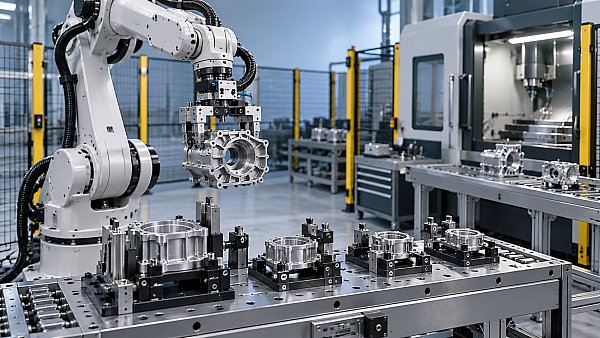
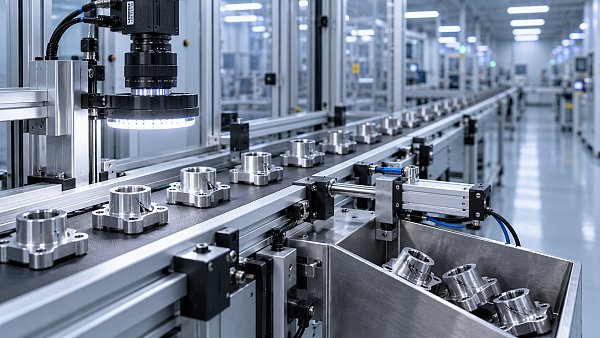
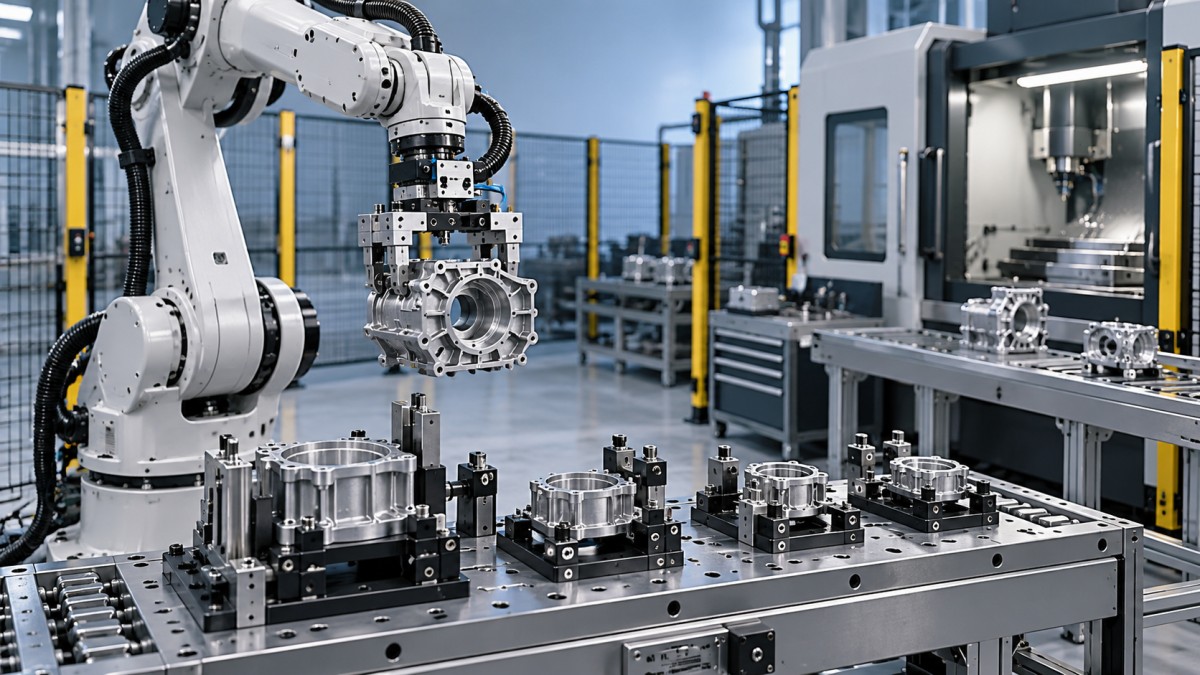
Consider a cell switching between two sizes of machined housing. Common locating features may allow one fixture base with replaceable nests, while adjustable gripper fingers handle both sizes. That works only if the grip remains secure, the parts are presented within the expected range, and the inspection system can distinguish the variants. If one housing has a critical cosmetic surface, a dedicated gripper may be the safer and simpler choice despite the extra hardware.
Plan where unused tools and fixtures will live. A changeover that depends on an unprotected fixture stored across the plant is vulnerable to damage, missing fasteners, and delays that will not appear in a cell simulation.
Repeatability is not the same as process accuracy
Robot repeatability describes how consistently the robot returns to a commanded position under specified conditions. It does not by itself guarantee that a tool reaches the correct position relative to a real part. Base location, fixture variation, tool calibration, part tolerances, thermal effects, compliance, and vision measurement error can all contribute to the final result.
Build an application-level error budget around the feature that matters. For insertion, that may be the relative position and angle between the held component and its mating feature. For dispensing, it may be the bead path relative to an edge. Determine which contributors can be controlled mechanically, which can be measured or compensated, and which require a process allowance.
Vision can locate parts with variable presentation, but it is not a cure for unstable mechanics. Lighting, surface reflectivity, occlusion, lens choice, calibration, and image processing all affect performance. A vision system qualified on clean, ideal parts should also be challenged with acceptable production variation, including changes in orientation and appearance. Define what happens when confidence is insufficient: reject, request an operator check, or stop the cell rather than silently applying a questionable correction.
This is where TechStat Vanguard’s parameter-first approach is useful: ask for the test conditions behind a repeatability or vision claim, then check whether those conditions represent the installed application. A specification without its measurement method is a weak basis for an acceptance decision.
Make recipes control the whole cell
A product recipe should do more than load robot coordinates. Depending on the process, it may select tooling, fixture settings, vision parameters, process limits, inspection criteria, and downstream routing. The control system should verify that the physical setup matches the selected recipe before automatic operation begins.
That verification can combine tool identification, fixture sensors, part identification, and operator confirmation. The right mix depends on the consequence of a mismatch. An operator prompt alone may be reasonable for a low-risk manual adjustment, but it is a fragile control where the wrong tool could damage equipment or produce an undetected defect.
Version control deserves equal attention. Keep approved robot programs, programmable logic controller configurations, vision jobs, and recipe parameters linked to their release records. Define who can edit them, how a change is tested, and how the team restores the last approved configuration. Backups should include the files and calibration information needed for recovery, not merely the robot program.
Offline programming can reduce disruption, but a simulated path still depends on the accuracy of the cell model and the real installation. Reserve time to verify clearance, approach points, cable behavior, and process results on the physical cell. A digital model is a planning tool, not automatic proof of production readiness.
Treat safety and quality release as part of changeover design
Each intended setup needs to fit within the cell’s risk assessment. A new tool can change reach, pinch points, retained energy, or the way a person enters the work area. A new part can change the consequences of a dropped load. Collaborative operation, where proposed, requires assessment of the complete application rather than reliance on the robot label alone.
Define which changes are covered by the original assessment and which trigger review. During tool replacement or maintenance, the required isolation and verification procedures depend on the equipment and applicable local requirements. Do not assume that selecting a setup mode makes every manual intervention safe.
Quality release should be equally explicit. Identify the characteristics to inspect after a changeover, the sampling method, the acceptance limits, and the person authorized to release production. For regulated or customer-controlled work, confirm the validation and change-control obligations with the quality team and relevant contracts. A routine recipe change may need a different level of evidence from a new fixture, software revision, or altered process parameter.
Put acceptance criteria and integration ownership in the project plan
Factory acceptance testing is most useful when it includes the transitions that are likely to cause trouble, not just the nominal cycle. Provide representative parts and fixtures, including agreed examples of acceptable variation. Ask the supplier to demonstrate a complete changeover with the people, tools, and documentation expected in normal operation.
The acceptance plan should state the timing boundary, number and sequence of trials, definition of a conforming part, and treatment of failed attempts. Test incorrect recipe selection, missing tools, sensor faults, interrupted cycles, and recovery from a stop. Confirm which functions can be demonstrated at the supplier’s site and which require site acceptance after connection to actual upstream, downstream, and plant systems.
Integration gaps often sit between contracts. The robot supplier may own motion, a separate vendor may own vision, and the plant may own part presentation and manufacturing data. Assign an owner for the interfaces: signal definitions, handshakes, fault recovery, time synchronization where needed, and the authority to modify each system. Otherwise, a changeover delay can become an argument about whose equipment caused it.
Before approving the investment, compare the cost of flexibility with the production plan it must serve. Include tooling, integration, validation, training, spare parts, software support, and the expected effort to introduce another variant. If product families are stable and changeovers are rare, dedicated tooling may be easier to qualify and operate. If mix changes frequently, the more adaptable cell can justify its complexity—but only when its changeover performance is demonstrated at the production boundary the factory actually cares about.
Search News
Hot Articles
- Carbon Fiber StructuresHow to Specify Aerospace Carbon Fiber Assemblies for Lightweight, Load-Bearing PartsJul 11, 2026
- Machine VisionXiaomi, Alibaba DAMO Academy Drive Open-Source Robotics Model Ecosystem, Lowering Algorithm Development Barriers for Overseas SMEs Adopting Chinese Robotics SolutionsMar 30, 2026
- Cobots & ArmsShanxi 'AI+' Conference Showcases Embodied Intelligence with Multinational Buyer Engagement: Key Industry ImplicationsMar 30, 2026
Popular Tags
Recommended News
 Jul 11, 2026How to Specify Aerospace Carbon Fiber Assemblies for Lightweight, Load-Bearing PartsAerospace carbon fiber assemblies: learn how to specify laminate design, load data, joining methods, and inspection controls for lighter, reliable load-bearing aerospace parts.Elena Rostova (UAV Systems Researcher)
 Mar 30, 2026Xiaomi, Alibaba DAMO Academy Drive Open-Source Robotics Model Ecosystem, Lowering Algorithm Development Barriers for Overseas SMEs Adopting Chinese Robotics SolutionsXiaomi & Alibaba DAMO Academy's open-source robotics models lower algorithm barriers for global SMEs. Boost efficiency in manufacturing, logistics & smart retail with ROS 2 compatible solutions.TSV Data Lab
 Mar 30, 2026Shanxi 'AI+' Conference Showcases Embodied Intelligence with Multinational Buyer Engagement: Key Industry ImplicationsShanxi 'AI+' Conference highlights embodied intelligence with Tesla, Ubtech & Jiantao showcasing multimodal robotics. 40+ global buyers validated tech on-site, creating new B2B channels for industrial automation & AI solutions.Chen Wei (Automation Lead Engineer)
 Mar 30, 2026Zhongguancun Unveils 6G Integrated Sensing-Computing-Intelligence Platform to Empower Embodied Robots for Global Industrial ApplicationsZhongguancun's new 6G platform revolutionizes industrial robotics with <10ms latency, empowering global automotive, logistics & port automation. Discover how this tech boosts China's smart manufacturing exports.TSV Data Lab
 Mar 30, 2026Mech-Mind Tianjin Embodied Intelligence R&D and Production Base Goes Live, Cutting Delivery Time by 20%–30% for Global Customized AMR+Vision SolutionsMech-Mind's Tianjin AMR+Vision production base cuts delivery time by 20%-30% for欧美 & Latin American markets. Discover how this PLd-certified facility accelerates customized robotics solutions for smart manufacturing and logistics.Chen Wei (Automation Lead Engineer)
 Mar 30, 2026Boao Forum Reveals 'Co-evolution of Big and Small Brains' Trend in Humanoid Robots, China's Embodied Intelligence Accelerates Adaptation to Overseas Manufacturing Service ScenariosDiscover how China's humanoid robots, featuring 'Co-evolution of Big and Small Brains,' are revolutionizing global manufacturing. Learn about Embodied Tian Gong 3.0's ISO compliance and overseas deployment at Boao Forum 2026.Chen Wei (Automation Lead Engineer)
 Mar 30, 2026China Railway Industrial Secures Patent for Embodied Robotics in Material Handling, Boosting High-Precision Delivery Capabilities for Overseas Infrastructure and Manufacturing ProjectsChina Railway Industrial's new patent for embodied robotics in material handling boosts high-precision delivery for global infrastructure & manufacturing. Discover how this innovation enhances logistics accuracy in automotive, rail transit & EPC projects.Chen Wei (Automation Lead Engineer)
 Nov 02, 2026Robotic Automation for Flexible Production: Managing Product ChangeoversExplore robotics automation flexible production strategies to streamline product changeovers, reduce downtime, and improve safety and quality.Victor Lin (Chief Software Architect)
 Nov 01, 2026Industrial Pressure Transmitter Bulk Pricing: Quantity Discounts and Cost FactorsCompare industrial pressure transmitter bulk price options, quantity discounts, specifications, and landed costs to source compliant devices with confidence.Victor Lin (Chief Software Architect)
 Oct 31, 2026A3: North American Robot Orders Rose 24.8% Year on Year in Q3 2026North American robot orders rose 24.8% year on year in Q3 2026, according to A3. Explore the demand trends and what buyers should check before ordering.Chen Wei (Automation Lead Engineer)
 Oct 31, 2026Servo Motor MTBF for Robotics: How to Interpret Reliability RatingsServo motor MTBF for robotics: learn how to interpret reliability ratings, compare supplier evidence, and choose motors suited to your robot’s duty cycle.Chen Wei (Automation Lead Engineer)
 Oct 30, 2026Choosing a Procurement Content Provider: Data Quality and CoverageChoose a procurement content provider with confidence. Learn how to assess data quality, supplier coverage, traceability, and verification before you buy.Chen Wei (Automation Lead Engineer)
 Oct 29, 2026Shanghai Plan Targets 8,000 Humanoid Robots in Factories by 2028Shanghai's humanoid robot plan targets 8,000 factory deployments by 2028. Explore what it means for smart manufacturing and robot suppliers.Chen Wei (Automation Lead Engineer)
 Oct 29, 2026Aerospace Aluminum Alloy Strength: 2024-T3 vs. 7075-T6 ComparedCompare aerospace aluminum alloy strength in 2024-T3 vs. 7075-T6. Explore fatigue, corrosion, and weight trade-offs to choose the right alloy for your design.Dr. Marcus Vance
 Oct 28, 2026IDC: Global Quadruped Robot Shipments Rise 92.5% in H1 2026 as Volume and Value DivergeGlobal quadruped robot shipments rose 92.5% in H1 2026, according to IDC. Explore what diverging volume and value trends mean for industrial buyers and manufacturers.Chen Wei (Automation Lead Engineer)
 Oct 28, 2026Interpreting Industrial IoT Latency Data for Monitoring and Real-Time ControlInterpret industrial category latency data to assess jitter, deadline misses, and real-time readiness. Learn how to benchmark IIoT systems and choose monitoring and control solutions.TSV Data Lab
 Oct 27, 2026GXO and Agility Robotics Expand Partnership to Accelerate US Humanoid Robot DeploymentGXO and Agility Robotics plan to expand US humanoid robot deployment with Digit 4 in early 2027. Explore warehouse automation plans, service terms and future Digit 5 upgrades.Chen Wei (Automation Lead Engineer)
 Oct 27, 2026Robotic Automation Costs: Budgeting for Equipment, Integration, and MaintenancePlan your robotics automation cost with confidence. Explore equipment, integration, and maintenance expenses, compare quotes, and build a realistic budget for better ROI.Chen Wei (Automation Lead Engineer)
 Oct 26, 2026AMAXiMAL Releases Open-Source TopMod 3D v3 With Claude AIExplore AMAXiMAL’s free, open-source TopMod 3D v3 with Claude AI assistance, topology-based modeling and plywood fabrication tools that connect complex designs to physical builds.Dr. Marcus Vance
 Oct 26, 2026Choosing a SCADA System Integrator Company: PLC Compatibility and Long-Term SupportChoose a scada system integrator company with proven PLC compatibility and reliable long-term support. Discover what to test, compare, and require before investing.Victor Lin (Chief Software Architect)
 Oct 25, 2026Hesai Leads Global ADAS Main Lidar Shipments in Yole’s 2026 ReportHesai led global ADAS main lidar shipments with a 43% share in 2025, according to Yole’s 2026 report. Explore what this ranking reveals about its automotive market position.TSV Data Lab
 Oct 25, 2026Choosing an Aerospace Materials Manufacturer: Quality and Traceability ChecksChoosing an aerospace materials manufacturer? Learn how to verify certifications, test reports, and lot traceability to qualify suppliers confidently and reduce costly sourcing risks.Dr. Marcus Vance
 Oct 24, 2026Guotai Haitong: Global Entry-Level 3D Printer Shipments Rose 39% in Q1 2026Entry-level 3D printer shipments rose 39% in Q1 2026, Guotai Haitong reports. Explore how AI, multicolor printing and print farms are shaping market growth.Dr. Marcus Vance
 Oct 24, 2026Choosing an Industrial Vision Inspection Supplier: Acceptance Tests That MatterChoose an industrial vision inspection supplier with confidence. Discover acceptance tests for defect detection, false rejects, production speed, and reliable part rejection before you buy.TSV Data Lab