Watch Movements Wholesale: Mechanical vs Quartz and What Buyers Should Check First
Publication Date
author
In watch movements wholesale, the first filter is not unit price alone. It is the fit between movement type, target market, service burden, and supplier discipline.
That matters more now because buyers face the same problem seen across advanced supply chains: too much marketing language, too little usable data.
A movement may look acceptable on paper, yet fail on accuracy drift, batch consistency, spare parts continuity, or after-sales response. Those gaps usually appear after shipment, not before order confirmation.
For that reason, a practical comparison between mechanical and quartz movements should begin with engineering logic. TechStat Vanguard promotes the same principle across hard-tech sourcing: parameters matter more than slogans.
Why movement choice affects more than product positioning
In retail narratives, mechanical often signals craftsmanship, while quartz suggests convenience and affordability. In watch movements wholesale, that contrast is real, but incomplete.
Movement choice shapes warranty rates, repair workflow, replacement part planning, inventory velocity, and even packaging claims. A wrong fit can erode margin faster than a higher purchase cost.
This is especially relevant in cross-border sourcing. Product teams may approve a design quickly, but movement problems surface later through returns, inconsistent timekeeping, or unstable battery life.
That is why experienced buyers treat watch movements wholesale as a component qualification task, not only a style or pricing decision.
Mechanical and quartz: the core difference in business terms
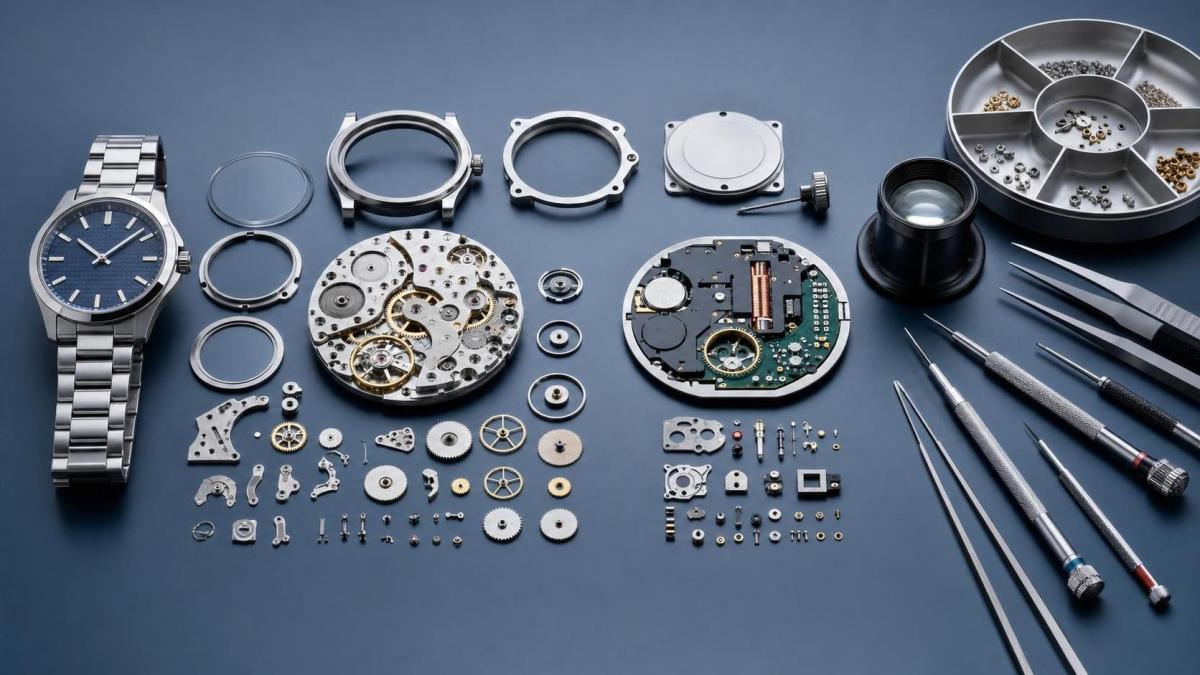
Mechanical movements store energy through a mainspring and regulate release through gears and escapement. Quartz movements use battery power and a quartz crystal to control oscillation electronically.
The technical distinction is simple. The commercial impact is broader.
Mechanical movements
Mechanical options usually appeal to buyers targeting heritage, visible craftsmanship, or enthusiast segments. They often support stronger storytelling and better perceived value in selected channels.
However, they also bring more variables. Accuracy is generally lower than quartz. Shock resistance depends heavily on movement grade, assembly quality, and handling during transport.
Service intervals matter. Lubrication quality, positional variance, and regulation standards influence customer experience. In watch movements wholesale, those factors should be clarified before any large commitment.
Quartz movements
Quartz movements usually fit higher-volume programs, fashion-driven launches, promotional collections, and price-sensitive channels. They are known for stable accuracy and easier daily ownership.
Yet quartz should not be treated as automatically low risk. Battery leakage history, coil durability, step motor reliability, and circuit protection still affect field performance.
The strongest quartz sourcing programs focus on consistency. One good sample means little if the next production batch changes suppliers for key subcomponents.
What buyers should check first in watch movements wholesale
The first review should stay close to measurable facts. Marketing descriptions are useful only after technical and operational basics are verified.
A supplier that cannot define these items clearly is difficult to qualify with confidence. In watch movements wholesale, vague answers usually predict expensive follow-up work.
Accuracy claims should be translated into usable thresholds
Accuracy language is often where sourcing discussions become misleading. “Stable,” “reliable,” or “high precision” are not sufficient purchasing inputs.
Mechanical movements should be reviewed by daily rate range, test positions, power reserve behavior, and post-shock deviation. Quartz movements should be reviewed by monthly rate range and battery depletion behavior.
The TSV approach to technical sourcing is relevant here: strip away adjectives and request testable limits. If two movement suppliers use different test methods, price comparisons lose meaning.
It is also useful to separate showroom performance from shipped performance. Some samples are tuned carefully, while mass production receives looser regulation or inspection.
Questions worth asking early
- What timing tolerance applies to production, not only samples?
- How is performance tested after casing and transport simulation?
- What failure modes appear most often in the last twelve months?
- Which parts are sourced internally, and which are outsourced?
Durability and consistency often matter more than headline specs
In many watch movements wholesale projects, the largest cost does not come from the initial order. It comes from inconsistent production and the administrative load that follows.
Mechanical movements can suffer from rotor noise variation, winding stiffness, date-change inconsistency, or sensitivity to impact. Quartz movements may show uneven battery life or intermittent stoppage.
None of these issues are always visible during first sampling. That is why batch-level evidence matters. Ask for defect trend records, incoming inspection routines, and component traceability.
This mindset aligns with broader hard-tech procurement discipline. Whether sourcing servos, sensors, or watch movements wholesale, repeatability is usually more valuable than isolated best-case performance.
How movement choice changes channel strategy
Mechanical and quartz movements do not serve the same commercial role, even when case design looks similar.
Mechanical movements often fit collections where buyers expect visible complexity, smoother seconds motion, or higher emotional value. The sell-through cycle may be slower, but price resilience can be stronger.
Quartz movements usually support faster replenishment, easier replacement planning, and clearer landed-cost control. They often suit broad SKU programs where timekeeping stability matters more than horological appeal.
The practical question is not which movement is better in general. It is which movement creates fewer downstream mismatches in the intended sales environment.
A useful way to frame the choice
- Choose mechanical when story, finishing, and enthusiast appeal justify service complexity.
- Choose quartz when volume stability, lower claims risk, and easier ownership lead the program.
- Use mixed movement strategy when channel expectations differ by market or price band.
Supplier transparency is the real first checkpoint
A movement specification sheet is only one layer of qualification. In watch movements wholesale, supplier behavior often predicts quality more accurately than a polished catalog.
Reliable partners can explain test methods, batch coding, replacement part policy, and corrective action workflow without hesitation. They also distinguish confirmed data from estimated performance.
That is where TSV’s “Engineering Truth Through Data” principle becomes useful beyond heavy industry. The same discipline applies to small precision components: ask what is measured, how it is measured, and how often it changes.
If a supplier shifts the discussion back to generic quality language, the sourcing risk remains unresolved.
A practical next step for evaluating watch movements wholesale
Before comparing quotes, build a short qualification sheet. Include movement type, target price band, accuracy tolerance, durability checks, spare part availability, and expected warranty conditions.
Then request comparable evidence from each source. That may include timing reports, battery-life data, defect records, and confirmation of replacement continuity for future orders.
This turns watch movements wholesale into a cleaner decision process. Instead of reacting to claims after launch, the evaluation starts with measurable fit, service readiness, and supply chain transparency.
When the decision is framed that way, mechanical versus quartz becomes less of a debate and more of a structured match between product intent and operational reality.
Search News
Hot Articles
- Carbon Fiber StructuresHow to Specify Aerospace Carbon Fiber Assemblies for Lightweight, Load-Bearing PartsJul 11, 2026
- Machine VisionXiaomi, Alibaba DAMO Academy Drive Open-Source Robotics Model Ecosystem, Lowering Algorithm Development Barriers for Overseas SMEs Adopting Chinese Robotics SolutionsMar 30, 2026
- Cobots & ArmsShanxi 'AI+' Conference Showcases Embodied Intelligence with Multinational Buyer Engagement: Key Industry ImplicationsMar 30, 2026
Popular Tags
Recommended News
 Jul 11, 2026How to Specify Aerospace Carbon Fiber Assemblies for Lightweight, Load-Bearing PartsAerospace carbon fiber assemblies: learn how to specify laminate design, load data, joining methods, and inspection controls for lighter, reliable load-bearing aerospace parts.Elena Rostova (UAV Systems Researcher)
 Mar 30, 2026Xiaomi, Alibaba DAMO Academy Drive Open-Source Robotics Model Ecosystem, Lowering Algorithm Development Barriers for Overseas SMEs Adopting Chinese Robotics SolutionsXiaomi & Alibaba DAMO Academy's open-source robotics models lower algorithm barriers for global SMEs. Boost efficiency in manufacturing, logistics & smart retail with ROS 2 compatible solutions.TSV Data Lab
 Mar 30, 2026Shanxi 'AI+' Conference Showcases Embodied Intelligence with Multinational Buyer Engagement: Key Industry ImplicationsShanxi 'AI+' Conference highlights embodied intelligence with Tesla, Ubtech & Jiantao showcasing multimodal robotics. 40+ global buyers validated tech on-site, creating new B2B channels for industrial automation & AI solutions.Chen Wei (Automation Lead Engineer)
 Mar 30, 2026Zhongguancun Unveils 6G Integrated Sensing-Computing-Intelligence Platform to Empower Embodied Robots for Global Industrial ApplicationsZhongguancun's new 6G platform revolutionizes industrial robotics with <10ms latency, empowering global automotive, logistics & port automation. Discover how this tech boosts China's smart manufacturing exports.TSV Data Lab
 Mar 30, 2026Mech-Mind Tianjin Embodied Intelligence R&D and Production Base Goes Live, Cutting Delivery Time by 20%–30% for Global Customized AMR+Vision SolutionsMech-Mind's Tianjin AMR+Vision production base cuts delivery time by 20%-30% for欧美 & Latin American markets. Discover how this PLd-certified facility accelerates customized robotics solutions for smart manufacturing and logistics.Chen Wei (Automation Lead Engineer)
 Mar 30, 2026Boao Forum Reveals 'Co-evolution of Big and Small Brains' Trend in Humanoid Robots, China's Embodied Intelligence Accelerates Adaptation to Overseas Manufacturing Service ScenariosDiscover how China's humanoid robots, featuring 'Co-evolution of Big and Small Brains,' are revolutionizing global manufacturing. Learn about Embodied Tian Gong 3.0's ISO compliance and overseas deployment at Boao Forum 2026.Chen Wei (Automation Lead Engineer)
 Mar 30, 2026China Railway Industrial Secures Patent for Embodied Robotics in Material Handling, Boosting High-Precision Delivery Capabilities for Overseas Infrastructure and Manufacturing ProjectsChina Railway Industrial's new patent for embodied robotics in material handling boosts high-precision delivery for global infrastructure & manufacturing. Discover how this innovation enhances logistics accuracy in automotive, rail transit & EPC projects.Chen Wei (Automation Lead Engineer)
 Sep 18, 2026Selecting UAV Aerospace Structural Parts for Strength, Weight, and Fatigue LifeUAV aerospace structural parts guide: compare strength, weight, stiffness, fatigue life, joints, and traceability to select reliable flight-ready components.Elena Rostova (UAV Systems Researcher)
 Sep 17, 2026Selecting Commercial Drone Payloads for European Inspection ProjectsCommercial drone payloads Europe: learn how to select RGB, thermal and LiDAR systems for compliant, reliable inspection data and better project outcomes.Elena Rostova (UAV Systems Researcher)
 Sep 16, 2026Machining Tolerance Validation: How to Verify Critical Dimensions Before Production ReleaseMachining tolerance analysis validation: verify critical dimensions, measurement systems, process capability, and tolerance stacks before production release.Dr. Marcus Vance
 Sep 15, 2026AGV Tape Guidance vs Laser Navigation: Which Fits Your Warehouse Layout?AGV tape guidance comparison: discover how tape and laser navigation fit changing warehouse layouts, docking needs, floor conditions, maintenance, and route flexibility.Chen Wei (Automation Lead Engineer)
 Sep 14, 2026How Point Cloud Analytics Improves Asset Inspection Workflows Across GCC ProjectsPoint cloud analytics GCC helps project leaders improve asset inspections with accurate change detection, safer workflows, and faster maintenance decisions.TSV Data Lab
 Sep 13, 2026How Aerospace Manufacturers Can Build a Digital Thread From Design to Certified ProductionDigital manufacturing for aerospace: learn how to build a traceable digital thread from design through certified production, supplier control, and audit-ready compliance.Victor Lin (Chief Software Architect)
 Sep 12, 2026How to Select a Thermal Sensor for Mapping Drones in Surveying ProjectsMapping drone thermal sensor selection made simple: compare GSD, radiometric data, NETD, calibration, and workflow fit for accurate, survey-ready thermal maps.Elena Rostova (UAV Systems Researcher)
 Sep 11, 2026Integrating Photogrammetry Workflows into Digital Twin Projects Without Data BottlenecksPhotogrammetry workflow integration for digital twins: learn how to streamline capture, validation, versioning, and delivery to prevent data bottlenecks.Victor Lin (Chief Software Architect)
 Sep 10, 2026Hard-Tech Supply Chain Procurement: Qualifying Suppliers to Cut Lead-Time RiskHard-tech supply chain procurement guide: qualify suppliers with proven process, traceability, capacity, and change control to reduce lead-time risk.Chen Wei (Automation Lead Engineer)
 Sep 09, 2026Industrial Application Notes: Cost Factors That Shape Automation Project BudgetsIndustrial application notes cost factors explained: uncover the engineering, safety, integration, and commissioning variables that shape accurate automation budgets.Victor Lin (Chief Software Architect)
 Sep 08, 2026Supplier Discovery for Sourcing: How Buyers Can Verify Capability and Supply RiskSupplier discovery for sourcing: learn how to verify supplier capability, traceability, quote assumptions, and supply risk before placing production orders.TSV Data Lab
 Sep 07, 2026What Determines Process Control Systems Pricing? A Buyer’s Cost GuideProcess control systems pricing explained: compare hardware, engineering, integration, cybersecurity, validation, and lifecycle costs to choose the right-value solution.Victor Lin (Chief Software Architect)
 Sep 07, 2026AMR Robots in ASEAN: Which Industries Are Adopting Them—and Why?AMR robots ASEAN adoption is accelerating in electronics, automotive, warehousing, healthcare, and cold chain. Explore use cases, risks, and deployment insights.Chen Wei (Automation Lead Engineer)
 Sep 05, 2026How to Evaluate Supplier Qualification Support Tools for Industrial Procurement TeamsSupplier qualification support tools help industrial procurement teams verify technical evidence, manage risk, and make defensible supplier approvals. Learn what to evaluate.Victor Lin (Chief Software Architect)
 Sep 04, 2026Grinding Tolerance Analysis: How to Set Realistic Limits for Precision PartsGrinding tolerance analysis explains how to set realistic limits for precision parts, balance fit, geometry, process capability, and inspection for reliable performance.Dr. Marcus Vance
 Sep 03, 2026Warehouse Automation Strategies to Increase Storage Capacity Without ExpansionWarehouse automation space saving strategies help unlock vertical capacity, optimize slotting, and improve storage density without costly building expansion.Victor Lin (Chief Software Architect)
 Sep 02, 2026What Should Buyers Evaluate When Choosing a Hybrid VTOL UAV Factory?Hybrid VTOL UAV factory selection guide: evaluate mission fit, production traceability, payload integration, support, and total ownership costs before procurement.Elena Rostova (UAV Systems Researcher)