Trampoline Park Equipment That Affects Throughput the Most
Publication Date
author
For business evaluators, trampoline park equipment is not just a capital expense but a direct driver of hourly capacity, guest flow, and revenue efficiency. From layout-critical attractions to queue-sensitive modules, the right equipment mix determines how many visitors can move safely and profitably through the venue. This article examines which equipment categories influence throughput the most and how to assess them with practical, operations-focused criteria.
Why Throughput Has Become the Core Buying Signal
The market for trampoline park equipment has changed. Operators are no longer evaluating attractions only by visual appeal or installation cost. The stronger signal today is operational density: how many guests a zone can process per hour, how evenly traffic distributes across the site, and how reliably staff can manage turnover during peak periods. This shift matters because family entertainment venues now face tighter labor economics, higher customer expectations, and stronger pressure to improve revenue per square meter.
In earlier project cycles, a park could succeed with a broad mix of standard trampoline beds, foam pits, and a few novelty elements. Now, buyers are asking harder questions. Which modules create bottlenecks? Which attractions absorb crowds without long wait times? Which layouts support repeat play without concentrating guests in one corner? These questions place throughput at the center of commercial evaluation.
For a business evaluator, the most important takeaway is that trampoline park equipment should be assessed as a flow system rather than a collection of standalone products. The highest-impact equipment is not always the most expensive or the most visually dramatic. It is usually the equipment that determines queue behavior, dwell time, supervision intensity, and circulation stability across the entire venue.
Current Trend: Equipment Selection Is Moving from Attraction-Led to Capacity-Led
A clear industry change is underway. More buyers are prioritizing trampoline park equipment that supports predictable guest movement instead of relying purely on high-thrill signature pieces. This does not mean visual attractions are losing value. It means their role is being judged differently. A feature that looks impressive but causes persistent queues can reduce total park productivity, compress spending opportunities, and weaken guest satisfaction during busy sessions.
The strongest equipment decisions now reflect a balance between headline appeal and operating efficiency. Parks increasingly segment attractions into three roles: anchor equipment that drives visits, throughput equipment that absorbs volume, and transition equipment that redistributes traffic. The best-performing parks usually combine all three intentionally.
This is where trampoline park equipment selection becomes a strategic issue. Buyers who understand these roles can better forecast revenue efficiency and avoid layouts that look attractive in concept drawings but underperform in live operations.
Which Trampoline Park Equipment Affects Throughput the Most
Not all equipment influences throughput equally. The categories below typically have the biggest effect on hourly capacity and guest flow.
1. Main jump arenas remain the biggest volume absorber
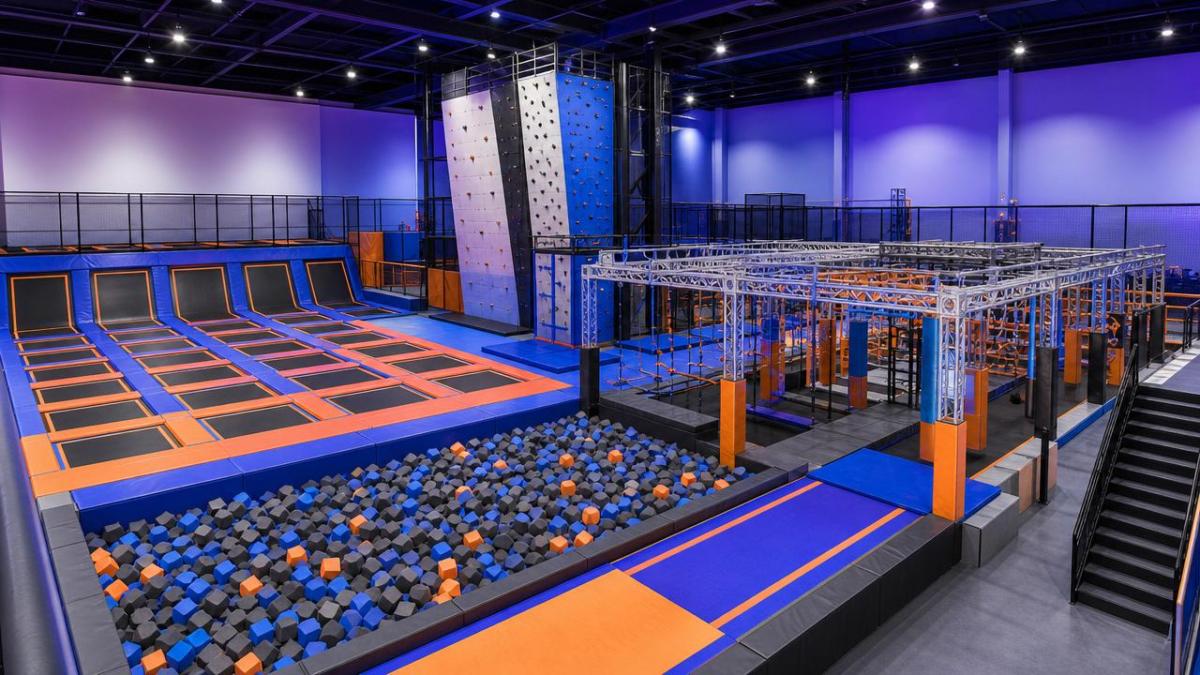
The core trampoline field usually has the strongest direct effect on park throughput because it can support continuous use with relatively low reset time. When designed well, it absorbs beginners, casual users, and mixed-age groups at the same time. For evaluators, key signals include jump bay count, separation logic, visibility for supervision, and how easily users enter and exit without crossing active lanes.
A large main arena often outperforms more complex attractions in revenue terms simply because it reduces idle waiting. If a venue undersizes this area, pressure spills into every other zone, increasing queues and lowering the effective value of premium attractions.
2. Ninja and obstacle courses shape dwell time and queue discipline
Obstacle-based trampoline park equipment has grown because it supports repeat attempts and social engagement. However, it can also create severe throughput constraints. Many obstacle zones process one participant at a time or require longer cycle intervals than standard jumping areas. This makes them highly sensitive to line management and entry design.
Business evaluators should focus on lane count, bypass options, and whether multiple skill levels can be used simultaneously. A well-designed course channels ambitious guests without trapping casual guests in long waits. A poorly designed one becomes a throughput sink despite strong marketing value.
3. Climbing walls and challenge towers influence vertical capacity use
As parks seek better monetization of floor area, vertical attractions have become more common. Climbing modules and interactive towers help diversify appeal, but their throughput depends heavily on harnessing systems, dispatch speed, and landing zone turnover. They can improve total venue flow if they pull guests away from crowded floor attractions. They can also slow operations if equipment requires intensive staff involvement or long reset sequences.
The trend here is clear: buyers are favoring vertical modules with faster transition mechanics and simpler supervision models. Throughput value increases when the attraction adds capacity without generating concentrated waiting clusters below it.
4. Foam pits, airbags, and landing systems can either release or block traffic
Landing systems are often underestimated in trampoline park equipment planning. Yet they strongly influence how quickly users clear an attraction and how safely the next participant can enter. Traditional foam pits may encourage longer dwell time as users recover, climb out, or gather for repeated attempts. Airbag systems may improve exit speed in some formats, depending on access and retrieval design.
For throughput analysis, the issue is not just the landing surface itself but the full movement sequence: launch, land, recover, and exit. If exit pathways are narrow or awkward, throughput drops even when the attraction itself is popular.
5. Soft play and junior zones protect flow across age segments
One major trend in the family entertainment sector is the need for broader age coverage. That makes junior-oriented trampoline park equipment and soft play zones more important than many investors expect. These zones do not always produce the highest ticket premium, but they reduce congestion in older-user areas and improve group distribution. In practical terms, they allow families with mixed-age children to stay longer without forcing all users into the same attraction profile.
When junior zones are missing or undersized, young guests often occupy spaces that were not optimized for them, creating supervision friction and reducing throughput in adjacent attractions.
What Is Driving These Equipment Priorities
Several market forces explain why throughput-centered trampoline park equipment decisions are becoming more important.
- Peak-hour economics are tighter, so operators need more guests processed in the same session window.
- Labor availability and wage pressure make high-supervision attractions more expensive to run.
- Guest expectations have shifted toward shorter waits and more visible activity choices.
- Multi-attraction venues increasingly compete on dwell quality, not only ticket price.
- Risk management and insurance scrutiny reward layouts with clearer control of user movement.
These factors do not eliminate the role of high-impact signature attractions. Instead, they change how those attractions should be evaluated. The key question is no longer “Will this equipment attract attention?” but “Can this equipment attract attention without degrading site-wide flow?”
How the Impact Differs by Stakeholder
The same trampoline park equipment decision affects different business functions in different ways. Evaluators should align their review criteria with the concerns of each stakeholder involved in project approval.
This is why effective evaluation frameworks should avoid single-variable decisions. Equipment that appears attractive to one function may create hidden costs for another. The most resilient parks are usually those where throughput, safety, and visitor appeal are considered together early in the design process.
What Business Evaluators Should Watch During Assessment
When comparing trampoline park equipment suppliers or design proposals, evaluators should move beyond product descriptions and ask for flow-relevant evidence. The right review process is less about adjectives and more about operational logic. In line with TSV’s data-driven mindset, the best questions are measurable ones.
- How many users per hour can each zone realistically process under normal supervision, not just ideal conditions?
- What is the expected cycle time from entry to exit for each attraction?
- Where are the likely queue formation points during school holidays or weekend peaks?
- Which equipment requires the highest staff attention per participant?
- Can the attraction mix serve different age groups without overlap conflicts?
- Does the layout allow guests to self-distribute, or does it force repeated cross-traffic?
These questions help evaluators distinguish between trampoline park equipment that merely fills space and equipment that actively supports commercial throughput.
The Direction of Future Demand
Looking ahead, demand is likely to favor trampoline park equipment with stronger modularity, clearer user segmentation, and better compatibility with data-driven operations. Operators increasingly want attractions that can be refreshed, re-zoned, or re-sequenced without major reconstruction. This supports seasonal programming, age-specific sessions, and event monetization.
Another likely direction is deeper integration between attraction design and operational analytics. Even where advanced digital systems are limited, buyers are becoming more disciplined about measuring utilization, dwell time, and bottleneck patterns. As a result, equipment with simpler flow logic may outperform more complex systems that are harder to monitor or optimize.
In practical terms, the future of trampoline park equipment procurement will favor solutions that do three things at once: maintain excitement, simplify supervision, and preserve continuous movement. That combination is becoming a more reliable indicator of long-term performance than novelty alone.
A Practical Judgment Framework Before You Commit
Before approving a project, business evaluators should test each major equipment category against a simple decision framework. First, identify which attractions absorb volume. Second, identify which ones create stop-start traffic. Third, determine whether the layout includes enough transition space to keep guests moving between them. This approach turns trampoline park equipment evaluation into a structured commercial review rather than a visual preference exercise.
If an operator wants to understand how these trends affect a specific venue plan, the most useful next step is to confirm a few operational questions: Which zone is expected to handle the highest hourly load? Which attraction has the longest user cycle? Which guest segment needs dedicated space to avoid cross-traffic? And which equipment still delivers value when staffing, safety, and queue behavior are evaluated together? Those answers usually reveal which trampoline park equipment affects throughput the most—and where the real investment risk or opportunity lies.
Search News
Hot Articles
- Carbon Fiber StructuresHow to Specify Aerospace Carbon Fiber Assemblies for Lightweight, Load-Bearing PartsJul 11, 2026
- Machine VisionXiaomi, Alibaba DAMO Academy Drive Open-Source Robotics Model Ecosystem, Lowering Algorithm Development Barriers for Overseas SMEs Adopting Chinese Robotics SolutionsMar 30, 2026
- Cobots & ArmsShanxi 'AI+' Conference Showcases Embodied Intelligence with Multinational Buyer Engagement: Key Industry ImplicationsMar 30, 2026
Popular Tags
Recommended News
 Jul 11, 2026How to Specify Aerospace Carbon Fiber Assemblies for Lightweight, Load-Bearing PartsAerospace carbon fiber assemblies: learn how to specify laminate design, load data, joining methods, and inspection controls for lighter, reliable load-bearing aerospace parts.Elena Rostova (UAV Systems Researcher)
 Mar 30, 2026Xiaomi, Alibaba DAMO Academy Drive Open-Source Robotics Model Ecosystem, Lowering Algorithm Development Barriers for Overseas SMEs Adopting Chinese Robotics SolutionsXiaomi & Alibaba DAMO Academy's open-source robotics models lower algorithm barriers for global SMEs. Boost efficiency in manufacturing, logistics & smart retail with ROS 2 compatible solutions.TSV Data Lab
 Mar 30, 2026Shanxi 'AI+' Conference Showcases Embodied Intelligence with Multinational Buyer Engagement: Key Industry ImplicationsShanxi 'AI+' Conference highlights embodied intelligence with Tesla, Ubtech & Jiantao showcasing multimodal robotics. 40+ global buyers validated tech on-site, creating new B2B channels for industrial automation & AI solutions.Chen Wei (Automation Lead Engineer)
 Mar 30, 2026Zhongguancun Unveils 6G Integrated Sensing-Computing-Intelligence Platform to Empower Embodied Robots for Global Industrial ApplicationsZhongguancun's new 6G platform revolutionizes industrial robotics with <10ms latency, empowering global automotive, logistics & port automation. Discover how this tech boosts China's smart manufacturing exports.TSV Data Lab
 Mar 30, 2026Mech-Mind Tianjin Embodied Intelligence R&D and Production Base Goes Live, Cutting Delivery Time by 20%–30% for Global Customized AMR+Vision SolutionsMech-Mind's Tianjin AMR+Vision production base cuts delivery time by 20%-30% for欧美 & Latin American markets. Discover how this PLd-certified facility accelerates customized robotics solutions for smart manufacturing and logistics.Chen Wei (Automation Lead Engineer)
 Mar 30, 2026Boao Forum Reveals 'Co-evolution of Big and Small Brains' Trend in Humanoid Robots, China's Embodied Intelligence Accelerates Adaptation to Overseas Manufacturing Service ScenariosDiscover how China's humanoid robots, featuring 'Co-evolution of Big and Small Brains,' are revolutionizing global manufacturing. Learn about Embodied Tian Gong 3.0's ISO compliance and overseas deployment at Boao Forum 2026.Chen Wei (Automation Lead Engineer)
 Mar 30, 2026China Railway Industrial Secures Patent for Embodied Robotics in Material Handling, Boosting High-Precision Delivery Capabilities for Overseas Infrastructure and Manufacturing ProjectsChina Railway Industrial's new patent for embodied robotics in material handling boosts high-precision delivery for global infrastructure & manufacturing. Discover how this innovation enhances logistics accuracy in automotive, rail transit & EPC projects.Chen Wei (Automation Lead Engineer)
 Sep 28, 2026Spindle Runout Measurement in Germany: DIN Standards, Methods, and Acceptance LimitsSpindle runout measurement Germany: explore DIN standards, proven methods, acceptance limits, and audit-ready practices for reliable machining quality.Dr. Marcus Vance
 Sep 27, 2026How to Select Wall-Mount Edge Devices for Space-Constrained Factory NetworksWall mount edge devices for space-constrained factories: evaluate workload, thermal design, power resilience, cable access, and network reliability for smarter deployments.TSV Data Lab
 Sep 26, 2026Machining Tolerance Analysis: How to Set Limits That Meet Function and Cost TargetsMachining tolerance analysis: learn how to set functional limits, control tolerance stacks, reduce inspection risk, and balance precision with production cost.Dr. Marcus Vance
 Sep 25, 2026How to Evaluate an Industrial Infrastructure Data Platform for Multi-Site OperationsIndustrial infrastructure data platform evaluation guide for multi-site operations: compare data quality, edge resilience, interoperability, governance, and scalable proof-of-value criteria.Victor Lin (Chief Software Architect)
 Sep 24, 2026How to Select Machine Vision Optics for Accurate Inspection at Different Working DistancesMachine vision optics selection guide for accurate inspection at every working distance. Compare FOV, pixel scale, DOF, distortion, lighting, and telecentric options.TSV Data Lab
 Sep 23, 2026How to Evaluate a Machine Vision System Integrator for High-Speed Inspection LinesChoose a machine vision system integrator with proven expertise in high-speed inspection, reliable reject timing, robust optics, and measurable acceptance criteria.TSV Data Lab
 Sep 28, 2026When is a SCADA API the right choice for connecting plant systems?SCADA API guide: learn when governed plant data integration improves traceability, security, and scalability—without compromising real-time control.Victor Lin (Chief Software Architect)
 Sep 27, 2026How SCADA data integration improves traceability across production linesSCADA data integration connects production-line data to improve traceability, accelerate quality investigations, and strengthen safety decisions.Victor Lin (Chief Software Architect)
 Sep 26, 2026What to define before starting SCADA integration planningSCADA integration planning starts with clear scope, control boundaries, data models, cybersecurity, and testing. Discover the definitions that reduce risk and costly rework.Victor Lin (Chief Software Architect)
 Sep 25, 2026How a smart factory with Industrial IoT reduces production blind spotsDiscover how a smart factory with Industrial IoT turns real-time machine, quality, and workflow data into actionable insights that reduce production blind spots and delivery risks.Victor Lin (Chief Software Architect)
 Sep 24, 2026When does Industrial IoT make smart manufacturing easier to scale?Smart manufacturing Industrial IoT scales when trusted data, interoperable systems, and secure workflows turn connected assets into measurable gains.TSV Data Lab
 Sep 23, 2026What drives ultra-precision machining cost at 1-micron tolerance?Ultra precision machining cost per part at 1 micron tolerance depends on process, material, metrology, and yield. Learn how to compare quotes confidently.Dr. Marcus Vance
 Sep 22, 2026Drone Engine-T550CC Applications: Build the UAV Power System Around the MissionAn application guide for Drone Engine-T550CC integration, covering payload planning, airframe matching, cooling, fuel, vibration, test procedures, documentation, and service preparation.Elena Rostova (UAV Systems Researcher)
 Sep 22, 2026How to Evaluate Industrial Edge Computing Vendors for Factory DeploymentIndustrial edge computing vendor evaluation guide for factories: compare latency, protocol fit, reliability, security, and lifecycle support before deployment.TSV Data Lab
 Sep 21, 2026Drone Payload Integration: Matching Power, Data, and Center of Gravity for Reliable FlightsDrone payload integration made practical: balance power, data, center of gravity, and endurance to build safer, more reliable mission-ready flights.Elena Rostova (UAV Systems Researcher)
 Sep 20, 2026Autonomous Navigation Pricing: Cost Drivers and Budget Benchmarks for AMR ProjectsAutonomous navigation price explained: compare AMR cost drivers, software, sensors, integration, safety, and lifecycle budgets to build a scalable project plan.Chen Wei (Automation Lead Engineer)
 Sep 19, 2026How to Scope Automation Integration Services for Multi-System Factory ProjectsAutomation integration services: learn how to scope multi-system factory projects with clear workflows, interface contracts, safety boundaries, and acceptance criteria.Victor Lin (Chief Software Architect)