
Tethered drone for border security has limits worth planning for
Publication Date
author
A tethered drone for border security can deliver persistent overwatch, rapid deployment, and lower operating costs, but its real-world value depends on understanding range, weather, power, bandwidth, and integration limits. For teams comparing a UAV fleet management system, UAV data link supplier options, or a drone for search and rescue operations, planning around these constraints is what turns surveillance capability into reliable field performance.
For most buyers and operators, the key question is not whether a tethered drone can support border security missions. It can. The more important question is where it performs well, where it does not, and what supporting infrastructure is required to make it dependable in the field. In practice, tethered platforms are strongest when agencies need persistent local overwatch, rapid setup near checkpoints or temporary gaps, and stable power for long-duration sensors. They are weaker when missions demand broad-area mobility, long standoff distance, or resilience in harsh weather and complex terrain without fixed support equipment.
That makes planning essential. Procurement teams need to assess not only the aircraft, but also tether mechanics, power systems, site logistics, communications architecture, and operator workflow. Decision-makers should treat a tethered drone for border security as a node in a larger surveillance system rather than as a standalone air asset.
Where a tethered drone for border security creates real operational value
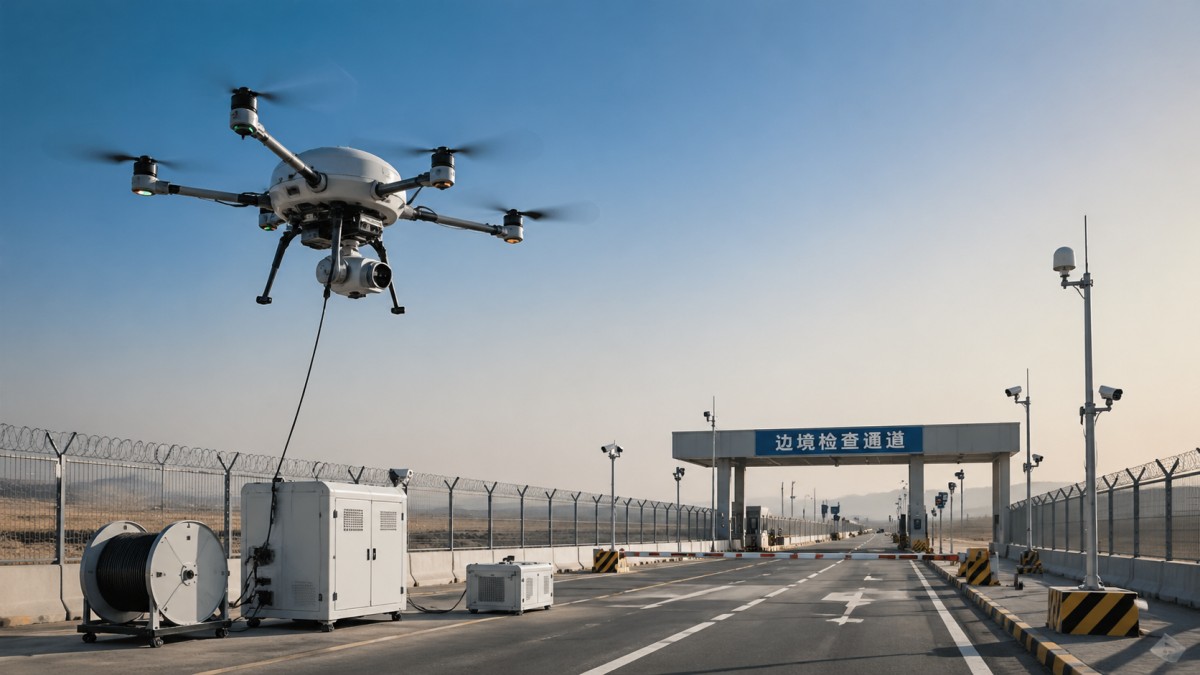
A tethered system is most valuable when border teams need eyes in the sky for hours or days over a defined location. Unlike conventional battery-powered UAVs, a tethered platform draws continuous power from the ground station, allowing long-endurance observation without repeated landings and battery swaps. This makes it useful for:
- Monitoring fixed checkpoints and inspection lanes
- Temporary surveillance at high-risk crossing corridors
- Supporting event-based security surges
- Providing elevated communications relay in constrained terrain
- Supplementing drone for search and rescue operations near border incidents
For operators, the biggest advantage is persistence. For procurement and management teams, the benefit is often a lower cost per surveillance hour compared with repeatedly cycling untethered drones for the same small-area mission. The platform can also carry electro-optical and thermal payloads continuously, which improves incident detection during low-light operations.
Still, this value only holds if the mission area fits the system’s geometry. A tethered drone is not a replacement for patrol aircraft, roaming multirotor teams, or fixed towers spread across long border segments. It is best understood as a rapidly deployable elevated mast with flexibility, not as a wide-area pursuit platform.
What limits matter most in real border deployments
The main limitations are practical, measurable, and often underestimated during early evaluation.
1. Coverage radius is constrained by the tether
The drone can only operate within the tether’s length and flight envelope. Even with a high operating altitude, actual line of sight can still be blocked by ridges, vegetation, man-made structures, or earth curvature in uneven terrain. Teams should map the real observation footprint, not assume ideal visibility from brochure altitude figures.
2. Weather is a hard operational boundary
Wind loading on both the airframe and the tether can sharply reduce stability. Rain, icing, sand, salt spray, and extreme temperatures also affect safety and sensor performance. Border environments are often harsh, so weather tolerance should be verified through actual operational envelopes, not only nominal specifications.
3. Tether management adds mechanical and logistical complexity
The tether is both an advantage and a constraint. It supplies power and often secure data transmission, but it also introduces risks such as snagging, wear, reel failures, setup time, transport burden, and maintenance overhead. Uneven ground and vehicle-mounted deployment further complicate operations.
4. Mobility is limited compared with untethered systems
If surveillance priorities shift quickly across a wide area, a tethered drone can become less efficient. It must be repositioned along with its ground power unit, winch system, and support crew. This matters for border sectors where threats are mobile and unpredictable.
5. Bandwidth and data workflow can become bottlenecks
Long-duration surveillance produces a steady stream of video and sensor data. Even when the tether supports robust communications, teams still need downstream processing, storage, alerting, and command-center integration. If the UAV fleet management system cannot organize feeds, telemetry, maintenance status, and event tagging efficiently, persistence turns into operator overload.
How to judge whether the system fits your border mission profile
A better buying decision starts with mission design, not product comparison alone. Four evaluation questions usually separate useful deployments from disappointing ones.
Is the mission fixed-site or mobile?
If the requirement is to watch a known crossing point, infrastructure asset, or temporary hotspot for long periods, a tethered platform may be highly effective. If the mission is to track moving targets across changing terrain, an untethered UAV or mixed fleet is often the better fit.
What sensor persistence is actually needed?
Many agencies overbuy endurance and underdefine detection requirements. Start with target size, expected distance, day-night conditions, and identification threshold. Then assess whether the tethered drone can keep the right payload stable enough for useful imagery.
What ground support can your team sustain?
The true system includes the drone, tether reel, power source, launch area, operator procedures, spare parts, and service support. Teams with limited field logistics may struggle if the platform requires specialized vehicles, generators, or constant environmental management.
How will the data enter the command chain?
A border drone is only useful if the intelligence it collects can be acted on quickly. That means integrating video, geolocation, alarms, and mission logs into dispatch, patrol, and incident-response workflows. This is where selecting a capable UAV data link supplier and management software stack becomes just as important as selecting the aircraft.
Integration gaps that often undermine performance after purchase
Many deployments fail not because the drone cannot fly, but because surrounding systems were not planned properly.
One common issue is weak integration with command-and-control software. If operators must manually switch between drone feeds, mapping tools, and incident logs, response times increase and fatigue rises. Another issue is poor interoperability between sensor payloads and existing security infrastructure such as radar, perimeter sensors, mobile patrol tablets, or fixed camera networks.
Cybersecurity and link resilience also deserve more attention. A tethered drone may have advantages in secure power and data handling, but the broader network still depends on routers, edge processors, storage, and remote access controls. Procurement teams should ask for documented encryption standards, failover behavior, downtime history, and interface support for existing security platforms.
There is also a maintenance reality. Tethers, connectors, winches, and ground power units have wear points that differ from standard battery UAV fleets. Spare availability, inspection intervals, and field replacement procedures should be reviewed early, especially for remote border sectors where downtime is costly.
What buyers should ask vendors before making a decision
For information researchers, purchasers, and enterprise decision-makers, the most useful vendor conversations are specific and testable. Ask for numbers and operating evidence, not generic claims.
- What is the verified wind tolerance during full-payload operation?
- How does endurance change under thermal imaging payloads and high data throughput?
- What is the maximum effective observation footprint in non-ideal terrain?
- What are the tether lifecycle expectations and replacement costs?
- What deployment time is required from transport to stable mission altitude?
- How does the system integrate with our UAV fleet management system and command software?
- Which UAV data link supplier components are embedded or required, and what are their redundancy options?
- What maintenance tasks can field teams perform without factory support?
- What happens during power interruption, reel malfunction, or sudden weather deterioration?
- Can the platform support adjacent use cases such as drone for search and rescue operations?
These questions help teams compare not only purchase price, but total operational viability. In border security, the better system is often the one with clearer constraints and better integration support, not the one with the most aggressive headline specifications.
When a mixed architecture is the smarter choice
In many border environments, the best answer is not tethered versus untethered, but both. A tethered drone can provide persistent local overwatch near a checkpoint or suspected corridor, while untethered drones cover pursuit, route verification, or rapid area scans. Fixed towers, ground sensors, and mobile patrol units then complete the surveillance layer.
This mixed approach reduces the weaknesses of each tool. The tethered platform supplies continuous presence and reliable power. The untethered fleet provides reach and flexibility. A unified UAV fleet management system ties together flight status, sensor feeds, operator assignment, maintenance tracking, and mission records.
For decision-makers, this architecture often produces better return on investment than trying to force a single drone type into every mission. It also supports phased adoption: agencies can begin with a tethered site deployment in a high-priority area, validate field results, and expand only when data supports broader rollout.
Conclusion: a tethered drone is valuable for border security, but only inside its real operating envelope
A tethered drone for border security is a strong tool for persistent overwatch, rapid deployment at fixed sites, and long-duration sensor operation. But its benefits are tightly linked to terrain, weather, tether range, data architecture, and field logistics. The core planning mistake is treating it like a universal aerial solution. It is not.
For operators, the practical question is whether the system can deliver stable surveillance where and when it is needed. For procurement teams, the key is to evaluate total system fit, including power, bandwidth, maintenance, and integration with existing workflows. For business and security leaders, the best investment decision comes from matching the platform to a defined mission profile and measuring outcomes in coverage, uptime, response speed, and operating cost per useful surveillance hour.
In short, the limits are not reasons to avoid the technology. They are the reasons to plan carefully. Agencies that understand those limits early are the ones most likely to turn a tethered drone from an interesting capability into a dependable border security asset.
Search News
Hot Articles
- Carbon Fiber StructuresHow to Specify Aerospace Carbon Fiber Assemblies for Lightweight, Load-Bearing PartsJul 11, 2026
- Machine VisionXiaomi, Alibaba DAMO Academy Drive Open-Source Robotics Model Ecosystem, Lowering Algorithm Development Barriers for Overseas SMEs Adopting Chinese Robotics SolutionsMar 30, 2026
- Cobots & ArmsShanxi 'AI+' Conference Showcases Embodied Intelligence with Multinational Buyer Engagement: Key Industry ImplicationsMar 30, 2026
Popular Tags
Recommended News
 Jul 11, 2026How to Specify Aerospace Carbon Fiber Assemblies for Lightweight, Load-Bearing PartsAerospace carbon fiber assemblies: learn how to specify laminate design, load data, joining methods, and inspection controls for lighter, reliable load-bearing aerospace parts.Elena Rostova (UAV Systems Researcher)
 Mar 30, 2026Xiaomi, Alibaba DAMO Academy Drive Open-Source Robotics Model Ecosystem, Lowering Algorithm Development Barriers for Overseas SMEs Adopting Chinese Robotics SolutionsXiaomi & Alibaba DAMO Academy's open-source robotics models lower algorithm barriers for global SMEs. Boost efficiency in manufacturing, logistics & smart retail with ROS 2 compatible solutions.TSV Data Lab
 Mar 30, 2026Shanxi 'AI+' Conference Showcases Embodied Intelligence with Multinational Buyer Engagement: Key Industry ImplicationsShanxi 'AI+' Conference highlights embodied intelligence with Tesla, Ubtech & Jiantao showcasing multimodal robotics. 40+ global buyers validated tech on-site, creating new B2B channels for industrial automation & AI solutions.Chen Wei (Automation Lead Engineer)
 Mar 30, 2026Zhongguancun Unveils 6G Integrated Sensing-Computing-Intelligence Platform to Empower Embodied Robots for Global Industrial ApplicationsZhongguancun's new 6G platform revolutionizes industrial robotics with <10ms latency, empowering global automotive, logistics & port automation. Discover how this tech boosts China's smart manufacturing exports.TSV Data Lab
 Mar 30, 2026Mech-Mind Tianjin Embodied Intelligence R&D and Production Base Goes Live, Cutting Delivery Time by 20%–30% for Global Customized AMR+Vision SolutionsMech-Mind's Tianjin AMR+Vision production base cuts delivery time by 20%-30% for欧美 & Latin American markets. Discover how this PLd-certified facility accelerates customized robotics solutions for smart manufacturing and logistics.Chen Wei (Automation Lead Engineer)
 Mar 30, 2026Boao Forum Reveals 'Co-evolution of Big and Small Brains' Trend in Humanoid Robots, China's Embodied Intelligence Accelerates Adaptation to Overseas Manufacturing Service ScenariosDiscover how China's humanoid robots, featuring 'Co-evolution of Big and Small Brains,' are revolutionizing global manufacturing. Learn about Embodied Tian Gong 3.0's ISO compliance and overseas deployment at Boao Forum 2026.Chen Wei (Automation Lead Engineer)
 Mar 30, 2026China Railway Industrial Secures Patent for Embodied Robotics in Material Handling, Boosting High-Precision Delivery Capabilities for Overseas Infrastructure and Manufacturing ProjectsChina Railway Industrial's new patent for embodied robotics in material handling boosts high-precision delivery for global infrastructure & manufacturing. Discover how this innovation enhances logistics accuracy in automotive, rail transit & EPC projects.Chen Wei (Automation Lead Engineer)
 Oct 25, 2026Hesai Leads Global ADAS Main Lidar Shipments in Yole’s 2026 ReportHesai led global ADAS main lidar shipments with a 43% share in 2025, according to Yole’s 2026 report. Explore what this ranking reveals about its automotive market position.TSV Data Lab
 Oct 25, 2026Choosing an Aerospace Materials Manufacturer: Quality and Traceability ChecksChoosing an aerospace materials manufacturer? Learn how to verify certifications, test reports, and lot traceability to qualify suppliers confidently and reduce costly sourcing risks.Dr. Marcus Vance
 Oct 24, 2026Guotai Haitong: Global Entry-Level 3D Printer Shipments Rose 39% in Q1 2026Entry-level 3D printer shipments rose 39% in Q1 2026, Guotai Haitong reports. Explore how AI, multicolor printing and print farms are shaping market growth.Dr. Marcus Vance
 Oct 24, 2026Choosing an Industrial Vision Inspection Supplier: Acceptance Tests That MatterChoose an industrial vision inspection supplier with confidence. Discover acceptance tests for defect detection, false rejects, production speed, and reliable part rejection before you buy.TSV Data Lab
 Oct 23, 2026US Navy Raises Gecko Robotics Contract Ceiling to $300M for Robotic Fleet MaintenanceUS Navy raises Gecko Robotics’ contract ceiling to $300M for Pacific Fleet robotic inspections. Explore potential opportunities for maintenance suppliers and key procurement considerations.Chen Wei (Automation Lead Engineer)
 Oct 23, 2026Choosing Industrial Sensing Systems for Global Plants: Protocol CompatibilityCompare industrial sensing systems international buyers can trust. Explore protocol compatibility, reduce integration risks, and select proven configurations for reliable global plant deployments.TSV Data Lab
 Oct 22, 2026KUKA Showcases Physical AI and iiQKA.AI Vision at NVIDIA GTC BerlinExplore KUKA’s Physical AI showcase at NVIDIA GTC Berlin and discover how iiQKA.AI Vision aims to simplify robotic vision integration and improve 2D and 3D scene recognition.TSV Data Lab
 Oct 22, 2026Robotic Machining of Advanced Composites: What Tolerances Are Achievable?Explore advanced materials machining robotics: discover what drives achievable composite tolerances and how to validate accuracy before investing in your next machining system.Dr. Marcus Vance
 Oct 21, 2026China’s Industrial Robot Exports Near RMB 10 Billion in First Nine Months of 2026China’s industrial robot exports neared RMB 10 billion in January–September 2026, with value rising faster than volume. Explore the data and what it could mean for suppliers.Chen Wei (Automation Lead Engineer)
 Oct 21, 2026Low-Latency Industrial Data Processing: Pricing and Key Cost DriversExplore industrial data latency price drivers, from edge hardware to integration and support. Learn how to compare quotes, verify performance, and avoid unnecessary costs.TSV Data Lab
 Oct 20, 2026KUKA Launches iiQKA.AI Vision to Simplify Industrial Image ProcessingKUKA iiQKA.AI Vision simplifies industrial image processing with controller-based 2D and 3D vision. Explore drag-and-drop setup for vision-guided automation.TSV Data Lab
 Oct 20, 2026Smart Industrial Edge Devices: Key Criteria for Legacy PLC IntegrationChoose smart industrial edge devices for legacy PLC integration. Discover key criteria for compatibility, data quality, security, and reliable collection without disrupting control.TSV Data Lab
 Oct 19, 2026Choosing a Radar Sensor by Application: Range, Resolution, and Field of ViewSimplify radar sensor application based product selection. Compare range, resolution, and field of view to avoid blind spots and choose with confidence. Explore the guide.TSV Data Lab
 Oct 18, 2026Comparing Material Options for Procurement: Specs, Costs, and Supply RisksExplore procurement oriented technical content on material options, specs, costs, and supply risks. Compare alternatives to cut hidden expenses and make confident sourcing decisions.Dr. Marcus Vance
 Oct 17, 20265-Axis CNC Positioning Accuracy: How to Interpret ISO 230-2 Test ResultsAssess 5 axis CNC machining positioning accuracy with ISO 230-2. Learn to interpret repeatability, reversal error, and test conditions to compare suppliers and make confident acceptance decisions.Dr. Marcus Vance
 Oct 16, 2026Choosing a Rugged Edge AI Box Supplier: Thermal Tests and Lifecycle SupportChoose a rugged edge AI box supplier with proven thermal performance and reliable lifecycle support. Discover the tests and commitments to verify before you buy.TSV Data Lab
 Oct 15, 2026R&D Cost Reduction Services: How to Evaluate Fees, Savings, and ROIEvaluate R&D cost reduction services with confidence. Compare fees, verify savings, and calculate ROI without compromising performance. Discover how to choose a provider that delivers real value.Chen Wei (Automation Lead Engineer)























