Inspection Drone Payload Benchmarks: Comparing Weight, Endurance and Sensor Fit
Publication Date
author
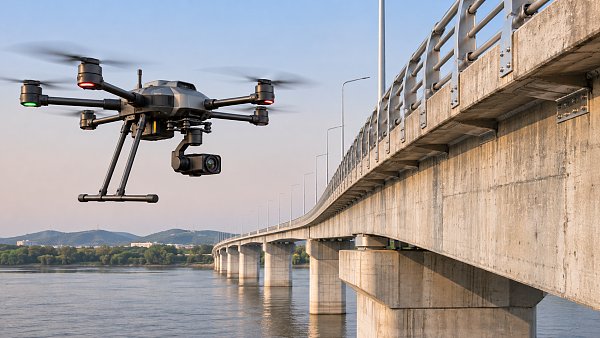
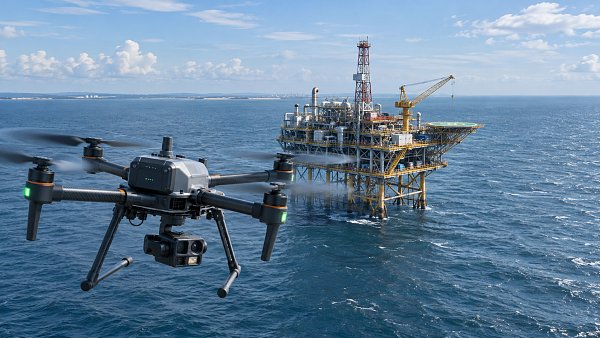
An inspection drone payload benchmark is useful only when it connects aircraft capacity to mission conditions. Maximum payload alone does not reveal how a thermal camera, LiDAR unit, or stabilized zoom sensor will affect flight endurance, power consumption, or aircraft balance. For technical evaluators, the real question is whether a complete sensor configuration can collect usable data, cover the required inspection area, and return with an appropriate energy reserve.
A drone that carries the heaviest sensor is not automatically the best choice. A lighter platform may complete more sorties per shift, while a larger aircraft may be justified by a sensor that reduces repeat flights. Comparing those trade-offs requires more than placing manufacturer specifications side by side.
Start with the mission, not the maximum payload
Define the inspection task before screening aircraft. A transmission-line survey, a close visual inspection of a bridge, and a thermal scan of a solar installation may all involve cameras, but they impose different demands on standoff distance, flight speed, maneuvering, and data quality.
Document the expected inspection area, required ground or object detail, typical launch-to-asset distance, environmental conditions, and whether the aircraft must hover or fly a continuous route. Include operational constraints such as airspace permissions, site access, and the time available for each flight window. These details turn an abstract payload comparison into a testable requirement.
Then describe the complete flight configuration: aircraft, battery, sensor, gimbal, mount, cables, onboard computing, communications equipment, and any accessories carried during inspection. A payload figure that excludes mounting hardware or assumes a different battery configuration can make two platforms appear comparable when they are not.
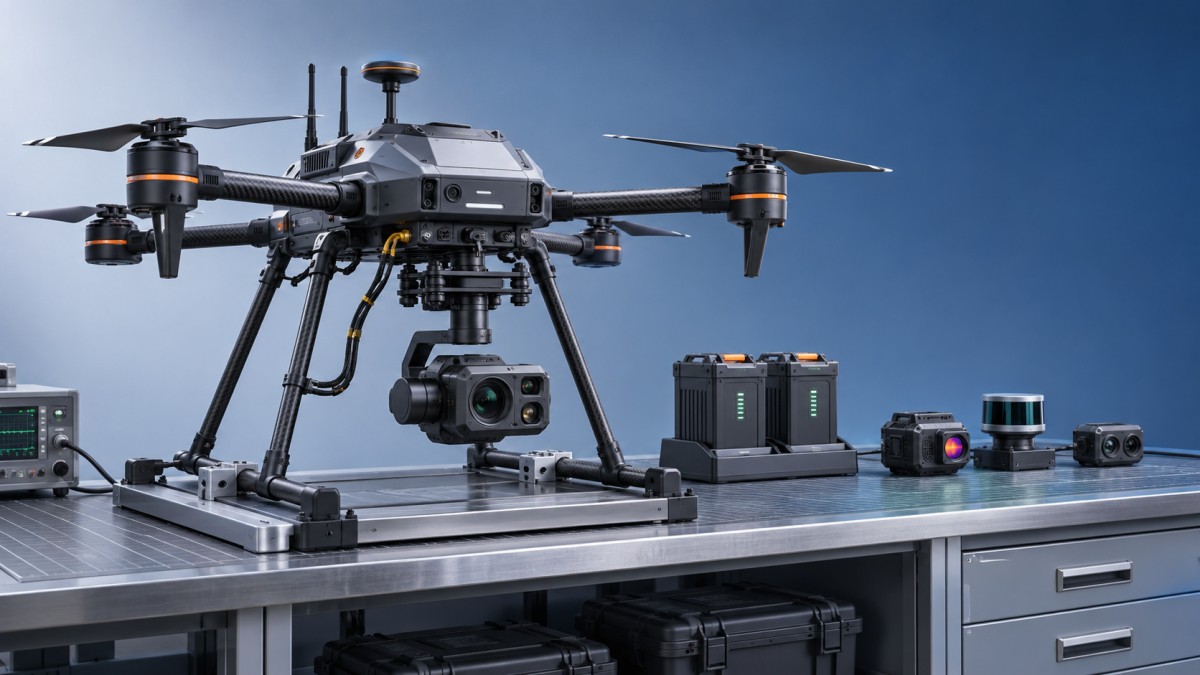
What an inspection drone payload benchmark should compare
Keep the test configuration visible beside every result. At minimum, record takeoff mass, payload mass, battery type and condition, flight mode, ambient temperature, wind conditions, route profile, and landing state of charge. If a supplier cannot provide these details for a quoted endurance figure, treat that figure as a starting point for discussion rather than an equivalent benchmark.
Weight: the number on the sensor is only the beginning
Sensor mass is rarely the whole payload. A stabilized visual camera may require a gimbal and protective housing; a LiDAR package may add positioning equipment, storage, and a processing module. Even small components matter when the aircraft is close to a certified or manufacturer-stated mass limit.
Build a mass budget that separates the aircraft’s standard equipment from items added for the mission. Check which components the manufacturer includes in its empty-aircraft or payload definitions. Avoid adding or subtracting a battery twice when comparing specifications that use different conventions.
Two limits deserve separate attention: the allowable payload and the maximum takeoff mass. A configuration must comply with both, along with any other manufacturer restrictions. Payload capacity alone does not establish that a particular battery, accessory combination, or mounting position is permissible.
Balance is equally important. A payload can be within the mass limit but place its center of gravity too far from the approved range. An offset sensor may also affect clearance, vibration, or flight behavior. Ask for the permitted center-of-gravity envelope and mounting limitations for the specific aircraft and payload arrangement.
Leave room for the configuration you will actually fly
Do not plan around an idealized minimum sensor weight if the inspection requires shielding, cables, additional storage, or a different lens. A useful procurement question is: What remains within the approved mass and balance envelope after every required component is installed? That answer is more valuable than a headline payload figure with no integration details.
Endurance: compare useful inspection time
Manufacturers may report maximum flight time under different conditions. One figure may reflect hovering in calm air; another may be based on forward flight. Battery state, aircraft mass, temperature, wind, and sensor power draw can all change the result. Neither number should be assumed to represent a loaded inspection mission without verification.
A practical planning calculation is:
Available inspection time = planned flight time − outbound transit − return transit − landing allowance − contingency reserve.
This is a time-budgeting tool, not a substitute for energy modeling. Wind, maneuvering, and aircraft loading can make energy consumption vary across flight phases. Establish the reserve using the operator’s procedures, manufacturer guidance, site risks, and applicable rules; do not treat a single reserve percentage as universally appropriate.
Consider an illustrative comparison. If a loaded flight is planned for 30 minutes, transit and landing allowances total 12 minutes, and the operator sets aside 6 minutes for contingencies, the nominal inspection window is 12 minutes. A competing platform with a longer advertised flight time may still offer less useful inspection time if its sensor demands slower passes or additional setup. These figures illustrate the arithmetic, not expected performance for any aircraft.
For a fair test, fly comparable routes with the intended payloads and document both elapsed time and battery state throughout the mission where available. Repeat flights when conditions permit. Record any automatic return or battery warnings, but do not deliberately approach unsafe limits to produce a longer endurance figure.
Sensor fit: lifting the instrument is not enough
The best inspection sensor is the one that produces the required evidence from a position the aircraft can safely maintain. Compatibility has several layers, and each can become a procurement blocker.
Mechanical and electrical integration
Verify the mounting interface, payload dimensions, center of gravity, vibration isolation, and clearance throughout the gimbal’s range of motion. Check whether the payload obstructs propellers, antennas, navigation sensors, or the aircraft’s view of its surroundings.
For power, compare the payload’s operating and startup requirements with the aircraft’s available supply, including voltage, current, connectors, and any restrictions on simultaneous accessories. Also confirm how the sensor communicates with the aircraft or ground station. A physical connection does not guarantee control of recording, triggering, zoom, or sensor settings.
Data and operational compatibility
Ask how data is stored, time-stamped, transferred, and reviewed. For mapping or LiDAR, determine how positioning and orientation information is synchronized with measurements and what processing software is needed. For visual inspection, confirm that the operator can see sufficient live detail to frame the target without confusing the live-view quality with the quality of recorded images.
Software support matters over the life of the platform. Clarify firmware dependencies, supported payload versions, calibration procedures, and who is responsible for diagnosing faults across aircraft and sensor vendors. An integration that works only under a narrow software combination may create maintenance risk even when the first demonstration succeeds.
Match the payload to the inspection output
Zoom imaging: For defects on towers, bridges, or industrial structures, assess the detail captured at the required standoff distance, not optical zoom alone. Stabilization, autofocus behavior, lighting, aircraft movement, and viewing angle influence whether a suspected defect can be interpreted. Define the smallest feature that needs to be visible and test against a representative target.
Thermal imaging: Sensor resolution is only one part of the decision. Determine whether the task requires relative temperature differences or defensible temperature measurements. Emissivity, reflections, viewing geometry, atmospheric conditions, and calibration can affect interpretation. A thermal image that highlights an anomaly does not by itself establish its cause.
LiDAR: Evaluate the point cloud over the actual surfaces and flight geometry of interest. Point density, coverage, positioning accuracy, trajectory quality, and occlusion all matter. A dense cloud is not necessarily an accurate one, and a quoted ranging specification is not the same as verified accuracy for a completed survey.
Where possible, use a common acceptance target: the same representative asset, capture geometry, environmental window, and review criteria. If payloads require different flight profiles, document those differences rather than forcing an artificial comparison.
Run a procurement trial that exposes trade-offs
A short, controlled trial can answer more than a long specification sheet, provided the test is designed before the demonstration. Give each supplier the same mission brief and request the proposed aircraft, battery, payload configuration, and operating limits in advance.
- Verify the build. Weigh the flight-ready configuration, check installed components against the mass budget, and confirm approved mounting and balance limits.
- Fly a representative profile. Include takeoff, transit, inspection passes or hover periods, return, and landing. Log environmental conditions and any deviations.
- Review the evidence. Assess raw and processed outputs against predefined inspection criteria. Note missed areas, unreadable details, and repeat-pass requirements.
- Calculate operational coverage. Record useful inspection time, area or assets inspected, battery changes, setup time, and any rework needed to deliver acceptable data.
- Repeat and investigate. Where practical, repeat the mission and explain material differences rather than relying on the best result.
Do not ignore the work between flights. A payload that captures excellent data but requires lengthy calibration or complex processing may reduce inspection throughput. Conversely, an aircraft with shorter individual sorties may still be suitable if battery changes are predictable and the data is ready for review quickly.
Questions to resolve before selection
Can the drone carry more than one sensor at once? Only if the combined configuration is supported within the aircraft’s mass, balance, power, mounting, and software limits. Simultaneous capture can save flight time, but it can also reduce endurance or compromise placement.
Should maximum payload be the deciding metric? No. Treat it as an eligibility constraint. Once a configuration is permitted, compare the usable data and inspection coverage it delivers under the mission conditions.
How much confidence should evaluators place in advertised endurance? Use it to identify candidates and ask how it was measured. Selection should rely on documented results with the intended payload and a representative mission profile, including an appropriate return and landing reserve.
The strongest choice is the platform that clears the mission’s minimum data-quality and safety requirements with a repeatable operating margin—not necessarily the one with the largest payload or the longest isolated flight-time claim. Keep the assumptions, test conditions, and unresolved integration risks with the procurement record so the benchmark remains useful when the aircraft reaches the field.
Search News
Hot Articles
- Carbon Fiber StructuresHow to Specify Aerospace Carbon Fiber Assemblies for Lightweight, Load-Bearing PartsJul 11, 2026
- Machine VisionXiaomi, Alibaba DAMO Academy Drive Open-Source Robotics Model Ecosystem, Lowering Algorithm Development Barriers for Overseas SMEs Adopting Chinese Robotics SolutionsMar 30, 2026
- Cobots & ArmsShanxi 'AI+' Conference Showcases Embodied Intelligence with Multinational Buyer Engagement: Key Industry ImplicationsMar 30, 2026
Popular Tags
Recommended News
 Jul 11, 2026How to Specify Aerospace Carbon Fiber Assemblies for Lightweight, Load-Bearing PartsAerospace carbon fiber assemblies: learn how to specify laminate design, load data, joining methods, and inspection controls for lighter, reliable load-bearing aerospace parts.Elena Rostova (UAV Systems Researcher)
 Mar 30, 2026Xiaomi, Alibaba DAMO Academy Drive Open-Source Robotics Model Ecosystem, Lowering Algorithm Development Barriers for Overseas SMEs Adopting Chinese Robotics SolutionsXiaomi & Alibaba DAMO Academy's open-source robotics models lower algorithm barriers for global SMEs. Boost efficiency in manufacturing, logistics & smart retail with ROS 2 compatible solutions.TSV Data Lab
 Mar 30, 2026Shanxi 'AI+' Conference Showcases Embodied Intelligence with Multinational Buyer Engagement: Key Industry ImplicationsShanxi 'AI+' Conference highlights embodied intelligence with Tesla, Ubtech & Jiantao showcasing multimodal robotics. 40+ global buyers validated tech on-site, creating new B2B channels for industrial automation & AI solutions.Chen Wei (Automation Lead Engineer)
 Mar 30, 2026Zhongguancun Unveils 6G Integrated Sensing-Computing-Intelligence Platform to Empower Embodied Robots for Global Industrial ApplicationsZhongguancun's new 6G platform revolutionizes industrial robotics with <10ms latency, empowering global automotive, logistics & port automation. Discover how this tech boosts China's smart manufacturing exports.TSV Data Lab
 Mar 30, 2026Mech-Mind Tianjin Embodied Intelligence R&D and Production Base Goes Live, Cutting Delivery Time by 20%–30% for Global Customized AMR+Vision SolutionsMech-Mind's Tianjin AMR+Vision production base cuts delivery time by 20%-30% for欧美 & Latin American markets. Discover how this PLd-certified facility accelerates customized robotics solutions for smart manufacturing and logistics.Chen Wei (Automation Lead Engineer)
 Mar 30, 2026Boao Forum Reveals 'Co-evolution of Big and Small Brains' Trend in Humanoid Robots, China's Embodied Intelligence Accelerates Adaptation to Overseas Manufacturing Service ScenariosDiscover how China's humanoid robots, featuring 'Co-evolution of Big and Small Brains,' are revolutionizing global manufacturing. Learn about Embodied Tian Gong 3.0's ISO compliance and overseas deployment at Boao Forum 2026.Chen Wei (Automation Lead Engineer)
 Mar 30, 2026China Railway Industrial Secures Patent for Embodied Robotics in Material Handling, Boosting High-Precision Delivery Capabilities for Overseas Infrastructure and Manufacturing ProjectsChina Railway Industrial's new patent for embodied robotics in material handling boosts high-precision delivery for global infrastructure & manufacturing. Discover how this innovation enhances logistics accuracy in automotive, rail transit & EPC projects.Chen Wei (Automation Lead Engineer)
 Nov 19, 2026Choosing a Palletizing System for Bagged Food: Speed and Bag HandlingChoose the right palletizing system for bagged food. Compare throughput, bag handling, food safety, and robotic vs. conventional options.Chen Wei (Automation Lead Engineer)
 Nov 18, 2026Formnext 2026 Opens as Additive Manufacturing Advances Industrial ApplicationsFormnext 2026 highlights additive manufacturing innovations for industrial applications. Explore what they could mean for production, procurement and suppliers.Dr. Marcus Vance
 Nov 18, 2026Flexible Robotics Integration for High-Mix, Low-Volume ProductionFlexible robotics integration can make high-mix, low-volume production more adaptable. Explore practical ways to reduce changeover risk and plan a reliable robotic cell.Victor Lin (Chief Software Architect)
 Nov 17, 2026Formnext 2026: UK Additive Manufacturing Leads in Research but Faces Production BarriersUK additive manufacturing leads in research but faces barriers to production at scale. Explore the Formnext 2026 insights and what businesses should consider.Dr. Marcus Vance
 Nov 17, 2026Choosing Warehouse Automation Packaging Systems: Throughput and SpaceCompare warehouse automation packaging systems by throughput, footprint, and order mix. Discover how to choose a layout that meets peak demand.Victor Lin (Chief Software Architect)
 Nov 16, 2026China's October Industrial Robot Output Up 26%, 3D Printing Equipment Up 85.9%China's industrial robot output reportedly rose 26% in October, while 3D printing equipment grew 85.9%. Explore what the figures could mean for buyers.Chen Wei (Automation Lead Engineer)
 Nov 16, 2026Commercial Drones in North America: Choosing Payloads for Inspection and MappingCommercial drones North America: compare RGB, thermal and LiDAR payloads for inspection and mapping, and choose a system that delivers reliable data.Elena Rostova (UAV Systems Researcher)
 Nov 15, 2026Aerospace Materials in the UK: Choosing Metals and Composites for AircraftExplore aerospace materials UK teams use for aircraft. Compare metals and composites by weight, fatigue, manufacturing and approval needs to make informed choices.Dr. Marcus Vance
 Nov 14, 2026Ukraine Tests 3D-Printed Protective Structure Against M2 Heavy Machine-Gun FireUkraine’s 3D-printed protective structure reportedly resisted M2 heavy machine-gun fire. Explore the test’s limits and potential procurement implications.Dr. Marcus Vance
 Nov 14, 2026Rugged UAV Metrics: Assessing Wind Resistance, Endurance and IP RatingsCompare rugged UAV metrics for wind resistance, endurance and IP ratings. Learn what evidence to request and choose a platform fit for your mission.Chen Wei (Automation Lead Engineer)
 Nov 13, 2026Physical AI Gains Attention as Robot Investment Moves Beyond HardwarePhysical AI is reshaping robot investment beyond hardware. Explore what the shift toward perception and algorithms could mean for buyers and suppliers.Chen Wei (Automation Lead Engineer)
 Nov 13, 2026Precision Machining Benchmarks: A Guide to Tolerances and Surface FinishExplore this precision machining benchmarks guide to compare tolerances, surface finish, and inspection methods—and specify parts with confidence.Dr. Marcus Vance
 Nov 12, 2026Beijing Issues Three-Year Plan for Embodied AI Robotics IndustryBeijing’s embodied AI robotics plan targets leading humanoid robot makers by 2028. Explore its goals for supply chains, AI models and deployment.Chen Wei (Automation Lead Engineer)
 Nov 12, 2026Choosing an Edge AI Box for Robotics: Compute, Latency and I/OChoose the right edge AI box for robotics with practical guidance on compute, latency, sensor I/O and sustained performance. Explore the selection checklist.Chen Wei (Automation Lead Engineer)
 Nov 11, 2026Beijing Sets 200,000-Unit Annual Capacity Goal in Robotics PlanBeijing's robotics plan targets 200,000 units of annual capacity by 2027. Explore its technology goals, benchmark applications and adoption outlook.Chen Wei (Automation Lead Engineer)
 Nov 11, 2026Aero Engine Blade Machining: 5-Axis CNC Methods and ChallengesExplore aero engine blade machining, from 5-axis toolpaths to thin-wall challenges, surface integrity, and inspection. Learn what makes a process reliable.Dr. Marcus Vance
 Nov 10, 2026FAA Authorizes Skyways’ Long-Distance BVLOS Flights for Shell in Gulf of MexicoFAA authorizes Skyways’ long-distance BVLOS drone flights for Shell in the Gulf of Mexico. Discover what the decision means for offshore pipeline inspection.Elena Rostova (UAV Systems Researcher)